Newsletter
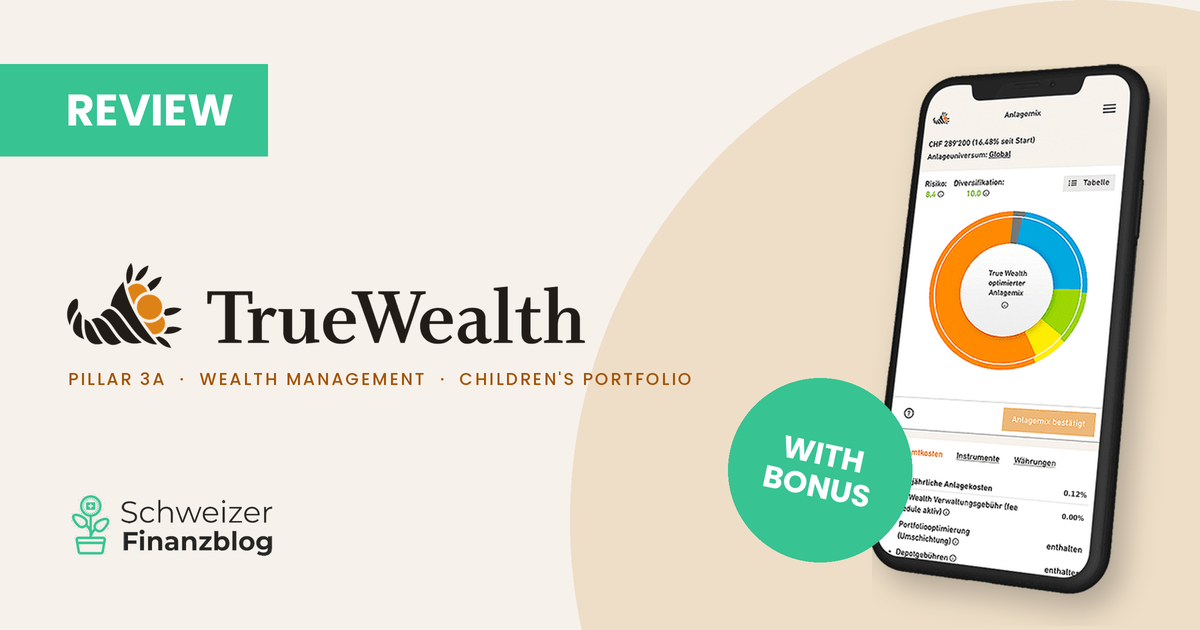
Zero percent management fee in Pillar 3a: What sounds like a bait-and-switch offer has been a reality at True Wealth since 2022. On top of that, there’s automatic account tiering and tax-optimized index funds. In our True Wealth review, we’ll show you how this works in practice, who would benefit from switching, and how the other investment solutions stack up.
In a Nutshell
- True Wealth has been a pioneer in digital wealth management in Switzerland since 2013, manages approximately CHF 3.5 billion for over 50,000 clients, and is regulated by FINMA.
- No management fee for the 3a account: You pay only product costs of 0.12–0.14% (sustainable options starting at 0.21%) plus transaction costs when investing. According to our research, this makes True Wealth the most affordable 3a investment solution in Switzerland.
- The “Free Assets” and “Children’s Portfolio” plans, at just over 0.6% per year, are more expensive on their own than those offered by other robo-advisors. However, when combined with the low-cost 3a plan, the total costs decrease significantly, depending on the asset allocation.
- In addition to ETFs, True Wealth uses index funds—some of which are optimized for withholding tax—in the 3a plan, which further improves the net return.
- One unique feature is automatic staggering: Over the years, True Wealth automatically opens five 3a accounts and distributes the contributions evenly—for a more tax-efficient, staggered withdrawal.
- The trade-off for this automation: A single investment strategy applies to both 3a accounts and non-3a assets, and the distribution among accounts cannot be manually controlled.
🎁 With our bonus code SFB100TW , as a new customer, you’ll receive a 100 CHF fee credit (does not apply to 3a accounts; see below for details).
Disclosure: We were impressed by True Wealth’s investment solutions, particularly their 3a offering. That’s why we’ve entered into a partnership with them. If you open an account through our link, you’ll receive a fee credit on your discretionary assets and children’s portfolio, and we may earn a commission. We remain editorially independent.
Contents
- True Wealth at a Glance
- Our True Wealth Experience: How We Tested It
- True Wealth Fees for the 3a Plan: What You Actually Pay
- Standard Strategies and Asset Classes
- Investment Products: ETFs and Tax-Optimized Index Funds
- Personalized Strategy: How to Customize the Suggestion
- Automatic dollar-cost averaging across five accounts with True Wealth 3a
- Processing, Reporting, and Support at True Wealth
- How secure is True Wealth?
- Disposable Assets and Children’s Portfolio: How Much Do They Cost?
- True Wealth with Its Bumps and Bruises
- Opening an Account and Transferring Funds to a 3a Account
- What are the pros and cons of True Wealth?
- True Wealth Bonus Code: 100 CHF Fee Credit
- Conclusion Based on Our Experience with True Wealth
- Frequently Asked Questions About True Wealth
- What has been your experience with True Wealth?
- Who owns True Wealth?
- Is my money safe with True Wealth?
- Is the 3a pillar really free with True Wealth?
- How does True Wealth make money on the 3a plan without charging a management fee?
- How many 3a accounts does True Wealth open?
- Can I transfer my existing 3a account to True Wealth?
- What is the minimum deposit at True Wealth?
- How much does True Wealth cost?
- How much does it cost to switch to or from True Wealth?
- Is True Wealth also worth it for personal assets?
- Does the bonus code SFB100TW also apply to Pillar 3a?
- What is the return on investment for True Wealth?
- True Wealth or VIAC?
- Which robo-advisor is the best?
- You might also be interested in this
- Updates
- Disclaimer
True Wealth at a Glance
True Wealth was founded in 2013 by Felix Niederer, a physicist and portfolio manager, and Oliver Herren, co-founder of Digitec Galaxus, and has been in business since 2014. The idea: professional asset management based on the principles of modern portfolio theory, fully digital, and at a fraction of the costs typically charged by banks. Since 2016, the Basellandschaftliche Kantonalbank (BLKB) has held a minority stake in the company.
Today, True Wealth manages approximately 3.5 billion CHF for over 50,000 clients, making it one of Switzerland’s largest digital asset managers. The company is licensed by FINMA as a collective asset manager and is subject to its direct supervision. The platform was developed in-house, which makes True Wealth independent of external banking software providers.
The product line consists of three products:
- Online asset management: for personal assets starting at 8,500 CHF, with a choice of BLKB (a bank backed by a government guarantee) or Saxo Bank Switzerland as the custodian bank.
- Pillar 3a: Since 2022, starting at CHF 1,000, through the 3a Digital Pension Foundation. The custodian bank is BLKB, a bank with a government guarantee.
- Children’s Portfolio: Since 2023, a separate investment solution for children and teenagers starting at CHF 1,000. The assets belong to the child and are at their free disposal once they turn 18.
In this report, we’ll take a look at all three products, with a focus on the 3a solution.
Our True Wealth Experience: How We Tested It
Unlike with VIAC, we aren’t early adopters of True Wealth—we’ve been new customers since October 2026. This report is therefore based on our own account opening and the first few weeks with a 3a portfolio consisting of 99% stocks, on the publicly documented terms and conditions, and on the experiences of long-time customers as reflected in App Store and Trustpilot reviews. Where we rely on third-party opinions, we’ll make that clear.
True Wealth Fees for the 3a Plan: What You Actually Pay
True Wealth does not charge a management fee for Pillar 3a; total investment costs range from 0.12% to 0.14% per year (as of October 2026). These costs consist of two components:
- True Wealthmanagement fee: 0% for 3a
- Product costs for ETFs and index funds (TER): 0.12% in the standard strategy, 0.14% in our customized portfolio. These costs are not charged separately but are deducted directly from the fund’s assets.
With a 3a account balance of 100,000 CHF, you’ll pay between 120 and 140 CHF per year.
Not included are the transaction costs associated with buying, selling, and rebalancing the funds. According to True Wealth, these costs are incurred primarily at the time of the initial investment: For an initial deposit of approximately 7,300 CHF, True Wealth estimates these costs at around 10 CHF—a one-time fee of just over 0.1%. This includes stamp duty, spreads, a foreign currency surcharge from the custodian bank of up to 0.1%, and sales charges for the index funds. Without further deposits or withdrawals, transaction costs are negligible thereafter. True Wealth keeps the foreign currency surcharge low by internally offsetting the deposits and withdrawals of all 3a clients, rather than submitting each order individually to the stock exchange.
Good to know:
- No custody fees, front-end loads, redemption fees, or retrocessions
- Electronic tax statement included
- Cash portion earns 0.35% interest (as of October 2026)
- Minimum deposit of 1,000 CHF; you don’t need a separate account for your personal assets
If you want to invest sustainably, you can switch the investment universe to “Sustainable.” True Wealth will then use ETFs based on MSCI’s SRI indices, which exclude controversial sectors and include only the top ESG performers in each sector. This increases product costs to 0.21% or more.

True Wealth in a 3a Cost Comparison
A comparison with other competitively priced digital 3a providers—for the strategy with the highest equity allocation in each case—shows just how significant the cost advantage is:
| Vendor | Total investment costs | Costs for 100,000 CHF | Max. equity allocation |
|---|---|---|---|
| True Wealth | 0.12–0.14% | 120–140 CHF | 99% |
| findependent | 0,29% | 290 CHF | 99% |
| finpension | 0,39% | 390 CHF | 99% |
| frankly | 0,43% | 430 CHF | 95% |
| VIAC | 0,44% | 440 CHF | 99% |
How does True Wealth make money on the 3a plan without charging a management fee?
Since True Wealth charges no management fees at all for the 3a plan, receives no retrocessions (kickbacks) from fund providers, and product and transaction costs are incurred externally, the company earns no ongoing revenue from this product.
We therefore assume a mixed scenario: The low-cost 3a account attracts new clients, and some of them also invest their discretionary assets with True Wealth, where a management fee applies. This strategy seems to be paying off: Since its launch in 2022, True Wealth has continued to offer the 3a plan without a management fee.
Our conclusion regarding 3a fees: Based on our research, True Wealth is the most affordable investment solution in Switzerland.
Standard Strategies and Asset Classes
Once your minimum deposit has been received, True Wealth will ask you a few questions to determine your risk profile and, based on that, suggest a globally diversified portfolio. The equity allocation can be as high as 99%.

With True Wealth, you can invest in up to five asset classes. In the public sample portfolio, the allocation looks like this:

An Overview of the Five Asset Classes:
- Cash: a small liquidity reserve, earning 0.35% interest in the 3a account.
- Bonds: Stabilize the portfolio, primarily long-term U.S. Treasury bonds and some high-yield corporate bonds.
- Real estate: publicly traded real estate companies from developed countries, excluding Switzerland.
- Commodities: A broadly diversified basket of commodities comprising energy, metals, and agricultural goods as a hedge against inflation; gold is included only as part of this basket and not as a separate position.
- Stocks: the main driver of returns, globally distributed across seven regions—more on this in the next chapter.
True Wealth adjusts the weightings based on your risk profile. Instead of using the default settings, you can also freely adjust the weightings of the asset classes—see the chapter on individual strategies for more details. If you want to invest sustainably, you can switch to a sustainable investment universe.
Our conclusion on strategy and asset classes: The strategy recommendation based on the risk profile is reasonable, and the selection of asset classes is sound. We believe that, as an alternative to the proposed standard option, the asset classes can be freely weighted or omitted entirely. Real estate and commodities are available as alternative investments. However, if you’re looking for cryptocurrencies or private equity, you won’t find them at True Wealth. For us, the devil is in the details at the product level—more on that in the next chapter.
Investment Products: ETFs and Tax-Optimized Index Funds
True Wealth relies not only on ETFs in its 3a plan, but also, in some cases, on tax-optimized index funds. The reason is withholding tax, a cost factor that does not appear in any TER but reduces returns. True Wealth does not have any funds of its own, and, according to its own statements, it has no business relationship with fund providers. This helps avoid conflicts of interest in product selection.
You can see for yourself which specific funds True Wealth uses in the public sample portfolio, broken down separately for Pillar 3a and discretionary assets. It is preset with foreign currency hedging, but you can adjust the portfolio by changing the strategy and then view the corresponding products. We explain why we’ve deactivated the hedging in the chapter on individual strategy.

An ETF based in Ireland typically loses 15% in withholding tax on U.S. dividends, which cannot be reclaimed. This deduction does not apply to the Swiss index funds that True Wealth uses for U.S. stocks and global real estate.
With a dividend yield of about 1.3% on U.S. stocks, this amounts to about 0.2 percentage points per year on the U.S. portion of the portfolio. With a 40% allocation to U.S. stocks, as in the 3a model portfolio, this amounts to about 0.08 percentage points for the entire portfolio—more than half of the total product costs of 0.12–0.14%.
True Wealth divides the stocks into seven regions:

This has clear strengths:
- You can freely allocate weights to all seven regions, including by market capitalization.
- You can avoid a home bias: You can set the Swiss allocation as low as you want.
- Emerging markets and the Asia-Pacific region are broadly covered as separate regions.
However, we were surprised by a few gaps and inconsistencies:
- “Europe” should really be called “Eurozone”: The region is covered only by the Euro Stoxx 50—that is, the 50 largest companies in the countries that use the euro. Sweden, Denmark, and Norway are missing, as are mid-sized companies.
- Canada is completely absent.
- Small companies, known as “small caps,” are covered only in Switzerland and emerging markets. This means you can’t invest globally in small caps.
- The indices come partly from FTSE and partly from MSCI. The two providers classify countries differently, so South Korea appears twice in the portfolio: in Asia-Pacific and in emerging markets.
In response to our inquiry, True Wealth explains that its approach is based on criteria such as low fees, sufficient liquidity, and tax efficiency. Scandinavia and Canada are underrepresented relative to the additional ETF costs. Even if these factors may have little impact on returns, we would expect a provider with a scientific approach to maintain a consistently global and uniform portfolio strategy.
Our conclusion on the investment products: With low-cost ETFs and withholding tax-optimized index funds, True Wealth implements the 3a plan in a well-thought-out and cost-efficient manner. However, there are shortcomings in terms of global coverage.
Personalized Strategy: How to Customize the Suggestion
True Wealth’s strategy recommendation is based on your risk profile. It consists of two components: your objective risk capacity and your subjective risk tolerance. The longer your investment horizon, the more stable your financial situation, and the more calmly you can accept paper losses, the higher-return and riskier your portfolio will be—which is reflected in particular by a high equity allocation. However, you are not required to accept the proposal:
- Flexible Allocation: You determine the asset classes and equity regions yourself, including by market capitalization. If your choices deviate significantly, True Wealth will notify you but will implement your selections within one to two business days.
- Currency Hedging: By default, True Wealth hedges a portion of its foreign-currency holdings. Because we want to invest as cost-effectively as possible and consider currency risk to be manageable over the long term, we have disabled this hedging. As a result, the proportion of Swiss francs in the portfolio decreases noticeably.
- One strategy for everything: Your settings apply to both the 3a account and your personal assets; only the children’s portfolio has its own strategy.
- 3a first: You can set it so that contributions up to a defined maximum are automatically allocated to the 3a account first.
Automatic dollar-cost averaging across five accounts with True Wealth 3a
If you withdraw your 3a savings all at once, you’ll pay a disproportionately high amount of tax due to progressive taxation. That’s why it’s worth spreading your assets across multiple accounts and withdrawing them in staggered installments over several years. With most providers, you have to handle this yourself. True Wealth does it automatically. However, the tax benefit only applies if you withdraw the funds from the accounts in different tax years. For married couples, both partners’ withdrawals in the same year are combined. Therefore, coordinate your withdrawals with your spouse.
Here’s how it works: With annual deposits, True Wealth opens a new account each year until there are five accounts. Starting in the sixth year, each deposit is allocated to the account with the lowest balance. This ensures that the accounts grow as evenly as possible.

For each transfer from another provider, an additional, separate account is opened. This account cannot be replenished later. When making a withdrawal, you choose which accounts to close.
You can’t manually override the mechanism. We see this as an advantage, but those who want to optimize it themselves will run into limitations here.
Processing, Reporting, and Support at True Wealth
True Wealth is available as an app and a desktop version, each in German, English, and French. The app is clearly structured and displays costs, currencies, risk, and diversification at a glance. You can choose whether to view your total assets, just your 3a assets, or just your non-3a assets. With the right settings, logging in is also convenient—more on this in the section on security.
True Wealth invests deposits within a few business days. According to customer support, it typically takes an additional 3 to 5 business days for the purchased instruments to be fully settled and appear in the portfolio. When it comes to rebalancing, True Wealth reviews the 3a portfolio almost daily and adjusts the allocation as soon as the actual allocation deviates by 2 to 3 percentage points from the target allocation.
If you have any questions, you can reach the multilingual support team by phone at 044 508 70 17 or by email at support@truewealth.ch; there is no chat feature. Our experience with True Wealth’s support is based on six inquiries made by phone and email: We were able to get through on the phone immediately each time and received expert information; written inquiries were answered within 48 hours.

What Other Customers Say
On Trustpilot, True Wealth has a TrustScore of 4.7 out of 5 (as of October 2026). For a financial services provider, this is a very good score: Banks and brokers typically fare significantly worse on the platform, mainly because dissatisfied customers are the ones most likely to leave reviews. However, it’s important to note the relatively small sample size of about 40 reviews. The app’s user-friendly interface, transparent fees, and fast, personalized support over the phone are particularly praised. There was some isolated criticism regarding the initially unclear distinction between Pillar 3a and personal assets.
How secure is True Wealth?
Risk: “Insolvency of True Wealth or the Custodian Bank”
True Wealth only manages your assets; they are held in custody by the custodian bank: your non-pension assets are held in a securities account in your name, and your pension assets are held by the foundation. ETFs and index funds are separate funds and are not included in the bankruptcy estate even if the bank fails. For cash, the bankruptcy privilege applies up to 100,000 CHF; at BLKB, there is also a government guarantee.
By default, True Wealth requires a code sent via email in addition to your password when you log in. This is secure, but it can be a hassle over time. Our tip: On your desktop, enable two-factor authentication using an authenticator app like Google Authenticator and set up biometric login in the app—this eliminates the need for the email code without compromising security.
Risk “Realized price losses”
This risk does not depend on the provider, but rather on your equity allocation and investment horizon. To ensure that a market downturn shortly before withdrawal doesn’t hit you too hard, it’s best to gradually reduce your equity allocation a few years before withdrawal. In addition, thanks to the staggered withdrawal schedule, you can spread your withdrawals over several years. But be careful: If you also have discretionary assets with True Wealth, the lower equity allocation applies to those as well due to the uniform strategy.
Disposable Assets and Children’s Portfolio: How Much Do They Cost?
In addition to the 3a pillar, True Wealth offers asset management for discretionary assets and a children’s portfolio. Both are based on the same investment strategy but cost significantly more. True Wealth advertises “radically low fees” for these services. While this is true compared to traditional banks, it is no longer the case when compared to robo-advisors such as VIAC or findependent. True Wealth’s fees are radically low only for the 3a solution.
As your custodian bank, you can choose between BLKB and Saxo Bank Switzerland. Saxo uses some lower-cost ETFs domiciled in the U.S., which offer advantages regarding withholding tax but may be subject to U.S. estate tax.
The 0.50% management fee decreases gradually starting at 500,000 CHF, down to 0.25% for amounts of 8 million CHF or more. As True Wealth has confirmed to us, this fee applies to the entire available net worth, including the cash portion. Since this portion currently does not earn interest (as of October 2026), every uninvested franc costs you 0.5% per year. For small amounts, this is hardly noticeable, but it’s better to keep larger liquidity reserves in a savings account.
This includes custody and trading fees, rebalancing, and the electronic tax statement. Not included is the foreign currency surcharge of up to 0.1%. However, this applies only to the amount traded—for example, during deposits, withdrawals, or rebalancing—and is therefore hardly relevant. The overview shows just how significant the difference is compared to Pillar 3a:
| Pillar 3a | Personal Assets | |
|---|---|---|
| Minimum deposit | 1,000 CHF | 8,500 CHF (Children’s Portfolio: 1,000 CHF) |
| Management fee | 0% | 0.50% (up to 500,000 CHF) |
| Product Costs | 0.12–0.14% | 0.12–0.14% |
| Total investment costs | 0.12–0.14% | 0.62–0.64% |
| Annual costs for 100,000 CHF | 120–140 CHF | 620–640 CHF |
When Does It Make Sense to Invest Your Disposable Income?
Our threshold is 0.5% of total investment costs. For free assets alone, True Wealth doesn’t reach this threshold until assets total 1.2 million CHF, at which point the management fee drops to 0.37%. If you include your 3a account (which has no management fee), the average fee across your entire portfolio with True Wealth will fall below this threshold much sooner, depending on the breakdown of your assets.

The same sliding scale applies to children’s portfolios. The total assets held with True Wealth—that is, discretionary assets and children’s portfolios combined—are used as the basis for calculation. A children’s portfolio on its own therefore also costs about 0.6% per year; it’s only cheaper for families with a large amount of discretionary assets at True Wealth. Good to know: The assets legally belong to the child, and you can set up a separate login for them so they can track how their money is performing.
Our conclusion on discretionary assets and children’s portfolios: When considered on its own, True Wealth is more expensive than other robo-advisors here, with total investment costs of just over 0.6%, and only meets our threshold starting at 1.2 million CHF. Things get more interesting with the combined option: If you also manage your 3a account with True Wealth, the total costs drop significantly depending on the allocation—for every CHF 100,000, for example, to about 0.37%. Anyone who wants to conveniently manage both their 3a account and discretionary assets through a single provider gets a comprehensive solution at a fair cost.
True Wealth with Its Bumps and Bruises
True Wealth operates differently from other robo-advisors in a number of ways, as the following examples show:
- Five accounts automatically: Ideal for staggered withdrawals in retirement, without you having to worry about it. Some people might consider this excessive—especially for smaller balances—and would prefer to choose the number of accounts themselves.
- A strategy for 3a accounts and wealth management: All 3a accounts and the online wealth management service follow the same investment mix; only the children’s portfolio is managed separately. This approach is consistent—True Wealth views your assets as a whole—but it strikes us as rather unconventional. With other providers, you can choose a separate strategy for each account.
- Minimum deposits: At 1,000 CHF for the 3a account and the children’s portfolio, and 8,500 CHF for asset management, the barriers to entry are comparatively high. Many robo-advisors deliberately set their minimum deposits very low.
- Regions can be weighted freely, but there are gaps in global coverage: You can determine the allocation across the seven regions yourself if you wish, which offers a high degree of flexibility. However, True Wealth defines the “Europe” region as the Eurozone and covers it only through the Euro Stoxx 50, which means countries like Sweden, Denmark, and Norway are missing. Canada is also not represented, and small-cap stocks are available only for Switzerland and emerging markets. For us, this is a clear drawback: A global portfolio should be consistently global.
- Significant price differences: The 3a solution is among the most affordable on the market, while unallocated assets and children’s portfolios cost a good 0.6% per year. That’s cheaper than traditional asset managers but more expensive than other robo-advisors. If you combine both, the total costs go down, as shown by the combined fee calculator on the website.
For the 3a option, none of these points is a deal-breaker, and even when combined with disposable income, the price difference is less significant. If, on the other hand, you only want to invest your disposable income, there are more cost-effective alternatives.
Opening an Account and Transferring Funds to a 3a Account
The account opening process is entirely digital and consists of four steps. The first three take about ten minutes:
- Personal Information: You choose whether you want to open only a Column 3a account or also a personal investment account (this can be changed later). True Wealth will then ask for your income, assets, and the source of your funds, as required by anti-money laundering regulations. To verify your identity, you’ll take a selfie.
- Signing the contract: You’ll sign the contracts digitally.
- Deposit: You transfer 1 CHF from a Swiss bank account in your name—which will be refunded to you—or the minimum deposit amount directly. This allows True Wealth to verify your bank account and register it as your reference account for future withdrawals.
- Investment Strategy: As soon as the minimum deposit is received, True Wealth determines your risk profile and suggests a strategy that you can customize to your liking.
Our tip: Transfer the minimum deposit right away instead of just 1 CHF—that way, you can set your strategy right away. If you’d like to get a feel for it first, you can open a demo account and test out the strategies without making a deposit.
🎁 If you also open a personal investment account or a children’s portfolio, you’ll receive a bonus with our promo code SFB100TW . It will be automatically applied when you click the link.

Transferring 3a Assets from Another Provider
You can transfer your existing 3a assets to True Wealth and later switch back to another provider. Please note:
- Depending on the notice period required by your current pension foundation, the transfer may take some time.
- Each transfer is deposited into a separate account that cannot be topped up later. If you have several small 3a balances with different providers, this will result in a corresponding number of accounts.
- The fee schedule does not charge a fee for a later transfer to another provider, and withdrawals starting at the normal retirement age are also free of charge. For an early withdrawal—such as for home ownership—True Wealth charges 250 CHF plus VAT.
What are the pros and cons of True Wealth?
 Extremely low costs in the 3a plan: 0% management fee, total of approximately 0.12–0.14% High flexibility: A standard strategy tailored to your risk profile or a customized strategy with up to 99% in stocks Broad investment universe covering all major asset classes: stocks, bonds, real estate, commodities, and cash Withholding Tax-Optimized Index Funds in a 3a Plan for Higher Net Returns Automatic allocation across five 3a accounts for a tax-optimized withdrawal A Comprehensive View of Section 3a and Unrestricted Assets A clear, intuitive app and desktop version available in German, English, and French Expert, multilingual support, available quickly by phone and email 100 CHF fee credit with our bonus code SFB100TW (for personal assets and children’s portfolios)
 Relatively high costs for discretionary assets and the children’s portfolio: a total of about 0.6%, more than with some other robo-advisors Gaps in Global Equity Coverage No separate strategies per account or for 3a and non-3a assets
True Wealth Bonus Code: 100 CHF Fee Credit
As a new customer, you’ll receive a SFB100TW you’ll receive a 100 CHF fee credit, valid for twelve months. It will be automatically applied when you click the link.
Since the 3a solution has no management fees, you’ll only benefit if you invest additional personal assets or a children’s portfolio. You can fully utilize the credit starting at around 20,000 CHF. If you first open a demo account via our link, the code will be saved, and the twelve-month period will not begin until you make the minimum deposit into your live account.
Conclusion Based on Our Experience with True Wealth
According to our research, True Wealth offers the most cost-effective investment solution in Switzerland under Pillar 3a. In addition, it provides withholding tax-optimized index funds and automatic tiered contributions, which handle one of the most important tax optimization strategies under Pillar 3a without requiring any action on your part.
We were also impressed by the user-friendly app, the fast and knowledgeable support, and the high level of security. However, there are some drawbacks: the stock coverage is limited—for example, Canada and the Nordic countries are missing—and the same strategy applies to both the 3a account and the online wealth management service.
When it comes to discretionary assets and the children’s portfolio, the “radically low fees” are only radical when compared to traditional banks: With total investment costs of just over 0.6%, True Wealth is more expensive than other robo-advisors. However, when combined with the 3a plan, the total costs drop significantly depending on the asset allocation—to around 0.37% for every 100,000 CHF.
Our verdict: A clear recommendation for the 3a solution: Thanks to the low fees, you’ll see higher returns year after year, and once it’s set up, you won’t have to worry about a thing. For personal assets and children’s portfolios, we offer a conditional recommendation: the pricing is acceptable when combined with the 3a plan, and it makes sense for anyone who wants to have their entire portfolio managed by a single provider. Those who wish to invest only their personal assets will find more affordable alternatives.
Do you have any questions or personal experiences with True Wealth or other robo-advisors? Let us know in the comments.
Frequently Asked Questions About True Wealth
What has been your experience with True Wealth?
Mostly positive. According to our research, the 3a solution is the most affordable in Switzerland; the app is user-friendly, and customer support is fast and knowledgeable. There are some drawbacks, however, regarding stock coverage—for example, Canada and the Nordic countries are missing—and because 3a and personal assets follow the same strategy. Our report is based primarily on our own experience using the service since October 2026.
Who owns True Wealth?
True Wealth was founded in 2013 by Felix Niederer and Oliver Herren. Since 2016, the Basellandschaftliche Kantonalbank (BLKB) has held a minority stake in the company.
Is my money safe with True Wealth?
Yes. True Wealth is subject to FINMA supervision. The 3a assets are held at BLKB, a bank with a government guarantee, while discretionary assets can be held either at BLKB or at Saxo Bank Switzerland. ETFs and index funds are separate accounts and are not included in the bankruptcy estate even if the bank fails.
Is the 3a pillar really free with True Wealth?
No, but almost. True Wealth does not charge a management fee for the 3a plan. The only costs are product fees of 0.12–0.14% per year (sustainable funds start at 0.21%), plus one-time transaction fees when investing (as of October 2026).
How does True Wealth make money on the 3a plan without charging a management fee?
True Wealth itself does not generate any ongoing revenue from the 3a plan, as there are neither management fees nor retrocessions. We assume a mixed scenario: The low-cost 3a plan attracts new clients, some of whom also invest their personal assets, where management fees apply.
How many 3a accounts does True Wealth open?
Up to five, automatically: During the first five years, a new account is created each year; after that, deposits are credited to the account with the lowest balance. Each transfer from another provider is assigned an additional, separate account.
Can I transfer my existing 3a account to True Wealth?
Yes. True Wealth opens a separate account for each transfer, and funds cannot be added to that account later. Depending on the notice period required by your previous pension fund, the transfer process may take some time.
What is the minimum deposit at True Wealth?
1,000 CHF in the 3a account and the children’s portfolio, 8,500 CHF in non-restricted assets.
How much does True Wealth cost?
In the 3a account, 0.12–0.14% per year, since only product costs apply; for CHF 100,000, this amounts to approximately CHF 120 to CHF 140. For the discretionary portfolio and the children’s portfolio, the fee is just over 0.6% (0.50% management fee plus product costs), which amounts to approximately 620 to 640 CHF for 100,000 CHF. The management fee also applies to the cash portion of the portfolio.
How much does it cost to switch to or from True Wealth?
According to the fee regulations, a transfer to another provider is free of charge, as is withdrawal upon reaching the normal retirement age. An early withdrawal, such as for the purchase of a home, costs 250 CHF plus VAT.
Is True Wealth also worth it for personal assets?
Yes, under two conditions: You also manage your 3a account with True Wealth, and it’s important to you to have everything in one place. When combined with the 3a account, the total costs drop significantly—to about 0.37% for every 100,000 CHF. Viewed in isolation, however, True Wealth is more expensive than other robo-advisors for non-pension assets, at just over 0.6%.
Does the bonus code SFB100TW also apply to Pillar 3a?
No. The 100 CHF credit is offset by administrative fees, which do not apply to 3a accounts. It applies only to non-restricted assets and children’s portfolios, and is fully exhausted once the balance reaches approximately 20,000 CHF.
What is the return on investment for True Wealth?
True Wealth does not guarantee any return; it depends on the equity allocation and market conditions. The model projection for our portfolio with 99% equities shows, under a neutral scenario, a return of approximately 135,000 CHF after 15 years, based on contributions of approximately 112,000 CHF. You can primarily influence the costs, and this is where True Wealth excels in the 3a plan with low fees and withholding tax-optimized index funds.
True Wealth or VIAC?
When it comes to costs, True Wealth clearly leads the 3a category: 0.12–0.14% per year compared to 0.44% for VIAC (the strategy with the highest equity allocation, as of October 2026). VIAC, on the other hand, stands out with a customized strategy for each account and included basic coverage in the event of disability or death. Read more about this in our VIAC review.
Which robo-advisor is the best?
That depends on your goal. According to our research, True Wealth is the most affordable option for Pillar 3a. If you’re only investing your personal assets, you’ll find more affordable providers. You can find an overview on our recommendations page.
You might also be interested in this

Updates
October 22, 2026: Initial publication
Disclaimer
Disclaimer: Investing involves the risk of loss. You must decide for yourself whether or not you are willing to assume these risks. Past performance is no guarantee of future results.
Subject to errors: We have written this article about our True Wealth experience to the best of our knowledge and belief. Our goal is to provide you, as a retail investor, with information on financial topics that is as objective and informative as possible. However, if we have made any errors, omitted important details, and/or if the information is no longer current, we would appreciate it if you could bring these issues to our attention.