
 Newsletter
How much of your assets belong in shares – and how much stays in your bank account? The answer to this question is the most important decision when investing your money. Not the choice of the right ETF, not the perfect time to start – but the question of how you structure your assets. In this fourth lesson of our financial guide, you will find out how to determine your personal asset allocation step by step and what role your risk profile, liquidity reserve and 3rd pillar play in this.
< Lesson 3 | Overview | Lesson 5 >

Short & sweet
- Asset allocation – the division of your assets into a high-risk and a low-risk part – is the most important decision when investing your money.
- Before you invest, you need a liquidity reserve of three to six months’ expenditure. This is not part of the asset allocation.
- Your risk profile – consisting of risk appetite and risk capacity – determines the weighting. The more cautious of the two factors sets the framework.
- Broadly diversified equity ETFs are at the heart of the risky part. The simplest solution: a single global ETF. If you want, you can add according to the core-satellite principle.
- The low-risk part – bank deposits and possibly bonds with a high credit rating – offers hardly any return, but stability, flexibility and rebalancing ammunition.
- Make a note of your target allocation. It is your fixed star – and worth more than any hot investment tip in the next stock market crisis.
Contents
What does asset allocation mean?
The term asset allocation is based on a simple idea: the structuring of your assets. Specifically, it’s about how you distribute your money across different asset classes – how much goes into shares, how much stays in your bank account, how much you put into real estate or other investments?
If diversification is the blueprint, then asset allocation – or your asset structure – is the foundation of your house. It determines how stable the building is, not the color of the walls or the model of the kitchen. Numerous studies confirm exactly this: it is not the choice of individual products, but the allocation of your assets that has the greatest influence on long-term investment success. You base all other investment decisions on your asset allocation.
Before we get into the details, it’s worth taking a look at the big picture. Your assets can be divided into three categories, each serving a different purpose: the liquidity reserve as a safety net, the low-risk portion as a source of stability, and the high-risk portion as a driver of returns.
The liquidity reserve: your safety net
Every sound financial plan includes a liquidity reserve – a nest egg of three to six months’ expenses in your bank account. This reserve serves to cushion unforeseen expenses such as job loss, illness or major repairs without you having to touch your investments.
Even if the liquidity reserve is also held in a low-risk bank account, it is not part of your asset allocation. The difference is that the low-risk portion of your investment is a conscious strategic decision within your portfolio. The liquidity reserve, on the other hand, is a requirement that must be met before you even think about investing. It is reserved for emergencies – and therefore taboo for investment purposes. The repayment of any consumer loans also has priority – their interest rates exceed any realistic investment return.
Only what remains after your nest egg and debt reduction is your freely available investment capital. And it is precisely these assets that are now structured using asset allocation.
Your risk profile determines the allocation
How you allocate your disposable assets depends on your individual risk profile – i.e. the interplay between your risk appetite and your risk capacity, which we covered in detail in lesson 2.
As a reminder: risk appetite describes how much price loss you can withstand without lying awake at night or selling in a panic. Risk capacity describes how much loss your wallet can take without you getting into financial difficulties – determined by your initial financial situation and your investment horizon.
Both factors must be in harmony. An example: You are young, earn well and could easily cope financially with a 50% drop in the share price. But at minus 20% you get nervous and sell. Then it is not your ability to take risks that is decisive, but your willingness to take risks – this sets the narrower limit. Conversely, if you consider yourself a risk-taker but want to buy an apartment in three years’ time, you should stick to the lower risk capacity. In short: the more cautious of the two factors sets the framework.
From theory to practice: dividing up your assets
Based on your risk profile, you divide your freely available investment assets into two parts: a high-risk part and a low-risk part. As a rule of thumb, the higher the proportion of equities, the higher the risk – but also the higher the return – of your portfolio.
Let’s assume fictitious fixed assets of CHF 100,000 – your nest egg is already secured. You have a regular income and have your running costs under control. Five typical breakdowns for your assets:
| Risk profile | High risk* | Low risk** | Historical return p.a.*** | Max. loss*** | Min. investment horizon |
|---|---|---|---|---|---|
| Defensive | 0-20% | 80-100% | 1-2% | up to -12% | 0-2 years |
| Conservative | 20-40% | 60-80% | 2-3% | up to -23% | 3-4 years |
| Balanced | 40-60% | 40-60% | 3-4% | up to -35% | 5-7 years |
| Dynamic | 60-80% | 20-40% | 4-5% | up to -46% | 7-9 years |
| Offensive | 80-100% | 0-20% | 5-6% | up to -58% | 10+ years |
For the offensive profile, we recommend an investment horizon of at least 10 years due to the high susceptibility to fluctuations. More conservative models with a low equity component, on the other hand, are also suitable for shorter periods.
The risky part: equities in the core, additions in the satellite
The risky part is the return driver of your portfolio – and its most important component is equities.
“In the risky part, you can’t avoid stocks.“
Specifically, it fulfills four tasks:
- Long-term wealth accumulation: Shares are the asset class with the highest historical returns – and compound interest ensures that your money grows exponentially over decades.
- Inflation protection: While bank deposits lose value in real terms, shares offer effective long-term protection against inflation.
- Participation in the global economy: With a global ETF, you benefit from the growth of thousands of companies – without having to analyze a single one.
- Passive income: Broadly diversified equity ETFs pay out dividends regularly – either directly to your account or automatically reinvested, depending on the fund, which increases the compound interest effect.
ETFs that track broad market indices from all regions of the world are particularly suitable investment vehicles. You can find out why we consider ETFs to be particularly attractive when investing in lesson 6.
A global ETF as a foundation
The simplest and most elegant solution: with a single global ETF – such as the Vanguard FTSE All-World or an MSCI ACWI ETF – you invest in thousands of companies from industrialized and emerging countries, weighted by market capitalization. A single purchase, global diversification, minimal effort. This is the core idea behind passive investing – and for most investors, it’s the ideal way to get started.
Targeted additions according to the core-satellite principle
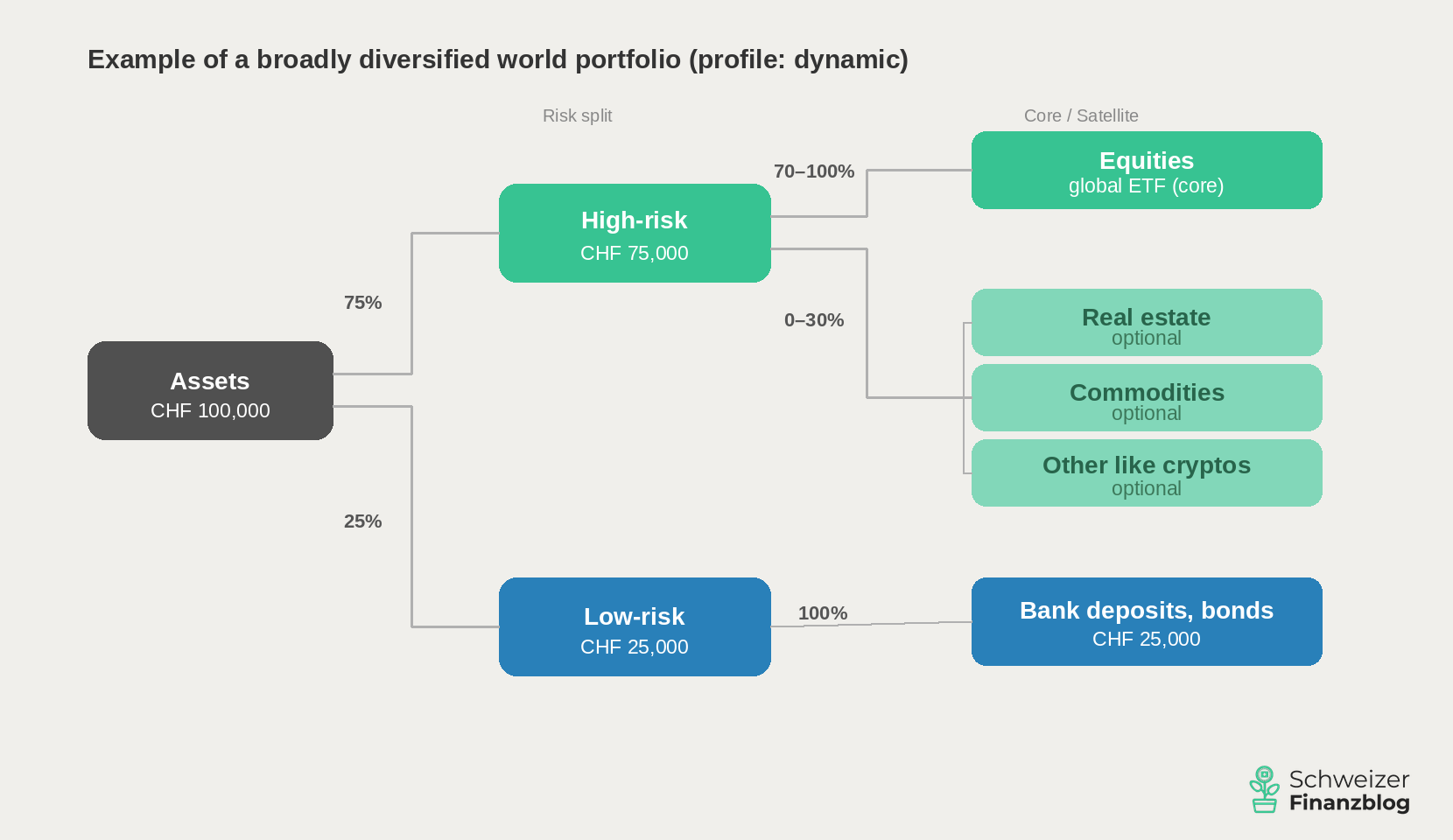
If you want to go beyond this foundation, you can apply the core-satellite approach from lesson 3. The core – 70 to 100% of the risky part – remains a broadly diversified equity ETF. If you wish, you can supplement the remainder up to a maximum of 30% in the satellite with targeted additions:
- Real estate with globally diversified REITs (real estate investment trusts) can improve the risk/return ratio due to their sometimes lower correlation to the stock market.
- Commodities such as gold can serve as inflation protection and a crisis buffer – but do not generate any current income.
- Cryptocurrencies like Bitcoin are among the most volatile asset classes out there—if you invest in them, you should be able to withstand significant price swings and only invest money that you can afford to lose in the worst-case scenario.
- Other options such as collectibles, crowdlending, factor ETFs or individual shares are conceivable for risk-takers – as a small addition, not as a core component.
Rule of thumb: the more exotic the investment, the lower its weighting.
The low-risk part: security and availability
The low-risk part is the anchor of stability in your portfolio – and the calming pill for your nerves. If the stock markets plummet by 30% again, it is this part that ensures that you remain calm. Specifically, it fulfills three tasks:
- Psychological anchor: If not everything is red, it’s easier to keep going and make better decisions.
- Flexibility: If your circumstances change unexpectedly – new job, relocation, unplanned expenses beyond your nest egg – you have room to maneuver.
- Rebalancing ammunition: After a crash, you can buy additional shares at a low price and rebalance your portfolio (more on this in lesson 5).
Bank balances – in savings or private accounts – are the simplest and most liquid option. You can access them at any time. In Switzerland, deposits of up to CHF 100,000 per person and bank are protected by the deposit guarantee scheme. The expected return is clear: at best some protection against inflation, but no real asset growth. That’s not the purpose of this part – it’s to give you security and the ability to act.
High-quality bonds—such as Swiss government bonds with a top “AAA” rating—also offer a high degree of security. However, in Switzerland, their yields have historically been close to the inflation rate. Investors hoping for a significant return after accounting for inflation will generally be disappointed by Swiss bonds. Nevertheless, they can still serve as a stabilizing force in a portfolio—especially for investors with a balanced or conservative profile.
Other options such as medium-term notes or fixed-term deposits offer slightly higher returns than a savings account, but tie up the capital for a fixed term. You can find an overview of this in lesson 2.
“Determining your individual asset allocation tailored to your risk profile is the be-all and end-all of your investment.“
And what about pillar 3a?
A question we are asked time and again: Where in my asset allocation do the 3a assets actually belong – low-risk or high-risk?
Our answer: Neither. Your 3a assets are tied pension assets – you cannot simply withdraw them if you want to. Early withdrawals are only possible in a few cases, such as when buying a home, emigrating or becoming self-employed. Pillar 3a therefore does not belong in the same drawer as your disposable assets, but follows its own rules.
But that doesn’t mean you should ignore them – on the contrary. If you still have 10, 20 or more years until retirement, you are sitting on an enormous compound interest lever. And this is precisely why we recommend investing your 3rd pillar in equities. The biggest return guzzler here? The fees. Traditional bank products often charge 1% or more per year – sounds like little, but can add up to tens of thousands of francs in lost returns over the long term. Low-cost online providers with fees of less than 0.5% make a huge difference here.
– Partner offers –
Still looking for the right financial solution? Our recommendations – with attractive starting bonuses.
– – – – –
Conclusion
Asset allocation is the most important decision in your investment – more important than the choice of individual products, more important than the time of entry, more important than the question of whether to buy ETF A or ETF B. It is your fixed star to which you align all other investment decisions.
The principle is simple: first secure your liquidity reserve. Then divide your freely available assets into a high-risk and a low-risk part based on your risk profile. In the high-risk part, broadly diversified equity ETFs are at the core – if you wish, you can supplement them with additions according to the core-satellite principle. In the low-risk part, bank deposits provide stability and peace of mind. You view your 3a assets separately – equity-based and cost-effective.
Make a note of your target allocation – so that you can monitor it periodically and take countermeasures if necessary. Because when shares rise or fall, the weighting shifts automatically. In our next lesson, we will look at how you can restore your original portfolio structure easily and cost-effectively: rebalancing.
You can find an overview of all the lessons here: Learning to invest – in eight lessons.
This might also interest you

Updates
2026-06-12: Minor adjustments made.
2026-05-19: Table with historical returns and losses adjusted to CH ratios (inflation- and currency-adjusted).
2026-04-10: Article completely revised and updated.
Disclaimer
Disclaimer: Investing involves risks of loss. You must decide for yourself whether you want to bear these risks or not.
Errors excepted: We have written this article on asset allocation to the best of our knowledge and belief. Our aim is to provide you as a private investor with the most objective and meaningful financial information possible. However, if we have made any errors, forgotten important aspects and/or are no longer up to date, we would be grateful if you could let us know.




10 Kommentare
Hallo, welche tools benutzt Ihr um das Portfolio bei mehreren Positionen aufzuschlüsseln? Konkret: bei mir gibt es zB die Positionen FWRA (Invesco FTSE all world ) , WOSC (State street SPDR MSCI Wrld SmlCap) und SPIA (UBS Core SPI). Mein Depot bei Saxo ermöglicht keine detaillierte Analyse zur Überprüfung, ob sich dabei regional oder spartenmässig Klumpenrisiken verstecken. Schaut Ihr Euch das an? Oder reicht eine grobe Schätzung?
Danke und Gruss
Kathrin
Hoi Kathrin
Für das periodische Prüfen der Asset Allocation verwenden wir in der Praxis ein einfaches Excel-File. Darin führen wir die einzelnen ETFs auf und kategorisieren sie nach Regionen sowie nach Grösse (Standardwerte vs. Nebenwerte).
Die konsolidierten Ist-Werte gleichen wir anschliessend mit den definierten Zielwerten ab (z.B. 80/20% entwickelte Märkte/Schwellenländer sowie 80/20% Standardwerte/Nebenwerte). Die entsprechenden Abweichungen werden dabei mittels Formeln automatisch ausgewiesen und als Grundlage für Anpassungen bzw. fürs Rebalancing genutzt.
Auf weitergehende Analysen – etwa zur genauen Sektorengewichtung – verzichten wir bewusst. Sowohl in deinem (gemäss deinen Beispielen) wie auch in unserem Fall handelt es sich um breit diversifizierte, nach Marktkapitalisierung gewichtete ETFs. Das bedeutet: Einzelne Sektoren können zeitweise ein höheres Gewicht haben, dies ist jedoch eine Folge ihrer aktuellen Marktbedeutung (Marktkapitalisierung) und keine bewusste Übergewichtung einer bestimmten Branche. Es widerspiegelt letztlich die Entwicklung und den Erfolg der jeweiligen Sektoren am Markt.
Beste Grüsse
SFB
Ich habe nur die 4te Edition des Buches, dort wird es bei der Asset Allocation noch gelistet. Interessant, dass das die 5te Edition nicht mehr listet.
Demnach sollte man nur in Aktien ETFs und Immobilien ETFs investieren?
Was ist da so der übliche Split im Portfolio oder was empfehlt ihr/Kommer? 70% ETF entickelte Länder und 30% Emerging Markets? Und mit Immobilien: 60% ETF Entwickelte Länder, 30% ETF Emerging Markets, 10% ETF Immobilien?
Ja, bei Kommer stehen beim risikobehafteten Teil der Asset Allocation klar Aktien-ETFs im Fokus. Als Beimischung kommen für ihn (optional) Immobilien-ETFs in Frage. That’s it.
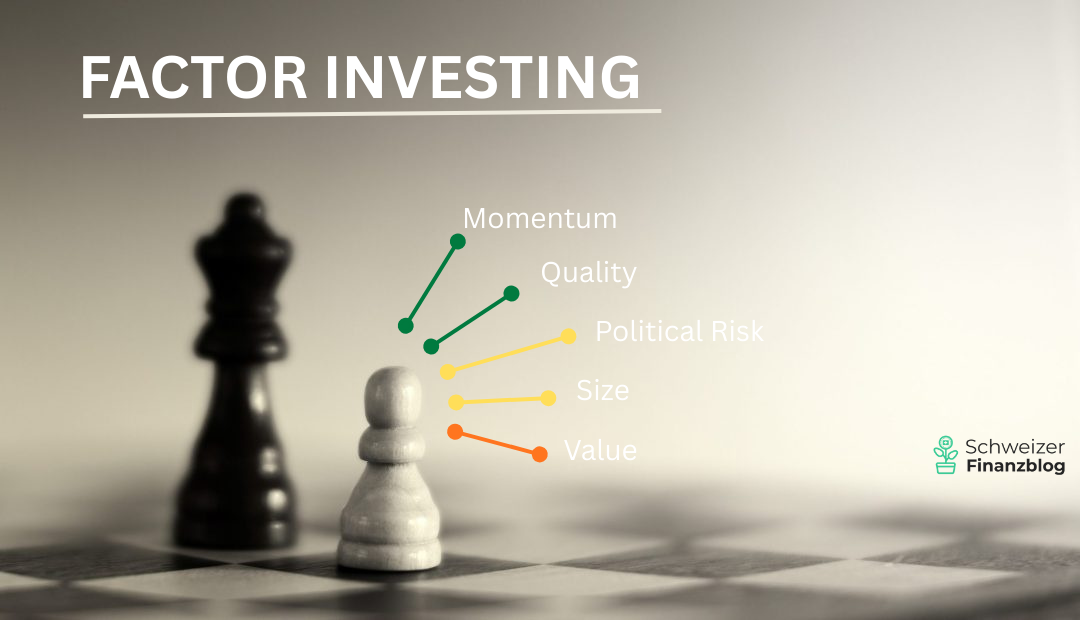
Der “übliche” Split und die einfachste Variante ist, wenn du mit einem einzigen ETF (z.B. Vanguard FTSE All-World) die entwickelte Welt und die Emerging Markets abdeckst, und zwar nach Marktkapitalisierung gewichtet, einschliesslich der Mid und Small Caps (Gemäss Kommer ist dies Variante 1). Dazu kannst du beispielsweise 10 Prozent Immobilien-ETFs beimischen (Kommer’s Variante 2). Bei Kommer’s Varianten 3 und 4 spielt das Factor Investing eine zentrale Rolle. Faktorbasiertes Investieren ist also das Übergewichten von Faktorprämien in einem Portfolio gegenüber einer marktneutralen Gewichtung (Variante 1). Bei der marktneutralen Gewichtung machen die Schwellenländer rund 11% aus. Wenn du diesen Faktor (“Political Risk”) stärker gewichten möchtest, musst du über diesen Anteil gehen. Stefan und Toni sind innerhalb der risikobehafteten Anlageklassen in Aktien-ETFs (70 – 80%; inkl. Übergewichtung der Faktoren “Small Size” und “Political Risk” sowie Toni zusätzlich “Momentum”), Immobilien-ETFs (10-20%) sowie Crowdlending bzw. sog. P2P-Kredite (ca. 10%) investiert. Letztere Anlageklasse empfiehlt Kommer übrigens nicht.
Hallo zusammen
Gerd Kommer empfiehlt ebenfalls Rohstoffe beizumischen. Was sind hier Eure Erfahrungen? Und was für Rohstoffe würdet Ihr beimischen? Geht das auch über DEGIRO?
Hoi Lena
Vorab: Die Asset Allocation ist für uns ein zentrales Element bei der Geldanlage, welches leider bei vielen Anlegerinnen und Anlegern zu kurz kommt. Denn durch die vordefinierten Zielanteile der unterschiedlichen Assetklassen wird ein regelbasiertes und (weitgehend) unemotionales Investieren ermöglicht, was letztlich der Rendite zugutekommt. Deshalb freut uns deine Anfrage zu diesem wichtigen Thema besonders.
In Kommer’s aktueller 5. Auflage seines Standardwerks “Souverän Investieren…” nimmt er gegenüber Rohstoffen eine sehr differenzierte bis ablehnende Haltung ein. So kommt er in Kapitel 5.7 zu folgendem Fazit: “Ich persönlich finde mich seit 2016 eher im Lager der Skeptiker (wo ich fast immer bin, wenn es keinen starken Konsens in der Wissenschaft gibt) und würde daher dafür votieren, auf Commodities bzw. Commodity-Futures in der Zukunft zu verzichten.”
Auch wir vom Schweizer Finanzblog sind nicht in die Assetklasse “Rohstoffe” investiert – zumindest nicht im herkömmlichen Sinn. (Stefan ist seit vielen Jahren in den Clean Energy ETF von iShares investiert.)
Beste Grüsse
SFB
Hallo zusammen
Wird eigentlich das 3. Säulenkonto, welches auch längerfristig ausgerichtet ist (Bis man halt 65 Jahre alt ist) auch in diese Asset Allocation als “Risikoarmer Teil” mit eingerechnet werden? Hier bezahle ich den jährlichen Maximalbetrag von 6883 CHF jeweils ein. -> Diese Einlage wird allerdings auch in diverse Anlagen investiert von meiner Bank.
Danke für eure Rückmeldung und LG
Hoi Allen
Nein, wir würden die 3. Sàule nicht dem risikoarmen Teil zuordnen, da du ja nicht sofort darauf zugreifen kannst. Vorsorgesparen ist stark reguliert und vorzeitige Auszahlungen sind auf wenige Ausnahmen beschränkt. Aufgrund des oft langen Anlagehorizonts (Pensionsalter) erachten wir es als sinnvoll, die 3. Säule (auch) in Aktien anzulegen. Wichtig: Tiefe Gebühren (<0,5%), wie sie innovative Online-Anbieter wie Viac haben, bedeuten mehr Rendite und im Alter mehr Vermögen.
Beste Grüsse
SFB
Hallo zusammen
Ich hätte noch eine Frage: was sagt ihr zu einem Home Bias im Aktien Teil des Portfolios? Z.b. indem man noch 10-20% auf den SPI setzt? Als Währungsabsicherung.
Danke für eine Antwort 🙂
Sonnige Grüsse
Hoi Eliana
Bei 10 bis 20% Beimischung von CH-Aktien hält sich der von dir erwähnte “Home Bias” in Grenzen. Also alles im grünen Bereich:-) Der SPI ist aus unserer Sicht jedoch ein ausgesprochen schlecht diversifizierter Index (die drei Titel Nestlé, Roche und Novartis sind mit rund 45% (zu) stark gewichtet), weshalb wir darauf basierende ETFs nicht empfehlen. (Der SMI ist bezüglich Klumpenrisiken noch schlechter.) Als bessere Alternative sehen wir den SPI Mid (80 CH-Unternehmungen mit mittlerer Marktkapitalisierung; die drei grössten Positionen machen gesamthaft rund 16% aus). Quelle: https://www.ubs.com/2/e/files/RET/FS_RET_CH0130595124_CH_DE.pdf
Beste Grüsse SFB