
 Newsletter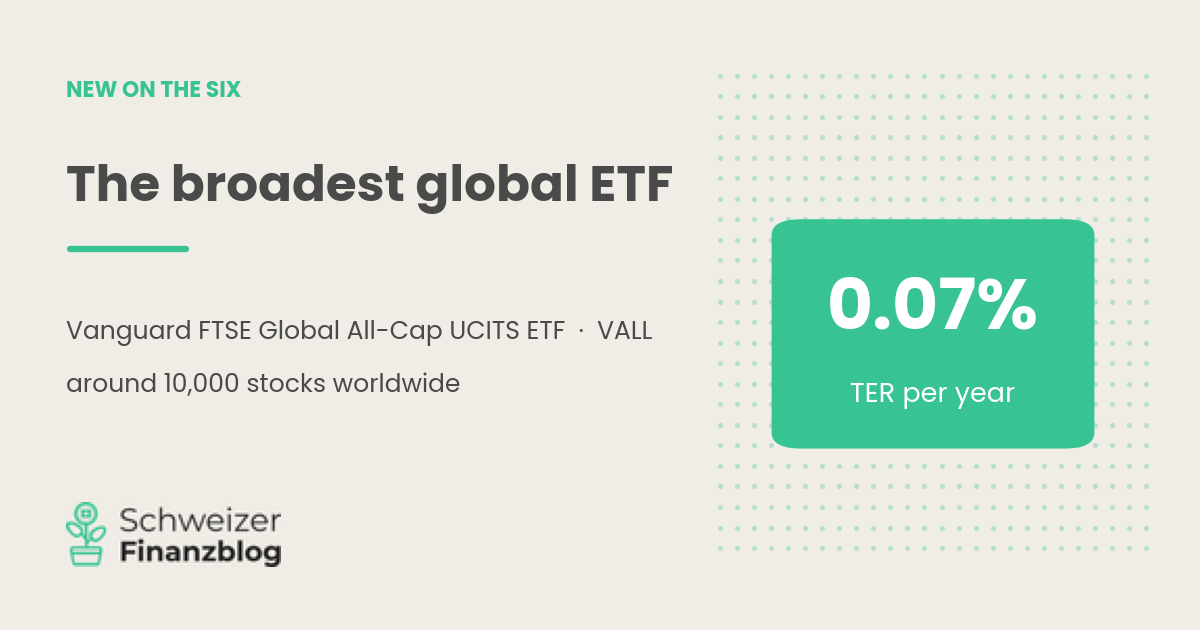
A single ETF, approximately 10,000 stocks, 0.07% annual fees. What would have been considered a misprint ten years ago has been tradable on SIX under the ticker symbol VALL since August 20, 2026. With the FTSE Global All-Cap UCITS ETF, Vanguard has launched the broadest global ETF to date for investors in Switzerland—and, at the same time, the lowest-cost in its category—along with two other products on the same day. In this article, you’ll learn what’s behind this move, why it’s coming now of all times, and who these new offerings are best suited for.

Short & sweet
- On August 20, 2026, Vanguard listed three new global equity ETFs on SIX and four other exchanges.
- The flagship of the new launches is the Vanguard FTSE Global All-Cap UCITS ETF (ticker VALL) with a TER of 0.07%—the lowest-cost global ETF that also includes small-cap stocks.
- The underlying index comprises approximately 10,000 securities and thus covers about 99% of the world’s investable market capitalization.
- Three weeks earlier, Vanguard had already lowered the fees for its two flagship All-World ETFs, VWRA and VWRL, from 0.19% to 0.14%.
- We assume these aren’t bait offers—on the contrary, the trend continues to point downward.
- Those who have already invested have no reason to rush: The ETF isn’t yet available for trading everywhere, and redirecting your savings is more cost-effective than rebalancing your portfolio.
Contents
- From Bogle to the Cooperative: A Brief History of Vanguard
- What Vanguard Has Launched
- Why Now? Vanguard Sets Its Sights on the Market Leader
- And what about Vanguard’s flagship funds, VWRA and VWRL?
- The Price War: TER vs. Zero
- Will the 0.07% remain?
- Why VALL isn’t included in our ETF comparison yet
- Should I sell my existing ETFs now?
- Conclusion
- This might also interest you
- Updates
- Disclaimer
From Bogle to the Cooperative: A Brief History of Vanguard
To understand why this launch is more than just a product announcement, it’s worth taking a look back. In 1975, John C. Bogle launched the first index fund for individual investors. Industry experts reacted with derision—a fund that didn’t even attempt to beat the market was seen as a capitulation to mediocrity. Today, passive investing is the standard, and Vanguard is the world’s second-largest asset manager after BlackRock—with an ownership structure that treats falling costs not as a marketing tool, but as the norm. We’ll explain why that is below.
For a long time, this was hardly noticeable in Europe—Vanguard charged significantly higher prices here than in its home market. This can be illustrated using Vanguard’s own product lineup: The Vanguard Total World Stock ETF (VT) tracks the same index in the U.S. as the new VALL—namely, large-, mid-, and small-cap stocks worldwide—and charges a fee of 0.06% there. There was simply no European equivalent, and where alternatives existed, investors paid many times that amount. The recent launch closes this gap: the difference is now just a single basis point—0.06% versus 0.07%.
What Vanguard Has Launched
Launched on August 18, 2026, and listed on August 20 on the London Stock Exchange, Deutsche Börse, Euronext Amsterdam, Borsa Italiana, and SIX Swiss Exchange—three new ETFs, each with a reinvesting and a distributing share class:
[table “114” not found /]VALL: Vanguard FTSE Global All-Cap UCITS ETF
The three new funds primarily cover large-, mid-, and small-cap stocks from developed and emerging markets and, with approximately 10,000 securities, include more than twice as many as the well-known FTSE All-World Index. The difference lies in the small companies: The All-World index stops at mid-cap companies and covers about 90% of investable market capitalization, while the Global All Cap covers about 99%.
Small-cap stocks thus account for only about 9% of the portfolio. In terms of the number of stocks, they dominate the index; in terms of weighting, they remain a minor component—so in practice, the difference in returns compared to the All-World index is correspondingly small.
As is typical for broadly diversified global ETFs, Vanguard also uses a sampling approach: The ETF does not hold all index constituents, but rather a representative selection of over 7,000 individual stocks. This is not a disadvantage, because the smallest index components are weighted so lightly that omitting them has virtually no impact on the index’s performance, while saving on costs.
This makes the ETF particularly well-suited for three situations: for a portfolio that aims to cover its entire equity allocation with a single product; for cost-conscious investors; and, last but not least, for anyone who wants to avoid the hassle of annual rebalancing. You can find all key data, including the ISINs for both share classes, on Vanguard’s product page.
The logical complement to its ESG counterpart, the V3AA
One point that gets lost amid all the excitement: Vanguard has long offered all-cap coverage—but only in the sustainable version. The Vanguard ESG Global All Cap UCITS ETF (V3AA) has been in operation since March 2021, but charges a fee of 0.24% and excludes companies based on sustainability criteria.
Geographically and in terms of company size, the two ETFs are identical. So anyone who previously wanted the broadest possible market coverage had no choice but to accept the ESG exclusions as well. This linkage has now been removed: The V3AA remains the choice for those who deliberately select investments based on sustainability criteria, while the VALL tracks the entire market—at one-third of the price.
VXUS: Vanguard FTSE All-World ex-US UCITS ETF
The ex-US ETF addresses a concern on many investors’ minds right now: the concentration risk in the U.S. In a traditional global ETF, U.S. securities account for a good 60% of the portfolio’s weighting. Investors who want to consciously manage this allocation themselves—for example, by combining it with a separate U.S. component—gain greater flexibility here.
The ETF is also an interesting alternative to a regional portfolio. Investors who previously covered the developed world using three components—one each for North America, Europe, and Asia-Pacific—and needed a fourth for emerging markets can now get by with just two: a U.S. ETF and the ex-U.S. ETF, which already includes emerging markets. This significantly reduces the effort involved in rebalancing without sacrificing the ability to determine the U.S. allocation yourself. You can find all key data, including the ISINs for both share classes, on Vanguard’s product page.
VSML: Vanguard FTSE Global Small-Cap UCITS ETF
This small-cap ETF is designed for anyone who wants to give small companies a larger weighting in their portfolio.
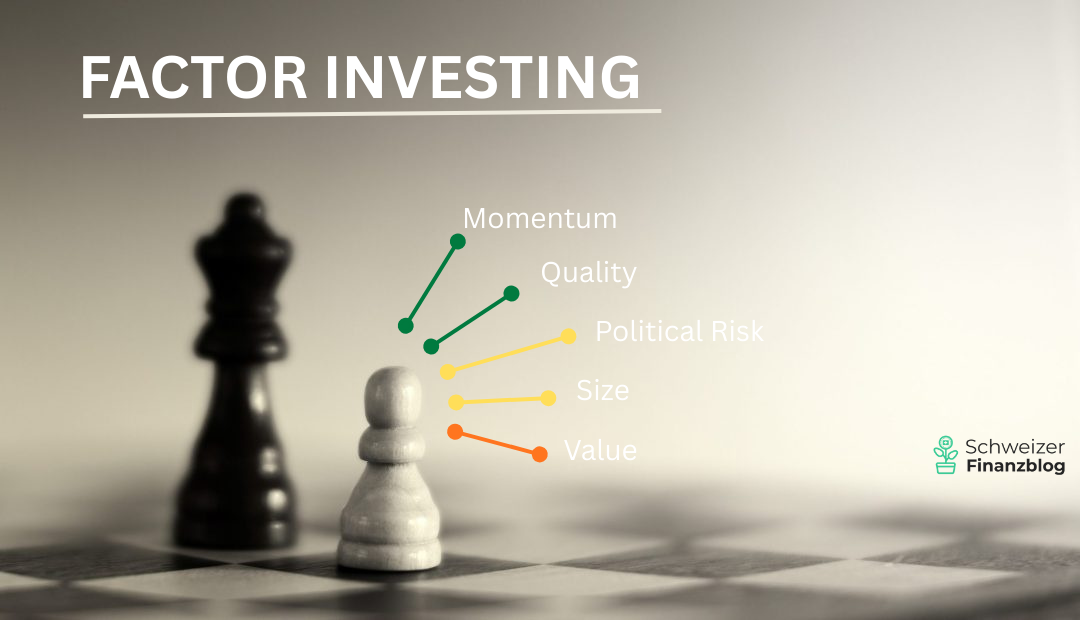
The background: Over long periods, smaller companies have, on average, generated slightly higher returns than large ones—though their prices have fluctuated more. In technical terms, this relationship is known as the size factor. We examined whether such a factor-based approach is worthwhile at all in a separate article: Is Factor Investing Worth It?
Whether you’re already benefiting from this depends on your existing ETF. Small-cap stocks simply aren’t included in the three best-known global indices—the MSCI World, MSCI ACWI, and FTSE All-World. These indices stop at mid-cap companies. The MSCI ACWI IMI and the FTSE Global All Cap, on the other hand, do include small companies, but they weight them according to their market capitalization. This results in a share of about 9%—exactly the same proportion they actually account for in the global market.
Anyone who wants to add small-cap stocks to their portfolio or increase their weighting beyond what this market share would suggest therefore needs a dedicated ETF. You can find all key details, including the ISIN codes for both share classes, on Vanguard’s product page.
Trading Currency and Taxes
Two points apply to all three new issues. First, they are traded exclusively in U.S. dollars on the SIX, not in Swiss francs. So if you don’t already have dollar balances, a currency conversion fee applies to every purchase—often between 0.2% and 1.5% of the transaction volume, depending on the broker. Unlike the annual TER, this fee is charged per transaction and can erode the cost savings accumulated over several years. However, this has nothing to do with currency risk: That arises from the currencies of the underlying stocks and is the same whether you buy in dollars or Swiss francs.
Second, all three ETFs are domiciled in Ireland—which is generally the most favorable option for investors in Switzerland because the double taxation treaty reduces the withholding tax on U.S. dividends. Capital gains remain tax-free as part of your personal assets; dividends, whether reinvested or distributed, are taxable as income. We explain how to optimize your portfolio for tax purposes in the article “ETF Taxes in Switzerland.”
Why Now? Vanguard Sets Its Sights on the Market Leader
Vanguard isn’t launching into a vacuum. In the “one ETF for the entire world, including small caps” category, there was already an established market leader: the SPDR MSCI ACWI IMI UCITS ETF (IE00B3YLTY66) with a TER of 0.17%. It follows virtually the same investment strategy and has a decisive advantage over the newcomer: a track record spanning many years.
That’s exactly why Vanguard has to compete on price, despite its strong brand name. Ongoing costs are the only factor that matters from day one and can be compared in black and white. 0.07% versus 0.17%—that’s not a subtle difference; it’s 59% less in fees.
Market Leader, Challenger, and Classic Compared
How VALL stacks up against the established competitor and the company’s own classic:
[table “117” not found /]With virtually identical market coverage, the newcomer undercuts the SPDR by 10 basis points. However, this also affects Vanguard itself: Investors holding the VWRA get less market coverage at twice the price. Although Vanguard is positioning the new VALL explicitly as a complement, this attack on the competition inevitably cannibalizes its own classic fund as well.
The SPDR, on the other hand, stands out for what VALL still needs to build: fifteen years of trading history, assets under management in the billions, and a verifiable tracking difference. These factors cannot be offset by a low price.
The fact that Vanguard can afford to do this is due to economies of scale. With the Vanguard FTSE All-World, the provider operates Europe’s largest globally invested equity ETF. On this basis, it can offer aggressive products in a niche market without jeopardizing its overall business.
And what about Vanguard’s flagship funds, VWRA and VWRL?
Three weeks before the launch, Vanguard had already made adjustments to its existing lineup: As of July 28, 2026, the TER of the FTSE All-World UCITS ETF fell from 0.19% to 0.14%—for both the accumulation version (VWRA, IE00BK5BQT80) and the distribution version (VWRL, IE00B3RBWM25).
The sequence is revealing. First, the portfolio was discounted, and only then did the new ETF make a big splash. Anyone holding VWRA or VWRL thus also benefits from an improvement—without a single click—and might think twice about switching.
The Price War: TER vs. Zero
This move is not an isolated one. Xtrackers has also lowered the fee for its FTSE All-World ETF to 0.07%; for global ETFs focused on developed markets, UBS has even undercut that mark; and for the major U.S. indices, fees as low as 0.03% have been achieved. Anyone looking to track a standard index today pays only a fraction of what was typical ten years ago.
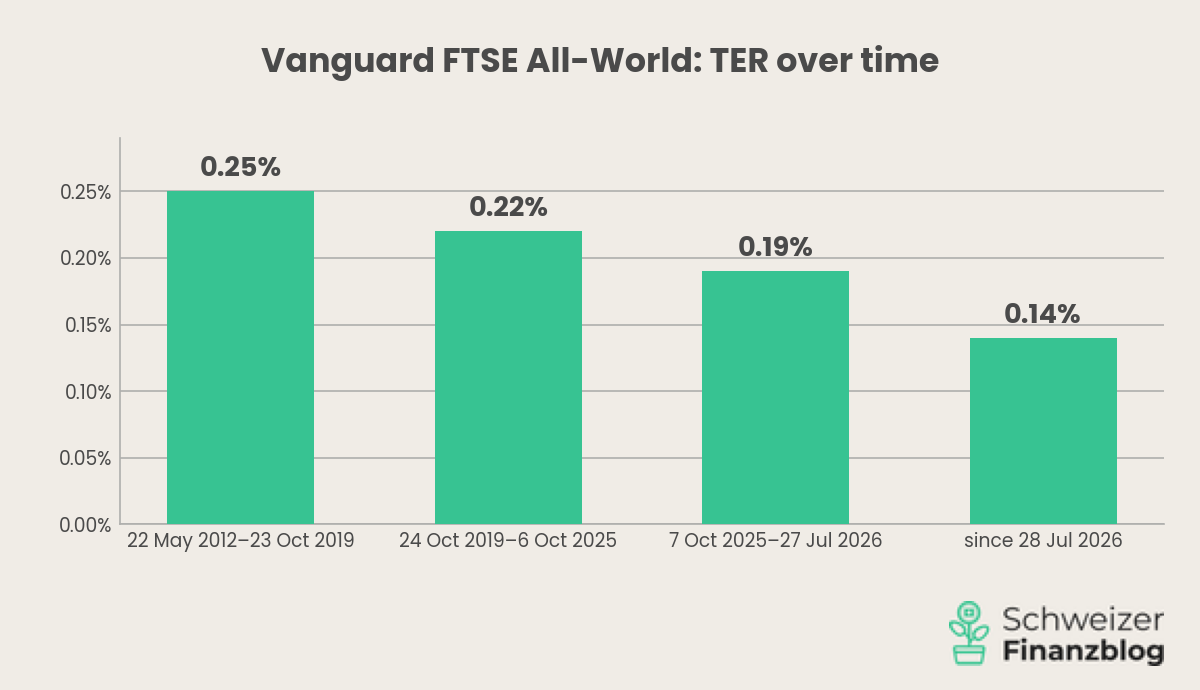
Vanguard’s flagship fund illustrates just how consistent this cost trend has been: The TER of the Vanguard FTSE All-World began at 0.25% when the first share class was launched in 2012, fell to 0.22% in October 2019, to 0.19% in October 2025, and has stood at 0.14% since the end of July 2026. There has not been a single increase—and the intervals between reductions are getting shorter.
For us retail investors, this is a welcome development—with one caveat. The TER only tells you what the provider charges; it doesn’t indicate how well the fund actually tracks the index. Only the tracking difference reveals that quality. An ETF with a low TER that tracks its index poorly can, on balance, cost you more in returns than a slightly more expensive one with accurate tracking. The tracking difference over several years is therefore often more meaningful than the TER alone.
What the TER Actually Costs You
A difference of just a few basis points may not sound like much—but the higher the investment amount, the more significant that difference becomes. A cost comparison of four ETFs:
| Total Investment Amount | VALL (0.07%) | VWRA (0.14%) | IMID (0.17%) | V3AA (0.24%) |
|---|---|---|---|---|
| 10,000 | 7 | 14 | 17 | 24 |
| 50,000 | 35 | 70 | 85 | 120 |
| 100,000 | 70 | 140 | 170 | 240 |
| 250,000 | 175 | 350 | 425 | 600 |
For an investment of 100,000 CHF, the new Vanguard fund costs 70 CHF per year—100 CHF less than the SPDR and 70 CHF less than its own flagship All-World fund. Over a long investment horizon, this adds up, because the savings remain in the portfolio and generate returns of their own.
However, you’ll never see these amounts on your account statement. The TER is deducted directly from the fund’s assets on an ongoing basis and isn’t reported separately anywhere—it’s already factored into the ETF’s price. This makes the costs invisible, but no less significant: they erode your returns day by day.
Will the 0.07% remain?
With prices this low, it’s only natural to ask: How long will this last? We consider a temporary loss leader offer unlikely—for three reasons.
First, the ownership structure: Vanguard is owned by its fund investors. There is no external investor who could later demand a margin increase. This is reflected in the company’s track record: According to its own figures, Vanguard has lowered the fees for its European funds and ETFs more than eighty times over the past ten years.
Second, the compact product lineup: Vanguard offers a relatively small number of carefully positioned products in Europe. A company that launches a product as a strategic cornerstone doesn’t withdraw it or raise its price after two years.
Third, market dynamics: The costs of standard global ETFs have been falling steadily for years, and the market has adjusted accordingly. A price increase would therefore be perceived as a break from this trend and would likely result in reputational damage that far exceeds the additional revenue.
This is our assessment, not a guarantee. Contractually, a TER can be adjusted at any time. But the incentives all point in the same direction.
Why VALL isn’t included in our ETF comparison yet
If you look at our article “Best ETFs in Switzerland and Globally” right now, you won’t find the new All-Cap ETF listed there. This is intentional, not an oversight.
Our selection criteria require, among other things, at least five years of market experience and a fund volume of at least 500 million CHF. Naturally, a newly launched ETF cannot meet the five-year requirement. The situation is different when it comes to assets under management: About CHF 160 million in just under two weeks is a flying start—VALL should easily reach the CHF 500 million threshold within a year.
That’s not to say the ETF is bad—we simply can’t evaluate it yet. An ETF needs an economic cycle to demonstrate how accurately it tracks the index and how tight the spreads remain during turbulent periods. As soon as VALL and VALLD meet our criteria—and we’re convinced they will—they’ll appear in the comparison.
Should I sell my existing ETFs now?
Our answer: Patience and good judgment.
One very practical reason to be patient is that VALL and VALLD are not yet available everywhere. It will likely be several months before a new product is offered by all the brokers commonly used in this country and can be purchased through a savings plan.
The second question is more crucial: Does the ETF even fit your strategy? If you’re deliberately avoiding small-cap stocks, you won’t benefit from the broader coverage. If you’re strategically weighting regions, investing in a single all-cap ETF means giving up exactly that control. And if you want to trade in Swiss francs, VALL doesn’t offer that option. So the question isn’t whether the ETF is affordable—it’s whether it fulfills the role your portfolio assigns to it.
On top of that, there are the costs associated with switching: trading fees on both sides, the spread, and, if applicable, a switching fee. Especially for smaller portfolios, these costs can erode the savings from the lower TER over the course of several years.
The more elegant approach involves adjusting your savings rate: Instead of liquidating your existing portfolio, you redirect future contributions to the new ETF and leave your current holdings as they are. This way, you benefit from the lower price with every new franc you invest, without paying a single cent in sales fees—and the portfolio will rebalance itself over the years. You can always rebalance later, but by then you’ll have better information to guide your decisions.
A new ETF is rarely a reason to rush: If you already have a diversified and cost-effective investment portfolio, you’ll lose almost nothing by waiting—but by acting hastily, you might lose more than you save. Before we wrap up, here’s a quick note about our partner offers.
– Partner Offers –
Still looking for the right broker for your ETF purchases? Here are our recommendations —with attractive sign-up bonuses.

–––––
Conclusion
With the Vanguard FTSE Global All-Cap UCITS ETF, virtually the entire investable equity universe is now available in Switzerland at a price previously seen only in ETFs on the U.S. market. For investors seeking to invest globally—including in small-cap stocks—through a single product, there is currently no more comprehensive solution.
What’s remarkable isn’t just the price, but the mindset behind it: With VALL, Vanguard is undercutting its own flagship fund, which manages billions. A company that acts this way isn’t counting on a short-term publicity boost, but rather on a market in which costs will continue to fall.
Still, a new ETF is merely a promise, not a track record. How accurately VALL tracks its index will only become clear over several years—and it won’t be truly put to the test until the next market downturn.
The real winners in this price war aren’t the providers, but us, the investors.
This might also interest you


Updates
August 31, 2026: First publication
Disclaimer
Disclaimer: Investing involves risks of loss. You have to decide for yourself whether you want to bear these risks or not.
Errors excepted: We have written this article to the best of our knowledge and belief. Our aim is to provide you as a private investor with the most objective and meaningful financial information possible. However, should we have made any errors, forgotten important aspects and/or no longer have up-to-date information, we would be grateful if you could let us know.
Disclosure: As of the date of publication, the Schweizer Finanzblog team holds an investment in the following security mentioned in this article: Vanguard FTSE All-World UCITS ETF (VWRA). Apart from this investment, there are no business relationships (commissions, etc.) with any of the index or ETF providers mentioned in this report.



5 Kommentare
Hallo miteinander,
Danke für eure fundierte Analyse. Ich sehe mit dem neue ETF wenige eine Kanibalisierung der eignen Anlageprodukte von Vanguard als vielmehr ein Angriff auf den ETF Amundi Prime All Country World UCITS ETFIE0009HF1MK9 /WEBG, der ebenfalls eine TER von 0.07% aufweist. Habt ihr diesen ETF auch auf dem Radar? Was unterscheidet die beiden Fonds im Wesentlichen?
Hoi Beat
Beim WEBG handelt es sich um einen ausschüttenden ETF, der 2024 lanciert wurde. Der entscheidende Unterschied: Er bildet den Solactive GBS Global Markets Large & Mid Cap ab – also ohne Small Caps. Damit ist er kein All-Cap-Konkurrent, sondern spielt in derselben Liga wie der Vanguard FTSE All-World, nur zu 0,07% statt 0,14%. Der WEBG greift also den VWRA bzw. VWRL an, der neue VALL dagegen den SPDR ACWI IMI.
Beste Grüsse
SFB
Top Beitrag – danke für den Tipp! Ich bespare nach mehreren Jahren FTSE All World nun den All Cap. In der willbe App ist er bereits gelistet und besparbar.
Bester Beitrag den ich bislang zu diesem Thema und zur Einführung des neues ETFs gelesen habe. Super Überblick und sehr gut der Vergleich zum Allworld und SPDR ETF. Danke dafür. Für mich ist es tatsächlich die Handelswährung, welche mich vom Wechsel abhält. Grundsätzlich würde ich gerne den All Cap besparen, aber eben nur in CHF. Der Allworld kommt so trotz doppelter TER, aber fehlender Währungsgebühren, günstiger. Warten wir ab. Denkst du, die Handelswährung für den All Cap wird sich auch einmal von USD zu CHF an der SIX ändern?
Liebe Grüsse
Vielen Dank für das positive Feedback – freut uns sehr!
Deine Rechnung teilen wir: Die Wechselgebühr kann den TER-Vorteil über Jahre aufwiegen. Ob eine Franken-Linie dazukommt, lässt sich nicht seriös vorhersagen. An der Börse London führt Vanguard oft zwei Währungen, für den kleineren Schweizer Markt meist nur eine. Entscheidend dürfte das Handelsvolumen sein – und das wird unseres Erachtens rasant wachsen. Wir behalten es im Auge.
Beste Grüsse
SFB