
 Newsletter
If you want to spread your wealth more broadly and depend less on price swings in the financial markets, alternative investments are an exciting addition to a classic stock portfolio.
The up-and-coming Swiss platform Splint Invest is taking a pioneering approach: it democratizes access to high-quality collectibles by making them accessible to a broad range of investors. Investments in art, luxury watches or rare wines, which used to be reserved almost exclusively for very wealthy people, can now be made easily and digitally via an app.
In our Splint Invest review, we show you how Splint Invest’s business model works, where we see the pros and cons, and how you can invest your first Splint in a collectible of your choice at no risk to yourself – now also in Swiss francs.

In a nutshell
With an innovative approach to alternative investments, Splint Invest opens up new ways to diversify your assets – from watches and art to wine and whisky. The app-based platform makes high-quality collectibles accessible to a broad range of investors.
- Swiss platform: founded in 2021, focusing on collectibles as an alternative asset class
- Simple app platform: investments from €50 in physical assets such as watches, art, wine, whisky or handbags
- Return & duration: expected and realized net returns often above 10% p.a., investment horizon between 1 and 10 years
- Ways to sell: either through Splint Invest (based on the expected return and time horizon) or via the weekly marketplace
- Fee model: no account fees, platform fees of 4–10% included in the purchase price, plus asset-specific management costs for storage and insurance
- Target group: return-oriented investors who want to add alternative investments to their portfolio in a targeted way and knowingly accept larger fluctuations in value
🎁 With the promo code SFB60 you get a starting credit of 60 in your reference currency (CHF/EUR/GBP) – and can use it to invest in your first collectible at no financial risk to yourself.
Contents
- Promo code SFB60 and a preliminary note on our Splint Invest review
- Alternative investments
- About Splint Invest
- A brief history
- How does Splint Invest work?
- What amounts are we talking about?
- What fees does Splint Invest charge?
- What are Splints?
- How are Splints taxed?
- How is the expected return determined?
- When are objects sold, and what real returns have been achieved so far?
- Where are the goods stored?
- Which tangible assets can you invest in?
- How does the registration process work?
- How do I transfer money?
- How good is the app?
- The first purchase
- Marketplace: who benefits most from the secondary market
- What are the risks?
- The Smart Club for committed investors
- What are the pros and cons of Splint Invest?
- Conclusion of our Splint Invest review
- You might also be interested in
- Updates
- Disclaimer
Promo code SFB60 and a preliminary note on our Splint Invest review
Splint Invest won us over, which is why we have entered into a partnership with this Swiss start-up, founded in 2021 and now well established.
This article is based mainly on our own research and experience. On individual topics where in-depth background knowledge was helpful, Splint Invest supported us directly and first-hand.
🎁 With the promo code SFB60 you get a starting credit of 60 in your reference currency (CHF, EUR or GBP) and can test Splint Invest with a real investment at no financial risk to yourself. You also support our blog.
Simply download the app to your smartphone, sign up, enter the promo code and off you go!
– Partner offer –
Disclaimer: Investing involves the risk of loss.
– – – – –
Alternative investments
For those of you to whom alternative investments are still fairly new territory, we have summarized the essentials about these asset classes beyond the mainstream in this chapter.
What are alternative investments?
As the name suggests, these are alternatives to traditional asset classes such as stocks or bonds. Alternative investments are often characterized by the following features:
- Weak correlation with traditional asset classes, or even opposite market movements
- Low liquidity or long-term capital commitment
- Higher potential for gains and losses
Examples of alternative investments established on the market include:
- Hedge funds: actively managed funds that aim for returns independent of the market
- Private equity: investments in unlisted companies with growth potential
- Commodities: e.g. wheat, oil or precious metals
- Real estate: investing in “bricks and mortar”
(see also our article Real estate ETFs: the easiest way to invest in bricks and mortar)
Less well known, but also part of alternative investments, are so-called collectibles or luxury items. That is what this article is about.
Why invest in alternative investments at all?
As part of comprehensive diversification of your assets, alternative investments can complement traditional asset classes such as stocks or bonds well.
Adding alternative investments can make your portfolio more resilient to stock market turbulence and interest rate fluctuations. This reduces your dependence on conventional investments and the market developments associated with them, and opens up new potential return opportunities.
About Splint Invest
A brief history
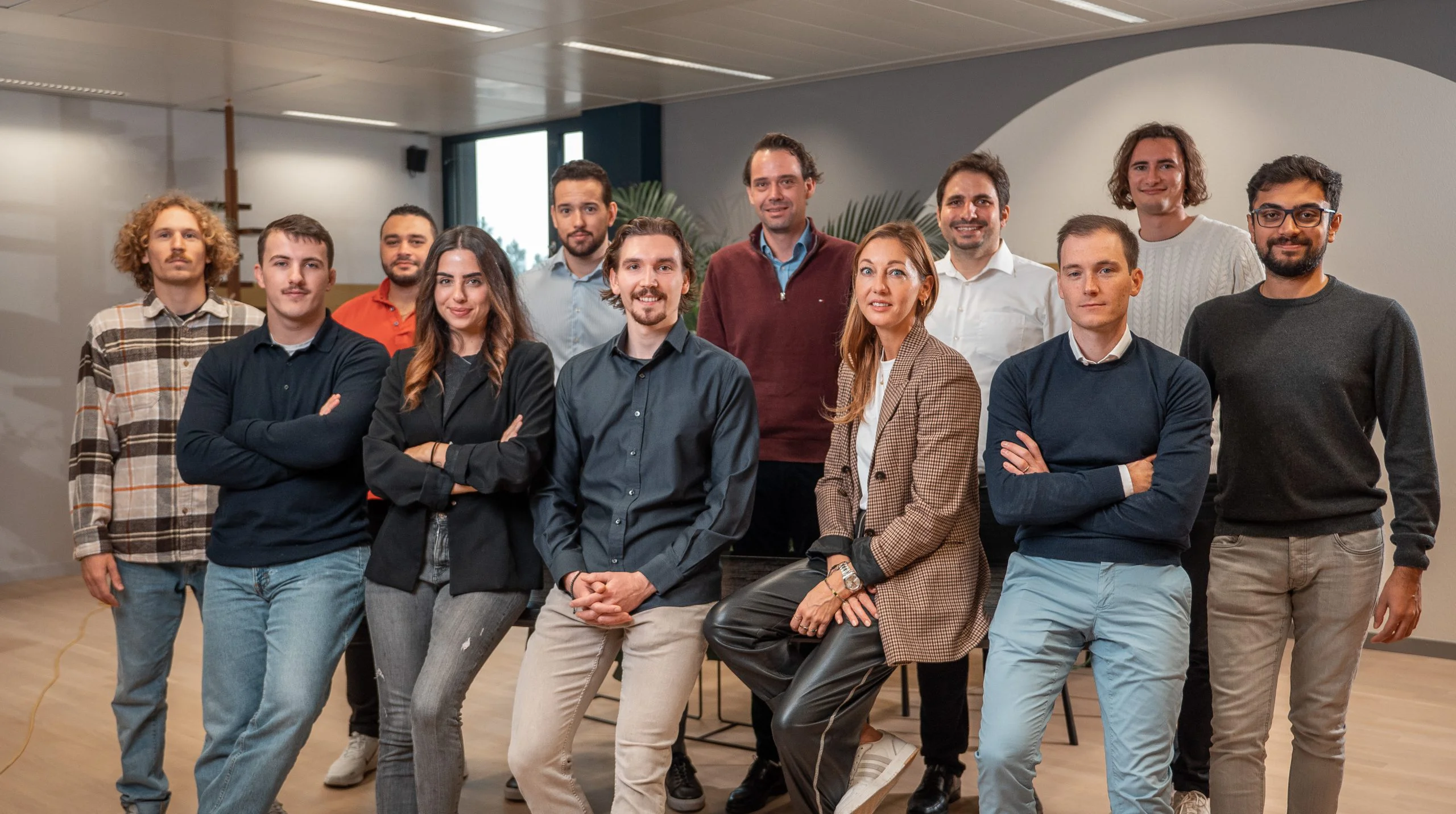
Splint Invest is a Swiss start-up based in Zug, founded in 2021 by, among others, the two private investors and auditors Aurelio Perucca and Mario von Bergen. Their motivation came from the realization that many private investors, driven by negative interest rates, stock market turbulence and rising inflation, were desperately looking for alternative investment opportunities.
After a test phase among friends and acquaintances, the app went live in February 2022. In 2026, the platform already has around 20,000 investors – and the number is rising sharply.
Splint Invest is a so-called financial intermediary. As a member of the self-regulatory organization VQF, Splint Invest is audited every year for compliance with anti-money laundering regulations.
How does Splint Invest work?
Platform & investment idea
Splint Invest is based on an app that you download to your smartphone. Via this platform, you can trade digital shares in alternative investments. These are collector’s items or luxury goods, known in industry jargon as collectibles or luxury items.
Specifically, you can invest in contemporary artworks, high-quality luxury watches, fine wines, selected whisky casks or exclusive handbags, for example, and thereby acquire co-ownership of these objects.
Splint Invest makes collectibles accessible to a broad range of investors. Until now, this asset class was mainly reserved for very wealthy people, as the company’s own slogan “Do it like the top 1%. Invest in alternative assets” also expresses.
Interplay between experts, platform and investors
Splint Invest operates the platform, selects external partners and validates their expert appraisals using data-based criteria. If Splint Invest concludes that the external partner is trustworthy and the collectible on offer is fairly valued, it is bought and offered on the platform as an investment.
What amounts are we talking about?
From as little as €50 – or the equivalent in CHF or GBP – you can buy shares, called Splints. With the promo code SFB60 your first Splint is even a gift, which effectively amounts to a risk-free investment.
Splint Invest now offers you three reference currencies: EUR (as before), now also CHF and GBP. A single Splint still corresponds to €50, but is converted into your chosen reference currency. You can find out exactly how this works in this article by Splint Invest.
Existing customers can change their reference currency once and irrevocably, for example from euros to Swiss francs. In our experience, the currency change can be initiated with just a few clicks and takes effect within 24 hours.
What fees does Splint Invest charge?
Let’s start with the positive: at Splint Invest there are no custody fees or other hidden costs. There is also no withdrawal fee when you transfer the proceeds from selling Splints back to your bank account.
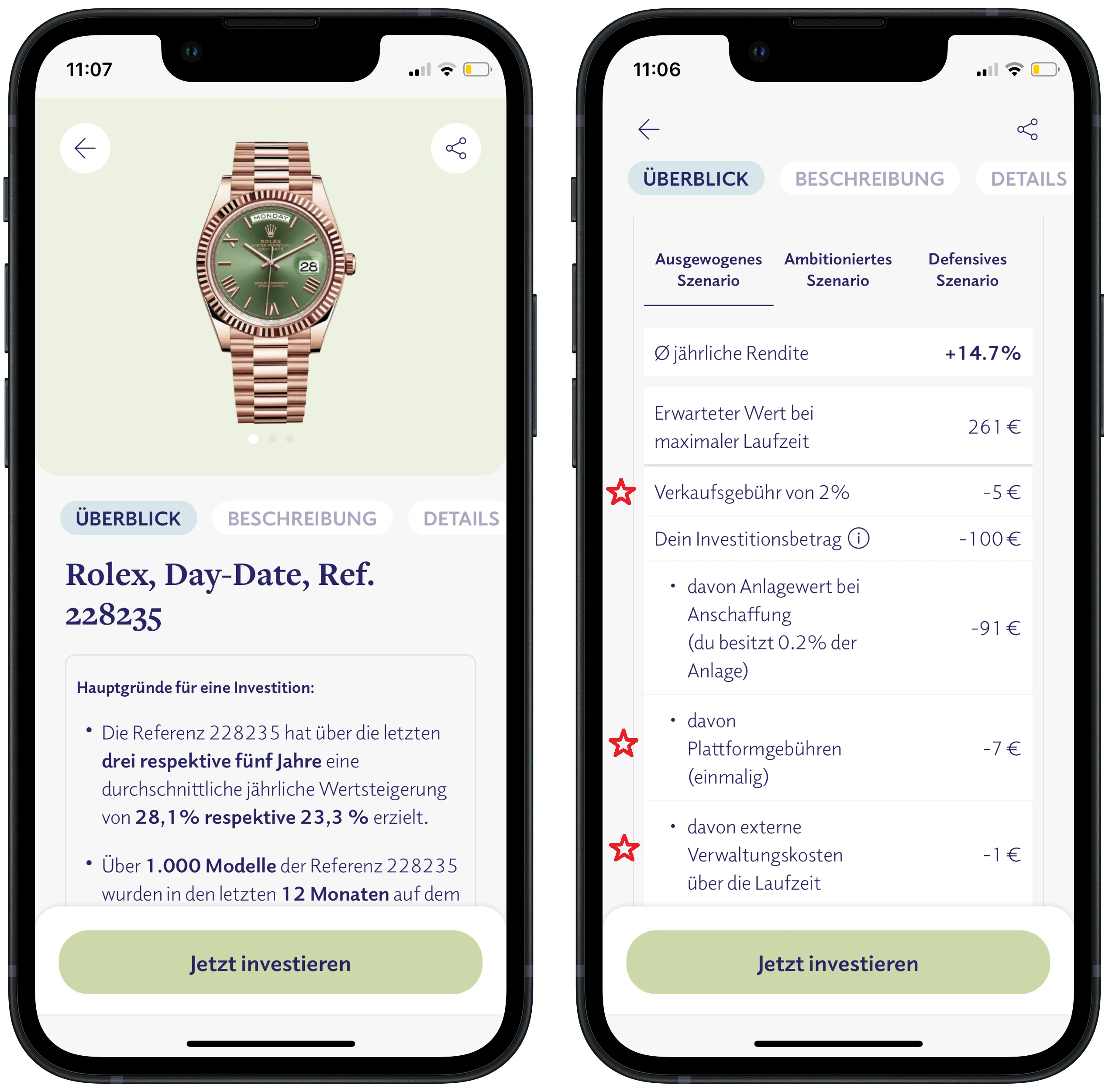
At Splint Invest, only transaction-related costs are incurred, namely when you buy Splints. This means that the purchase price of Splints already includes the so-called platform fees of 4–10% and asset-specific external management costs for storage and insurance. The latter are calculated once for the entire investment horizon and vary depending on the asset.
To help you decide, we recommend that you find out exactly which fees apply before each investment. You can do this easily in the app, individually for your planned investment amount.
What are Splints?
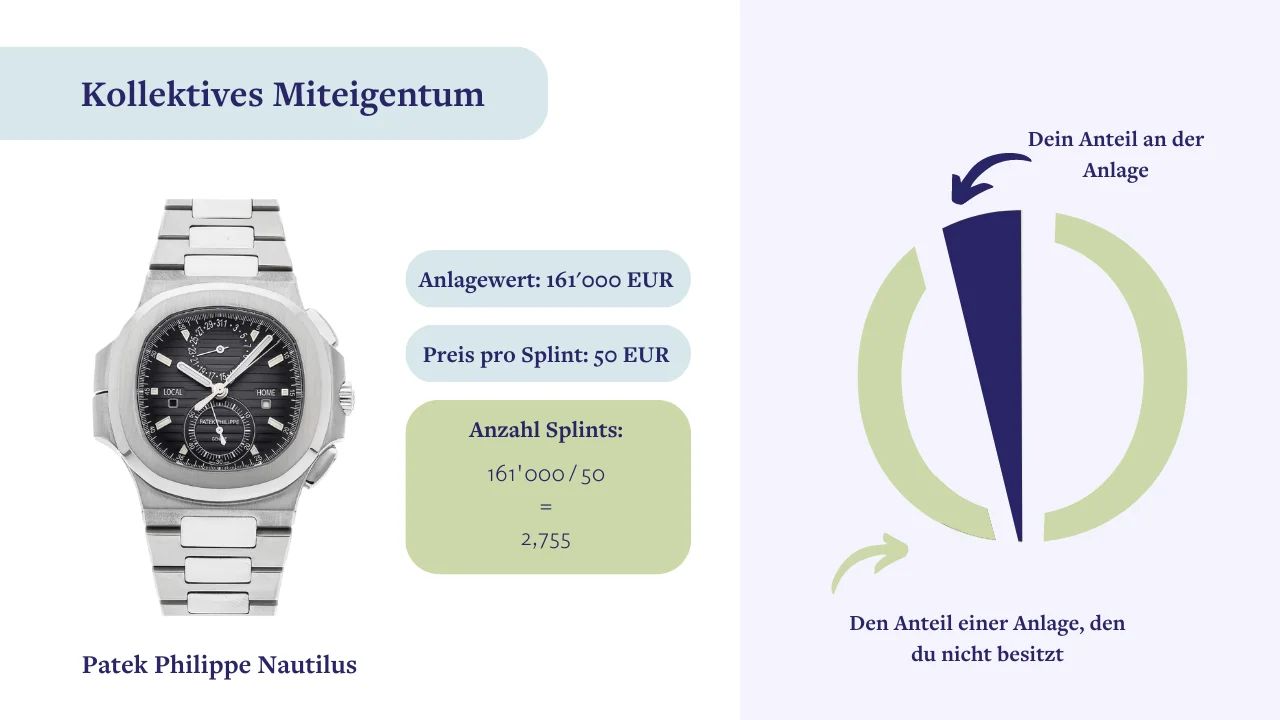
A Splint is a digital unit that represents co-ownership of a physical asset. A watch worth €20,000 is therefore divided into 400 Splints of €50 each. If you buy four of them, you own one percent of the watch.
How are Splints taxed?
Under Swiss law, Splints are tangible assets. The value of the Splints reported at the end of the year is added to your assets in your tax return. An investment with Splint Invest is therefore subject to wealth tax.
How is the expected return determined?
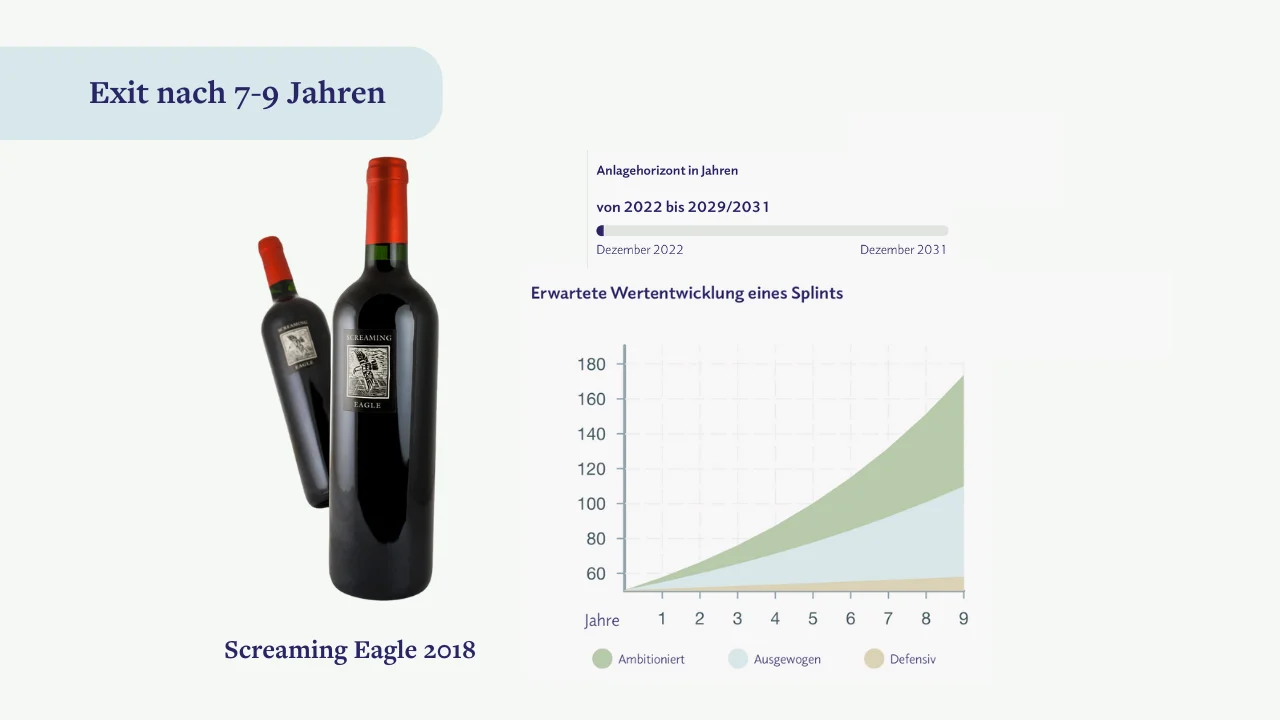
Together with the external experts, an investment horizon and three scenarios for the expected performance are defined for each object: a defensive, a balanced and an aggressive one. These forecasts are largely based on historical data, i.e. returns and sale prices achieved in the past by comparable objects.
In our Splint Invest experience, returns are often above 10% p.a., but vary quite a lot from object to object. As of 26 May 2026, the expected annual return for the balanced scenario across the 13 active offers ranges from an attractive 12.8% for Ornellaia, Bolgheri (a top red wine from Tuscany) to a high 29.4% for a painting by Javier Calleja.
In the next chapter, you will find out what real returns have been achieved through sales so far.
When are objects sold, and what real returns have been achieved so far?
The sales process is initiated by Splint Invest according to fixed rules, i.e. from the start of the defined investment horizon, and is usually based on the balanced or aggressive scenario.
In our Splint Invest experience, however, an offer matching the aggressive scenario often comes along before the stated investment period has ended. In this case, Splint Invest arranges the early sale of the collectible. Occasionally, the market prospects for a particular object may also deteriorate. In such cases, Splint Invest can recommend an early sale – even at a loss, on which all investors vote.
The regular investment period varies depending on the object and is usually between around one and ten years.
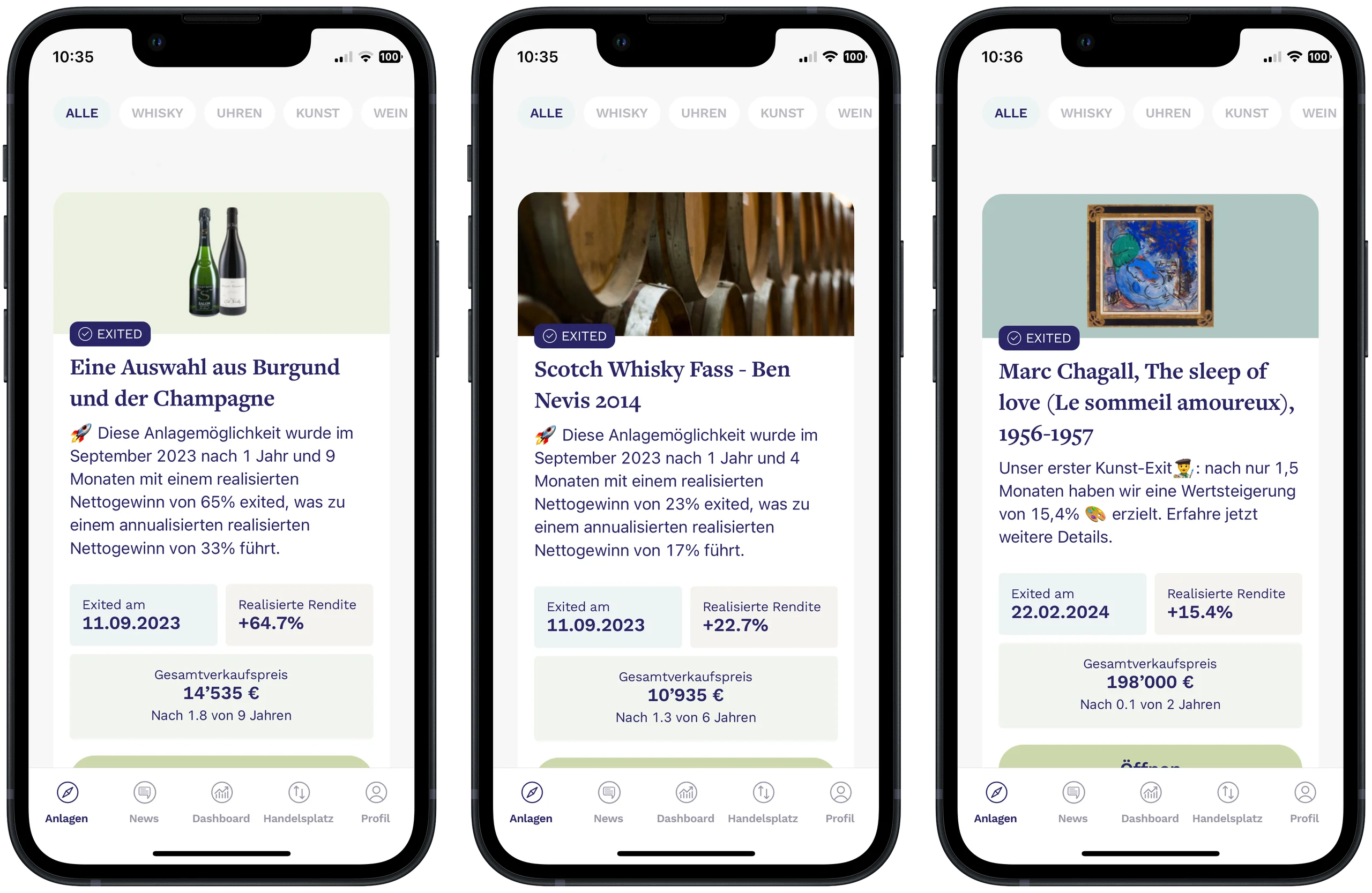
Splint Invest’s completed sales to date point to attractive returns and a comparatively short holding period, as the following overview shows.
| Key figure | Value |
| Total exit volume | CHF 4.71 million |
| Total number of exits | 76 |
| Average net return | 22% |
| Average holding period | 17 months |
| Best exit | 74,8% |
| Fastest exit | 2 months |
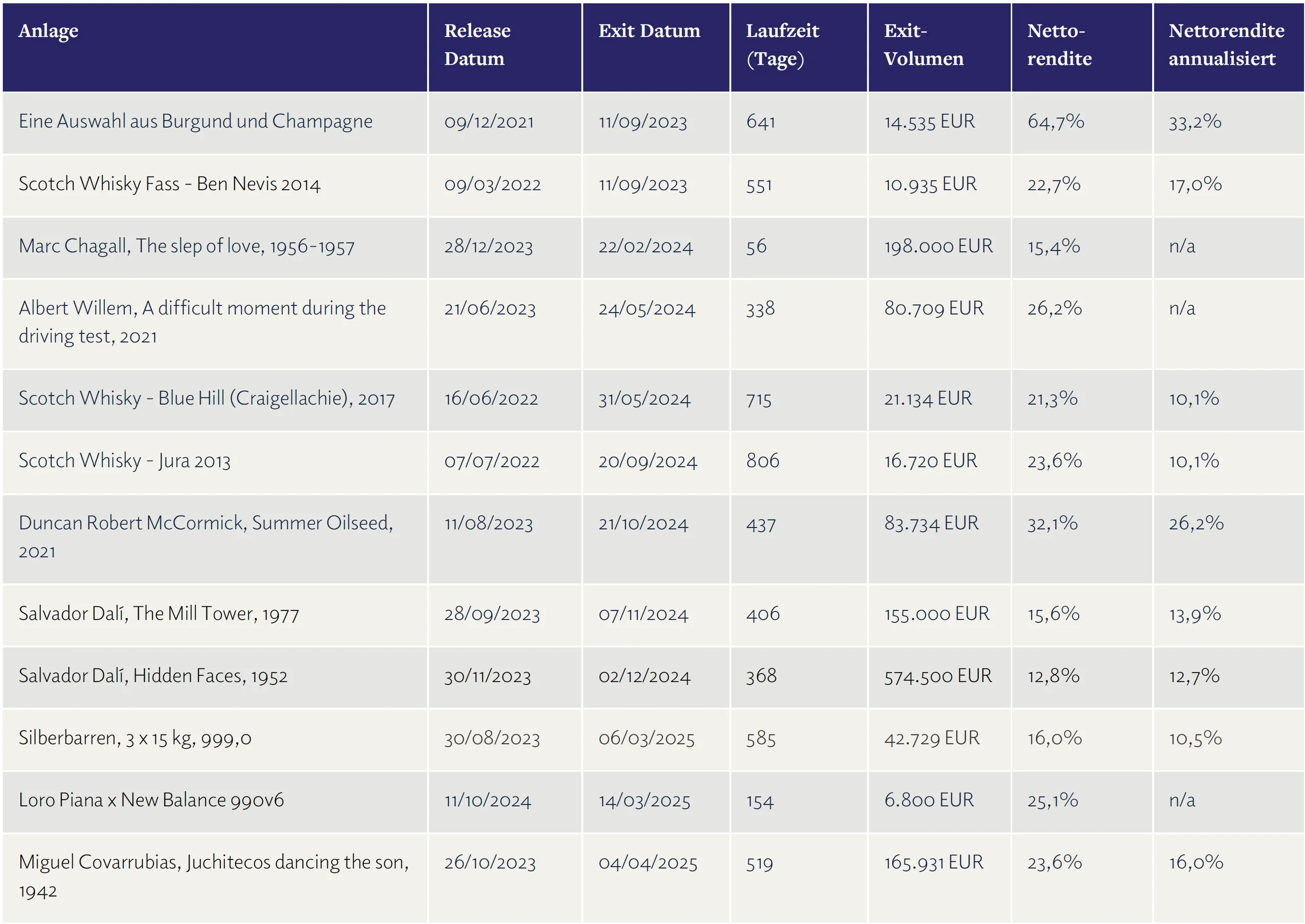
If no suitable purchase offer comes in within the defined sales window (usually 2–3 years), the sales process continues. In this case, offers that correspond to the defensive scenario are also accepted.
As an alternative to these sales organized by Splint Invest, you can also sell your shares in the investment object yourself. Splint Invest offers a secondary market, the so-called marketplace, where Splints can be traded within the community every week. Further below, we go into this in more detail and show you who benefits most from the marketplace.
Where are the goods stored?
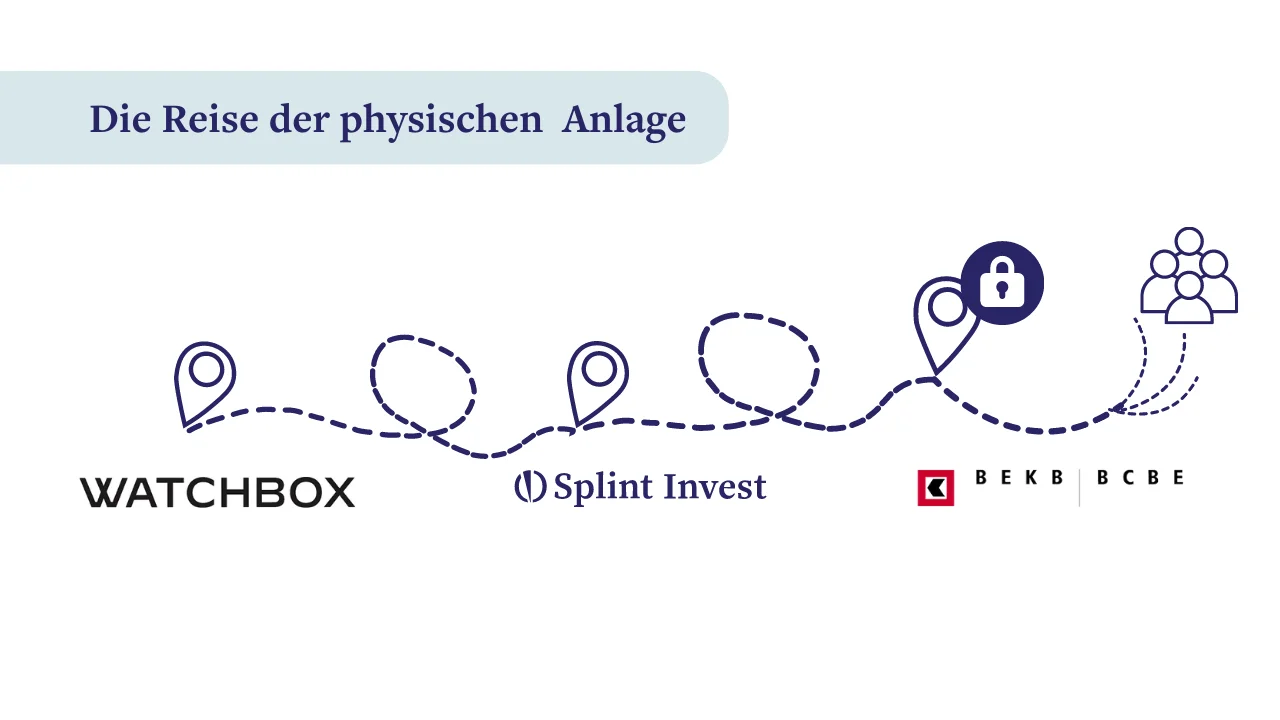
Storage is a factor not to be underestimated for an asset’s performance. Splint Invest therefore sets correspondingly high quality standards for its storage partners. Currently, for example, watches and handbags are stored in the vault of the Berner Kantonalbank in Bern, while whisky casks and wine bottles are kept in state-supervised bonded warehouses (e.g. in London).
Which tangible assets can you invest in?
The range of alternative investment opportunities is constantly being expanded, and with it the overarching categories. The following categories are currently open to you (sorted by launch, oldest category first):
- Whisky
- Watches
- Art
- Wine
- Handbags
- Rum
- Diamonds
- Lego
- Miscellaneous (e.g. precious metals, trading cards, sneakers)
- Digitized rights
- Luxury cars
- Private equity
As with stocks, the same applies to this asset class: to achieve the best possible risk/return ratio, it pays to diversify as broadly as possible across several object categories.
How does the registration process work?
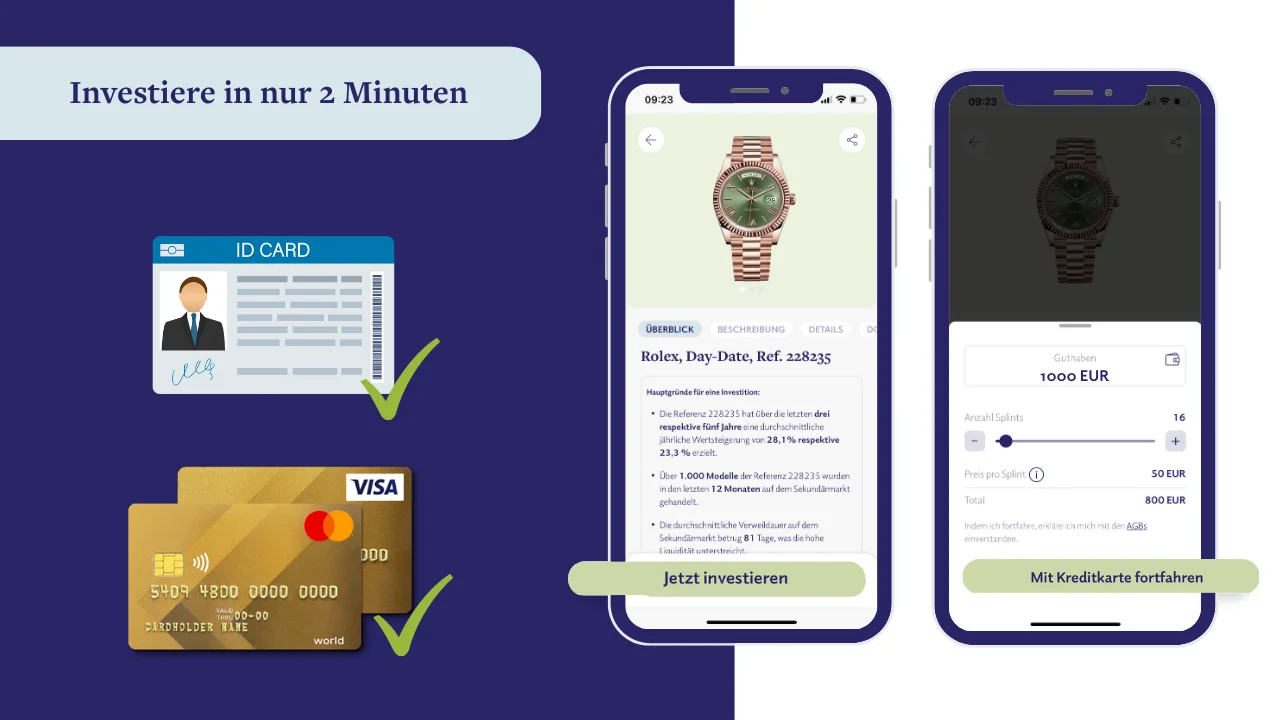
The registration process is simple and takes less than a minute: enter your name, email address and a password. A welcome email is generated immediately, which you need to confirm. Done!
After registering, you can redeem the promo code SFB60, which credits you with 60 in CHF, EUR or GBP, depending on your choice of reference currency. You can only transfer this gifted amount back to your bank account once it has been invested.
Only once you have bought a total of 10 Splints or more, i.e. from an investment amount worth €500, is verification of your identity required. You confirm it with a valid identity document and a selfie in the form of a short video sequence. This purely digital process took us about two minutes.
In principle, anyone aged 18 or over who lives in Europe or has access to the app can register.
How do I transfer money?
You can transfer money via your bank account (one-off transfers or standing orders possible). Thanks to the Single Euro Payments Area SEPA, which Switzerland is also part of, transfers from your bank to the platform and back are free of charge. Alternatively, you can also transfer money by credit card, but debit cards are not accepted.
Depending on your chosen reference currency, transfers are currently possible in CHF, EUR or GBP.
How good is the app?
To say it right away: we have rarely come across such an informative yet extremely clear app. Compliments to Splint Invest!
You can download the app for free from the Google Play Store and Apple’s App Store. We tested the latter.
The app is available in German, English, French and now also Italian. The actual content is organized into the following five sections in the menu bar:
“Investments” section
This is where the action is, or rather where the journey of discovery begins! A filter function lets you make an initial selection – by status (“My investments”, “New”, “Active” for objects that can still be bought, or “Sold out”) and, among other things, by category (e.g. art). You can further refine the selection by investment horizon, by stability (i.e. how much an object’s value fluctuates) and by track record (the object’s performance to date).
So far, we haven’t come across any shelf-warmers at Splint Invest: sooner or later every object finds its buyers, within a few hours to a few days depending on its popularity. By the way, there is no auto-invest function yet, but one is planned.
“Exits” section
This section is new and replaces the former “News” section. It offers a complete overview of all sales completed to date – not just your own exits, but those across the entire Splint Invest universe.
As we already showed above in the chapter on completed sales, the exits can be tracked both on a consolidated basis and in detail for each collectible – including duration, volume and return achieved.
For us, this is a real gain in transparency: anyone who wants to assess this still rather unknown asset class before investing gets a sound, data-based foundation here – and sees in black and white what real returns have been achieved across the whole platform so far.
“Dashboard” section
This is about your own investments. It shows the cumulative market and nominal values as well as the changes in value. To help you assess the diversification of your portfolio, you also see how many categories and investments you are invested in.

“Marketplace” section
Here you trade Splints directly with other investors. This secondary market opens every Thursday: from 9:00 a.m. to 6:00 p.m., you as the seller list your Splints, after which the market is open to buyers for four days until Sunday.
You set the asking price yourself, but within ranges specified by Splint Invest to prevent abuse. These price bands are set conservatively on the upside but allow large discounts on the downside – for a Splint with a market price of €52, for example, €29–55. There are no fees for transactions on the marketplace. We take a closer look further below at how the marketplace can be used in practice and who benefits most from it.
“Profile” section
Besides your personal details, there are also interesting things to discover in this section. The FAQs, for example, offer numerous explainer videos. If questions still remain unanswered, you can also type your individual question in the chat in this section. We did this several times and each time received a satisfactory answer within the promised 24 hours.
A small drawback: unfortunately, the answer comes by email, and there is no way to retrieve your requests in the app, let alone a ticket system where you could track your communication with support.
Our verdict on the app
The app positively surprised us with its functionality, clarity and information content. Whether purchases, transactions on the marketplace, explainer videos or questions to support: all interactions can be conveniently handled via the app – with no paperwork at all.
The first purchase
Stefan opts for an object with the greatest possible return potential and the shortest possible investment horizon – and finds one. He invests his first Splint in a painting by the artist David Hockney.
The value of this 2010 painting is estimated at a hefty €156,000, which makes 3,123 Splints in total. At the time of purchase, 42% of the Splints were still available.

And lo and behold: hardly had he invested when the artwork had already risen in value by 0.6%! The increase is based on the monthly revaluation of all assets on offer. On 10 July 2025, the painting was sold by Splint Invest after 33 months, which corresponds to a realized net return of 14.3% p.a.
Marketplace: who benefits most from the secondary market
Stefan first used the marketplace on 10 August 2023: he bought a Splint of a Rolex Sky-Dweller for €48.50, around €1.50 below its market value at the time. Since then, he has used it regularly – mostly for Splints offered below market value, for which there is a handy filter (“Below market value”).
On the seller side, an honest assessment is worthwhile. In our own test on 21 May 2026, we listed a total of 20 Splints for sale – all at least 2% below market value, so that they would also appear in the “Below market value” filter and improve the chances of a sale. Despite this deliberate sacrifice of return, only two Splints were sold. So don’t count on a quick, guaranteed sale, even if you deliberately offer at a lower price.
Two worthwhile tips from our Splint Invest experience with the marketplace:
- When selling: Only list your Splints in the last hour before 6:00 p.m. That way, you can see the other offers and their prices and position yourself accordingly.
- When buying: Be there in the very first hour – that’s when the most attractive offers are still available.
Our verdict on the marketplace
Unless it’s really necessary, don’t use the marketplace to sell: the hit to your return is often too big. We notice discounts of 10% or more strikingly often – presumably because the seller urgently needs liquidity. If you can wait, you are usually better off with the orderly sale organized by Splint Invest. It’s good to know, though, that the marketplace is there for you as a liquidity tool if you need it.
On the buyer side, it is extremely attractive: you keep finding real bargains here.
What are the risks?
The biggest risk of this alternative investment is a financial loss. This occurs when the sale proceeds are lower than the amount originally invested. Since there is not yet a long-term track record spanning several market cycles, only limited statements can currently be made about possible loss phases. On the positive side, however, numerous sales have already been successfully completed and many collectibles have found buyers at attractive prices.
Also important: a possible insolvency of Splint Invest does not pose a concentration risk for investors. The underlying luxury items do not form part of the bankruptcy estate but remain the property of the investors. In addition, all collectibles on offer are insured against theft and damage.
The Smart Club for committed investors
The Smart Club is an exclusive community of particularly active and committed investors. Membership comes with the following four benefits:
- Premium access: As a Smart Club member, you can reserve new Splints before they go public.
- Cashback bonus: Every year you receive a 1% bonus cashback on your invested amounts (net), credited directly as bonus credit in the app. The bonus is credited each January.
- Smart newsletter: You receive regular updates with insights, expert tips and insider information.
- Invitations to exclusive events: At exclusive events, you can network with other investors and gather insights from industry experts.
To become and remain a member of the Smart Club, you should meet the following two conditions:
- Annual net investment of at least CHF 2,500. The net investment amount is the total sum invested across all categories, minus sales and exits in the same period.
- Investments in at least three categories per year, e.g. art, watches and wine.
If you meet these conditions, you are automatically admitted. The former invitation process via existing members was abolished in 2026.
What are the pros and cons of Splint Invest?
 Stabilizing effect on the portfolio, because investments in collectibles show a different performance pattern or only a low correlation compared with traditional investments such as stocks (stock ETFs) or bonds High profit potential (collectors not infrequently pay “sky-high prices” for coveted pieces) Low entry barriers, broad diversification and no concentration risk: you’re in with just €50! Professional, intuitive app in which every investment object is presented in detail, incl. three scenarios for future performance Weekly marketplace (secondary market) for early sales and low-cost additional purchases No custody fees Greater potential for identification thanks to desirable tangible assets such as works by well-known artists or luxury watches CHF 60 starting credit with our Splint Invest promo code SFB60
 Question of trust: a long-term track record is still lacking, despite numerous completed sales Higher fees, i.e. more costly than classic (passive) investments such as stock ETFs No auto-invest
Conclusion of our Splint Invest review
Alternative investments such as high-quality collectibles can, as an addition, help to diversify a portfolio better and make it more stable. We were convinced by this asset class and by the user-friendly implementation, which is why we are adding Splints – i.e. shares in these collectibles – to our portfolio, which consists mainly of stock ETFs, in a targeted way. We are doing this gradually over a longer period, without exceeding a 10% share of the total portfolio value.
With a still young platform for alternative investments, the question of trust is central. Splint Invest is no exception: despite numerous completed sales, a long-term track record spanning several market cycles is still lacking. On the positive side, however, many collectibles have quickly found buyers and achieved double-digit returns. The fact that an early sale via the secondary market is not always easy hardly matters to us – we invest in Splints for the long term anyway.
In our view, Splints are particularly suitable for people who want to add alternative investments to their portfolio in a targeted way and who value at least one of the following aspects:
- better diversification and potentially less dependence on stock and interest rate markets
- higher return potential, combined with corresponding risks
- more emotion compared with classic investments such as stocks or bonds
Questions? Just write them in the comments below. We’ll get back to you quickly.
– Partner offer –
Disclaimer: Investing involves the risk of loss.
– – – – –
You might also be interested in

Updates
2026-08-08: New rules for admission to the Smart Club explained.
2026-06-22: Summer special offer published.
2026-05-29: Sales statistics and fee model updated, new experiences with the marketplace added.
2026-05-06: May special offer published.
2026-04-01: April special offer published.
2026-03-01: March special offer published.
2026-01-15: Article comprehensively updated.
2025-10-03: New accounts with reference currency CHF or GBP explained.
2025-06-23: Splint Invest’s Smart Club explained.
2025-04-15: Exit table updated.
2024-11-01: New table with all sales to date and the returns achieved added.
2024-04-09: Mention of previous sales, completion of the investment categories, multilingual app and bonus increased to 60.
2023-09-04: Our own experiences with the marketplace added.
Disclaimer
Disclaimer: Investing involves risks. You have to decide for yourself whether or not you want to bear these risks.
Errors excepted: We have written this article about our Splint Invest experience to the best of our knowledge and belief. Our aim is to provide you, as a private investor, with information on finance that is as objective and meaningful as possible. Should we nevertheless have made mistakes, or should important aspects have been forgotten and/or no longer be up to date, we would be grateful for your feedback.
About the authors

Stefan Huser
Stefan has been investing in the stock market himself since 2015. He has been shaped by Markowitz’s portfolio theory and Gerd Kommer’s book “Souverän investieren”. He follows a core-satellite strategy: a global equity portfolio of ETFs forms the core, complemented by alternative investments. At the blog, he mainly takes care of the writing. Stefan lives with his family in Zurich and is interested in literature, photography and financial freedom.

Antun Brcina
Antun (“Toni”) has been investing in the stock market since 2015. Financially, he has been particularly inspired by Gerd Kommer’s book “Souverän investieren” and the Fama-French five-factor model. His money is invested in a broadly diversified, long-term global equity portfolio of ETFs. At the blog, he mainly works on the calculators and the code. Toni lives with his family in the Zurich area and is interested in sports, technology and entrepreneurship.


4 Comments
Würden sie als Schweizer Investor empfehlen das Gesamtinvestment auch in CHF zu führen?
Hoi Patrick
Ja, ich ändere die Währung auf CHF, da dies meine Referenzwährung ist. Falls du die Währung ebenfalls anpassen möchtest, ist diese Mitteilung von Splint Invest vom 30.12.2025 hilfreich:
Du kannst jetzt die Währung deines Splint-Invest-Kontos ändern. Mit dem letzten Schritt unseres Multi-Currency-Projekts ermöglichen wir bestehenden Nutzer den Währungswechsel. Bitte lies die folgenden Punkte aufmerksam durch.
Was passiert beim Währungswechsel?
– Deine Portfolio-Währung wird auf CHF umgestellt
– Alle bestehenden Splints werden in CHF umgerechnet
– Deine aktuelle Performance ändert sich nicht
– Die Umstellung erfolgt rückwirkend — so, als wäre dein Konto schon immer in CHF geführt worden
– Die Performance beim Exit kann sich ändern, da sie vom zukünftigen Wechselkurs abhängt
Wichtig zu wissen
– Der Währungswechsel kann nicht rückgängig gemacht werden
– Pro Konto ist nur ein Wechsel möglich
So funktioniert der Wechsel
– Öffne die Splint Invest App
– Gehe zu Profil
– Öffne das Kontaktformular
– Wähle als Betreff: „Währungswechsel initiieren“
– Sende deine Anfrage ab
Bitte beachte:
Stelle sicher, dass du kein Guthaben in der App hast, wenn du den Prozess startest. Falls doch, wird dieses automatisch zum EZB-Schlusskurs des Vortages (letzter Arbeitstag) umgerechnet.
Beste Grüsse
Stefan
Eine Frage zu den Steuern in CH: Wenn mit Gewinn verkauft wurde, muss dieser versteuert werden? (Im Vermögen ist ja dann der Warenwert = 0 und etwas mehr Geld auf dem Konto).
Nein, der realisierte Kapitalgewinn aus Privatvermögen unterliegt in der CH nicht der Einkommenssteuer.