
 Newsletter
Dry January, veganuary, more sport or all of the above? As sensible as these and other resolutions may be, unfortunately they are often short-lived. We want to change that, at least for your money. Because once your finances are properly organized, they will run like clockwork for decades.
In this article, we’ll show you how to build up your wealth steadily and automatically while keeping a full overview of your spending. You’ll also find out why the right money mindset is a key success factor on the path to financial freedom.

Short & sweet
Finances are not the center of our lives, but should support us in living the way we want to. These five financial resolutions will help you achieve this goal:
- Acquire money education
Without a basic understanding of returns, risk and the compound interest effect, there is no basis for anything else. - Know your own finances
Net assets and savings ratio are your starting point. First measure, then optimize. - Pay off debt & build up a nest egg
Security before returns. Without a buffer for unexpected events, any strategy becomes fragile. - Increase savings rate
The most important lever for wealth accumulation and financial freedom. - Invest regularly
Passive, automated, with fixed amounts – the system is now being implemented.
Contents
- Why financial freedom is more than money
- Financial resolution no. 1: Acquire money education
- Financial resolution no. 2: Know your finances
- Financial resolution no. 3: Pay off debts & build up a nest egg
- Financial resolution no. 4: Increase savings rate
- Financial resolution no. 5: Invest regularly
- Conclusion on the financial resolutions
- This might also interest you
- Updates
- Disclaimer
Why financial freedom is more than money
Asset accumulation is not an end in itself. With these financial principles, we do not want to promote petty ragging or cut back on sensible expenditure such as donations. For us, it is clear that finances are not the focus of our lives, but should help us to live our lives as we wish. A worthwhile goal for us is a self-reliant life outside the hamster wheel.
No matter what your goals are: When you are financially secure, life is much more carefree – whether at work, when traveling or when you once again feel the need to freely express your opinion.
These five financial resolutions, which we discuss in more detail in this article, should pave the way to financial freedom and a self-determined life:
- Financial resolution no. 1: Acquire money education
- Financial resolution no. 2: Know your finances
- Financial resolution no. 3: Pay off debts & build up a nest egg
- Financial resolution no. 4: Increase savings rate
- Financial resolution no. 5: Invest regularly

Financial resolution no. 1: Acquire money education
Why should I do that?
We start with the most general of all financial resolutions: your financial education. The main motivation is that financial security is a crucial factor for a carefree, free life. On the “operational level”, a solid financial education gives you stability in your investment decisions and prevents you from making rash decisions.
Specifically, if you have internalized the most important financial basics, you will not sell all your securities at a loss out of panic the first time you dive into the stock market.
The challenge is therefore primarily of a mental nature and is strongly related to the “right” money mindset – only secondarily to the correct practical implementation.
How do I implement this?
Our preferred passive investment strategy with broadly diversified equity ETFs is scientifically sound and easy to implement. But it doesn’t work entirely without money education. You should internalize at least these three “financial wisdoms”:
Understanding the interplay between risk and return
Without risk, there is no return. And without a return, your assets will steadily lose purchasing power due to inflation. In 2025, inflation in Switzerland was 0.2%. To maintain the real value, you would therefore have to earn at least this rate of interest on your money. This is hardly possible with secure investments such as a deposit-backed bank account, as savings interest rates are likely to remain at zero across the board in 2026.
Nevertheless, such safe and liquid investments are ideal for emergency savings and current expenses. What counts here is security and immediate availability, not returns.
When it comes to long-term wealth accumulation – including the 3rd pillar – the opposite is true: short-term fluctuations are normal and necessary. Without equities, real wealth preservation is hardly possible. Broadly diversified equity ETFs significantly reduce the cluster risk compared to individual shares.
In short, any investment can only ever fulfill two of the three objectives of return, security and availability – never all three at the same time.
You can find out more in our article The magic triangle of investing.
Understanding the powerful effect of compound interest
Albert Einstein is said to have once said: “The compound interest effect is the eighth wonder of the world. Whoever understands it earns from it, everyone else pays for it.” In fact, the compound interest effect is one of the most powerful levers in wealth accumulation. Two factors are decisive: return and time. The higher the interest rate and the longer the investment horizon, the stronger the effect.
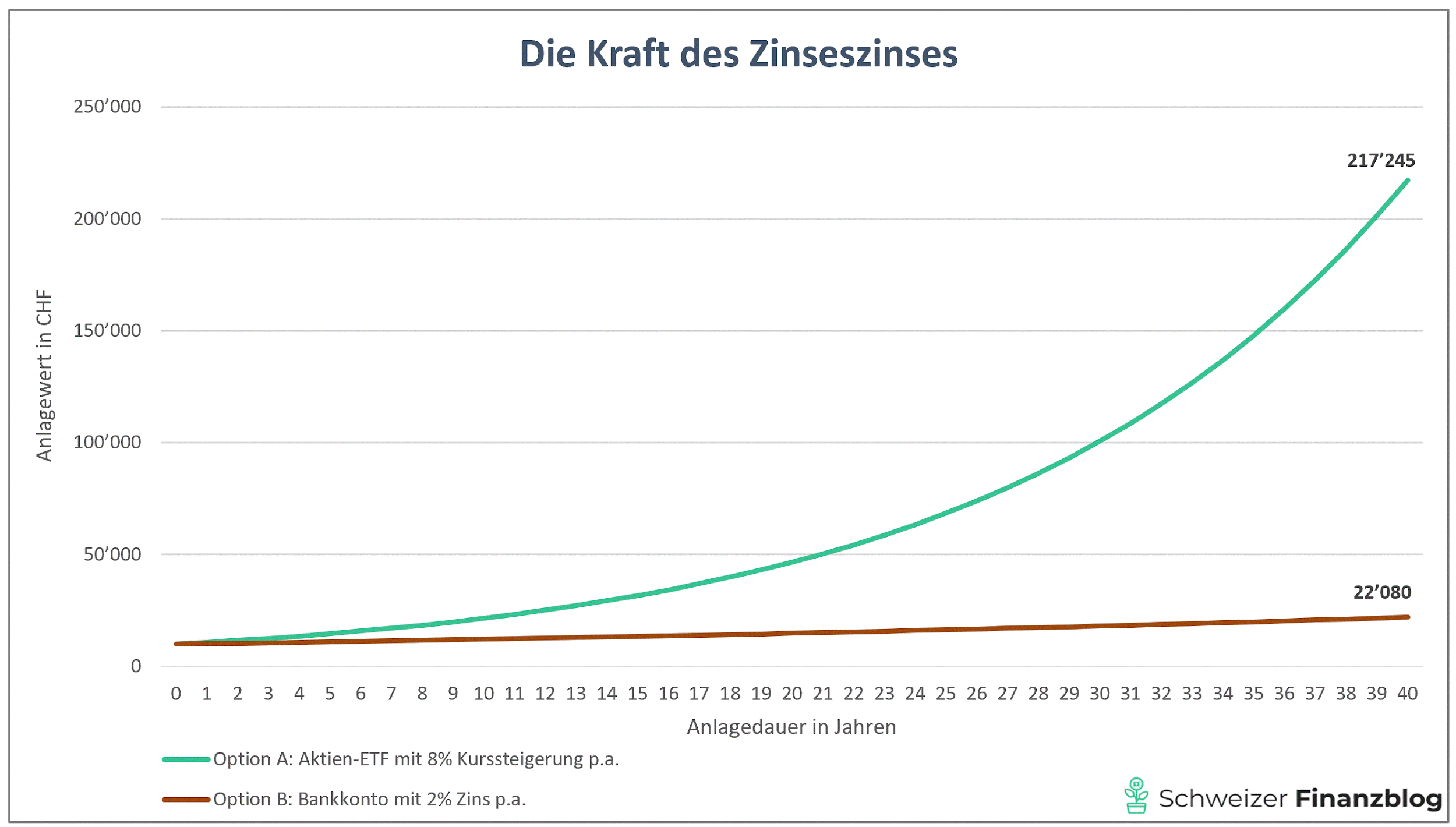
Compound interest calculator
Calculation
If you have 10 years, monthly 100CHF to 5% invest, your Final capital 23.763CHF. This is made up of 17.000CHF Deposits and 6.763CHF Interest or investment income.
Diagram
Understanding the benefits of passive investing
Passive investing means investing based on an index and being satisfied with the market return. You won’t beat the market – but you don’t have to. Historically, the long-term average return on equities has been around 8% per year.
If you assume that company values will continue to grow in the long term thanks to innovation and productivity (with interim setbacks), broadly diversified equity ETFs are the obvious choice. They are the simplest and cheapest implementation of passive investing.
On the other hand, there is active investing, which is particularly lucrative for asset managers. For you, however, it means significantly higher costs: 1-2% per year compared to often less than 20 basis points (<0.20%) for ETFs. So it’s no wonder that hardly anyone manages to beat the market over the long term and after costs.
All beginnings are difficult – but with money education, your finances will become manageable instead of burdensome.
You can find out why we are so convinced of ETFs in the article ETFs: The investment revolution.
We also recommend our series of articles Learn to invest – in 8 lessons.

Financial resolution no. 2: Know your finances
Why should I do that?
A well-founded assessment will provide you with clarity about your financial situation. But that’s not all: you will also find out what your biggest expenses are and where the greatest savings potential naturally lies dormant.
How do I implement this?
When taking stock of your finances, you need to determine your income streams (active income such as earned income and passive income such as dividends), your most important expenditure items and your savings rate as the difference. With a monthly disposable household income of CHF 10,000 and expenditure of CHF 8,000, the savings rate is CHF 2,000 or the savings ratio is 20% (=2,000/10,000).
You also calculate your assets (essentially consisting of your cash, securities and real estate), any debts (e.g. education and consumer loans, mortgages) and the difference in your net assets. We consider net assets to be the most important and meaningful financial indicator on the path to financial freedom. This is because, unlike a high income, a high net wealth is associated with financial security, often in combination with passive income streams such as dividends.

To achieve financial freedom, it is therefore less important how much money you earn, but rather how much you save – and invest profitably. Before we get to that point, however, we need to focus on financial security. This brings us to the next resolution.
Financial resolution no. 3: Pay off debts & build up a nest egg
Why should I do that?
If you live free of (consumer) debt, have existential risks insured and have a sufficient nest egg ready for uninsured, unforeseen events, the foundation for a carefree life has been laid. So you can enjoy the pleasant side of life and devote yourself to the non-financial challenges.

How do I implement this?
Before you start building up your assets, you should first reduce any debt. The focus here is on high-interest consumer debt, the interest on which is usually significantly higher than the expected increase in value of equity ETFs. Specifically:
-
Deactivate installment facility options for credit cards (the popular Certo! charges 12% p.a. for this, for example) and switch to free LSV or
-
only use debit cards without an overdraft function instead of credit cards.
Once consumer debt has been paid off, it is essential to build up a nest egg for unforeseen events such as a high dentist bill or the unexpected replacement of a washing machine. Depending on your income and personal risk assessment, this should amount to around two to three months’ salary.
Important: In Switzerland, you are covered by law for many events that could threaten your livelihood, such as job loss, illness or accident. In addition to the compulsory insurance, it is worth taking out private liability insurance, as it can also protect you from financial ruin.
However, other insurance policies that only cover relatively minor financial risks (e.g. “all-round protection for your cell phone”) should be canceled. In the event of an emergency, such losses are better covered by your emergency fund.
In our experience, the smartphone bank Yuh is particularly suitable for storing your nest egg: secure, separate from ongoing payment transactions in a separate savings pot, yet available at any time and – apart from historically low interest rate phases such as the current one – earning good interest. Account management is also free of charge. With our promotional code YUHSFB you can secure a starting bonus and support our blog at the same time.
Exception mortgage debt
Mortgage debt is an important exception. These do not necessarily have to be repaid quickly – especially at historically low interest rates. Owner-occupied residential property is primarily a consumer good with the character of an asset and not a classic investment class. Nevertheless, it ties up a lot of capital in a single, less flexible property. Full amortization therefore increases the cluster risk because a large proportion of the assets are “set in stone”.
In many cases, it therefore makes more sense to leave some of the assets invested and benefit from long-term return opportunities instead of amortizing the mortgage to the maximum.
Financial resolution no. 4: Increase savings rate
Why should I do that?
If you want to become financially free, there is no way around an ambitious savings rate. It is your key lever: the higher you set it, the faster you will achieve financial freedom and independence from your actively earned income. We describe how quickly this can happen in the article Financial freedom – hype or a goal worth striving for?
How do I implement this?
As a reminder, the savings rate is expressed as a percentage and puts the savings rate (in CHF) in relation to your total income.
But how can you increase the savings rate just like that? Admittedly, that’s easier said than done. And yet we are convinced that everyone can increase their savings rate. There are two levers at your disposal: Firstly, increase your income and secondly, reduce your spending.
The easiest and most effective way to increase your savings rate in special life situations is to avoid lifestyle inflation (income-related increase in consumption). This describes the phenomenon that the higher your income, the higher your standard of living and therefore your consumption – and the lower your savings rate. This correlation is scientifically well documented and applies to most people.
This is precisely why there is an enormous opportunity here: there is hardly any other phase in which you have better opportunities to come much closer to financial freedom during your lifetime than in precisely such situations with noticeable jumps in salary.
An example from our own experience
During our studies, a modest lifestyle was mandatory for us. With our limited financial resources at the time, there was simply no alternative. Although we earned “proper” money for the first time after graduating, we hardly raised our standard of living for years. (Stefan still doesn’t own a car decades later.) The reason: we had become accustomed to a frugal lifestyle during our studies.
After such life stage changes, it is often surprisingly easy to massively increase the savings rate from one day to the next – in extreme cases from 0 to 50% or more. The other way round, however, i.e. a conscious downgrade in living standards, is much more difficult. Savings are then quickly perceived as painful restrictions.
As mentioned, these are selected and rather rare, sometimes even one-off opportunities. Let’s now turn our attention to the more common situations in which you can increase your savings rate or your investments step by step.
When it comes to income, you are dependent on the goodwill of your boss and your negotiating skills in the short term. In the longer term, however, you can increase your income in a targeted manner – for example through further training and taking on more responsibility or better-paid tasks.
The spending lever as an instant savings rate booster
The spending lever has the great advantage that it has an immediate effect. Every franc you save directly increases your savings rate. Therefore, go through your previously determined expenditure items and focus on the large items – this is where the greatest savings potential lies.
It is often worth canceling contracts for cell phones and other devices as a precautionary measure. This gives you a strong negotiating position and also keeps the option of changing provider open.
Changing health insurer is a real no-brainer in Switzerland. As the benefits of basic insurance are set by the state, you can switch to the cheapest health insurance company every year without any loss of benefits. In addition, the maximum deductible of CHF 2,500 is worthwhile for most people – provided you have a nest egg in case of emergency. This brings us to the next financial resolution.
Financial resolution no. 5: Invest regularly
Why should I do that?
Finally comes the most important part of a financially carefree life: investing. It is not only the most important, but also the one with the highest priority. The appropriate motto is: invest today, consume tomorrow. Because the sooner you start, the more the compound interest effect will help you build up your wealth.
If you don’t prioritize investing, there will be a thousand reasons to allocate your savings to consumption. Incidentally, this behavior is scientifically proven and is often explained by Parkinson’s Law. According to this law, we tend to fully utilize available resources. Applied to money, this means that regardless of our income, we tend to spend everything – unless we follow a clear, well thought-out plan.
How do I implement this?
Based on your savings rate, it is now a matter of investing the money you have saved sensibly and profitably.
With an investment horizon of at least 10 years, you can use your savings installment – or part of it – to build up a global equity portfolio month by month with ETFs.
How high your equity allocation should be depends on your risk profile. This consists of two parts:
your risk capacity and your risk appetite.
Risk capacity can be determined objectively and depends on assets, income, expenditure and investment horizon.
Risk tolerance is subjective and describes how well you can deal with price fluctuations. Specifically: How does it feel for you if your portfolio is down 10, 20 or even 50% at times? The better you can deal with this, the higher your equity allocation can be.
Important: Even broadly diversified equity portfolios can suffer temporary losses of up to 50% in extreme phases.
Regardless of your equity allocation, asset accumulation should be as rule-based and automated as possible using an ETF savings plan.
Specifically, you set up a standing order with your bank to top up your securities portfolio – with an online broker or robo-advisor – at the beginning of each month. In addition, you activate another standing order for your securities-based pillar 3a.
You can find out more about the advantages of savings plans in the article ETF savings plan Switzerland: 3 strong reasons for the autopilot strategy.
– Partner offer –
Saxo Bank now offers all savings plans without purchase fees – it is also possible to save in several ETFs at the same time. You can find out more in our detailed test report.

– – – – –
Conclusion on the financial resolutions
We believe that implementing these five financial resolutions is the foundation for your financial freedom. Success depends on two factors: your money mindset and how well you organize your finances. You develop the former through financial education and practical experience as an investor. You can achieve the latter through clarity about your financial situation, the consistent automation of your investments via an ETF savings plan and – last but not least – by choosing suitable financial partners and solutions wisely.
As mentioned at the beginning, our financial resolutions are not about accumulating as much money as possible for the sake of it. Rather, a high net worth should give you financial independence and real self-determination outside the hamster wheel. A goal that not only enriches your bank account, but also your life.
This might also interest you



Updates
2026-01-22: Article comprehensively updated.
2025-03-11: Inflation rates and other data updated. 5. financial forecast supplemented by knowledge of own risk profile, consisting of risk capacity and risk appetite.
Disclaimer
Disclaimer: Investing involves risks of loss. You must decide for yourself whether you want to bear these risks or not.
Errors excepted: We have written this article on five financial resolutions for the new year to the best of our knowledge and belief. Our aim is to provide you as a private investor with the most objective and meaningful financial information possible. However, if we have made any mistakes, forgotten any important aspects and/or are no longer up to date, we would be grateful if you could let us know.





2 Kommentare
Interessante Tipps. Tatsächlich finde ich beim Thema sparen sollten wir von unseren Großeltern lernen. meine Oma hat mir beigebracht zu gärtnern, zu nähen, Hausmittel herzustellen und Kleinigkeiten im haus zu reparieren. So zahle ich zwar z.B. für Schrebergarten und gute Werkzeuge, sowohl für den Garten als auch für meine Wohnung, aber ich spare mir meistens einen Handwerker zu holen, Gemüse/Gewürze/Putzmittel einzulaufen, ich muss nicht immer Hose oder Shirt wegschmeißen uns neu kaufen und so weiter. Das Geld kann ich dann investieren, ist mehr als man denkt, wenn ich so die Ausgaben von Freunden betrachte.
Mal ehrlich, beim Thema Finanzen denken viele von uns doch zuerst ans Sparen, weniger ans Ausgeben, oder? Der Abschnitt über die Erhöhung der Sparquote im Artikel hat mich schon zum Nachdenken gebracht. Sicher, sparen ist wichtig, aber manchmal könnte ein bisschen mehr Ausgeben, gerade in Richtung Weiterbildung oder Qualitätsprodukte, die einem lange erhalten bleiben, nicht auch eine Art von Investition sein?
Vielleicht ist es ja ein Balanceakt – nicht nur die Sparquote erhöhen, sondern auch gezielt in Dinge investieren, die uns auf lange Sicht weiterbringen.