Newsletter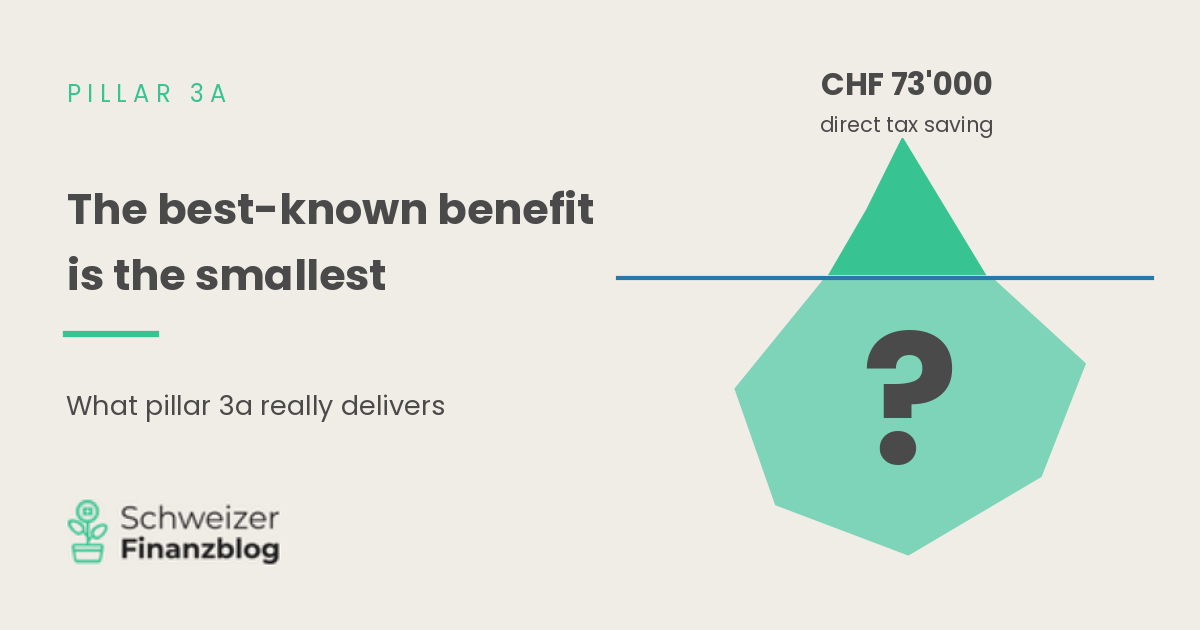
Why do you contribute to Pillar 3a? Most people answer: because of the taxes. Every December, it’s the same message across all channels: “Save on taxes with Pillar 3a now!” The tax deduction is indeed the best-known benefit of Pillar 3a. But it’s not the biggest one. The effects that really make a difference work almost unnoticed in the background over decades—and, in our model calculation, amount to around 500,000 CHF. That is, if the fees don’t eat into it first.

In a Nutshell
- Compared to investing on your own, Pillar 3a is worthwhile for almost everyone with taxable earned income—though for a different reason than most people think.
- Three factors make the difference: the annual tax deduction for Pillar 3a, as well as the absence of taxes on dividends and assets. However, these factors only become significant because of compound interest, which multiplies each of them over decades.
- In our model calculation, after 40 years, the 3a account is worth approximately 500,000 CHF more than a regular ETF account—you can run the numbers with your own figures using the calculator below.
- The key is the investment strategy: You need a securities portfolio with a high allocation to stocks and low fees. The benefits are largely lost if you invest in a 3a account or in expensive funds.
- Those who open multiple accounts and make staggered withdrawals can significantly reduce their taxes upon withdrawal.
- New as of 2026: Missed contributions can be made retroactively, but only for gaps starting in 2025.
Contents
- Pillar 3a at a Glance
- Pillar 3b: Freedom with a Tax Burden
- Pillar 3a or 3b: The Model Calculation
- Pillar 3a Tax Deduction: What It Offers—and What Withdrawals Cost
- Here’s how we do the math
- Benefit 1: The government contributes
- Benefit 2: No income tax on dividends
- Advantage 3: No wealth tax
- Another advantage: the withholding tax on U.S. dividends
- The downside: higher fees
- How robust is this result?
- 3a Tax Calculator: What Your Contribution Really Gets You
- The Honest Downside of Section 3a
- Is the 3a worth it even with small contributions or if you start late?
- Investing in Pillar 3a: Account or Securities—The Most Far-Reaching Decision
- Switching Pillar 3a Providers: Easier Than You Think
- Pillar 3a Tax Reduction: Multiple Accounts and Staggered Withdrawals
- New as of 2026: Making up for missed contributions
- Conclusion
- You might also be interested in this
- Updates
- Disclaimer
Pillar 3a at a Glance
Pillar 3a is a restricted private pension plan. It is part of the third pillar—the voluntary component of the Swiss three-pillar system—and supplements the AHV (first pillar) and the pension fund (second pillar). The government encourages participation through tax benefits, but in return, the funds are subject to certain rules.
It is widely used: In 2019, 56% of people aged 25 to 64 reported making regular contributions. In 2020, 1.8 million taxpayers claimed a 3a deduction and collectively contributed just under 11 billion francs—an average of just over 6,000 francs per person. The figures come from an analysis by the Federal Social Insurance Office, which combines data from the Federal Statistical Office (FSO) and the Federal Tax Administration (FTA).
Who is allowed to make a deposit and how much
Anyone who earns income in Switzerland that is subject to AHV contributions may make contributions. You can deduct the full amount of your contributions from your taxable income. How much you can contribute depends less on your salary than on whether you belong to a pension fund.
With a pension fund, the amount in 2026 will be exactly 7,258 CHF, regardless of salary level or work schedule. Even those working 40% of full-time hours may contribute the full amount, not just a portion of it. Starting in 2027, the maximum amount will increase to 7,373 CHF.
If you do not have a pension fund, the following applies instead: 20% of your net earned income—that is, your salary after social security contributions have been deducted—up to a maximum of 36,288 CHF; starting in 2027, the maximum will be 36,864 CHF. For the self-employed, this amount can be many times higher; to reach the maximum amount, an income of approximately CHF 180,000 is required. For employees with low wages, the same rule applies in the opposite direction: Anyone earning less than the BVG entry threshold of 22,680 CHF per year from an employer is not enrolled in a pension fund. With a net earned income of 20,000 CHF, this means only 4,000 CHF is possible.
That’s where things get tricky. With a salary of 23,000 CHF and a pension fund, you can contribute 7,258 CHF—almost a third of your salary. With a salary of 22,000 CHF and no pension plan, the limit is 4,400 CHF. On the other hand, there’s no lower limit—the 3a plan doesn’t require a minimum contribution.
Even individuals subject to withholding tax may make contributions, but they do not automatically receive the deduction. To do so, they must submit an application for a retroactive regular assessment by March 31 of the following year. The change is irrevocable.
Pillar 3a Payout: When You Can Access the Money
The funds are locked in until no earlier than five years before the AHV reference age. Anyone who continues to work beyond the reference age can defer withdrawal for up to five years and continue making contributions. You can only access the funds early in these cases, as specified by law:
- Purchase, construction, or amortization of owner-occupied residential property
- Starting a self-employed business
- Permanent departure from Switzerland
- Purchase of pension fund benefits
- Receipt of a full disability pension
Upon withdrawal, the capital is taxed once, separately from other income and at a reduced rate. This capital withdrawal tax—often colloquially referred to as the “withdrawal tax”—is levied only once. The federal government applies the same rate nationwide: one-fifth of the standard tax rate. Cantons and municipalities apply their own rates, which is why the tax burden varies significantly depending on where you live. Because the rates in most cantons are progressive, you can further reduce the tax by holding multiple accounts and staggering withdrawals over several years.
You decide how your 3a savings are invested: in a 3a account with a fixed preferential interest rate or in a securities portfolio consisting of funds or ETFs. This choice has more significant implications than the tax deduction itself, as the sample calculation below shows.
Pillar 3b: Freedom with a Tax Burden
Pillar 3b refers to voluntary retirement savings. This includes everything you set aside for the future in addition to Pillar 3a: savings accounts, securities accounts, home ownership, or life insurance policies. The government doesn’t impose any requirements on you, but it doesn’t offer any incentives either. Insurers usually use the term “3b” to refer to their policies. In this article, however, we’re using it to mean what’s the more sensible option for most investors: a self-managed ETF portfolio.
The Advantages of the 3b
- Complete freedom: You can make deposits at any time and access your money whenever you want. There are no maximum amounts, no lock-in periods, and no legal restrictions on when you can withdraw funds.
- Free choice of investments: You decide on the broker, ETFs, and equity allocation yourself and aren’t tied to the offerings of a pension foundation.
- Lower costs: A low-cost online broker offering a broadly diversified ETF is often slightly cheaper than the most affordable 3a solutions.
- No capital gains tax: Capital gains are tax-free for individual investors in this country, and no capital gains tax is levied upon sale.
The Disadvantages of the 3b
The downside is evident in the taxes you pay on an ongoing basis:
- Dividends are taxable as income, even for reinvesting ETFs that automatically reinvest their earnings.
- Your investment account is included in your taxable assets every year.
Each of these taxes seems small on its own. Over decades, however, the money is lost not just once, but along with all the returns it could have generated. The model calculation shows just how much that amounts to.
On top of that, there’s a drawback that doesn’t show up in any calculation: Money that’s available at any time is more likely to be spent. The lock-in period for Pillar 3a protects your retirement savings from yourself.
Pillar 3a or 3b: The Model Calculation
Pillar 3a Tax Deduction: What It Offers—and What Withdrawals Cost
Every December, it’s the same old argument: Make a quick contribution to your 3a account—it’ll save you taxes. That’s true, but only partly. The government isn’t giving you a tax break. When you withdraw the money, it takes it back—with interest and compound interest.
In our model calculation, you contribute 7,258 CHF per year and, at a marginal tax rate of 25%, save approximately 1,814 CHF in income taxes each year—totaling about 73,000 CHF over 40 years. When you withdraw the funds, you’ll owe just over 109,000 CHF in capital gains tax—more than the tax savings you’ve accumulated over all those years. In nominal terms, therefore, nothing remains of the much-touted tax deduction.
The reason lies in what these two taxes actually apply to. The deduction applies only to the 290,320 CHF that was deposited. The capital withdrawal tax ultimately applies to the entire balance of just over 1.8 million, including all earnings. A lower rate applied to a large amount can thus offset a higher rate applied to a smaller one. How this plays out depends on two independent factors: The deduction is based on your marginal tax rate, while the capital withdrawal tax depends on the amount of each tranche and your canton of residence in the year of withdrawal.
Nevertheless, the 3a account ends up with about 500,000 CHF more than a regular investment account. Patrick Eugster, who holds a Ph.D. in financial economics, pointed out this apparent contradiction in a thought-provoking guest article published by VIAC. We ran the numbers based on his analysis using our own assumptions.
Here’s how we do the math
Let’s compare two people with identical incomes. Both contribute 5,444 CHF out of their own pockets to their retirement savings each year for 40 years, from age 25 to 65. So it costs them the same amount. Although the 3a investor initially transfers the full CHF 7,258, they receive the difference back with their tax refund. One of them invests the amount in an ETF account. The other deposits it into a 3a securities account, where, thanks to the tax deduction, CHF 7,258 is credited. Both invest 100% in global stocks.
Our assumptions: An 8% annual return (nominal), including dividends, as historically achieved over the past decades with a globally diversified stock portfolio, of which 2% is dividend yield. Fees of 0.4% in the 3a account and 0.2% in the regular brokerage account. Marginal tax rate of 25%, wealth tax of 0.15%, and capital withdrawal tax of 6%, as applicable when withdrawals are staggered over several years.
These figures are simplified; they vary depending on the canton, income, and provider. In reality, the wealth tax is progressive and applies only after a certain exemption threshold has been reached. In the city of Zurich, 0.2% would correspond to assets of about one million, a level our portfolio would not reach until the very end. The 0.15% should therefore be understood as an average over the entire term. If different values apply to you, you can enter them in the calculator below.
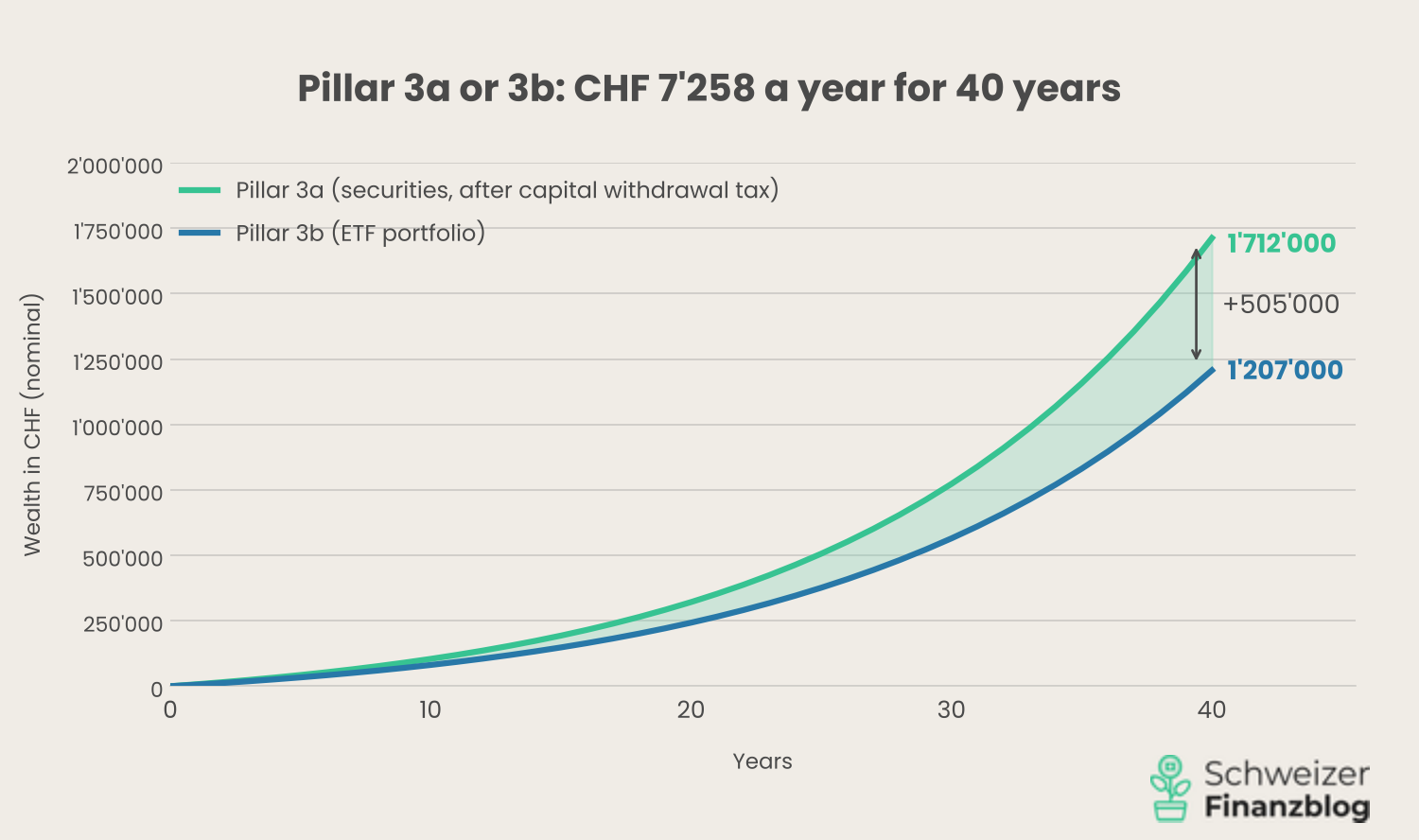
After 40 years, Account 3a holds approximately 1,712,000 CHF after capital gains tax, while the unrestricted account holds approximately 1,207,000 CHF. The difference of approximately 505,000 CHF can be attributed to three factors.

Benefit 1: The government contributes
CHF 7,258 goes into the 3a account, and CHF 5,444 into the regular brokerage account—with the same effort on your part. The difference of 1,814 CHF represents the tax savings based on our assumed marginal tax rate of 25%, and it remains in the retirement account from the start, rather than requiring you to invest it separately. Over 40 years, it generates returns, which in turn generate further returns.
So it’s not as if anything is taken away from your regular investment account. On the contrary, the government contributes to your 3a deposit, and that portion grows with your investment for forty years. When you withdraw the funds, the government recoups a portion of it—but only 6% of the final value, after having contributed 25% of the total amount deposited. After deducting the capital gains tax, this amounts to approximately 365,000 CHF in our calculation—the largest single item.
Benefit 2: No income tax on dividends
In a non-retirement account, dividends are taxable as income, even for reinvesting ETFs. With a 2% dividend yield and a 25% marginal tax rate, this costs you 0.5% of your return each year. That may not sound like much, but over 40 years it adds up to about CHF 182,000. In a 3a account, this tax is waived.
Advantage 3: No wealth tax
The 3a account balance is exempt from wealth tax, but the regular brokerage account is not. At 0.15% per year, this amounts to approximately 53,000 CHF over 40 years. The extent of this effect depends heavily on the canton and the rest of your assets.
Another advantage: the withholding tax on U.S. dividends
We deliberately omitted a fourth advantage from the model calculation because it does not apply to every 3a account: The U.S. tax authorities withhold a portion of U.S. dividends as withholding tax. In a private portfolio holding an Irish ETF, this money is lost; Swiss pension foundations, on the other hand, can reclaim it. However, this only applies to 3a plans that use Swiss index funds, not those that rely on ETFs. Where this claim is asserted, the 3a plan’s advantage is therefore even greater than shown here.
“The biggest advantage of Pillar 3a isn’t the tax deduction, but the time during which the tax money you’ve saved works for you.»
The downside: higher fees
On the other hand, we have to factor in the higher fees associated with the 3a plan, which amount to approximately 95,000 CHF in our calculation. The advantage remains significant nonetheless.
How robust is this result?
At a marginal tax rate of 15%, the lead shrinks to about 269,000 CHF; at 35%, it grows to about 721,000 CHF. With a conservative 6% return instead of 8%, the advantage stands at around 293,000 CHF. The 3a plan with stocks comes out ahead in all realistic scenarios. Only high fees reduce the advantage to a fraction of its original size.
3a Tax Calculator: What Your Contribution Really Gets You
All of the figures above are based on our assumptions. Here, you can enter your own: deposit amount, duration, marginal tax rate, rate of return, fees, and capital gains tax.
Calculator
Pillar 3a vs. a regular ETF portfolio
Adjust further assumptions
- Pillar 3a
- Regular ETF portfolio
- after dividend & wealth tax
The lead grows over time
Where the difference comes from
Model calculation with simplified assumptions: contributions at the start of each year, constant marginal tax rate, dividend and wealth tax paid annually from the portfolio. Wealth tax and capital withdrawal tax vary considerably by canton. Assumed returns are not guaranteed.

The Honest Downside of Section 3a
The 3a account comes at a price, and that price is freedom. Anyone who needs their money before retirement and cannot cite any of the statutory grounds for withdrawal will be locked out. Your 3a balance should therefore never be your only asset; you should also have a liquidity reserve and other available assets.
Added to this is a political risk. As part of the tax relief package, the Federal Council had sought to impose a higher federal direct tax rate on capital withdrawals exceeding 100,000 CHF. Although Parliament scrapped the measure in March 2026, the issue is not off the table. Anyone contributing today bears the risk that different rules will apply in 30 years. At least the impact remains manageable: In our calculations, an 8% capital withdrawal tax instead of 6% reduces the lead by approximately CHF 36,000.
And finally, our model calculation is based on assumptions. Past returns are no guarantee of future results, and your personal outcome depends on your income, the canton where you live, and your choice of provider.
Is the 3a worth it even with small contributions or if you start late?
Yes, but the advantage is smaller. According to our calculations, someone who contributes CHF 2,400 per year for 30 years and has a marginal tax rate of 15% will end up with approximately CHF 41,000 more than a regular investment account. Someone who starts at age 50 and contributes the maximum amount for 15 years will have a lead of about 58,000 CHF with a 30% marginal tax rate.
The rule of thumb: The higher your marginal tax rate and the longer your investment horizon, the more worthwhile the 3a plan is. It’s hardly worthwhile only if your income is very low—for example, while you’re in school. In that case, the tax deduction offers little benefit, and anyone who isn’t enrolled in a pension fund is limited to contributing only 20% of their income anyway. While the long investment horizon does make it advisable to start early—it applies just as much to a regular brokerage account, where you can access your money at any time.
Investing in Pillar 3a: Account or Securities—The Most Far-Reaching Decision
The 3a account only delivers its full benefits if your money actually earns a return. And this is precisely what makes the 3a account unique: The money is locked in until shortly before retirement anyway (apart from statutory exceptions such as home ownership or emigration). If you start contributing at age 30, you have an investment horizon of over 30 years. Such a horizon provides the best conditions for weathering market fluctuations, making it the strongest argument for a high allocation to stocks. The paradox is that, in this country, a large portion of this very money—which is tied up for the long term—sits in savings accounts.
The figures confirm this. According to calculations by VZ VermögensZentrum, 143 billion Swiss francs were held in Pillar 3a at the end of 2023. Of that amount, 91 billion was held by banks—and 58 billion, or nearly two-thirds of the bank deposits, was simply held in accounts rather than in securities.
The comparison below shows the costs involved based on an annual deposit of 7,258 CHF. We assume a 1.5% interest rate on the 3a account and an 8% return on stocks, minus 0.4% in fees for the securities solution, resulting in a net return of 7.6%. There are no product fees for the account, and both options are tax-free within the 3a framework. All figures are nominal, meaning inflation has not been factored in.
Both figures are long-term averages, as we derived them in Lesson 1 of our financial guide. Based on historical data, we therefore expect a significantly higher rate of return than is currently being offered: Today, interest rates on 3a accounts average less than half a percent.
| Investment Horizon | 3a Account | 3a with Stocks | 3b with stocks |
| 10 years | 74,000 | 104,000 | 81,000 |
| 20 years | 160,000 | 321,000 | 243,000 |
| 30 years | 260,000 | 773,000 | 565,000 |
| 40 years | 376,000 | 1,712,000 | 1,207,000 |
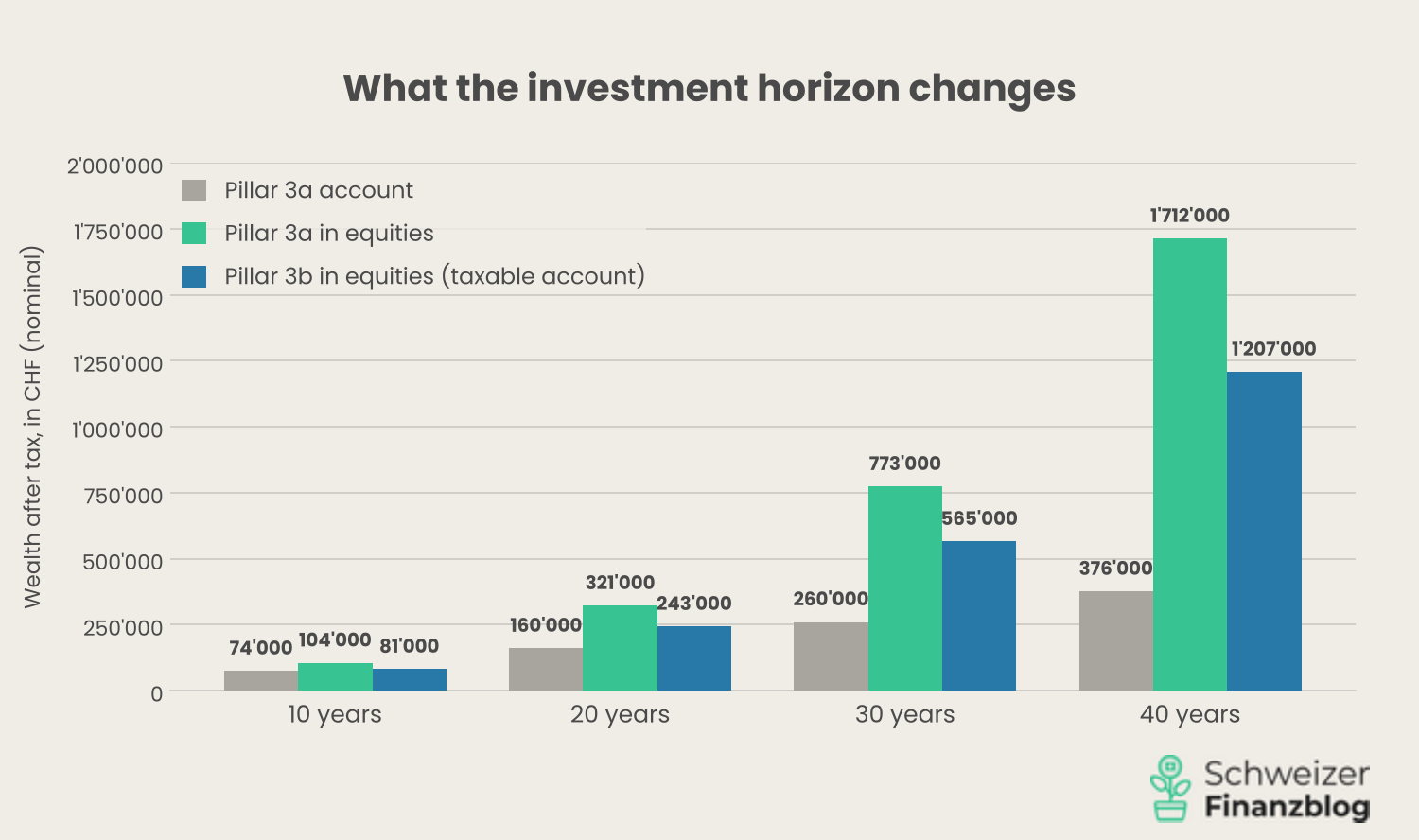
After 40 years, the account balance stands at approximately 400,000 CHF, with total deposits of 290,320 CHF. In nominal terms, this represents an attractive gain; however, when adjusted for purchasing power, it amounts to stagnation. After taxes upon withdrawal, approximately 376,000 CHF remains—which is not even a third of what a tax-free ETF account would yield without any tax advantages. The more favorable tax treatment is of little use if there are hardly any returns to tax.
The second factor: fees
Over decades, these fees also act like interest—just in the opposite direction. Many banks offer 3a funds with total costs ranging from 1% to 1.5%. At 1.5%, the advantage over a self-managed brokerage account shrinks in our calculation from about 505,000 CHF to just 69,000 CHF. The total costs of digital providers offering index funds or ETFs usually range between 0.4% and 0.5%. There are two exceptions: True Wealth and findependent are significantly cheaper.
| Provider | Total annual cost | Bonus |
| True Wealth | 0,12% | For a 3b account: 100 CHF with code SFB100TW |
| findpendent | 0,29% | 2,000 CHF permanently fee-free, code SFB3a |
| A typical 3a fund offered by a bank | 1.0% to 1.5% | – |
For a long-term investment horizon, the rule is therefore: securities instead of a checking account, a high allocation to stocks, and low fees.
When Stocks Aren’t the Right Choice
If you plan to withdraw the funds in a few years—for example, to buy a home, start your own business, or prepare for retirement—the money doesn’t belong in stocks. A 30% loss cannot be reliably recouped in three years, and unlike with a regular brokerage account, you have limited options for postponing the withdrawal. In these cases, the 3a account is the right choice despite the low interest rate. The key factor here isn’t the withdrawal itself, but whether you’ll actually need the money then: If you want to keep it invested, you can transfer the securities to a private brokerage account—depending on the provider—and won’t have to sell during a market crash.
Switching Pillar 3a Providers: Easier Than You Think
You’re not tied to the provider you originally chose. You can switch at any time, and it’s tax-free as long as the money stays in Pillar 3a. You open an account with the new provider and instruct them to transfer the funds; the two foundations will handle the rest between themselves.
There are three things you should know:
- Only an entire account can be transferred at a time; partial transfers are not possible.
- The transfer is free of charge with most providers. Some banks charge a settlement fee of a few dozen francs, which some new providers cover as a sign-up bonus.
- Securities are sold and repurchased from the new provider. A direct transfer of fund shares between two pension funds is generally not possible, so your money will not be invested for a few days.
The major exception is 3a insurance policies. They cannot be easily transferred, and early surrender usually results in significant losses. That is one of the reasons why we do not recommend such policies.
Pillar 3a Tax Reduction: Multiple Accounts and Staggered Withdrawals
In the case of a regular payout, a 3a account can only be fully withdrawn; partial withdrawals are not permitted. An exception is the early withdrawal for home ownership, which is also possible in partial amounts, generally no more than once every five years. And in most cases, the tax on lump-sum withdrawals increases progressively: the higher the amount paid out in a given year, the higher the tax rate. This is always the case at the federal level; some cantons, however, apply a fixed percentage. In those cantons, the progressive tax rate applies only to the federal portion.
That’s why it’s a good idea to open several 3a accounts from the start and withdraw the funds over a period of several years. Most providers allow you to maintain multiple accounts or portfolios simultaneously. Since you can’t withdraw funds until at least five years before your reference age, you can close one account each year. Be sure to factor in withdrawals from your pension fund and those of your partner. Many cantons aggregate all capital withdrawals for a given year.
New as of 2026: Making up for missed contributions
First things first: Every year your money is in the market ultimately has a greater impact than any tax consideration. Statistically speaking, this results in a small range:
- Gold: Deposit the full amount in January. Your money works for you 11 months longer than with the common December option.
- Silver: Set up a standing order spread out regularly throughout the year. This costs you a bit in returns, but you’ll hardly notice it in your budget.
- Bronze: Pay the remaining balance later. This won’t be possible until 2026.
Until the end of 2024, a missed payment was permanently lost. Starting in 2026, gaps can be filled retroactively for up to ten years, but only for payments starting in 2025. Specifically: In 2026, you can only make up for 2025; in 2027, you can also make up for 2026. Anything before that is lost forever.
The requirements: You must have income subject to AHV contributions during both the gap year and the catch-up year, and the regular contribution for the current year must first be paid in full. You can make additional catch-up payments of up to 7,258 CHF per year (as of 2026). Incidentally, this amount also applies to self-employed individuals. The catch-up payment is also tax-deductible, so in the best-case scenario, your deduction doubles to 14,516 CHF.
This rule is intended for years when your income simply isn’t enough: parental leave, continuing education, a tight budget, or starting your own business. Deliberately waiting to claim double the amount later, on the other hand, is rarely worth it. In our model calculation, this only pays off if your marginal tax rate increases by about eight percentage points—for example, when you start your career after college. A normal pay raise isn’t enough.
The back payment is therefore a lifeline, not a strategy.
– Partner Offers –
Still looking for the right financial solution? Our recommendations —with attractive sign-up bonuses.

– – – – –
Conclusion
A 3a pension plan is worth it, but not just because of the tax deduction. A significant portion of that deduction is recouped when you withdraw the funds. The real benefit accumulates over decades, almost unnoticed: In a 3a plan, the full amount works for you because the government doesn’t levy income tax on it. In a regular brokerage account, this benefit is missing from the start. And over the years, neither dividend taxes nor capital gains taxes eat into your returns. In our model calculation, this results in approximately 500,000 CHF more after 40 years compared to a regular ETF brokerage account.
However, you can only achieve this advantage if four conditions are met:
- Securities Instead of a Bank Account
- High equity allocation
- Low fees
- Multiple accounts for staggered withdrawals
The unrestricted investment account remains important nonetheless: for anything you might need before retirement, and for anything you want to invest beyond the maximum 3a limit.
That leaves the question of where you should best manage your 3a account. In the next article, we’ll compare all the major providers in detail: What are the actual costs, how much flexibility do you have in investing, and how do the 3a solutions perform in practice?
You might also be interested in this

Updates
October 13, 2026: First publication
Disclaimer
Disclaimer: Investing involves the risk of loss. You must decide for yourself whether or not you are willing to accept these risks.
Subject to errors: We have written this article on Pillar 3a taxes to the best of our knowledge and belief. Our goal is to provide you, as a private investor, with information on financial matters that is as objective and informative as possible. However, if we have made any errors, omitted important aspects, and/or if the information is no longer up to date, we would appreciate it if you could bring these issues to our attention.