Newsletter
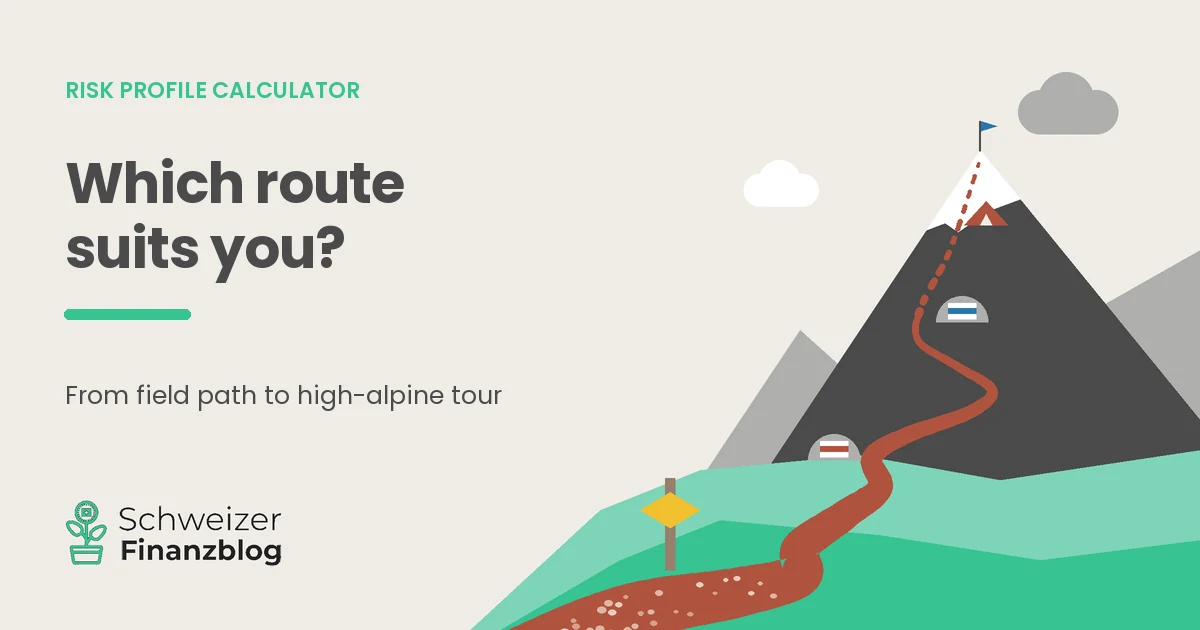
Which investment strategy suits you? That depends on two things: how much risk you can afford financially and how much fluctuation you can handle emotionally. Our free investment strategy check assesses both and finds your matching risk profile in nine questions, from the farm track to the high-alpine tour. This article explains how to put your profile through the crash test and how to implement it yourself with ETFs or automatically with a robo-advisor.



In a nutshell
- An investment strategy determines which part of your freely available assets is invested in high-risk assets, such as equities, and which part stays low-risk. This split determines return and risk far more than the choice of any individual ETF.
- The order matters: first pay off consumer debt, then build up a cash reserve, and only then invest.
- The investment strategy check assesses your risk capacity and your risk tolerance separately. The more cautious value sets the framework.
- The five risk profiles range from Defensive with 0–20% equities to Aggressive with 80–100%. As with hiking: the more demanding the route, the better the view, but the greater the risk of falling.
- A crash test shows you whether you can stick to your investment strategy in a market slump. You should review it once a year and whenever something significant changes in your financial life.
- You can implement your strategy yourself with one or more broadly diversified ETFs or automatically with a robo-advisor.
Investment strategy check
Find your investment strategy in 9 questions
Answer nine short questions. From your answers, the check works out how much risk you can and want to take, and suggests splitting your money into a low-risk and a high-risk part, implemented with globally diversified ETFs.
Investment strategy check
Find your investment strategy in 9 questions
You answer 9 simple questions about your money and your plans. Afterwards you’ll know how to split your assets and what to start with.
- How much in equities and how much in a savings account
- Specific ETFs to buy, with a suitable provider
- Free, no sign-up, as a PDF to save
Simplified model for guidance, not investment advice. Past returns and losses are no guarantee of future performance. Privacy: Your answers stay with you.
Assumptions and sources
Profiles, returns (real, from the perspective of investors in Switzerland) and maximum losses as in lesson 4 “Asset Allocation” of our financial guide: real equity return around 6%, high-quality bonds around 1%, largest crash of the MSCI ACWI –58% (2007–2009). The ETFs come from our comparison “Best ETFs in Switzerland and globally” and are updated together with it once a year. Lombard rates as of 24.7.2026. Check costs, taxes and availability with your broker before buying.

What is an investment strategy?
An investment strategy is your personal plan for how you split your freely available assets between high-risk and low-risk investments. It answers a single question: which share may fluctuate so that it grows over the long term, and which stays stable and available?
This split determines your portfolio’s return and risk far more than the choice of individual securities. We recommend investing passively with broadly diversified ETFs and holding them for the long term. We explain the basics in lesson 4 of our financial guide “Investing in 8 lessons”: Asset Allocation – The be-all and end-all of investing.
An investment strategy shouldn’t be confused with investment styles such as value, dividends or market timing, which govern which securities you buy and when. Find out more in our articles on buy and hold and the dividend strategy.
Before you start investing: pay off consumer debt, build a reserve
Before you think about your equity share, it’s worth looking at the foundations. The order is crucial:
- Pay off consumer debt: personal loans and credit card debt that you pay off in instalments often cost 5–12% interest a year, even in low-interest Switzerland. No ETF reliably earns back these interest costs.
- Build up a cash reserve: three to six months of expenses in your account as an emergency fund for the unexpected. This emergency reserve isn’t part of your actual asset allocation.
- Invest: only now do you invest the part of your assets that may fluctuate. At the same time, you build up the low-risk part, for example in a savings account. Unlike the reserve, it is part of your asset allocation and lets you buy more during a crash.
The check takes this into account: if you still have consumer debt or your reserve doesn’t yet cover three months of expenses, it recommends doing this homework first and shows you your profile for later.
How do you determine your risk profile?
Your risk profile determines how much of your freely available assets goes into equities. The check works it out. We deliberately didn’t want to build a black box: we disclose how your profile is determined. Your answers stay with you.
The 9 questions
The nine short questions cover three topics:
- Starting point: the first two questions concern any consumer debt and your cash reserve. Neither affects your risk profile; they check whether you should already be investing.
- Risk capacity: next come three questions on your investment horizon, the security of your income and how much you depend on the invested money.
- Risk tolerance: finally, four questions cover your investment goal, the loss you can still sleep soundly with, your reaction to a 30% market crash and whether leverage with a loan is an option for you.
How does the investment strategy check work?
The check assesses two things separately: your risk capacity, i.e. how much loss you can afford financially, and your risk tolerance, i.e. how much fluctuation you can handle emotionally.
The more cautious of the two values is what counts: if you could afford a lot of risk financially but would sell when prices dip by –20%, an aggressive strategy isn’t right for you. Conversely, the strongest nerves won’t help if you need the money for your home in two years. In the result, you can see what determines your profile.
For risk capacity, your investment horizon sets the level. An uncertain income and a strong dependence on the invested money each lower it by one level.
For risk tolerance, the loss you can still sleep soundly with sets the level. If you sell part of your holdings in a crash even though you said in the previous question that you could handle a loss of more than 30%, you go down one level. If you sell everything, Conservative is the limit. Your investment goal sets an upper limit: if, for example, you want a modest but steady return, you end up at Balanced at most, even with nerves of steel.
Want to look around first? In the check, you can also view all strategies without answering any questions, but without a recommendation yet.
If you’d like to dig deeper into the interplay between risk capacity and risk tolerance, you’ll find everything you need in lesson 2 of our financial guide: The magic triangle of investing.
From risk profile to investment strategy: the 5 profiles from the farm track to the high-alpine tour
The five profiles differ mainly in their equity share. Hiking is almost a national sport in Switzerland, so we show them as routes through our varied landscape, each more demanding than the last: climbing a mountain peak gives you a better view, but also a greater risk of falling. And you don’t go on an expedition without experience and equipment.
You can also open each profile and the special level directly: farm track, hiking trail, mountain trail, alpine route, high-alpine tour and expedition.
| Profile | Equities | Return* | Max. loss** | Investment horizon |
|---|---|---|---|---|
| Defensive Farm track | 0–20% | 1–2% | up to –12% | under 3 years |
| Conservative Hiking trail | 20–40% | 2–3% | up to –23% | 3–4 years |
| Balanced Mountain trail | 40–60% | 3–4% | up to –35% | 5–6 years |
| Dynamic Alpine route | 60–80% | 4–5% | up to –46% | 7–9 years |
| Aggressive High-alpine tour | 80–100% | 5–6% | up to –58% | 10 years or more |
| Special level with leverage Expedition | 100% + loan | 6% + leverage | up to –69%*** | 10 years or more |
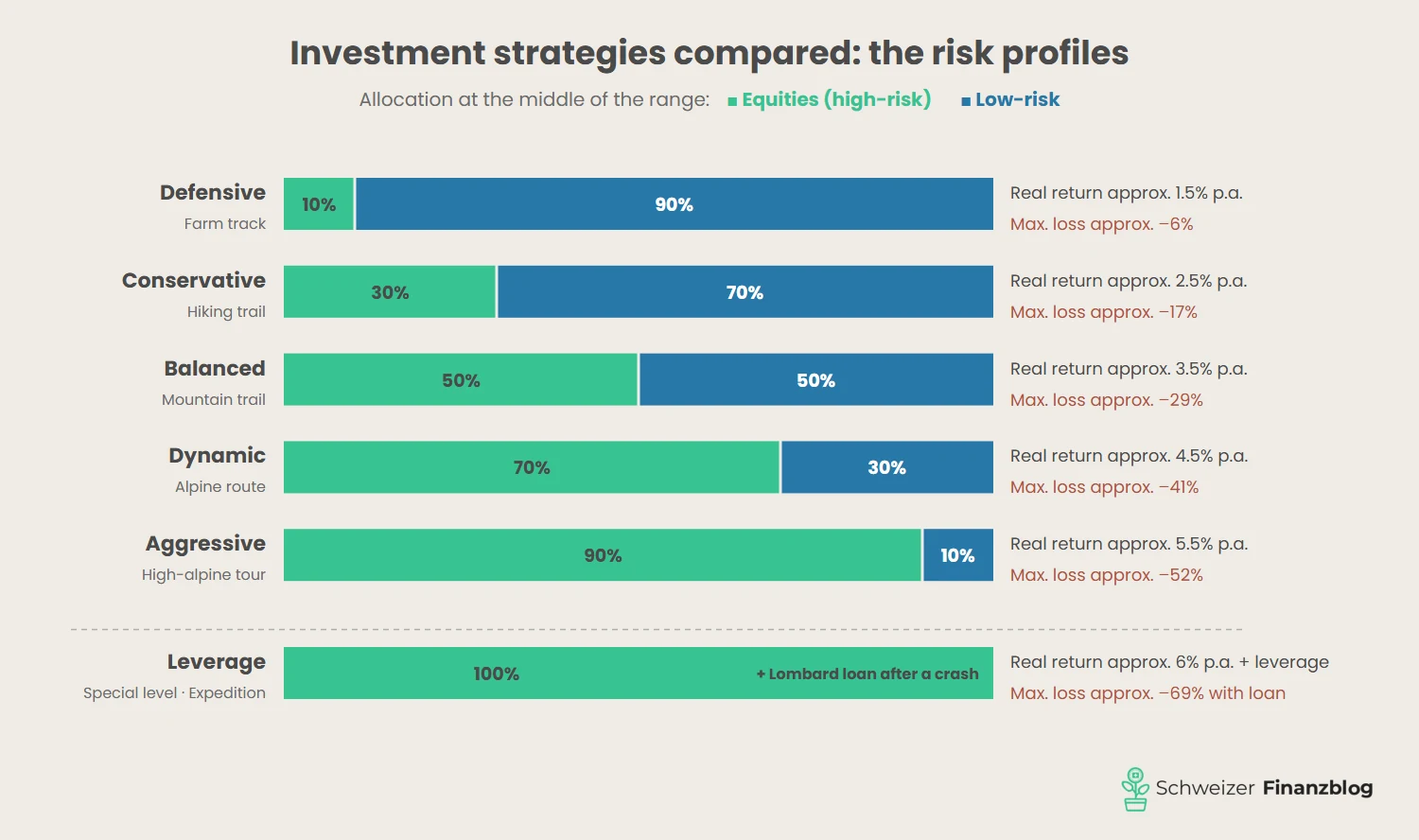
The rules of thumb behind them: expected return after inflation (real) = equity share × 6% + low-risk share × 1%. Historical maximum loss = equity share × 58%. So with 70% equities you can expect a return of around 4.5% a year and must be prepared for a temporary loss of up to 41%.
This is how your profile becomes your investment strategy: the check first suggests the middle of the range, i.e. 70% equities for Dynamic. Within the range, you move the slider yourself and immediately see how return and potential loss change.
Looking back, you can also see how your portfolio has actually performed over the last 3 to 20 years, after ETF costs and including all crashes.
Important: no profile is better than another. A more demanding route means more fluctuation, not more success. Shortly before retirement, even experienced investors are often better off with lower-risk profiles.
Defensive risk profile: the farm track

Flat and safe: the farm track suits you if you might need the money in less than three years or can’t bear price fluctuations. With no more than 20% equities, a real return of around 1–2% a year is realistic.
Conservative risk profile: the hiking trail

Marked in yellow and gently climbing: the larger part stays low-risk, while equities provide a noticeably higher return. With 20–40% equities, the hiking trail suits an investment horizon of 3 years or more.
Balanced risk profile: the mountain trail

Marked white-red-white, steeper, but very doable for experienced hikers. With 40–60% equities and an investment horizon of 5 years or more, the mountain trail is a sensible middle way between safety and return for many people. The upper limit corresponds to the well-known 60/40 portfolio (60% equities, 40% low-risk).
Dynamic risk profile: the alpine route

You need to be sure-footed here. With 60–80% equities and an investment horizon of at least 7 years, the return potential is much higher, but crashes of up to 46% are part of the deal. In a crash, you use the low-risk part to buy equities cheaply and restore your allocation (rebalancing).
Aggressive risk profile: the high-alpine tour
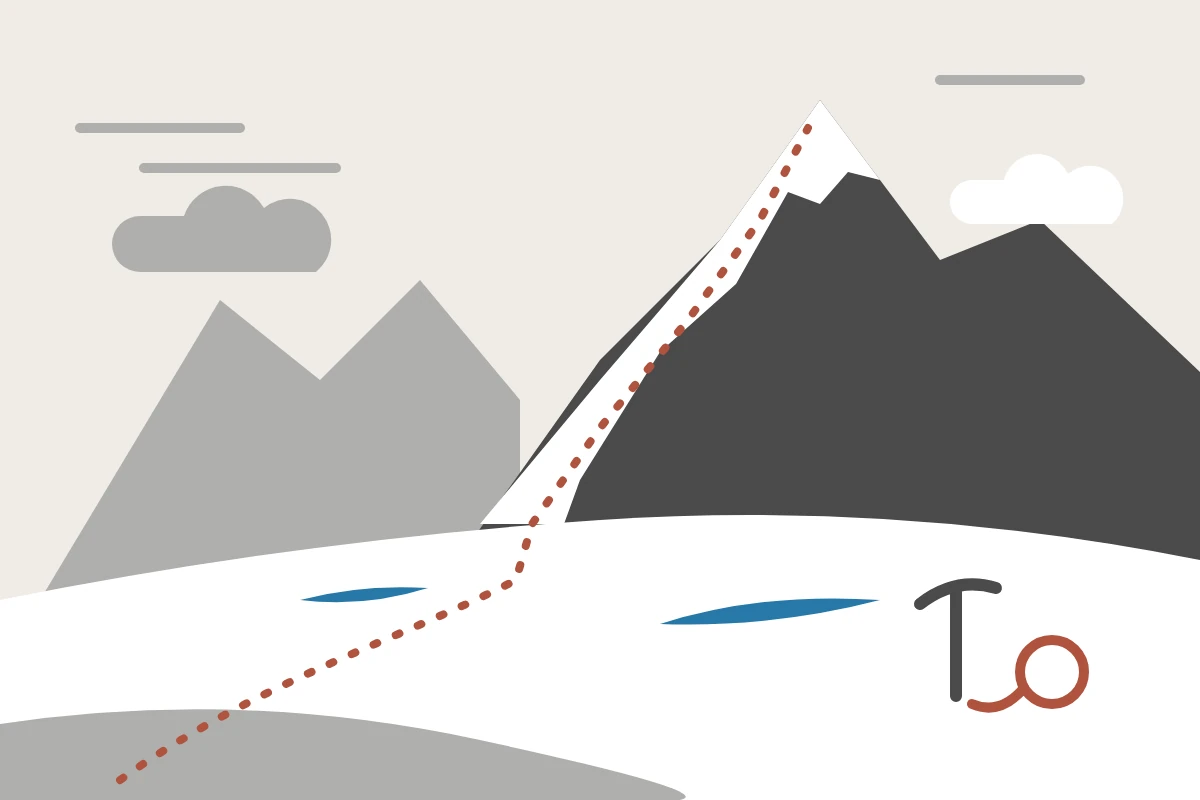
The best view, but also the greatest risk of falling. The high-alpine tour with 80–100% equities suits an investment horizon of 10 years or more. If you choose it, ask yourself honestly how you would react to a loss of over 50%.
Excursus: the special level with leverage for risk-takers
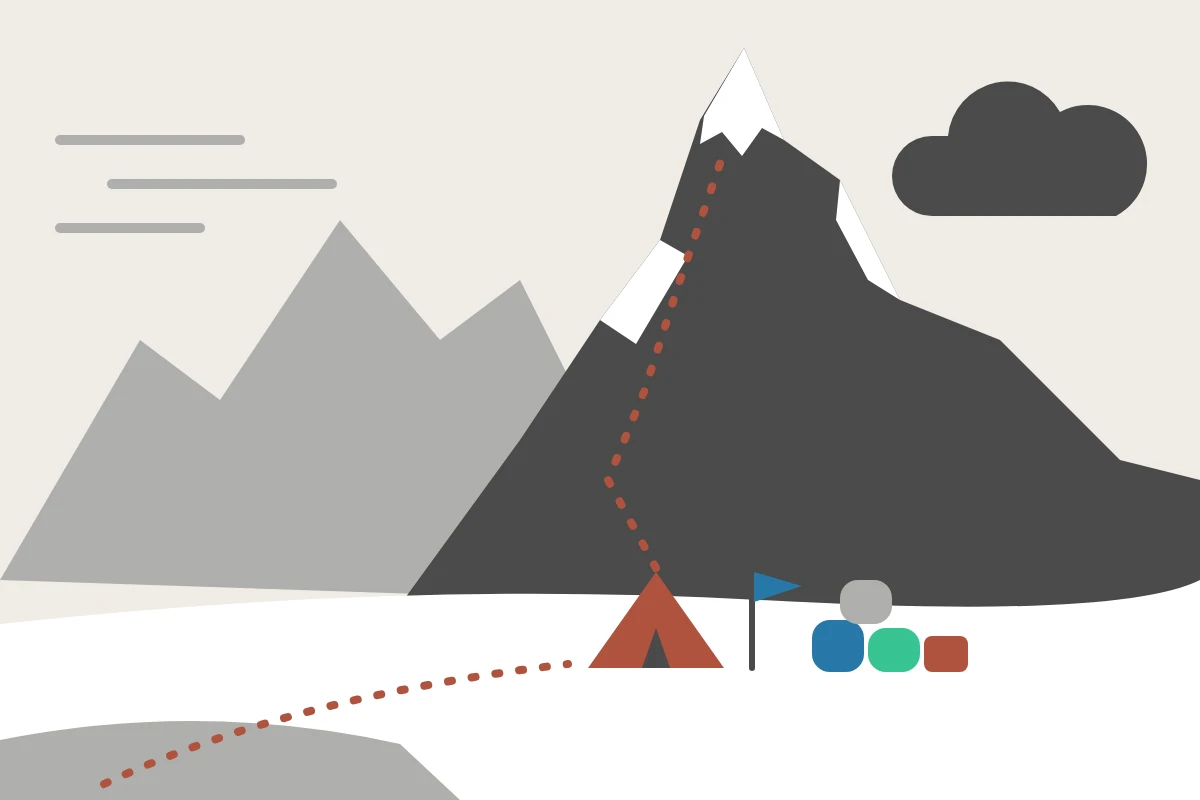
The expedition is a special level, not a sixth profile. In normal times, you invest 100% in equities, as with Aggressive. After a stock market crash, you take out a Lombard loan according to fixed rules, i.e. a loan secured by your securities, and use it to buy more equities.
The special level is only recommended if you say in the last question that leverage is an option for you, you end up at Aggressive anyway and you also meet all of these requirements:
- Investment horizon of 10 years or more
- Reserve of at least three months of expenses
- very secure income
- hardly dependent on the invested money
- buying more in a crash, based on rules
- high loss tolerance of more than 40%
You can also select the special level manually without meeting all the requirements. You will then see which ones you lack. Before you get to a Lombard loan, you confirm in a short checklist, among other things, that you have already experienced a crash of 30% or more with your own money and stayed invested.
Fixed rules apply: the loan is taken out in three steps when the global equity portfolio falls by –25%, –40% and –50%, and is repaid at the next all-time high. The catch: you only know where the low was in hindsight, and it can take years to reach the next all-time high, during which interest keeps running.
If the bank lowers its lending values in a crisis, a margin call looms. In the worst case, you lose up to 69% of your equity capital in our model calculation. You’ll find all the rules and calculations in our background article Lombard loans for buying ETFs.
The crash test: does your investment strategy keep its promise?
Whether farm track or expedition: before you implement your investment strategy, check whether you can stick to it when things get serious. In a questionnaire, it’s easy to click “hold” for a 30% crash. In a real portfolio, the same crash feels very different. In the crash test, you choose a crash between 10% and 60% and see what it means for your portfolio and how it could develop over the next ten years.
An example with CHF 100,000 and the Dynamic profile with 70% equities: if stock markets fall by 30%, your portfolio shrinks to CHF 79,000. If you stay invested, it will be worth around CHF 117,400 after ten years. If you sell at the low, it stays at CHF 79,000, around CHF 38,400 less with the same ETFs.

If you already feel uneasy just watching, choose a more cautious investment strategy. Our stock market crash guide shows how to keep a cool head in real crises.
“Whether you stay the course isn’t decided by the market, but by your mind.”
Implementing your investment strategy: yourself with ETFs or automatically
Your profile is set, now it’s time to implement it. There are two ways to do this: you buy the ETFs yourself through a broker, or a robo-advisor invests your money automatically according to your profile.
Yourself with ETFs
You implement the equity part with 1, 2 or 5 broadly diversified ETFs weighted by market capitalisation. You get a shopping list with amounts in Swiss francs and the ISINs (International Securities Identification Numbers) to copy. You decide yourself whether your ETFs reinvest the dividends automatically (accumulating) or pay them out to your account (distributing). Accumulating ETFs are preset.
- 1 ETF: a single global ETF. The best choice for most people, because buying and rebalancing are easiest.
- 2 ETFs: developed and emerging markets.
- 5 ETFs: split by region, with more effort.
With 2 and 5 ETFs, only ETFs whose indices are precisely matched are combined, so that the ETFs complement each other with as few gaps as possible. You’ll find the specific ETFs we recommend in our comparison Best ETFs in Switzerland and globally. We update the selection once a year together with this comparison.
You can buy the ETFs through a broker. The check suggests brokers that we have tested in depth. The broker that suits your ETFs and your buying method, i.e. whether you buy manually or use a savings plan, is highlighted.
While you are building up your assets, and especially for a savings plan, accumulating ETFs are the better choice. That way you benefit as much as possible from compound interest. We present selected brokers on our recommendations page with a profile and their pros and cons.
Note: your ETFs belong to you, not to the broker. If the broker goes bankrupt, they don’t become part of its bankruptcy estate.
Overweight Swiss equities?
Basically not necessary, because every global ETF already contains around 2% Swiss equities, matching their share of the global stock market. But you don’t have to rule out a Swiss ETF. You can moderately overweight Swiss equities, for example with 10%, and thereby limit currency risk somewhat.
Too high a share carries additional risks, however, because the Swiss stock market depends heavily on a few heavyweights such as Nestlé, Roche and Novartis. You can add a Swiss ETF during implementation. We explain why broad diversification is so important in lesson 3 of our financial guide: Diversification.
The low-risk part: savings account or government bond ETF
For the low-risk part, a savings or personal account is usually your best option. Your balance is protected by deposit protection up to a maximum amount per person and bank. If you hold more, spread it across several banks.
Short-term Swiss Confederation bonds pay hardly any more interest and are less flexible, as we show in Bonds explained simply.
Is it worth it with small amounts too?
Yes. “Look after the cents and the francs will look after themselves.” You don’t need CHF 100,000 to get started. An example: you have CHF 15,000 and spend around CHF 3,500 a month. Of that, CHF 10,500, i.e. three months of expenses, stays as your reserve. Of the remaining CHF 4,500, with 70% equities, CHF 3,150 goes into a global ETF and the rest stays in your savings account. After that, you save an extra CHF 300 every month with the same split.
Automatically with a robo-advisor
Don’t want to take care of anything? Then choose “Robo-advisor” for the implementation. A robo-advisor such as findependent, VIAC or True Wealth invests your money according to your profile and takes care of the savings plan and rebalancing. You then don’t need a shopping list. The downside: an annual management fee. We present selected Swiss robo-advisors on our recommendations page with a profile and their pros and cons.
How does the investment strategy check differ from your bank’s investor profile?
Your bank will also ask you about your risk profile. The bank and our check assess the same thing, namely your risk capacity and your risk tolerance. The difference lies in implementation and costs: the bank usually derives an in-house strategy with its own funds from it, often with total costs of 1% a year or more.
With our approach, you implement more cheaply, either yourself with ETFs or with a robo-advisor whose investment universe is also based on passive index products. If you have already created a risk profile with a bank or a digital provider, use our check as an independent second opinion.
5 pitfalls when choosing and implementing your investment strategy
The best investment strategy is of little use if you don’t stick to it. We come across these five pitfalls again and again:
- Overestimating your own nerves: after years of rising prices, everyone feels like a risk-taker. Plan for the worst case.
- Investing with debt and without a reserve: if you have to sell in an emergency, you often do so at the worst possible moment. “Save for a rainy day.”
- Including your retirement savings in the allocation: money in pillar 3a or the pension fund is tied up until shortly before retirement and isn’t part of your freely available assets.
- Changing strategy during a crash: if you switch to Defensive at minus 30%, you lock in the loss and miss the recovery. Adjustments belong in calm times.
- Too much complexity: ten ETFs and three thematic funds look diversified, but above all they increase costs and effort.
How often should you review your investment strategy?
We think once a year is enough, most easily with your PDF. And whenever something financially relevant changes in your life: losing your job, starting a family, divorce, buying a home or when retirement is less than ten years away. Your investment horizon gets shorter every year, which affects your risk capacity and therefore your risk profile.
Stock market headlines, on the other hand, are definitely no reason for us to change investment strategy. When markets move, only your weighting shifts: if equities rise, their share grows above your target; after a weak phase on the stock market, it falls below it.
When rebalancing, you restore your original allocation by reducing the part that has risen or by channelling new money specifically into the part that has fallen behind. This way you tend to sell high and buy low. Find out more in lesson 5 of our financial guide: Rebalancing.
You can save your result as a PDF. It contains your risk profile, the matching asset allocation, your answers and, depending on the implementation, the ETF shopping list with ISINs or the suitable robo-advisors. That way you have everything at hand when you review your investment strategy.
– Partner offers –
Still looking for the right financial solution? Our recommendations – with attractive welcome bonuses.

– – – – –
Conclusion
Which ETF, which broker? These questions only come second. First you decide how much risk you can and want to take. That’s exactly what we developed the investment strategy check for: it assesses your risk capacity and your risk tolerance separately, and the more cautious value determines your route, from the farm track to the high-alpine tour.
What matters, though, isn’t the result on your screen, but whether you can stick to it in the next market slump. So check your profile with the crash test before you buy. After that, review it once a year or whenever something significant changes in your financial life. One or two broadly diversified ETFs or a robo-advisor are enough for the implementation.
Choose the route you’ll finish even in bad weather, not the one with the most beautiful view.
Frequently asked questions about investment strategy
Which investment strategy suits me?
The right investment strategy matches your investment horizon, your financial situation and your nerves. Depending on the result, the equity share ranges from 0–20% (Defensive) to 80–100% (Aggressive). Our investment strategy check determines your profile, i.e. your investor type, in nine questions.
Which investment strategy is the best?
There isn’t one that is best for everyone. The best one is the one you can stick to even in a market slump. An aggressive strategy that you abandon in a panic yields less than a cautious one that you see through.
How can I invest money safely?
There is no investment without risk and with a high return. The safest is the Defensive profile with no more than 20% equities, but the real return is only around 1–2% a year. Money in a savings or personal account is protected by deposit protection up to a maximum amount per person and bank, but loses purchasing power through inflation.
What is the difference between risk capacity and risk tolerance?
Risk capacity shows how much loss you can afford financially: investment horizon, security of income and how much you depend on the invested money. Risk tolerance shows how much fluctuation you can handle emotionally: investment goal, the loss you can still sleep soundly with, behaviour in market slumps and willingness to use leverage.
What is a passive investment strategy?
With a passive investment strategy, you buy broadly diversified ETFs that track the whole market and hold them for the long term. Instead of trying to beat the market, you get its return at low cost.
What is a 60/40 investment strategy?
60% equities and 40% low-risk investments such as bonds or bank deposits. In the investment strategy check, this corresponds to the upper limit of the Balanced profile.
Do I need a Swiss ETF?
Basically not necessary, because every global ETF already contains around 2% Swiss equities. But you can moderately overweight them, for example with 10%. This limits currency risk somewhat.
Is pillar 3a part of the investment strategy?
No. Money in pillar 3a or the pension fund is tied up until shortly before retirement and isn’t part of your freely available assets. Invest your 3a savings separately and, with a long investment horizon, in equities. Our pillar 3a background article shows how.
How often should I review my investment strategy?
Once a year and whenever something significant changes in your financial life. Stock market headlines are no reason to switch.
How should I invest my money?
In three steps: first pay off consumer debt, then build a reserve of three to six months of expenses, and only then invest. You split your freely available assets into a high-risk part with broadly diversified ETFs and a low-risk part in a savings account. Our investment strategy check works out in nine questions how big your equity share may be.
What should I invest in?
For the high-risk part, a single global ETF is enough for most people; the rest stays in a savings or personal account. The split between the two parts matters more than the choice of the individual ETF: it has the biggest influence on your portfolio’s return and risk.
What is the best investment in Switzerland?
There is no single best investment for everyone. We recommend investing passively with broadly diversified ETFs and holding them for the long term, complemented by a low-risk part in your account. Depending on your risk profile, the right equity share ranges from 0–20% (Defensive) to 80–100% (Aggressive). What matters is that you stick to the split even in a market slump.
How do I invest correctly as a beginner?
First sort out the foundations: no consumer debt and at least three months of expenses as a reserve. Then determine your risk profile and implement it as simply as possible, with a global ETF through a broker or automatically with a robo-advisor. After that, it’s enough to review your investment strategy once a year. Our financial guide “Investing in 8 lessons” explains the basics.
How do I invest CHF 100,000?
First keep three to six months of expenses as a reserve and split the rest according to your risk profile. If the full CHF 100,000 is freely available, CHF 70,000 goes into a global ETF in the Dynamic profile with 70% equities, and CHF 30,000 stays in your savings account. In the crash test of the investment strategy check, you can see what a market crash means for this amount: if stock markets fall by 30%, your assets temporarily drop to around CHF 79,000.
Can I invest with little money?
Yes, you don’t need CHF 100,000 to get started. An example: with monthly expenses of CHF 3,500, CHF 10,500 of CHF 15,000 stays as a reserve. Of the remaining CHF 4,500, with 70% equities, CHF 3,150 goes into a global ETF and the rest stays in your savings account. After that, you save an extra amount every month with the same split, for example CHF 300.
We recommend broadly diversified ETFs rather than individual shares. With a single stock, the worst case is a total loss, and even the Swiss stock market carries a concentration risk because it depends heavily on a few heavyweights such as Nestlé, Roche and Novartis. With a globally diversified ETF, on the other hand, you always automatically own the winning stocks without having to analyse every company.
Is crypto a good investment?
Cryptocurrencies don’t fit our investment philosophy, which is why we don’t actively suggest them. Our recommendations are based on scientifically sound findings: for equities and bonds, return and risk have been well studied over many decades. For crypto, this basis is missing. It is therefore impossible to reliably estimate how high the risk is in relation to the return you get for it.
How much money should I invest in ETFs?
That depends on your risk profile: between 0–20% (Defensive) and 80–100% (Aggressive) of your freely available assets. Your cash reserve and your pillar 3a savings don’t count. As a rule of thumb for the risk: equity share × 58% gives the historical maximum loss. So with 70% equities, you must be prepared for a temporary loss of up to 41%.
What should I do in a stock market crash?
Stick to your investment strategy. If you switch to Defensive at minus 30%, you lock in the loss and miss the recovery. With the low-risk part, you can buy equities cheaply during the crash and restore your allocation (rebalancing). The best way to check beforehand whether you can handle a crash is the crash test in the investment strategy check.
You might also be interested in

Updates
2026-11-19: First publication
Disclaimer
Disclaimer: investing involves the risk of loss. You must decide for yourself whether or not you want to take these risks. A Lombard loan increases these risks further.
No investment advice: the investment strategy check is a simplified model for guidance. It doesn’t replace individual advice and takes into account neither taxes nor your overall financial situation.
Errors excepted: we have written this article on investment strategy to the best of our knowledge and belief. Our aim is to provide you as a private investor with information on finance that is as objective and meaningful as possible. Should we nevertheless have made mistakes, forgotten important aspects and/or included outdated information, we would be grateful if you let us know.
Transparency notice: we only recommend products that we have tested ourselves and whose quality we are convinced of. The check contains partner links and promo codes for brokers and robo-advisors. If you click on one of these links or open an account through it, we may receive a commission. This doesn’t cost you anything extra.
We have no business relationships with the providers of the ETFs suggested by the check. However, we may ourselves be invested in some of these ETFs.
About the authors
Stefan Huser
Stefan has been investing in the stock market himself since 2015. He has been shaped by Markowitz’s portfolio theory and Gerd Kommer’s book “Souverän investieren”. He follows a core-satellite strategy: a global equity portfolio of ETFs forms the core, complemented by alternative investments. At the blog, he mainly takes care of the writing. Stefan lives with his family in Zurich and is interested in literature, photography and financial freedom.
Antun Brcina
Antun (“Toni”) has been investing in the stock market since 2015. Financially, he has been particularly inspired by Gerd Kommer’s book “Souverän investieren” and the Fama-French five-factor model. His money is invested in a broadly diversified, long-term global equity portfolio of ETFs. At the blog, he mainly works on the calculators and the code. Toni lives with his family in the Zurich area and is interested in sports, technology and entrepreneurship.