
 Newsletter
ETF names often look like a jumble of abbreviations with no clear logic. But in fact they follow fixed patterns and contain important clues for choosing your ETF.
In this article, you’ll learn with concrete examples how to decode ETF abbreviations and find your way safely through the jargon jungle.

In a nutshell
- Reading ETF abbreviations correctly can be tricky, but it is crucial when choosing the ETF you want.
- Basically, an ETF name is made up of the following five components:
- Provider
- Index
- Product type
- Distribution policy and, depending on the ETF and provider,
- other features such as the regulatory standard “UCITS” or the fund currency
- Variable parameters such as fund size, costs or tracking difference also matter when choosing your ETF. However, you can’t read this information from the ETF name; you have to look it up separately, e.g. in the product factsheet.
Contents
- Stocks + ETF = equity ETF = brilliant investment
- ETF abbreviations: what’s in an ETF name?
- Real ETF names broken down into their components
- ETF component “provider”
- ETF component “index”
- ETF component “product type”
- ETF component “distribution policy”
- Other ETF abbreviations
- Information you won’t find in the ETF name
- Conclusion: ETF abbreviations made easy
- You might also be interested in
- Updates
- Disclaimer
Stocks + ETF = equity ETF = brilliant investment
Before we get into how to read ETF abbreviations correctly, let’s recall what, in our view, makes ETFs so unique. If you want to learn even more, we’ve put together this article series on investing with ETFs for you.
Combining the asset class “stocks” with the investment vehicle “ETF” brings together the best of both worlds. A share is a real asset backed by an actual company. As a shareholder, you therefore participate in that company’s success, whether through price changes, profit distributions (dividends) or both. A great thing, then!
The only problem is that companies come and go, and faster and more often than we generally think. Just think of once proud and internationally successful Swiss brands such as Swissair or Credit Suisse.
This means that if you invest in individual stocks, there is always a risk of total loss. Not to mention the emotional turbulence that comes with it.
Not so with an equity ETF that is ideally broadly diversified beyond your own country’s borders. Of course, companies keep disappearing from an equity ETF too, and new ones are added. You just don’t notice, because you’re not taking on any concentration risk.
Even if Apple, currently the largest company by market capitalisation, were to switch off the lights tomorrow, your global equity portfolio would see only a one-off, marginal correction of just a few percent.
As you can see, we, Toni and Stefan, are really enthusiastic about ETFs. And not just from a theoretical point of view, but with a high degree of “skin in the game”: we have invested the lion’s share of our assets, including Pillar 3a, in broadly diversified equity ETFs.
– Partner offer –
Pioneer broker Swissquote (read the review) not only offers Swiss investors the largest selection of investment products. You can also get all ETFs traded on the Swiss stock exchange SIX at a fair flat fee of CHF 9. With the promo code “MKT_SFB” you secure trading credits and support our blog at the same time. One click on the ad below takes you straight to the account opening.
– – – – –
ETF abbreviations: what’s in an ETF name?
Whichever ETF you choose, you will almost always come across these four “basic ingredients”:
- Provider: e.g. Vanguard, iShares, UBS ETF, Xtrackers
- Index: e.g. FTSE All-World, MSCI World, S&P 500, Russell 2000, SMI, DAX
- Product type: ETF, ETC, ETN
- Gewinnverteilung:
- Distributing: e.g. A-dis, Distributing, (Dist), 1D, (D)
- Accumulating: e.g. A-acc, Accumulating, (Acc), 1C, (C)
Depending on the product and provider, the ETF name may also contain other features:
- Regulatory standard: UCITS
- Fund currency: e.g. USD, EUR, CHF
- Fund domicile: e.g. “IE” for Ireland
- Replication method:
- Physical: e.g. “DR” for direct replication
- Synthetic: e.g. “Swap”
- Provider-specific marketing terms: e.g. “Core”, “Edge”, “Prime”
To make things clearer, we’ve broken down four well-known ETF names from different providers into their components below. These are the official ETF names, used not only by the respective providers but also by established ETF platforms such as justETF or TrackingDifferences.
Real ETF names broken down into their components
| Provider | Fund- domicile | Marketing | Index | Regulat. Standard | Product- type | Fund- currency | Profit- distribution |
|---|---|---|---|---|---|---|---|
| Vanguard | FTSE All-World | UCITS | ETF | (USD) | Distributing | ||
| Xtrackers | MSCI World | UCITS | ETF | 1C | |||
| iShares | Core | MSCI EM IMI | UCITS | ETF | (Acc) | ||
| UBS ETF | (CH) | SMI | (CHF) | a-dis |
In the iShares ETF, the index abbreviations “EM” stand for Emerging Markets and “IMI” for Investable Market Index, which also includes small investable companies, known as small caps.
In the UBS product, there was no need to mention the product type (again), because this information is already clear from the provider name “UBS ETF”. Since our home index, the “SMI”, contains only 20 stocks and is therefore poorly diversified, it does not meet the UCITS directive.
You now have a first taste of the most important ETF components and the associated ETF abbreviations. We’ll look at them in more detail in the following chapters.
ETF component “provider”
The ETF name starts with the ETF provider, also known as the issuer. For many investors, this is important information, as the various fund companies have built up a particular reputation or a unique market position over many years.
Global market leader iShares, the ETF arm of US giant BlackRock, for example, stands out for its extremely broad ETF range, while its closest rival, Vanguard, also from the US, scores above all with very low prices and local trading currencies. UBS ETF, the ETF arm of UBS, in turn impresses with a wealth of sustainable ETFs, which are also often offered in your home currency.
Other well-known fund companies include Germany’s Xtrackers, the US-based SPDR from State Street Global Advisors, Britain’s HSBC and France’s Amundi.
ETF component “index”
Besides the ETF provider, there is a second, independent player that is at least as important: the index provider. The most significant are the two US heavyweights MSCI (Morgan Stanley Capital International) and S&P Global Ratings, as well as the British FTSE Russell. Following the merger of the Financial Times Stock Exchange Group (FTSE Group) with Russell Investments in 2015, the latter is today a subsidiary of the London Stock Exchange Group (LSEG).
There are also numerous country-specific benchmark indices such as the SMI (CH), DAX (D), CAC 40 (F) or Nikkei 225 (JP).
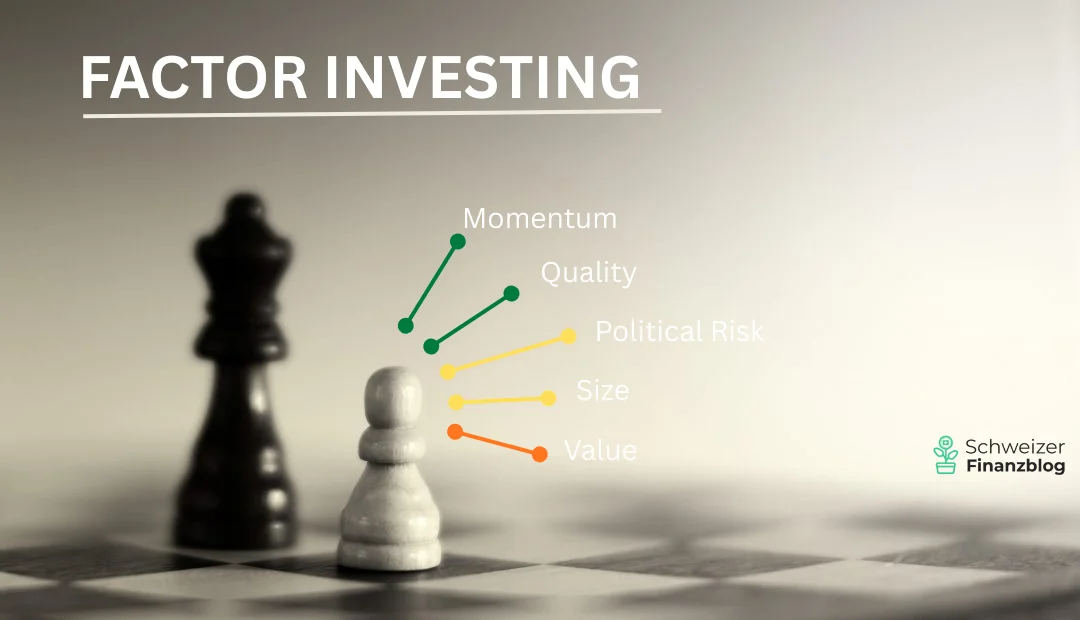
An index not only tells you about the ETF’s geographical focus, but also whether it is a sustainable (e.g. “ESG”, “SRI”; more on this: Green stocks: 40 ETFs compared), a thematic (e.g. Real Estate, Robotics, Clean Energy) or a factor-based (e.g. Small Caps, Value, Momentum; more on this: Is factor investing worth it? The 5 best factor premiums put to the return test) product.
Index suffixes “ex”, “Leveraged”, “Capped”, “TRN”
There are other index suffixes that can appear in the ETF name:
ex: The abbreviation “ex” tells you that certain companies, sectors or countries have been excluded from the index.
Example ETF: UBS ETF (LU) MSCI Pacific (ex Japan) UCITS ETF (USD) A-dis
Leveraged: These are leveraged ETFs that aim to track the underlying strategy index as closely as possible. The ETF name often also states the multiplier, e.g. “2x”, and the interval at which the multiplier applies, e.g. “Daily”. Such ETFs offer high return potential combined with high risks. You can find more on this in the article Leveraged ETFs: dream returns of over 100% or a speculative bet with the risk of total loss?
Example ETF: Amundi EURO STOXX 50 Daily (2x) Leveraged UCITS ETF Acc
“Inverse”: Speculators who like to play with fire, i.e. bet on falling prices in the short term, choose a so-called short ETF with the index suffix “Inverse”. These ETFs move in the opposite direction to the market, e.g. by a factor of “-2x”.
Example ETF: Amundi SMI Daily (-2x) Inverse UCITS ETF Acc
Capped: This term usually refers to an upper limit for the companies represented in the index. It indicates the maximum weighting a single company may have in the index, e.g. “5% Capped”. UBS offers many such capped ETFs, in particular to minimise concentration risk in niche ETFs and thus become UCITS-compliant. Today, however, “Capped” is rarely used in the ETF name any more and is usually found in the small print of the factsheet instead.
Example ETF: BNP Paribas Easy MSCI Europe Small Caps SRI S-Series PAB 5% Capped UCITS ETF
TRN: This abbreviation stands for an index that takes into account not only price changes but also distributions, though after deduction of withholding taxes (i.e. net, or “N” or “net”). Most ETFs measure themselves against such a benchmark index, even if this often only becomes clear in the small print of the ETF description. Any deviations are reflected in the tracking error and the tracking difference.
The following example shows that index information in ETF names is often heavily abbreviated. That’s why you should also consult the relevant factsheets.
ETF name with abbreviated index information (highlighted):
UBS ETF (LU) MSCI World Socially Responsible UCITS ETF (USD) A-dis
Full index name according to the MSCI and UBS factsheets:
“MSCI World SRI Low Carbon Select 5% Issuer Capped Total Return Net” (SRI = Social Responsible Index)
MSCI World: popular but misleading
Probably the best-known index is the MSCI World. It brings together around 1,400 companies worldwide. Worldwide? Not quite, because its name is somewhat misleading. It only covers the “developed world”, not the emerging markets. If you want to be truly globally invested, you also need an ETF that tracks the MSCI Emerging Markets, as a complement to the MSCI World.
The important thing with this combo is that you stick with the same index provider. Because if you combine an MSCI World ETF with a FTSE Emerging ETF, for example, you end up invested twice in some countries while missing others. This is because the two index providers, MSCI and FTSE Russell, define the markets differently.
For example, South Korea is classified as a developed market by FTSE Russell, while MSCI assigns it to the emerging markets. In the table below, we’ve highlighted the different country classifications.
MSCI vs. FTSE
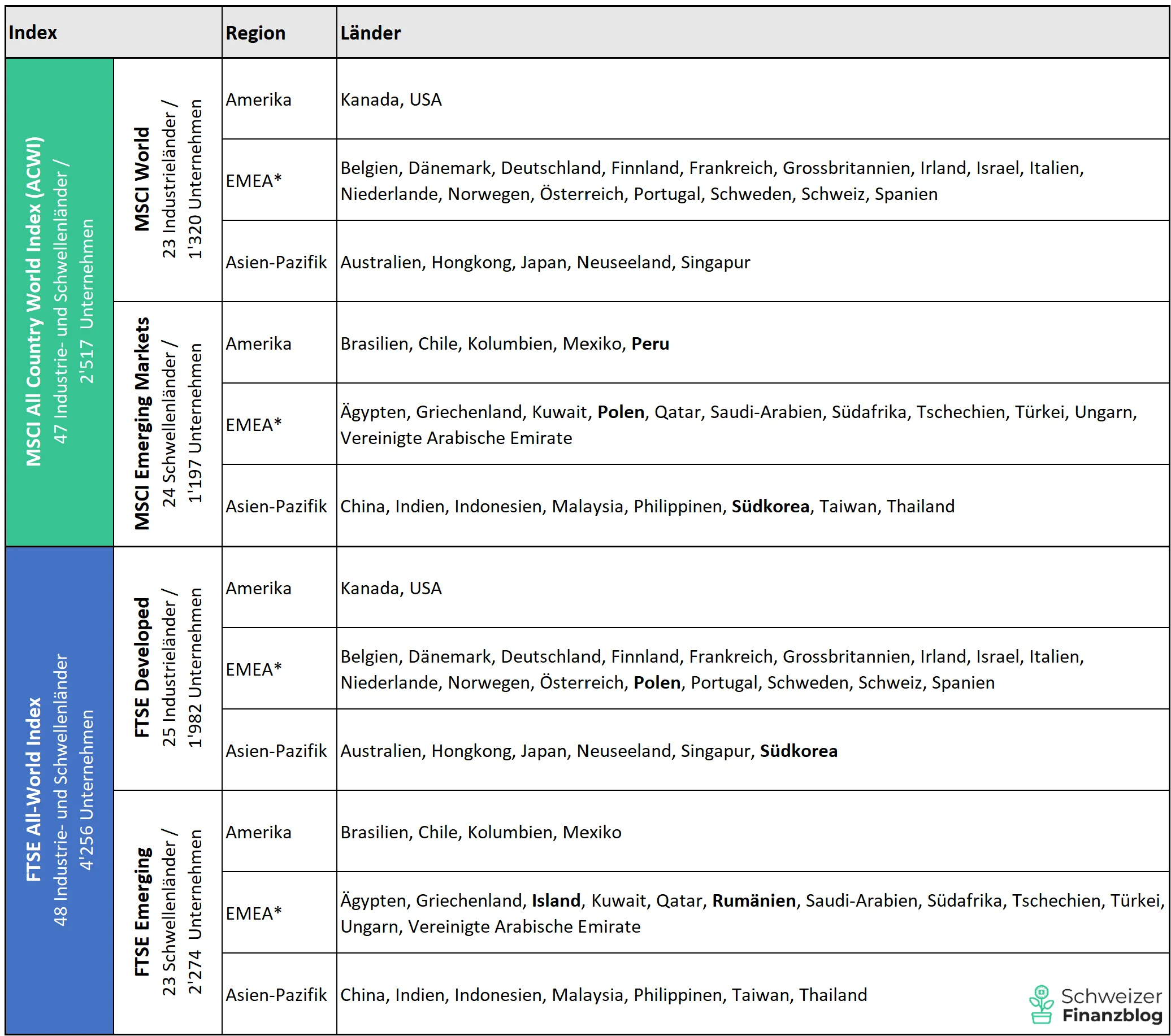
So when choosing an index, go for either MSCI or FTSE. By the way, most ETF providers mainly rely on MSCI indices. Not so the extremely attractively priced US pioneer Vanguard, which mainly uses indices from the FTSE family.
ETF component “product type”
The abbreviation ETF is, of course, also a fixed part of the product name. It stands for exchange traded fund, i.e. a fund traded on a stock exchange. This product type differs significantly from ETC (exchange traded commodity) and ETN (exchange traded notes), which relate to commodities and cryptocurrencies respectively. They therefore cover a niche and offer you less investor protection. Such products are not UCITS-compliant because, among other things, they do not count as segregated assets and are not subject to any diversification rules.
ETP (exchange traded product), by the way, is the umbrella term for ETF, ETC and ETN, but it is not used in ETF names.
ETF component “distribution policy”
When it comes to indicating whether an ETF is accumulating (i.e. dividends are not paid out to you but automatically reinvested in the ETF) or distributing, the abbreviations can vary greatly from provider to provider, as the following comparison shows:
| Provider | Accumulating | Distributing |
|---|---|---|
| Amundi | Acc | Dist |
| HSBC | No indication in the ETF title | No indication in the ETF title |
| iShares | (Acc) | (Dist) |
| SPDR | (Acc) | (Dist) |
| UBS ETF | A-acc | A-Dis |
| Vanguard | Accumulating | Distributing |
| Xtrackers | 1C | 1D |
Whether you opt for an accumulating or a distributing ETF is ultimately a matter of taste, i.e. it depends on your personal preferences.
If the (full) power of the compound interest effect is particularly close to your heart, choose an accumulating ETF. But if you are motivated by regular payouts that you can spend freely, a distributing product is the right choice for you.
Tax considerations, on the other hand, should not influence your decision. In the Swiss tax system, both variants are taxed in exactly the same way. You can find more on this here: ETF taxes in Switzerland: optimise your portfolio with these 5 tax-saving tips
Other ETF abbreviations
“UCITS”
You will often find “UCITS” in the ETF name. This abbreviation stands for “Undertakings for Collective Investment in Transferable Securities”. It is a regulatory standard, namely the so-called UCITS Directive.
A UCITS-compliant ETF is likely to appeal especially to safety-conscious investors. That’s because the European UCITS standard aims to strengthen investor protection. This includes rules under which the ETF is treated as segregated assets or which require sufficient diversification to avoid concentration risk.
For this reason, i.e. due to insufficient diversification, ETFs based on country-specific indices such as the “SMI” or the “DAX” are often not UCITS-compliant.
Country-specific indices may be popular with the media and investors, but because of their insufficient diversification (concentration risk) we are sceptical about them and prefer globally or at least regionally focused ETFs – for efficiency reasons too.
“IE”, “LU” & Co.
In some cases, such as with UBS, you can even read the fund domicile (e.g. “IE” for Ireland or “LU” for Luxembourg) from the ETF name. Most fund providers, however, leave this information out of the ETF name. In these cases, you can find the fund domicile in the relevant factsheet or in the twelve-character ISIN, which always begins with the country code of the fund domicile (e.g. LU0950674175 for the ETF below).
Example ETF: UBS ETF (LU) MSCI Emerging Markets UCITS ETF (USD) A-acc
CHF, EUR, USD
Currency codes such as CHF, EUR or USD in the ETF name usually describe the fund currency. Vanguard and UBS ETFs include this information in the ETF name, while most other providers leave it out.
An ETF is based on a specific fund currency, usually USD, but you can often trade it in different currencies. Which trading currencies are available is stated in the small print or in the provider’s factsheet.
Example ETF: Vanguard S&P 500 UCITS ETF (USD) Distributing
“Hedged”
Currency-hedged ETFs are labelled “Hedged”. If your reference currency is the Swiss franc and you want to avoid larger currency fluctuations, choose a “Hedged to CHF” or “CHF Hedged” variant. Bear in mind, however, that currency-hedged ETFs are often significantly more expensive than their classic counterparts.
Example ETF: iShares MSCI World CHF Hedged UCITS ETF (Acc)
“Core”, “Edge”, “Prime”, “Easy” & Co.
Some providers, or rather their marketing departments, embellish their ETF names with their own word creations. Market leader iShares stands out in particular, often adding “Core” (broadly diversified) or “Edge” (selective, i.e. focused on certain factors such as “Value”) to its ETF names.
Example ETF: iShares Edge MSCI World Value Factor UCITS ETF
Information you won’t find in the ETF name
While in the previous chapters we explained ETF abbreviations that, depending on the fund and provider, always or at least sometimes appear in the ETF name, we now turn to the product information you have to find elsewhere.
It goes without saying that the ETF name basically lacks all information that is dynamic in nature, i.e. can change constantly. These are often important selection criteria that you absolutely need to know when choosing the ETF you want: e.g. fund size, costs (TER), tracking difference.
In our most popular article to date, Best ETFs in Switzerland and worldwide: And the winner is…, you’ll find the selection criteria that matter most to us and that we used to pick the best ETFs.
Conclusion: ETF abbreviations made easy
Understanding ETF abbreviations correctly protects you from bad picks. The ETF name gives you a reliable first decision aid regarding the provider, the index and thus also the diversification, as well as whether the ETF meets a regulatory standard so that you as an investor benefit from special protection.
Some providers, such as UBS, use particularly informative ETF names by also including the fund domicile and fund currency in the ETF name.
An ETF called “UBS ETF (LU) MSCI World Socially Responsible UCITS ETF (USD) A-acc” tells you at a glance no fewer than eight characteristics:
- UBS ETF = fund provider
- (LU) = fund domicile Luxembourg
- MSCI World = index covers all industrialised countries worldwide
- Socially Responsible = index focuses on sustainable companies
- UCITS = fund meets a regulatory standard with enhanced investor protection
- ETF = product type
- (USD) = fund currency
- A-acc = dividends are reinvested (accumulating, not distributing)
But choosing an ETF based on its name alone would be too short-sighted. Important selection criteria such as fund size, costs or tracking difference are something you’ll look for in vain in ETF names. For these, you should check the providers’ product factsheets or established ETF portals such as justETF or TrackingDifferences.
If long ETF research bores you or you’re simply curious about our favourite ETFs, we recommend reading Best ETFs in Switzerland and worldwide: And the winner is…. In this big ETF comparison, we put over 1,500 ETFs through a rigorous, multi-stage selection process and picked the best products for different categories.
You might also be interested in

Updates
2026-01-23: Table with index comparison updated.
2025-01-20: Table with index comparison updated.
Disclaimer
Disclaimer: Investing involves the risk of losses. You have to decide for yourself whether or not you want to bear these risks.
Errors excepted: We have written this article on understanding ETF abbreviations easily to the best of our knowledge and belief. Our goal is to provide you as a private investor with information on finance that is as objective and meaningful as possible. Should we nevertheless have made mistakes, or should important aspects have been forgotten and/or no longer be up to date, we would be grateful for any feedback.
About the authors

Stefan Huser
Stefan has been investing in the stock market himself since 2015. He has been shaped by Markowitz’s portfolio theory and Gerd Kommer’s book “Souverän investieren”. He follows a core-satellite strategy: a global equity portfolio of ETFs forms the core, complemented by alternative investments. At the blog, he mainly takes care of the writing. Stefan lives with his family in Zurich and is interested in literature, photography and financial freedom.

Antun Brcina
Antun (“Toni”) has been investing in the stock market since 2015. Financially, he has been particularly inspired by Gerd Kommer’s book “Souverän investieren” and the Fama-French five-factor model. His money is invested in a broadly diversified, long-term global equity portfolio of ETFs. At the blog, he mainly works on the calculators and the code. Toni lives with his family in the Zurich area and is interested in sports, technology and entrepreneurship.


5 Comments
Im Paragraph ETF-Abkürzungen: Was steht im ETF-Namen? ist glaube ich ein kleiner Fehler. Da wird die Abkürzung IR für Irland genannt. Ist es nicht IE?
Auf jeden Fall grossen Dank für diese umfangreichen Infos. Toll!
Vielen Dank für den Hinweis. Ist korrigiert.
Grosse Hilfe für Jedermann, der sich mit dem Gedanken beschäftigt, Wertpapiere zu kaufen. Die Infos sind gründlich recherchiert.
Super cool! Vielen lieben Dank, dass ihr meiner Anregung gefolgt seid und diesen Beitrag geschrieben habt! Habe ich grad gebookmarked und meine eigenen ETFs entsprechend analysiert:)
Gerne! Vielen Dank für deinen tollen Vorschlag:-)