
 Newsletter
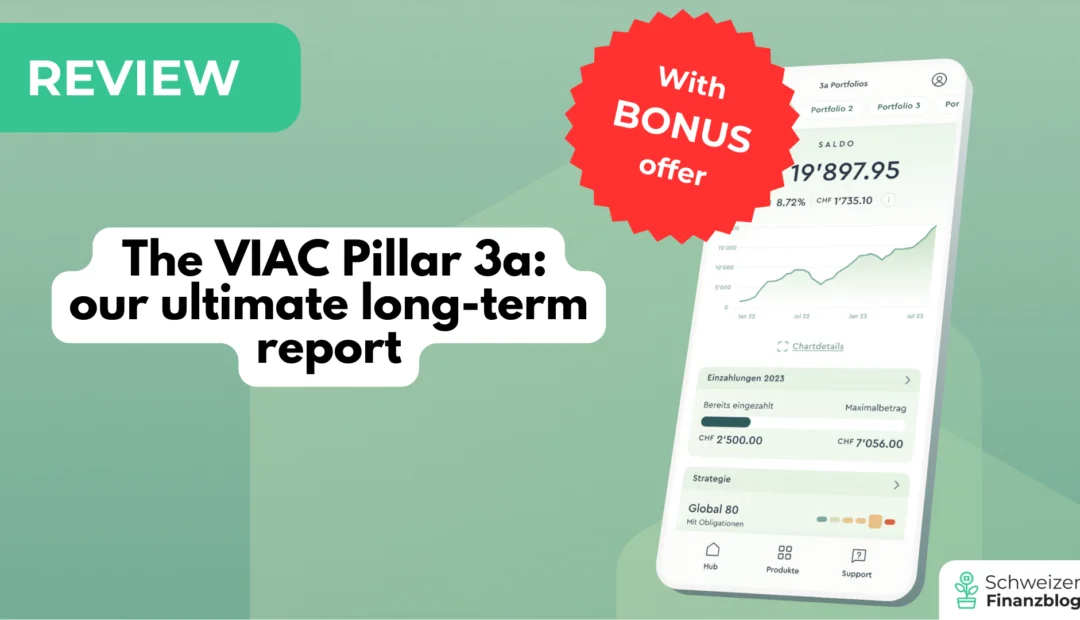
VIAC who? This quiet giant, with more than five billion Swiss francs in pension assets under management, is still (too) little known to the general public. We want to change that with this exclusive VIAC review. Thanks to our long-standing customer relationship with VIAC, you’ll learn first-hand what makes the Swiss pension pioneer so unique and which investment strategy we follow for our own Pillar 3a.

In a nutshell
- VIAC is a Swiss fintech that has been shaking up the local pension market since 2017 with low-cost, purely digital investment products.
- The associated Terzo pension foundation of WIR Bank manages steadily growing pension assets of more than CHF 5 billion. Besides Pillar 3a, VIAC offers vested benefits solutions and, with “VIAC Invest”, investing of non-pension assets; this review focuses on “VIAC 3a”.
- What makes “VIAC 3a” unique is a colourful mix of convincing arguments:
- Low fees: Depending on the investment strategy, total costs range between 0.00% and 0.44%.
- Attractive investments: Based on an investment universe of around 70 index-based securities, you can choose from numerous investment strategies with equity allocations from 0 to 99%, combined with the four investment focuses “Global”, “Switzerland”, “Sustainable” and – for advanced investors – “Own strategy”.
- High transparency: Information on performance, costs and every single transaction is available at any time.
- Intuitive platform: The user-friendliness of both the smartphone app and the desktop version is state of the art at VIAC.
- First-class support: The VIAC support team delivers competent answers within a few minutes.
- Free life insurance: VIAC insures part of its customers’ pension assets against death or disability free of charge.
- VIAC is less suitable for people who value a personal consultation at a nearby branch and/or want to handle both their retirement savings and their non-pension saving and investing on one single platform.
🎁 As a new VIAC customer, our bonus code VIACSFB gets you a lifetime fee waiver on the first CHF 2,000 of your pension or investment assets.
Contents
- Our VIAC experience with a bonus offer: invest your first CHF 2,000 fee-free!
- About Pillar 3a
- How VIAC came about
- VIAC’s product range
- Our many years of VIAC experience
- What does the “VIAC 3a” offering look like?
- Swisscanto and UBS as main partners, iShares as the joker
- Spoilt for choice: which investment strategy suits me?
- “Own strategy” with maximum freedom
- What fees does VIAC charge?
- What reports & co. are there?
- Our VIAC experience with support
- Our VIAC experience with day-to-day use
- How safe is VIAC?
- How does opening an account work?
- Conclusion from our VIAC experience
- You might also be interested in
- Updates
- Disclaimer
Our VIAC experience with a bonus offer: invest your first CHF 2,000 fee-free!
If this VIAC review leaves you as convinced of VIAC as we have been for many years, you can benefit from our bonus code as a new customer. Here’s how it works: enter the code VIACSFB when you open your account – VIAC will manage your first CHF 2,000 free of charge for life. The code applies to all products, i.e. Pillar 3a, vested benefits and Invest.
Independently of this, VIAC runs a “refer a friend” bonus programme. Once you are a customer, you can use it yourself and invite friends in turn. There are five levels per product, up to a fee-free amount of CHF 7,500 – so a maximum of CHF 22,500 across all three products.
Transparency note: We have been VIAC customers ourselves for many years. We get no financial benefit when you use our code, and there are no partnerships or commission arrangements of any kind with VIAC.
About Pillar 3a
This chapter is for those who would like a refresher on our pension system in general and the third pillar in particular. Everyone else can skip straight to our VIAC review.
While the first pillar is a state pension scheme (AHV) that guarantees a retirement pension to everyone in Switzerland, the second pillar is occupational pension provision (BVG), where both employers and employees pay regular contributions into a pension fund.
The third pillar, private pension provision, is meant to complement the first two pillars. A distinction is made between Pillar 3a and Pillar 3b (free saving with no maximum contributions and no withdrawal restrictions). Pillar 3a has the following characteristics:
- voluntary
- tax-privileged: contributions are deductible from taxable income
- capped in amount
- restricted withdrawal: at the earliest five years before and at the latest five years after reaching AHV retirement age. Early withdrawal is possible, among other things, for home ownership, self-employment or emigration
- attractive investment solutions thanks to healthy competition
Pension pioneer VIAC has contributed significantly to this healthy competition. Before that, 3a investment solutions were mainly known for high costs and low returns.
The responsible Federal Social Insurance Office (FSIO) has published more information on tied personal pension provision, as Pillar 3a is officially called, here.
Who can pay how much into Pillar 3a?
The following conditions apply in general, so also to a customer relationship with VIAC and its “VIAC 3a” product.
In principle, anyone over 18 can open a 3a account. To actually pay into Pillar 3a, however, you need income subject to AHV contributions. Without income, you can only transfer existing 3a assets.
Employees who belong to a pension fund may pay a maximum of CHF 7,258 per year into Pillar 3a (as of 2026). Self-employed people who do not belong to a pension fund and employees who are not affiliated with a pension scheme (e.g. people with very low incomes) can pay in 20% of their annual income, up to a maximum of CHF 36,288 (as of 2026).
New since 2026: contribution gaps from 2025 onwards can be filled retroactively within ten years – and these payments are tax-deductible too. Requirements: income subject to AHV contributions both in the gap year and in the year of the catch-up payment, plus the full contribution for the current year.
How VIAC came about
The idea for VIAC was born in 2015 with the vision of a Pillar 3a solution you could recommend to your best friends with a clear conscience. The founders were convinced that a solution optimised down to the smallest detail would show our generation a way to arm itself against the looming problems of retirement provision.
“ The idea grew out of our own need for a simple, understandable and, above all, efficient pension solution. Private retirement provision will become indispensable in the future and must be accessible to the masses without any hurdles. ”
Daniel Peter, initiator of VIAC
The following milestones have shaped VIAC’s still young history:
- 2015 Idea of an attractive pension solution for everyone
- 2017 Launch of the first digital 3a pension app
- 2020 Launch of the vested benefits solution
- 2021 Launch of VIAC Life to cover the risks of disability and/or death.
- 2022 Launch of the VIAC mortgage
- 2023 Investment universe expanded to include the “bonds” asset class and – in addition to the provider Credit Suisse – index investments from Swisscanto
- 2024 Investment universe expanded to include a Bitcoin ETF
- 2024 Launch of VIAC Invest for private saving.
In short: VIAC has revolutionised Switzerland’s previously sluggish and overpriced pension solutions in terms of pricing, simplicity and transparency. And it has done so without the big advertising fanfare of its financially powerful VIAC copycats, but very successfully: the 3a pension assets managed by the Terzo investment foundation of WIR Bank, together with the vested benefits money, now amount to more than CHF 5 billion.
VIAC’s product range
VIAC has steadily expanded its product range since it was founded. It currently looks like this:
- Pillar 3a: The main product (“VIAC 3a”), which we will present in detail later.
- Vested benefits: Pension solution for the second pillar with a similar pricing and investment model to “VIAC 3a”.
- Private saving: With “VIAC Invest”, VIAC has also offered investing of non-pension assets since December 2024. You invest freely in a portfolio of equities, bonds and/or cash put together according to your risk profile and preferences.
- Life insurance: With “Life Basic”, VIAC pension customers get free cover of CHF 2,500 in the event of death or disability per CHF 10,000 of invested assets. “Life Plus” is available as an optional, paid, extended risk cover.
- Mortgage: Exclusively for VIAC pension customers; no haggling, but the same terms for everyone; in combination with your VIAC pension assets, up to 100% financing is possible.
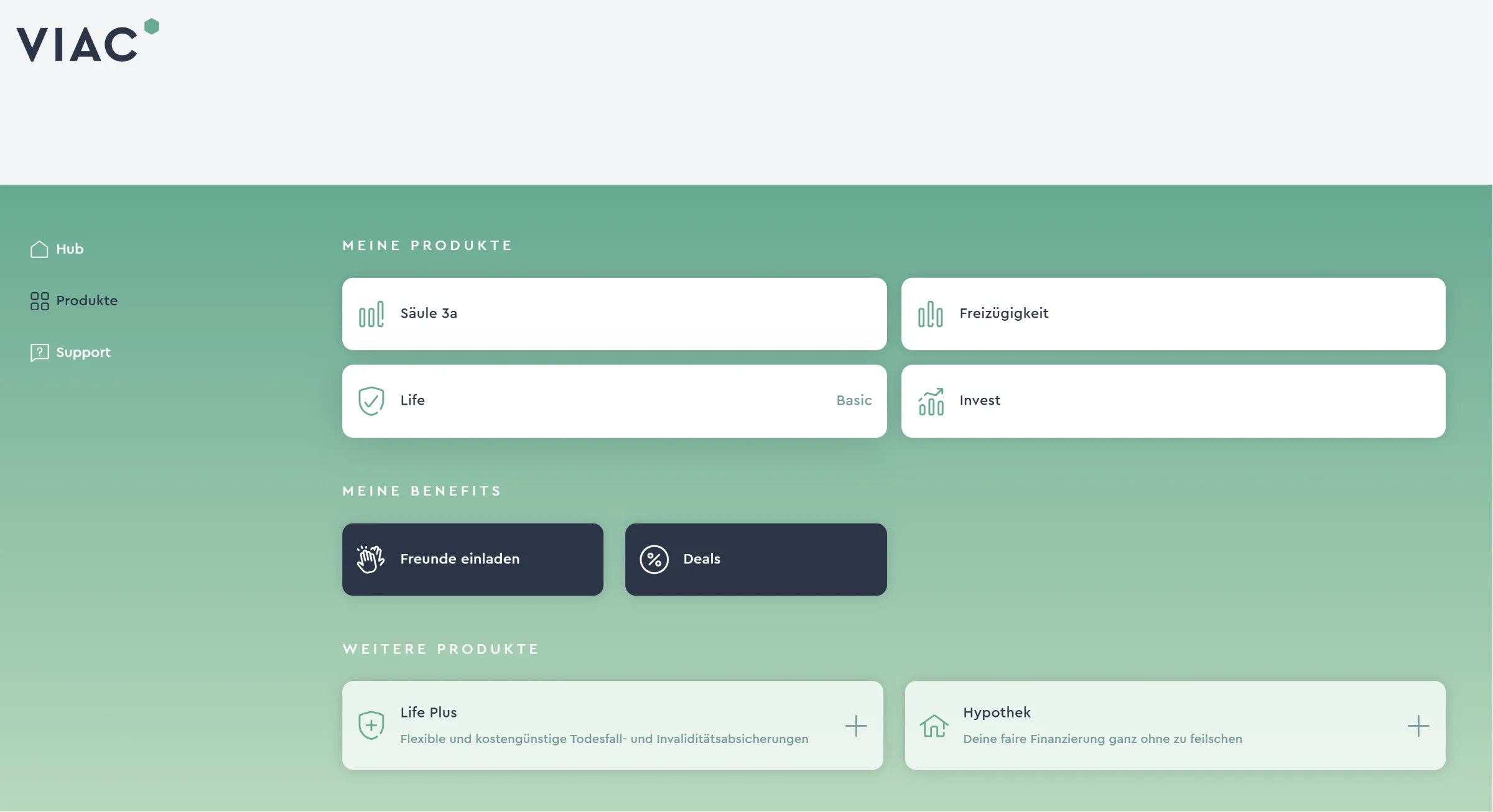
Since the beginning of December, VIAC has also offered an investment platform for non-pension saving and investing, “VIAC Invest”, like other robo-advisors (3 Swiss providers compared). We present this new product at the end of this article.
Below, we focus on “VIAC 3a”, VIAC’s most popular product, which is generally available to all adults with income subject to AHV contributions.
Our many years of VIAC experience
We, Toni and Stefan, are loyal VIAC customers from day one. We both hold several 3a accounts, which will later allow us to make staggered withdrawals at a lower tax rate. Year after year, we pay the maximum possible amount into one of our 3a accounts with the highest risk profile. Every week, on Tuesdays, the so-called trading day, the newly added cash is invested in the securities underlying the chosen investment strategy.
So as you can see, we have a high “skin in the game” factor, which means nothing stands in the way of a credible, first-hand VIAC review.
What does the “VIAC 3a” offering look like?
VIAC offers a comparatively wide range of 3a investment solutions, so VIAC should be an option for most people. The only thing you won’t find at VIAC is active investing, which we reject anyway because of its high costs with no expected extra return. VIAC’s science-based investment universe consists exclusively of passive index funds and ETFs. VIAC’s wide variety is reflected in the following facts:
- 4 investment focuses: “Global”, “Sustainable”, “Switzerland” and – for advanced investors – “Own strategy”
- 6 risk levels: from an interest-bearing account up to a 99% equity allocation
- 6 asset classes: cash, equities, bonds, real estate, commodities and alternative investments
- 70 investment products (passive index funds and ETFs)
Award-winning VIAC investment strategies
VIAC’s investment strategies are regularly named test winners by the Handelszeitung. In this annual comparison, 3a funds from numerous providers are first grouped by risk (equity allocation) and then rated on costs and performance over three and five years.
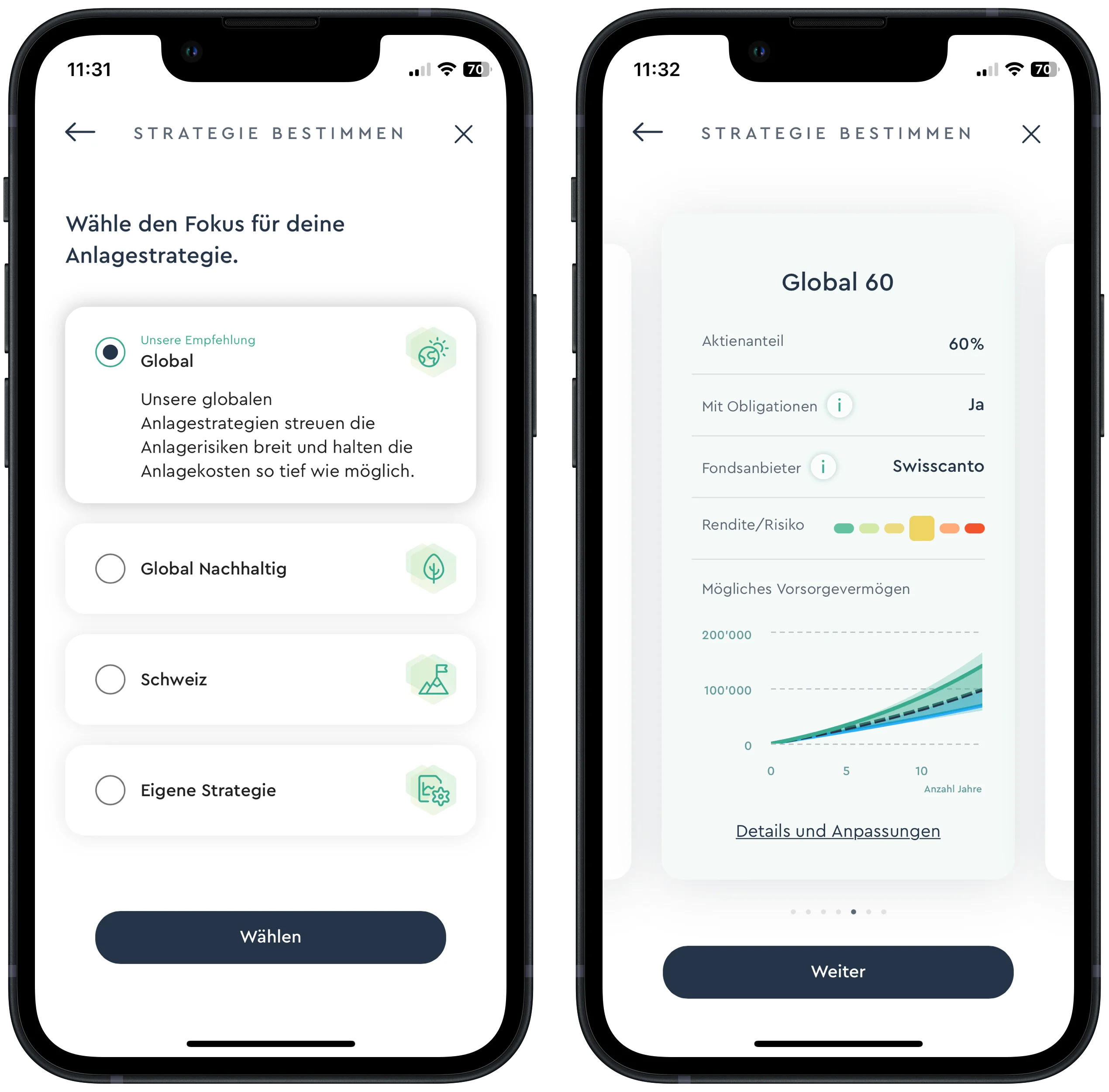
In the example above, we chose the “Global 60” investment strategy, a standard strategy that is fairly balanced in terms of risk and expected return. Total costs are 0.40% per year. With this strategy, which by the way you can change yourself at any time if needed, you are invested in the following five asset classes with different weightings:
- 60% equities: 20% Switzerland, 34% developed markets, 6% emerging markets
- 25% bonds: Swiss corporate bonds
- 10% real estate: 5% Switzerland, 5% global
- 4% commodities: gold
- 1% liquidity: interest-bearing account
For every standard strategy, you can choose between two sub-variants:
- With or without bonds: If you decide against bonds, the bond portion – 25% in our example – goes into liquidity. This makes the investment strategy slightly less risky and slightly less prone to fluctuations. The liquidity portion earns interest and is free of fees.
- Fund provider Swisscanto or UBS
Swisscanto joined as a second product provider in 2023 – probably because of Credit Suisse’s difficulties at the time and the resulting pressure from customers. Credit Suisse, in turn, was replaced by UBS following the takeover. Both VIAC partners offer only low-cost index funds that differ only in a few details. If you choose UBS funds, your units are traded and held in custody by UBS; with Swisscanto funds, Zürcher Kantonalbank takes care of this.
In addition, VIAC offers well-established ETFs from iShares (BlackRock). These more expensive, often specialised products (e.g. clean energy, Bitcoin) are not available for VIAC’s standard strategies and can only be selected for the “Own strategy”.
The publicly available list of securities here (scroll all the way down) represents VIAC’s entire investment universe, including all index funds and ETFs from the VIAC partners mentioned above.
Spoilt for choice: which investment strategy suits me?
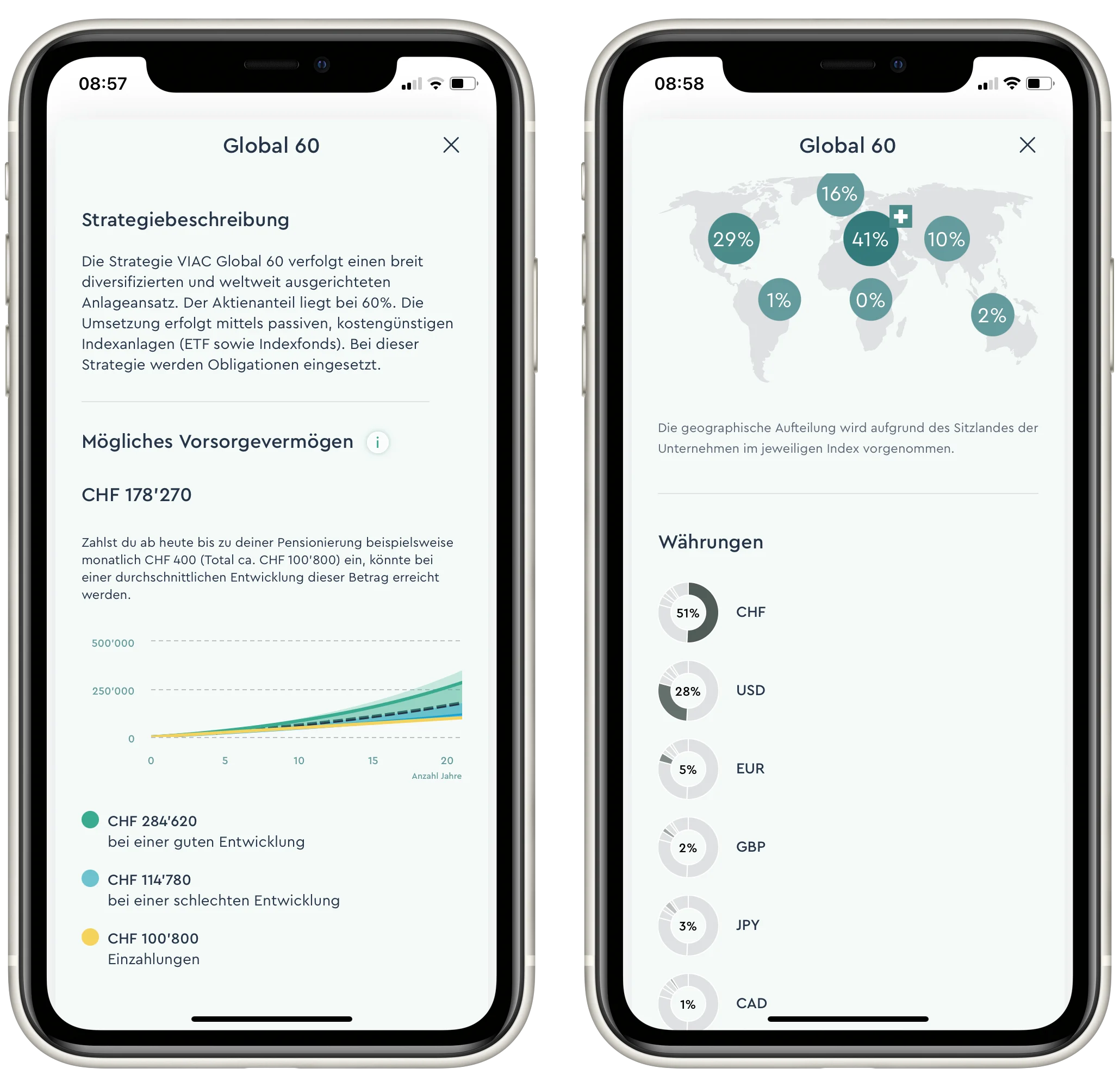
Tip: If all these products and strategies leave you unsure, simply choose the standard strategy suggested by VIAC. It is based on your profile, i.e. on the information you provided when opening your account.
On top of that, you can stick to the following rule of thumb: the longer your investment horizon and the greater your risk tolerance, the higher the equity allocation you can choose.
Because we still have a long investment horizon of more than ten years, we follow our own strategies at the highest risk level. Unlike VIAC’s “Global 100” standard strategy, which also belongs to the highest risk level and which Stefan uses in addition, our individually built portfolios have a lower share of Swiss equities. Our aim is to counter “home bias”. You can find out more about “home bias” and other psychological pitfalls in our article Behavioral finance: how to avoid the 13 biggest mistakes in your investing.
Important: You can change the strategy you have chosen at any time with just a few clicks. The new strategy always takes effect on the following Tuesday, the so-called trading day. VIAC takes care of the related securities transactions, and they are shown transparently on the platform.
Whichever strategy or strategies you choose, at VIAC you can hold up to five different 3a accounts, which will later allow you to make staggered withdrawals at a lower tax rate, i.e. to “break” the tax progression.
“Own strategy” with maximum freedom
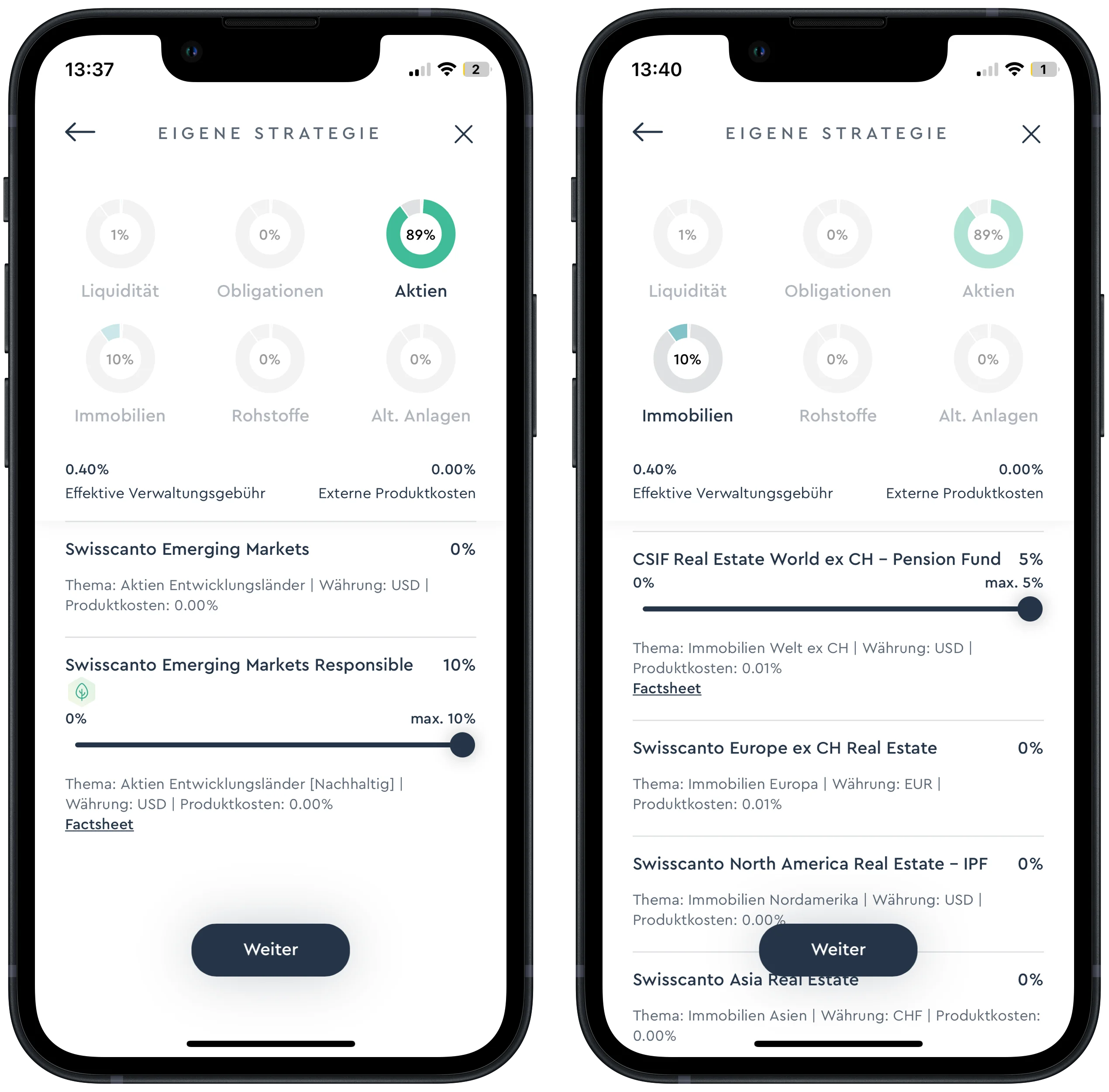
The “Own strategy” makes sense for you if you want to include additional asset classes (e.g. alternative investments), diversify more broadly within an asset class (e.g. with small-cap equities), prefer a different regional weighting (e.g. a smaller Swiss share) and/or want to hedge your portfolio at least partly against currency risks.
But even with your own strategy, it’s not a case of “anything goes”. VIAC sets a limit for each of the roughly 70 securities on offer. For example, you can’t invest large shares in particularly risky investments such as emerging markets equities or the newly added iShares Bitcoin ETF. So VIAC, and above all the state regulator, want to protect you from overly wild speculative adventures.
What fees does VIAC charge?
The total costs, made up of management fees and product costs, range from 0.00% to a maximum of 0.44% per year, depending on the strategy and investment focus. They include
- Custody fee
- Product fee
- Foundation fee
- Transaction fees
- Administration fee
- Basic cover in case of disability or death
The two low-risk strategies “3a account” and “Account Plus” (cash with a 5% equity allocation) are free of charge for all investment focuses. Fair: unlike with other providers, the cash portion at VIAC is always free of fees, regardless of the strategy chosen.
What’s more, you pay no basic fee, retrocessions, performance fee, account closing fees or fees for deposits and withdrawals.
With fees ranging from 0.00% to 0.44%, VIAC is without doubt one of the cheapest providers on the market. Traditional pension providers with an active investment approach in particular often cost several times as much as VIAC.
For example, the total costs of UBS’s active pension fund “UBS Vitainvest – World 100% Sustainable” amount to a staggering 1.62% per year (as of the end of July 2026).
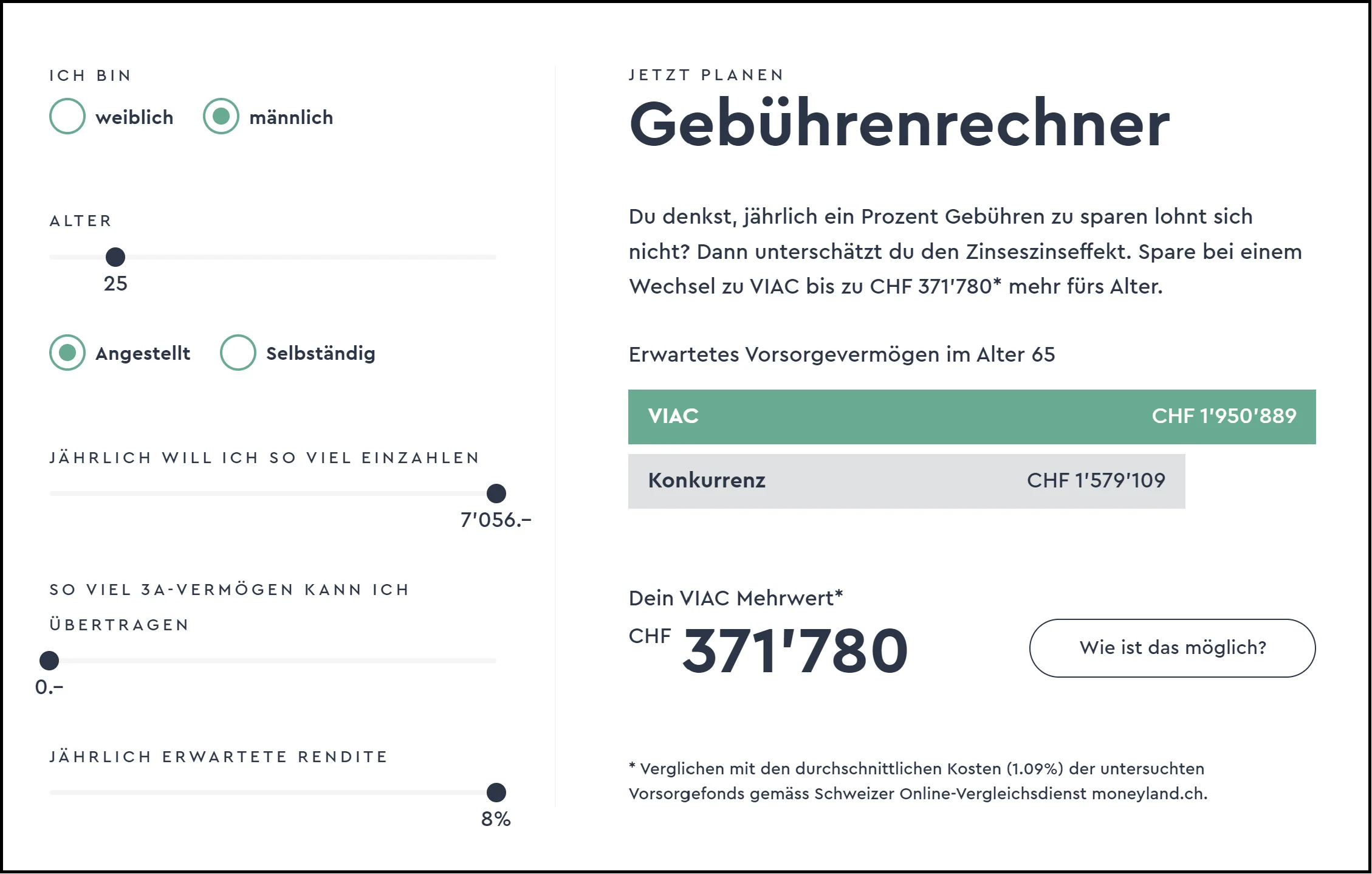
Even if you take the lower average market costs of 1.09% shown by VIAC in its fee calculator instead of these extreme examples, the compound interest effect results in a huge plus in pension assets over the long term, as the chart below impressively shows.
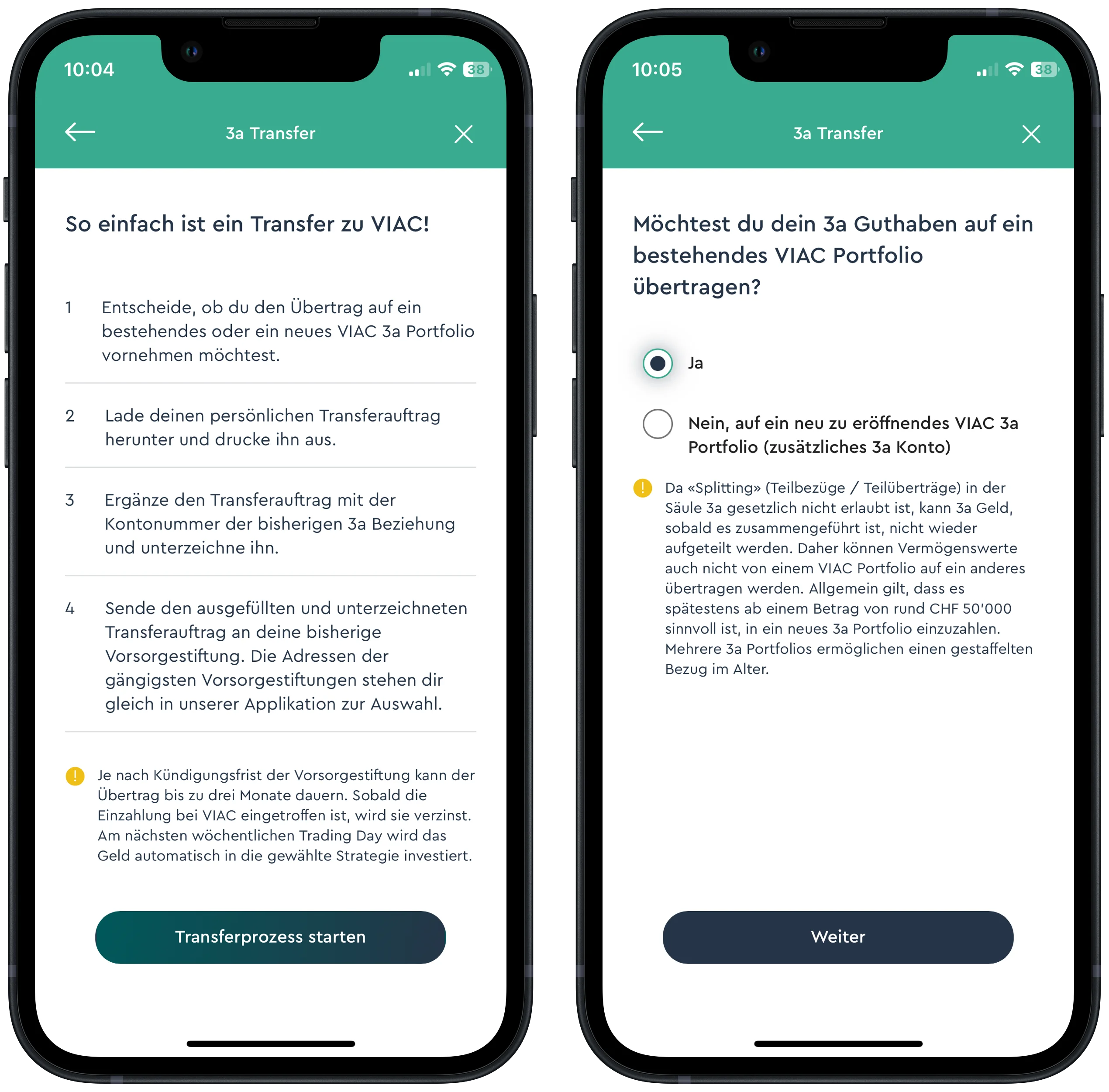
If you are faced with excessive fees, you should consider not only switching provider (for future contributions) but also transferring your existing 3a assets. You can easily start this process in the VIAC app, and it is done in just a few steps (see explanations in the image below).
What reports & co. are there?
VIAC doesn’t skimp on information. On the contrary: VIAC stands out for its high transparency and informative reports:
Besides the annual tax certificate, VIAC delivers a comprehensive half-yearly report including a market review to your digital inbox.
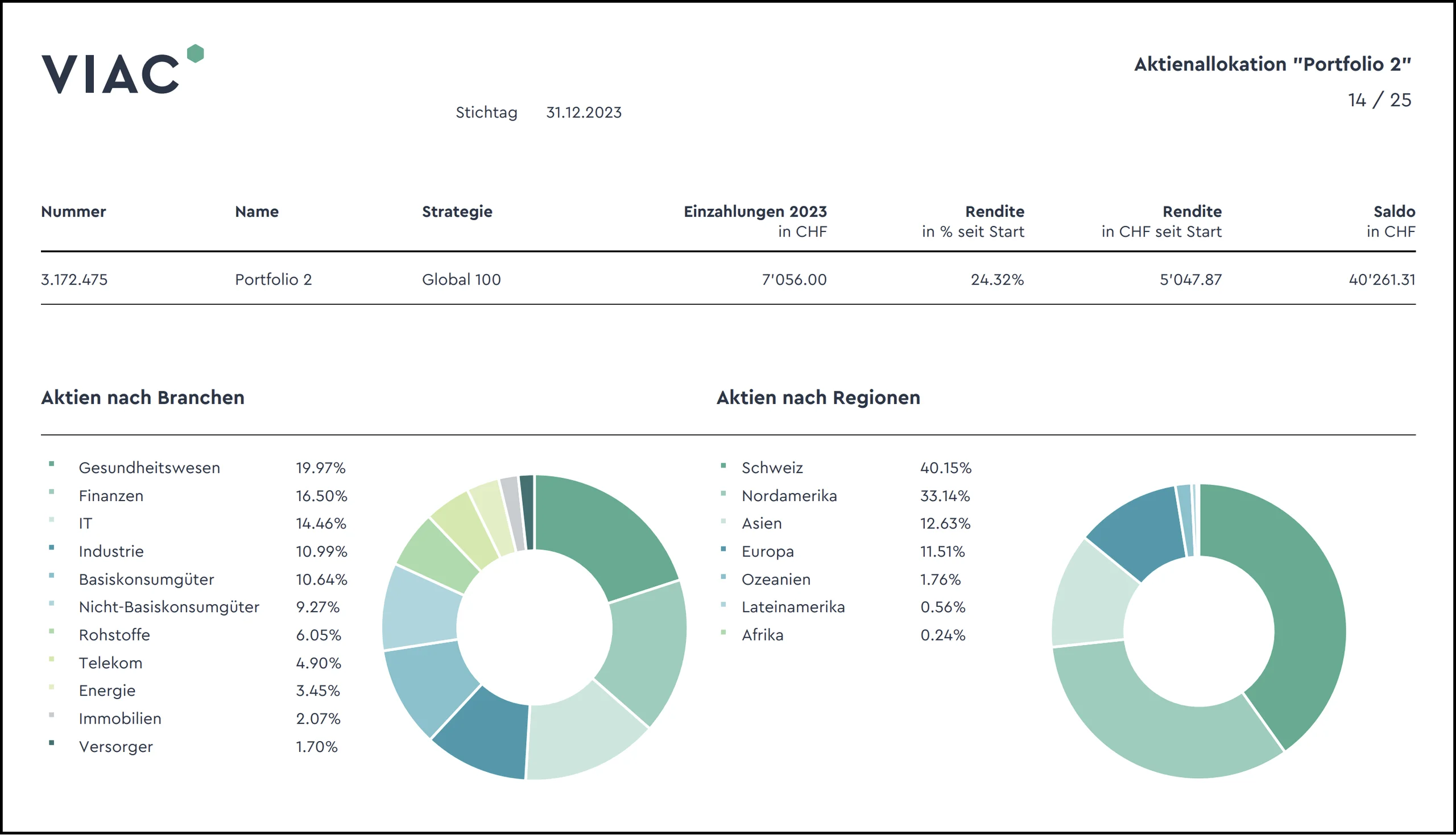
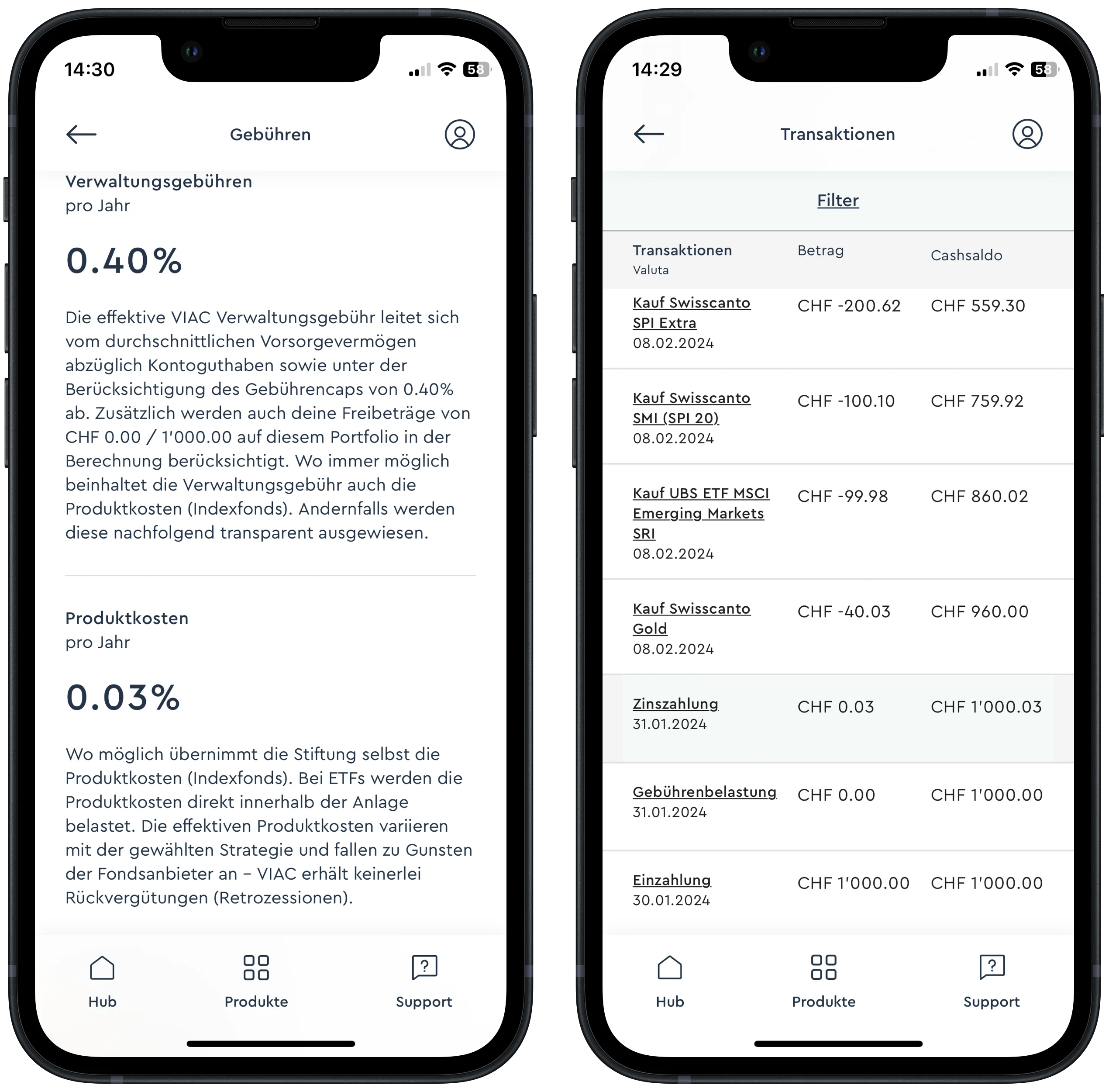
On top of that, you can keep up to date on your 3a pension solution at any time, right down to individual transactions:
- Deposits
- Securities purchases and sales
- Interest payments
- Dividends received
- Fee charges
Our VIAC experience with support
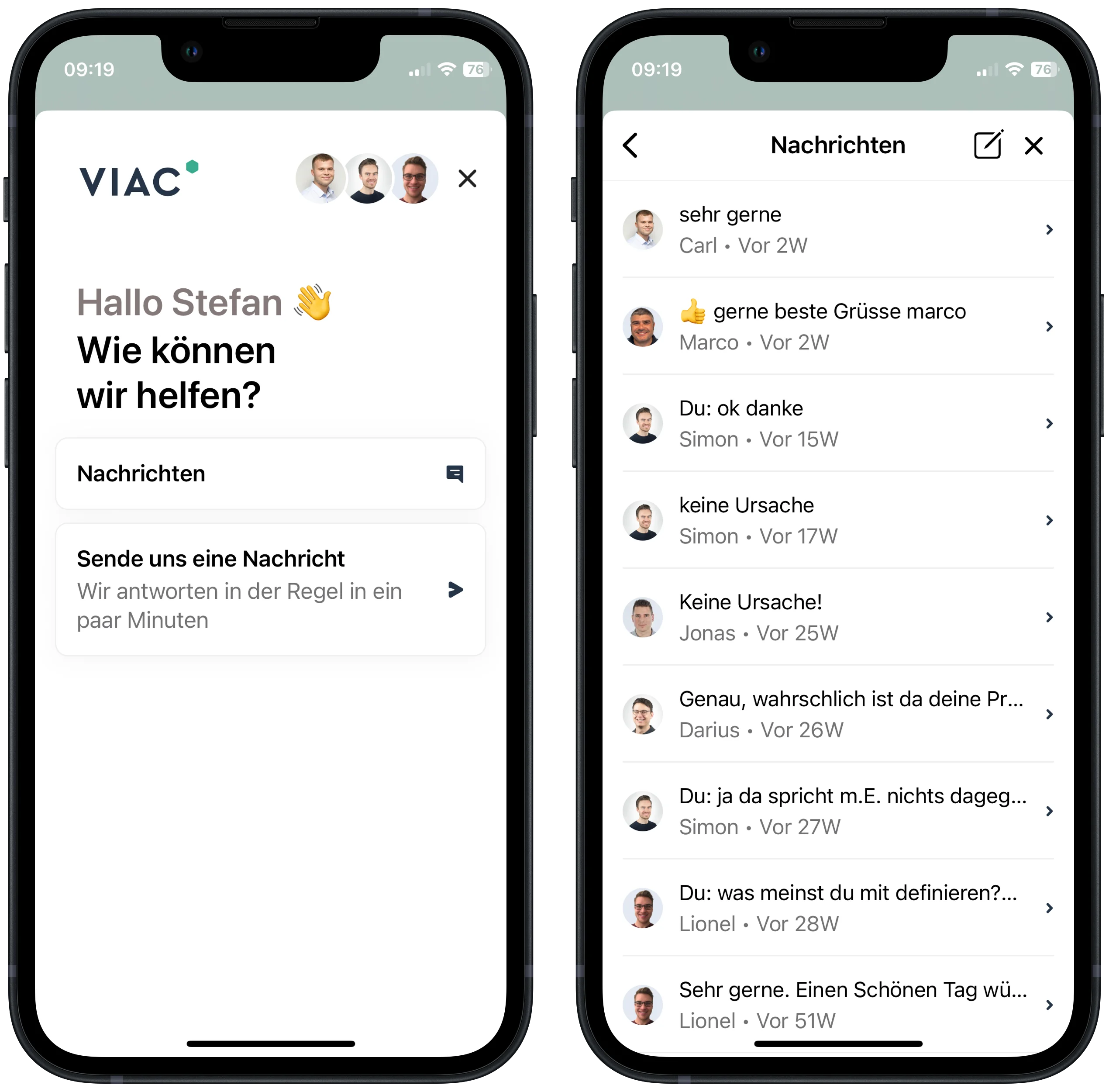
Let’s keep it short: VIAC’s support is simply phenomenal and far better than that of any other financial provider we have tested so far!
And we know what we’re talking about: over the years, we have collected plenty of tricky questions, which we put to the VIAC support team via chat. Whether we were helped by Carl, Christian, Darius, Emir, Jonas, Lionel, Marco or Simon: there was never anything to complain about. Based on our many years of VIAC experience, we would like to highlight the following two strengths of the support:
- High level of expertise: The VIAC support team handles even complex and/or in-depth questions with flying colours.
- Extremely fast response time: Questions are usually resolved within a few minutes.
What may surprise you at first is that the digitally minded VIAC uses no bots for support, only advisers of flesh and blood (so far we have never been in touch with a female adviser). Good thing, because let’s be realistic: these support bots are unfortunately usually only useful for trivial standard questions and all too often simply out of their depth.
Our VIAC experience with day-to-day use
VIAC is available both as an app on your smartphone and in the classic way via the internet on your desktop. In our VIAC experience, both versions offer you the same useful features, such as:
- Asset overview in total or per account, broken down by asset class, region and currency
- Information on your chosen strategy or strategies and the option to adjust them at any time (both regular rebalancing and rebalancing due to a strategy change take place weekly, on Tuesdays, the so-called trading day.)
- Securities overview per account with detailed product information on the individual index funds and ETFs and their weighting in your portfolio
- Ongoing transactions such as purchases and sales, incoming interest (on cash) and dividends (from distributing ETFs) as well as fee charges (the annual fees are also shown separately, broken down into management fees and product costs)
- Chat function for direct contact with the VIAC support team.
In 2023, VIAC launched a comprehensive redesign that once again clearly improved the appearance and user-friendliness (“look & feel”).
How safe is VIAC?
Risk: “insolvency of the custodian bank”
All money that is not invested is held at VIAC’s partner bank “WIR”. Its pension foundations have already been entrusted with more than CHF 5 billion in customer assets. So if WIR Bank were to get into financial difficulties, it would be up to the pension foundation to take the necessary measures to protect the pension assets (this could, for example, mean switching to another custodian bank).
Important: thanks to the bankruptcy privilege, your account balance up to CHF 100,000 is given preferential treatment if the account-holding bank becomes insolvent. Privileged deposits fall into the second bankruptcy class. As additional security, the custodian bank must hold domestic claims or other assets located in Switzerland (usually mortgages) amounting to 125% of its privileged deposits.
The securities – in VIAC’s case index funds and ETFs – count as segregated assets, are held separately and do not become part of the bankruptcy estate if the custodian bank becomes insolvent. You can find more information at esisuisse.
VIAC’s login meets the same security standard as the e-banking of various Swiss banks. Access to your VIAC account is protected by your personal password. As soon as you want to make significant changes, you also receive a code by text message for maximum security, which you have to enter to confirm. So your account is well protected against unauthorised access by what is known as two-factor authentication.
Risk: “realised price losses”
This risk is not related to VIAC or its custodian bank, but to your portfolio composition (“asset allocation”) and your investment horizon. The higher the risky share of your assets (e.g. in the form of equities) and the shorter your investment horizon, the greater the likelihood that this risk materialises.
The worst-case scenario would therefore be if you still held a large share of equities shortly before withdrawing your pension assets and a severe stock market crash happened at the same time. That’s why, from a risk perspective, we consider it absolutely essential that you gradually reduce the high-risk portions several years before withdrawal or shift them into lower-risk investments such as cash and/or bonds.
VIAC gives you a lot of flexibility here: every week on the so-called trading day, you can switch to a new strategy, for example a lower-risk one, with just a few clicks if needed.
How does opening an account work?
As a new VIAC customer, enter our code VIACSFB at the end of the registration and benefit from a lifetime fee waiver on the first CHF 2,000.
In just a few minutes, you can get a truly attractive financial solution, entirely online: simply download the app or start the sign-up process (“Register”) at www.viac.ch, have your ID card or passport ready and enter our code at the end of the registration.
Don’t be alarmed: during onboarding, a few simple questions are used to determine your investor type. Based on this, VIAC suggests one of its standard strategies (account, 20, 40, 60, 80, 100). If you don’t agree with the investment strategy VIAC suggests, you can of course override it at any time.
– Partner offer –
Still looking for the right financial solution? Our recommendations – with attractive sign-up bonuses.

– – – – –
Conclusion from our VIAC experience
The pension market is lucrative and fiercely contested by numerous providers. So how can VIAC stand out? We think it’s not a single aspect that makes VIAC shine, but rather that its overall package is convincing. In our VIAC experience, this overall package consists of a whole bundle of advantages. Below, we have summarised the five arguments for a “VIAC 3a” pension solution that matter most to us:
Argument 1: Low costs
We consider VIAC’s pricing model very fair: you pay no fees at all on cash in your portfolio. On the contrary: you earn 0.2% interest (as of September 2026). Fees are charged only on the invested part of your portfolio (equities, bonds, real estate etc., but not on cash held in the account), with a cost cap of 0.44% at most. According to VIAC, this makes the solution 65% cheaper on average than comparable offers. In addition, thanks to the free Life Basic, up to 25% on top of your accumulated 3a assets is paid out in the event of disability or death.
Argument 2: Attractive investment products
VIAC’s investment universe of passive index investments is extremely diverse. More than 70 products from different asset classes such as equities, bonds, real estate and commodities, plus a Bitcoin ETF, are available to you.
Argument 3: High transparency
You can get a picture of the costs and performance of your pension solution at any time, both consolidated and per individual investment. You also have access to your accounts at all times and can adjust your investment strategies when your needs change.
Argument 4: Intuitive platform
Since the last comprehensive release in 2023, we rate the VIAC app as extremely user-friendly and informative. All transactions can be carried out easily in the app. If you’d rather not make strategy changes & co. on your smartphone, you can use VIAC’s equally convincing desktop version instead.
Argument 5: First-class customer support
The otherwise fairly accurate rule of thumb that the cheaper the prices, the worse the service definitely doesn’t apply to VIAC. On the contrary: VIAC’s customer support is truly top-notch. And we know what we’re talking about. During our long customer relationship with VIAC, we have asked many tricky questions, and all of them were resolved within a few minutes.
And arguments against VIAC?
Right from the start in 2017, VIAC came up with a unique offering that thoroughly shook up the then sluggish and overpriced pension market.
In our VIAC experience, the pension platform has kept getting even better over the years. That’s why we are actually completely satisfied with VIAC at the moment and really have to look for the fly in the ointment or put ourselves in the shoes of people with other needs to find the following supposedly critical points:
- No branch network: Old-school customers who value a personal conversation at a nearby branch are unlikely to be happy with the digitally focused VIAC.
- Too many choices: VIAC offers dozens of standard strategies, spread across the three investment focuses “Global”, “Sustainable” and “Switzerland”. Most of these strategies can then also be specified in terms of the “bonds” asset class (with or without) and the securities provider (Swisscanto or UBS). Many people (like us) appreciate these choices, while others feel overwhelmed by them. The latter would probably be better off simply following VIAC’s strategy suggestion based on the questions answered when opening the account, or looking for an alternative provider with fewer investment options.
If you see further pros and cons and/or appreciate particular advantages of another 3a provider, feel free to let us know in the comments below.
You might also be interested in



Updates
2026-09-03: Article updated and new, uniform bonus code added.
2024-12-09: Investment universe of “VIAC Invest” explained and various images updated.
2024-12-07: New product “VIAC Invest” presented.
Disclaimer
Disclaimer: Investing involves the risk of losses. You have to decide for yourself whether or not you want to bear these risks.
Errors excepted: We have written this article about our VIAC experience to the best of our knowledge and belief. Our goal is to provide you, as a private investor, with information on financial topics that is as objective and meaningful as possible. If we have nevertheless made mistakes, forgotten important aspects and/or if information is no longer up to date, we would be grateful if you let us know.
About the authors

Stefan Huser
Stefan has been investing in the stock market himself since 2015. He has been shaped by Markowitz’s portfolio theory and Gerd Kommer’s book “Souverän investieren”. He follows a core-satellite strategy: a global equity portfolio of ETFs forms the core, complemented by alternative investments. At the blog, he mainly takes care of the writing. Stefan lives with his family in Zurich and is interested in literature, photography and financial freedom.

Antun Brcina
Antun (“Toni”) has been investing in the stock market since 2015. Financially, he has been particularly inspired by Gerd Kommer’s book “Souverän investieren” and the Fama-French five-factor model. His money is invested in a broadly diversified, long-term global equity portfolio of ETFs. At the blog, he mainly works on the calculators and the code. Toni lives with his family in the Zurich area and is interested in sports, technology and entrepreneurship.




9 Comments
Mit 0% internen Verwaltungskosten ist die 3a Lösung von Truewealth ebenfalls sehr attraktiv.
Stimmt, True Wealth überzeugt im 3a-Bereich mit attraktivem Pricing – genau deshalb nehmen wir sie diesen Herbst genauer unter die Lupe.
Hallo,
Ihr schreibt Ihr verfolgt mit VIAC eine eigene Anlagestrategie um den Home-Bias zu verringern. Wie sieht Eure Strategie aus?
Liebe Grüsse
Hoi David
Hier unsere individuellen Strategien, Toni: 99% Aktienanteil verteilt auf: 66% Entwickelte Welt (ex CH), 20% Emerging Markets, 3% CH, 10% Small Caps Entwickelte Welt (ex CH); Stefan: 84% Aktienanteil verteilt auf: 24% CH, 10% Europa (ex CH), 12% USA, 3% Canada, 5% Pacific (ex Japan), 5% Japan, 10% Emerging Markets; 15% Small Caps Entwickelte Welt (ex CH); zusätzlich 10% Immobilien und 5% Bitcoin.
Beide verfügen über mehrere Konten bei VIAC, wobei Stefan neben zwei individuellen auch ein Konto mit Standardstrategie “Global 100” führt.
Beste Grüsse
SFB
Ich setze bei meiner Säule 3a und Vermögensanlage auf VIAC – eine Schweizer App mit top Rendite, tiefer Kostenstruktur und voller Flexibilität.
Besonders spannend: Du kannst dein Portfolio frei gestalten – sogar mit Bitcoin-Anteil. 🪙
Mein aktuelles Portfolio:
• 81 % Swisscanto World ex CH – IPF
• 9 % Swisscanto Emerging Markets
• 4 % Swisscanto World ex CH Small Cap Responsible – IPF
• 5 % iShares Bitcoin Trust
• 1 % Cash
Weil es hier um Erfahrungen mit VIAC 3a geht, gebe auch ich mal meinen Senf dazu.
Am 08. Juli 2019 bin ich mit dem damals vollen Betrag von CHF 7’056.00 eingestiegen. Ab da habe ich jedes Jahr Anfang Januar den maximal möglichen Betrag einbezahlt. Bis Ende 2024 ist so ein total einbezahlter Betrag von CHF 41’530.00 zusammen gekommen.
Per 31.12.2024 steht der Kontosaldo auf CHF 50’891.62, was eine Gesamtperformance in CHF von 9’361.62 ausmacht.
Als Strategie kamen anhand der beantworteten Fragen Global 80 heraus, jedoch ohne Obligationen (wobei ich nicht mehr nachvollziehen kann, warum ich damals Obligationen ausgeschlossen habe). Mein Anlagehorizont ist übrigens auch kürzer, als die der Blogersteller.
Jeder kann für sich selbst ausrechnen, ob das eine ansprechende Performance ist. Ich jedenfalls bin damit zufrieden.
Und ja, einfacher und kostengünstiger kann das Anlegen von 3a Vermögen kaum sein. Ich kann VIAC also guten Gewissens empfehlen.
Hallo zusammen
Vielen Dank für den Bericht.
Ich habe meine 3 Säule momentan bei meiner Hausbank Raiffeisen aber die Gebühren sind einfach zu hoch. Desshalb bin ich auf der Suche nach einer Variante. VIAC scheint mir genau das Richtige zu sein.
Aus Steuerlichen Gründen macht es Sinn, mehrere 3a Konten zu eröffnen und nicht über ca. 50‘000.- CHF pro Konto zu gehen. Nur Frage ich mich, ob ich dann nicht der Zinseszinseffekt kaputt mache? Denn wenn ich immer in dasselbe Konto einzahle, erhalte ich nicht mehr aus den Zinsen?
Danke für ein Feedback.
Nein, mit mehreren 3a-Konten schmälerst du den Zinseszinseffekt nicht.
Mein persönlicher Tipp: Global 100. Läuft seit Jahren bei mir und wirft aktuell um die 10% Rendite ab.
Guten Start und viel Erfolg!
Gruss
MC