Newsletter
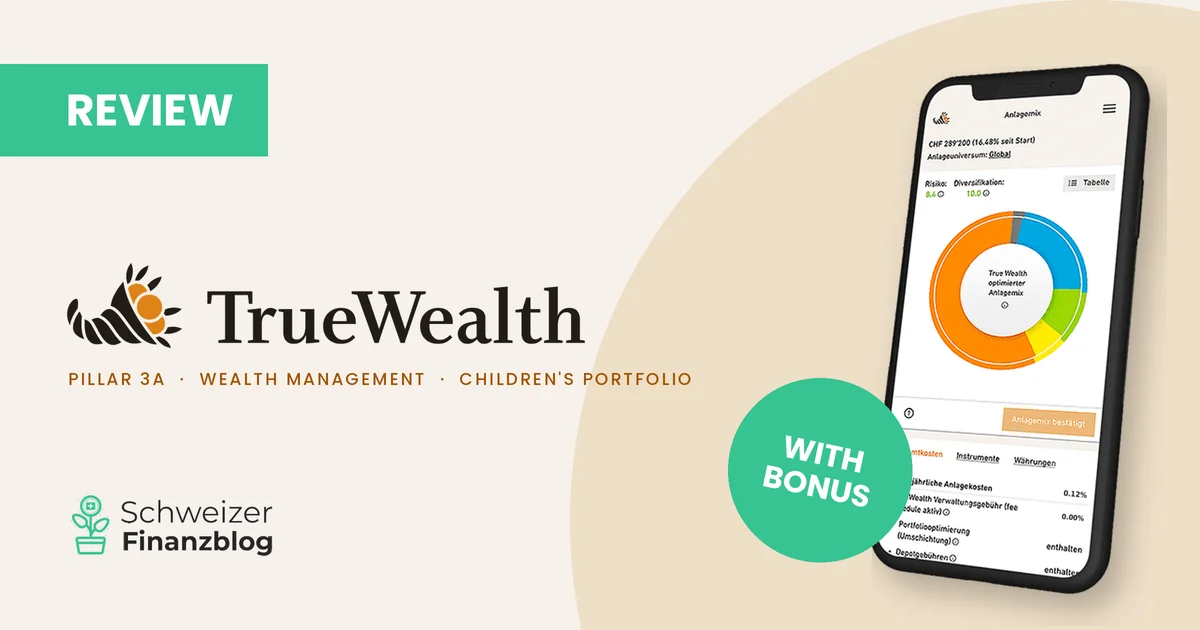
A zero percent management fee in Pillar 3a: what sounds too good to be true has been reality at True Wealth since 2022. On top of that, you get automatic account staggering and tax-optimised index funds. In our True Wealth review, we show you how this works in practice, who should consider switching and how the other investment solutions stack up.
In a nutshell
- True Wealth has been one of the pioneers of digital wealth management in Switzerland since 2013, manages around CHF 3.5 billion for more than 50,000 clients and is supervised by FINMA.
- No management fee in 3a: you only pay product costs of 0.12–0.14% (sustainable from 0.21%) plus transaction costs when investing. According to our research, this makes True Wealth the cheapest 3a investment solution in Switzerland.
- On their own, non-pension assets and the children’s portfolio are more expensive than with other robo-advisors, at just over 0.6% per year. Combined with the low-cost 3a, however, total costs drop noticeably, depending on how your money is split.
- Besides ETFs, True Wealth partly uses withholding-tax-optimised index funds in 3a, which further improves your net return.
- One special feature is automatic staggering: over the years, True Wealth opens five 3a accounts on its own and spreads your contributions evenly across them – for a more tax-efficient, staggered withdrawal.
- The price of this automation: one shared investment strategy applies to 3a and non-pension assets, and you can’t control how money is distributed across the accounts.
🎁 With our bonus code SFB100TW you get a CHF 100 fee credit as a new client (not valid for 3a, details below).
Transparency note: True Wealth’s investment solutions convinced us, above all the 3a offering. That’s why we entered into a partnership. If you open an account via our link, you get a fee credit on non-pension assets and the children’s portfolio, and we may receive a commission. Editorially, we remain independent.
Contents
- True Wealth at a glance
- Our True Wealth review: how we tested
- True Wealth fees in 3a: what you really pay
- Standard strategies and asset classes
- Investment products: ETFs and tax-optimised index funds
- Customised strategy: how to adjust the proposal
- Automatic staggering across five accounts with True Wealth 3a
- Handling, reporting and support at True Wealth
- How safe is True Wealth?
- Non-pension assets and children’s portfolio: what do they cost?
- True Wealth and its quirks
- Opening an account and transferring your 3a
- What are the pros and cons of True Wealth?
- True Wealth bonus code: CHF 100 fee credit
- Conclusion of our True Wealth review
- Frequently asked questions about True Wealth
- What has your experience with True Wealth been like?
- Who owns True Wealth?
- Is my money safe with True Wealth?
- Is Pillar 3a at True Wealth really free?
- How does True Wealth earn money on 3a without a management fee?
- How many 3a accounts does True Wealth open?
- Can I transfer my existing 3a to True Wealth?
- What is the minimum deposit at True Wealth?
- How much does True Wealth cost?
- What does it cost to switch to or away from True Wealth?
- Is True Wealth also worth it for non-pension assets?
- Does the bonus code SFB100TW also apply to Pillar 3a?
- What return does True Wealth deliver?
- True Wealth or VIAC?
- Which robo-advisor is the best?
- You might also be interested in
- Updates
- Disclaimer
True Wealth at a glance
True Wealth was founded in 2013 by Felix Niederer, a physicist and portfolio manager, and Oliver Herren, co-founder of Digitec Galaxus, and has been on the market since 2014. The idea: professional wealth management based on the rules of modern portfolio theory, fully digital and at a fraction of the usual bank costs. Since 2016, Basellandschaftliche Kantonalbank (BLKB) has held a minority stake.
Today, True Wealth manages around CHF 3.5 billion for more than 50,000 clients, making it one of the largest digital wealth managers in Switzerland. The company is licensed by FINMA as a manager of collective assets and is under its direct supervision. The platform was developed in-house, which makes True Wealth independent of external banking software providers.
The offering consists of three products:
- Online wealth management: for non-pension assets from CHF 8,500, with either BLKB (a bank with a state guarantee) or Saxo Bank Schweiz as custodian bank.
- Pillar 3a: since 2022, from CHF 1,000, via the pension foundation 3a Digital. The custodian bank is BLKB, a bank with a state guarantee.
- Children’s portfolio: since 2023, a separate investment solution for children and young people from CHF 1,000. The money belongs to the child, who can use it freely from age 18.
In this review, we look at all three products, with a focus on the 3a solution.
Our True Wealth review: how we tested
Unlike with VIAC, we are not clients from day one at True Wealth – we have been new clients since October 2026. This review is therefore based on opening our own account and our first weeks with a 3a portfolio of 99% equities, on the publicly documented terms and on the experiences of long-standing clients from App Store and Trustpilot reviews. Where we rely on other people’s opinions, we say so.
True Wealth fees in 3a: what you really pay
True Wealth charges no management fee in Pillar 3a; total investment costs are 0.12–0.14% per year (as of October 2026). They consist of two components:
- Management fee charged by True Wealth: 0% in 3a
- Product costs of the ETFs and index funds (TER): 0.12% in the standard strategy, 0.14% in our customised portfolio. They are not charged separately but are deducted directly within the fund assets.
With a 3a balance of CHF 100,000, you therefore pay CHF 120 to 140 per year.
Not included are the transaction costs for buying, selling and reallocating the funds. According to True Wealth, they mainly arise with the initial investment: for a first deposit of around CHF 7,300, True Wealth puts them at around CHF 10, i.e. a one-off of just over 0.1%. This includes stamp duty, spreads, a foreign currency surcharge of max. 0.1% charged by the custodian bank and issuing commissions of the index funds. Without further deposits or withdrawals, transaction costs are negligible after that. True Wealth keeps the foreign currency surcharge low by netting the deposits and withdrawals of all 3a clients internally instead of sending each order to the exchange individually.
Good to know:
- No custody fees, front-end loads, redemption fees or retrocessions
- Electronic tax statement included
- Cash portion earns 0.35% interest (as of October 2026)
- Minimum deposit CHF 1,000; you don’t need an account for non-pension assets
If you want to invest sustainably, you can switch the investment universe to “Sustainable”. True Wealth then uses ETFs on MSCI’s SRI indices, which exclude controversial industries and only include the ESG leaders of each sector. This raises product costs to 0.21% or more.

True Wealth in a 3a cost comparison
How big the cost advantage is becomes clear when comparing it with other competitively priced digital 3a providers, in each case for the strategy with the highest equity allocation:
| Provider | Total investment costs | Costs on CHF 100,000 | Max. equity allocation |
|---|---|---|---|
| True Wealth | 0.12–0.14% | CHF 120–140 | 99% |
| findependent | 0,29% | CHF 290 | 99% |
| finpension | 0,39% | CHF 390 | 99% |
| frankly | 0,43% | CHF 430 | 95% |
| VIAC | 0,44% | CHF 440 | 99% |
How does True Wealth earn money on 3a without a management fee?
Since True Wealth waives the management fee in 3a entirely, receives no retrocessions (kickbacks) from fund providers, and product and transaction costs are incurred externally, the company earns nothing on an ongoing basis from this product.
We therefore assume a cross-subsidy model: the low-cost 3a attracts new clients, and some of them also invest their non-pension assets with True Wealth, where the management fee applies. This strategy seems to be working: since its launch in 2022, True Wealth has offered 3a without a management fee, unchanged.
Our verdict on the 3a fees: according to our research, True Wealth is the cheapest investment solution in Switzerland here.
Standard strategies and asset classes
As soon as your minimum deposit has arrived, True Wealth determines your risk profile with a few questions and, based on it, suggests a globally diversified portfolio. The equity allocation goes up to 99%.

With True Wealth, you can invest in up to five asset classes. In the public sample portfolio, the allocation looks like this:

The five asset classes at a glance:
- Cash: a small liquidity reserve, earning 0.35% interest in 3a.
- Bonds: stabilise the portfolio, mainly long-dated US government bonds and some high-yield corporate bonds.
- Real estate: listed real estate companies from developed countries, excluding Switzerland.
- Commodities: a broadly diversified basket of energy, metals and agricultural commodities as an inflation hedge, with gold only as part of it and not as a separate position.
- Equities: the return engine, spread globally across seven regions – more on this in the next chapter.
Depending on your risk profile, True Wealth shifts the weights. Instead of the standard variant, you can also weight the asset classes freely – more on this in the chapter on the customised strategy. If you want to invest sustainably, you can switch to a sustainable investment universe.
Our verdict on strategy and asset classes: the strategy proposal based on the risk profile makes sense, and the choice of asset classes is convincing. We appreciate that, as an alternative to the suggested standard variant, the asset classes can be weighted freely or left out entirely. Real estate and commodities are available as optional alternative investments. But if you’re looking for cryptocurrencies or private equity, you won’t find them at True Wealth. For us, the devil is in the detail at product level – more on this in the next chapter.
Investment products: ETFs and tax-optimised index funds
In 3a, True Wealth relies not only on ETFs but partly on tax-optimised index funds. The reason is withholding tax, a cost factor that doesn’t show up in any TER but reduces your return. True Wealth has no funds of its own and, according to the company, has no business relationship with the fund providers. This avoids conflicts of interest when selecting products.
You can check which funds True Wealth actually uses yourself in the public sample portfolio, separately for Pillar 3a and non-pension assets. It is preset with currency hedging, but you can adjust the portfolio by changing the strategy and will then see the corresponding products. We explain why we deactivated hedging in the chapter on the customised strategy.

An ETF domiciled in Ireland usually loses 15% foreign withholding tax on US dividends, which cannot be reclaimed. With the Swiss index funds that True Wealth uses for US equities and global real estate, this deduction does not apply.
With a dividend yield of around 1.3% on US equities, this amounts to around 0.2 percentage points per year on the US portion. With a US share of 40%, as in the 3a sample portfolio, that’s around 0.08 percentage points on the whole portfolio – more than half of the total product costs of 0.12–0.14%.
True Wealth divides equities into seven regions:

This has clear strengths:
- You can weight all seven regions freely, including by market capitalisation.
- You can avoid a home bias: you set the Swiss share as low as you like.
- Emerging markets and Asia-Pacific are broadly covered as separate regions.
However, we were surprised by a few gaps and inconsistencies:
- “Europe” should really be called “Eurozone”: the region is only covered via the Euro Stoxx 50, i.e. the 50 largest companies in the euro countries. Sweden, Denmark and Norway are missing, as are mid-sized companies.
- Canada is missing entirely.
- Small companies, known as small caps, are only covered in Switzerland and the emerging markets. You can’t use this to invest in small caps globally.
- The indices come partly from FTSE and partly from MSCI. The two providers classify countries differently, so South Korea appears twice in the portfolio: in Asia-Pacific and in emerging markets.
When we asked, True Wealth justified its approach with criteria such as low fees, sufficient liquidity and tax efficiency. Scandinavia and Canada, it said, carry too little weight relative to the additional ETF costs. Even if these points may hardly affect returns, we would expect a provider with scientific aspirations to have a consistently global and uniform portfolio structure.
Our verdict on the investment products: with low-cost ETFs and withholding-tax-optimised index funds, True Wealth implements 3a in a well-thought-out and cost-efficient way. There are drawbacks in global coverage.
Customised strategy: how to adjust the proposal
True Wealth’s strategy proposal is based on your risk profile. It consists of two components: your objective risk capacity and your subjective risk tolerance. The longer your investment horizon, the more stable your financial situation and the more calmly you can accept paper losses, the more return-oriented and risky your portfolio will be, which shows in particular in a high equity allocation. But you don’t have to accept the proposal:
- Free weighting: you set the asset classes and equity regions yourself, including by market capitalisation. If you deviate significantly, True Wealth points this out, but implements your choice within one to two business days.
- Currency hedging: by default, True Wealth hedges part of the foreign currencies. Because we want to invest as cost-efficiently as possible and consider the currency risk acceptable in the long run, we deactivated this hedging. This noticeably reduces the Swiss franc share in the portfolio.
- One strategy for everything: your settings apply to 3a and non-pension assets together; only the children’s portfolio has its own strategy.
- 3a first: you can specify that deposits automatically go to 3a first, up to a defined maximum.
Automatic staggering across five accounts with True Wealth 3a
If you withdraw your 3a balance all at once, you pay disproportionately high taxes due to tax progression. That’s why it pays to spread your money across several accounts and withdraw them in stages over several years. With most providers, you have to take care of this yourself. True Wealth does it automatically. However, the tax advantage only arises if you withdraw the accounts in different tax years. For married couples, both partners’ withdrawals in the same year are added together. So coordinate your withdrawals with your partner.
Here’s how it works: with annual contributions, True Wealth opens a new account every year until there are five accounts. From the sixth year on, each contribution goes to the account with the lowest balance. This way, the accounts grow as evenly as possible.

For every transfer from another provider, an additional, separate account is opened. This account cannot be topped up later. When withdrawing, you choose which accounts to close.
You can’t override the mechanism manually. We see this as an advantage, but if you want to optimise things yourself, you’ll hit limits here.
Handling, reporting and support at True Wealth
True Wealth is available as an app and as a desktop version, each in German, English and French. The app is clearly structured and shows costs, currencies, risk and diversification at a glance. You can choose whether to see your total assets or only 3a or only non-pension assets. With the right settings, logging in is also convenient – more on this in the chapter on security.
True Wealth invests deposits within a few business days. According to support, it usually takes another 3 to 5 business days until the purchased instruments are fully settled and appear in the portfolio. For rebalancing, True Wealth checks the 3a portfolio almost daily and reallocates as soon as the actual allocation deviates from the target allocation by 2 to 3 percentage points.
If you have questions, you can reach the multilingual support team by phone at 044 508 70 17 or by email at [email protected]; there is no chat function. Our experience with support is based on six enquiries by phone and email: on the phone, we got through without waiting every time and received competent answers, and written enquiries were answered within 48 hours.
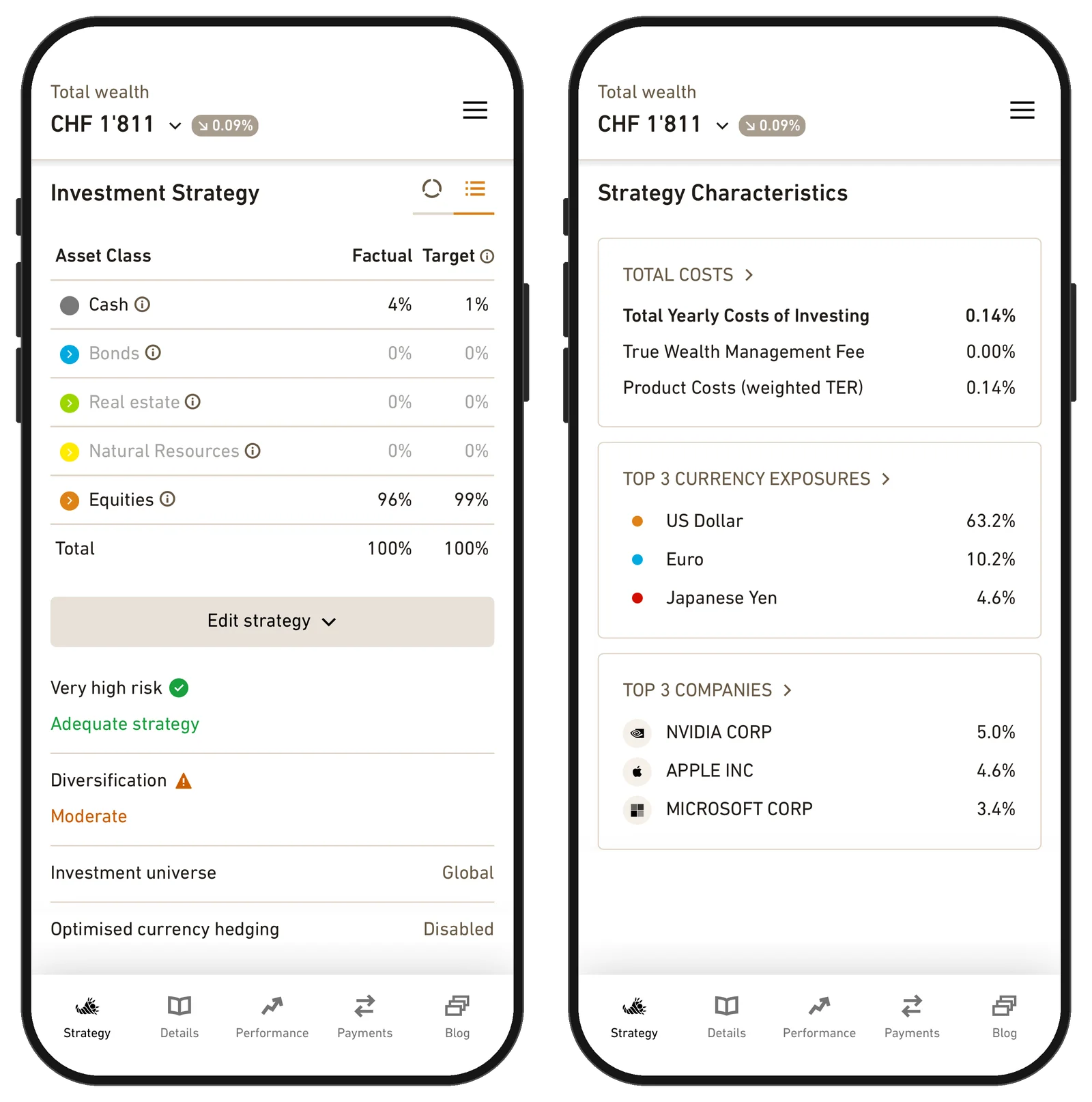
What other clients say
On Trustpilot, True Wealth has a TrustScore of 4.7 out of 5 (as of October 2026). For a financial services provider, that’s a very good score: banks and brokers usually do much worse there, because it’s mainly dissatisfied customers who leave reviews. Note, however, the rather small base of around 40 reviews. Reviewers mainly praise the clear app, the transparent fees and the fast, personal support by phone. A few criticised the initially unclear separation between Pillar 3a and non-pension assets.
How safe is True Wealth?
Risk: “Insolvency of True Wealth or the custodian bank”
True Wealth only manages your money; it is held by the custodian bank: non-pension assets in a securities account in your name, pension assets with the foundation. ETFs and index funds are segregated assets and do not become part of the bankruptcy estate even if a bank fails. Cash is covered by the bankruptcy privilege up to CHF 100,000, and at BLKB additionally by the state guarantee.
By default, True Wealth requires a code sent by email in addition to your password when you log in. That’s secure, but tedious in the long run. Our tip: on desktop, activate two-factor authentication with an authenticator app such as Google Authenticator, and in the app enable biometric login – then the email code is no longer needed, without any loss of security.
Risk: “Realised price losses”
This risk doesn’t depend on the provider but on your equity share and investment horizon. To make sure a market low shortly before withdrawal doesn’t hit you too hard, it’s best to reduce your equity allocation gradually a few years before withdrawal. Thanks to staggering, you can also withdraw the accounts spread over several years. But watch out: if you also hold non-pension assets with True Wealth, the lower equity allocation applies to them too because of the single strategy.
Non-pension assets and children’s portfolio: what do they cost?
In addition to Pillar 3a, True Wealth offers wealth management for non-pension assets and a children’s portfolio. Both follow the same investment logic but cost significantly more. Here, True Wealth advertises “radically low fees”. Compared with traditional banks, that’s true; compared with robo-advisors such as VIAC or findependent, it no longer is. True Wealth’s fees are only radically low for the 3a solution.
As custodian bank, you choose between BLKB and Saxo Bank Schweiz. With Saxo, some cheaper US-domiciled ETFs are used, which offer advantages in terms of withholding tax but may be subject to US estate tax.
The management fee of 0.50% only starts to decrease gradually from CHF 500,000, down to 0.25% from CHF 8 million. As True Wealth confirmed to us, it is charged on all non-pension assets, including the cash portion. Since cash currently earns no interest (as of October 2026), every franc not invested costs you 0.5% per year. For small amounts this hardly matters, but you’re better off parking larger liquidity reserves in a savings account.
Custody and trading fees, rebalancing and the electronic tax statement are included. Not included is the foreign currency surcharge of max. 0.1%. However, it only applies to the amount traded, for example with deposits and withdrawals or rebalancing, and is therefore hardly relevant. The overview shows how big the difference to Pillar 3a is:
| Pillar 3a | Non-pension assets | |
|---|---|---|
| Minimum deposit | CHF 1,000 | CHF 8,500 (children’s portfolio CHF 1,000) |
| Management fee | 0% | 0.50% (up to CHF 500,000) |
| Product costs | 0.12–0.14% | 0.12–0.14% |
| Total investment costs | 0.12–0.14% | 0.62–0.64% |
| Costs per year on CHF 100,000 | CHF 120–140 | CHF 620–640 |
When non-pension assets become worthwhile
Our pain threshold is 0.5% in total investment costs. For non-pension assets alone, True Wealth only reaches it from CHF 1.2 million, when the management fee drops to 0.37%. If you add your 3a without a management fee, the average across all your assets at True Wealth falls below this threshold much sooner, depending on the split.

The same tiered scale applies to the children’s portfolio. What counts is your total assets with True Wealth, i.e. non-pension assets and children’s portfolios combined. A children’s portfolio on its own therefore also costs just over 0.6% per year; it only becomes cheaper for families with large non-pension assets at True Wealth. Good to know: the money legally belongs to the child, and you can set up a separate login for them so they can follow how their money is doing.
Our verdict on non-pension assets and the children’s portfolio: on its own, True Wealth is more expensive here than other robo-advisors, with total investment costs of just over 0.6%, and only reaches our pain threshold from CHF 1.2 million. It gets more interesting in combination: if you also keep your 3a at True Wealth, total costs fall significantly depending on the split – with CHF 100,000 each, to around 0.37%. If you want 3a and non-pension assets conveniently managed by one provider, you get an all-in-one solution at fair costs.
True Wealth and its quirks
True Wealth works differently from other robo-advisors in a few respects, as the following examples show:
- Five accounts automatically: ideal for staggered withdrawal in retirement, without you having to worry about it. Some may find this excessive, especially with smaller balances, and would rather decide on the number of accounts themselves.
- One strategy for 3a and wealth management: all 3a accounts and the online wealth management follow the same investment mix; only the children’s portfolio is managed separately. That’s consistent – True Wealth looks at your assets as a whole – but feels rather unusual to us. With other providers, you can choose a separate strategy for each account.
- Minimum deposits: at CHF 1,000 for 3a and the children’s portfolio and CHF 8,500 for wealth management, the entry barriers are comparatively high. Many robo-advisors deliberately set very low minimum deposits.
- Regions freely weightable, but gaps in global coverage: you can set the split across seven regions yourself if you wish, which offers a lot of flexibility. However, True Wealth defines the Europe region as the eurozone and covers it only via the Euro Stoxx 50, so countries such as Sweden, Denmark and Norway are missing. Canada isn’t represented either, and small caps are only available for Switzerland and the emerging markets. For us, a clear minus: a global portfolio should be consistently global.
- Big price gap: the 3a solution is one of the cheapest on the market, whereas non-pension assets and the children’s portfolio cost just over 0.6% per year. That’s cheaper than traditional wealth managers but more expensive than other robo-advisors. If you combine both, total costs go down, as the combined fee calculator on the website shows.
For the 3a solution, none of these points is a deal-breaker, and in combination with non-pension assets the price gap matters less. If, on the other hand, you only want to invest non-pension assets, there are cheaper alternatives.
Opening an account and transferring your 3a
Opening an account is fully digital and takes four steps. The first three take around ten minutes:
- Personal information: you choose whether to open only Pillar 3a or non-pension assets as well (can be changed later). True Wealth then asks about your income, assets and the origin of your funds, as required by anti-money-laundering rules. For identification, you take a selfie.
- Signing the contract: you sign the contracts digitally.
- Deposit: from a Swiss bank account in your name, you transfer CHF 1, which is refunded to you, or the minimum deposit straight away. This allows True Wealth to verify your bank account and register it as the reference account for later withdrawals.
- Investment strategy: as soon as the minimum deposit has arrived, True Wealth determines your risk profile and suggests a strategy that you can adjust to your liking.
Our tip: transfer the minimum deposit right away instead of CHF 1, so you can set your strategy without a detour. If you want to get an idea first, you can open a test account beforehand and try out the strategies without making a deposit.
🎁 If you also open non-pension assets or a children’s portfolio, you get a CHF 100 fee credit with our bonus code SFB100TW. It is applied automatically via the link.

Transferring 3a from another provider
You can transfer existing 3a assets to True Wealth and later switch to another provider again. Keep in mind:
- Depending on the notice period of your current pension foundation, the switch takes some patience.
- Each transfer lands in its own account, which cannot be topped up later. If you have several small 3a balances with different providers, you’ll end up with just as many accounts.
- For a later transfer to another provider, the fee regulations provide for no fee, and withdrawal from the ordinary retirement age is also free of charge. For an early withdrawal, for example for home ownership, True Wealth charges CHF 250 plus VAT.
What are the pros and cons of True Wealth?
 Extremely low costs in 3a: 0% management fee, around 0.12–0.14% in total High flexibility: standard strategy matching your risk profile or a customised strategy with up to 99% equities Broad investment universe with all major asset classes: equities, bonds, real estate, commodities and cash Withholding-tax-optimised index funds in 3a for a higher net return Automatic staggering across five 3a accounts for a tax-optimised withdrawal Holistic view of 3a and non-pension assets Clear, intuitive app and desktop version in German, English and French Competent, multilingual support, quick by phone and email CHF 100 fee credit with our bonus code SFB100TW (for non-pension assets and children’s portfolio)
 Relatively high costs for non-pension assets and the children’s portfolio: just over 0.6% in total, more than with some other robo-advisors Gaps in global equity coverage No separate strategies per account or for 3a and non-pension assets
True Wealth bonus code: CHF 100 fee credit
As a new client, you get a CHF 100 fee credit with our bonus code SFB100TW, valid for twelve months. It is applied automatically via the link.
Since the 3a solution has no management fee, you only benefit if you also invest non-pension assets or open a children’s portfolio. You can use up the full credit from around CHF 20,000. If you first open a test account via our link, the code stays saved, and the twelve months only start with the minimum deposit in your real account.
Conclusion of our True Wealth review
In Pillar 3a, according to our research, True Wealth offers the cheapest investment solution in Switzerland. On top of that come withholding-tax-optimised index funds and automatic staggering, which takes care of one of the most important tax optimisations in 3a without any effort on your part.
We were also convinced by the clear app, the fast and competent support and the high level of security. There are drawbacks in equity coverage, where Canada and the Nordic countries, for example, are missing, and because the same strategy applies to both 3a and online wealth management.
For non-pension assets and the children’s portfolio, the “radically low fees” are only radical compared with traditional banks: with total investment costs of just over 0.6%, True Wealth is more expensive than other robo-advisors. In combination with 3a, however, total costs fall significantly depending on the split – with CHF 100,000 each, to around 0.37%.
Our verdict: a clear recommendation for the 3a solution: thanks to the low fees, you keep more return year after year, and once it’s set up, you don’t have to worry about anything. A conditional recommendation for non-pension assets and the children’s portfolio: acceptable in price in combination with 3a and worthwhile for anyone who wants all their assets managed by one provider. If you only want to invest non-pension assets, you’ll find cheaper alternatives.
Do you have questions or your own experiences with True Wealth or other robo-advisors? Let us know in the comments.
Frequently asked questions about True Wealth
What has your experience with True Wealth been like?
Mostly positive. According to our research, the 3a solution is the cheapest in Switzerland, the app is clear and the support fast and competent. There are drawbacks in equity coverage, where Canada and the Nordic countries, for example, are missing, and because 3a and non-pension assets follow the same strategy. Our review is primarily based on our own use since October 2026.
Who owns True Wealth?
True Wealth was founded in 2013 by Felix Niederer and Oliver Herren. Since 2016, Basellandschaftliche Kantonalbank (BLKB) has held a minority stake.
Is my money safe with True Wealth?
Yes. True Wealth is supervised by FINMA. 3a assets are held at BLKB, a bank with a state guarantee, and non-pension assets either at BLKB or at Saxo Bank Schweiz. ETFs and index funds are segregated assets and do not become part of the bankruptcy estate even if a bank fails.
Is Pillar 3a at True Wealth really free?
No, but almost. True Wealth charges no management fee in 3a. You only pay product costs of 0.12–0.14% per year (sustainable from 0.21%), plus one-off transaction costs when investing (as of October 2026).
How does True Wealth earn money on 3a without a management fee?
True Wealth earns nothing on an ongoing basis from 3a itself, as there is neither a management fee nor retrocessions. We assume a cross-subsidy model: the low-cost 3a attracts new clients, some of whom also invest non-pension assets, where the management fee applies.
How many 3a accounts does True Wealth open?
Up to five, and automatically: in the first five years, a new account is created every year; after that, contributions go to the account with the lowest balance. Every transfer from another provider gets an additional, separate account.
Can I transfer my existing 3a to True Wealth?
Yes. For each transfer, True Wealth opens a separate account, which cannot be topped up later. Depending on the notice period of your current pension foundation, the switch takes some patience.
What is the minimum deposit at True Wealth?
CHF 1,000 for 3a and the children’s portfolio, CHF 8,500 for non-pension assets.
How much does True Wealth cost?
In 3a, 0.12–0.14% per year, as only product costs apply – around CHF 120 to 140 on CHF 100,000. For non-pension assets and the children’s portfolio, it’s just over 0.6% (management fee of 0.50% plus product costs), around CHF 620 to 640 on CHF 100,000. The management fee is also charged on the cash portion.
What does it cost to switch to or away from True Wealth?
According to the fee regulations, a transfer to another provider is free of charge, as is withdrawal from the ordinary retirement age. An early withdrawal, for example for home ownership, costs CHF 250 plus VAT.
Is True Wealth also worth it for non-pension assets?
Yes, under two conditions: you also keep your 3a at True Wealth, and having everything with one provider matters to you. In combination with 3a, total costs fall significantly – with CHF 100,000 each, to around 0.37%. On its own, however, True Wealth is more expensive than other robo-advisors for non-pension assets, at just over 0.6%.
Does the bonus code SFB100TW also apply to Pillar 3a?
No. The CHF 100 credit is offset against management fees, which don’t exist in 3a. It only applies to non-pension assets and the children’s portfolio and is fully used up from around CHF 20,000.
What return does True Wealth deliver?
True Wealth doesn’t guarantee any return; it depends on the equity share and the markets. The model projection for our portfolio with 99% equities shows around CHF 135,000 in returns after 15 years in the neutral scenario, with deposits of around CHF 112,000. What you can influence above all are the costs, and here True Wealth scores in 3a with low fees and withholding-tax-optimised index funds.
True Wealth or VIAC?
On costs, True Wealth is clearly ahead in 3a: 0.12–0.14% per year compared with 0.44% at VIAC (strategy with the highest equity allocation, as of October 2026). VIAC, on the other hand, scores with a separate strategy per account and included basic cover in the event of disability or death. More on this in our VIAC review.
Which robo-advisor is the best?
It depends on your goal. For Pillar 3a, according to our research, True Wealth is the cheapest solution. If you only invest non-pension assets, you’ll find cheaper providers. You can get an overview on our recommendations page.
You might also be interested in
Updates
2026-10-22: First published
Disclaimer
Disclaimer: Investing involves the risk of loss. You have to decide for yourself whether or not you want to take these risks. Past returns are no guarantee of future returns.
Errors excepted: We have written this article about our True Wealth experience to the best of our knowledge and belief. Our goal is to provide you as a private investor with information on finance that is as objective and meaningful as possible. Should we nevertheless have made mistakes, or if important aspects have been forgotten and/or are no longer up to date, we would be grateful if you let us know.
About the authors

Stefan Huser
Stefan has been investing in the stock market himself since 2015. He has been shaped by Markowitz’s portfolio theory and Gerd Kommer’s book “Souverän investieren”. He follows a core-satellite strategy: a global equity portfolio of ETFs forms the core, complemented by alternative investments. At the blog, he mainly takes care of the writing. Stefan lives with his family in Zurich and is interested in literature, photography and financial freedom.

Antun Brcina
Antun (“Toni”) has been investing in the stock market since 2015. Financially, he has been particularly inspired by Gerd Kommer’s book “Souverän investieren” and the Fama-French five-factor model. His money is invested in a broadly diversified, long-term global equity portfolio of ETFs. At the blog, he mainly works on the calculators and the code. Toni lives with his family in the Zurich area and is interested in sports, technology and entrepreneurship.