
 Newsletter

Many investment mistakes, including the most damaging ones, are based on behavioral patterns that we trained ourselves in over thousands of years to ensure the survival of our species. The problem: to this day, these irrational behaviors are deeply ingrained in us. Mentally, we have largely remained hunters and gatherers. Actions that were vital to our survival as cave dwellers back then are harmful to our investments today. By the way, professionals and private investors are equally affected by these psychological pitfalls.
With this article, we want to make you aware of the biggest thinking errors when it comes to investing your money and show you effective countermeasures. We draw on scientific literature from the relatively new field of research known as “behavioral finance”.
Contents
- Introduction
- The 13 biggest thinking errors in investing
- Overview
- The thinking errors one by one, with explanations, examples and tips
- Thinking error no. 13: Black swan
- Thinking error no. 12: Survivorship bias
- Thinking error no. 11: Home bias – preference for the home market
- Thinking error no. 10: Confirmation bias
- Thinking error no. 9: Action bias – overactivity
- Thinking error no. 8: Information bias – information overload
- Thinking error no. 7: “Regression toward the mean” ignorance – ignoring the regression effect
- Thinking error no. 6: Social proof – herd instinct
- Thinking error no. 5: Hindsight bias
- Thinking error no. 4: Loss aversion
- Thinking error no. 3: Overconfidence bias
- Thinking error no. 2: Sunk cost fallacy
- Thinking error no. 1: Underestimating exponential growth
- Calculation
- Diagram
- Further reading (incl. book tips)
- You might also be interested in
- Updates
- Disclaimer
Introduction
What do “behavioral finance” and “bias” mean?
Before we dive properly into this fascinating topic and look at what we consider to be the 13 biggest psychological pitfalls in investing, let’s clarify two key terms:
Behavioral finance
Behavioral finance is a relatively new field of research in finance that analyzes the psychology of investing. This short definition comes from the University of Zurich, more precisely from the description of its “Behavioral Finance” course. In an ideal financial world, completely rational investors (“Homo oeconomicus”) can classify all the information on the market without error and draw purely logical conclusions from it. In reality, however, investors act irrationally, rate certain information as more or less important than it actually is, and therefore make poor investment decisions. The behavior-oriented theory of financial markets, as “behavioral finance” is called in German, explains why this is the case – and why repeating these decisions leads to seemingly illogical developments on the markets.
Bias
Biases are distortions. In this article, we focus on cognitive biases that are systematic and erroneous in nature, scientifically confirmed and related to money. Biases as defined here lead us to irrational behavior with our finances.
And one more important point: if you think biases only affect fools, you are unfortunately mistaken. Biases affect people at every level of education, albeit to varying degrees depending on the bias. As we will see later, highly educated people are sometimes even more affected by biases than simpler minds.
In this article, we use thinking errors and psychological pitfalls as synonyms for biases.
How are biases identified?
To identify systematic, erroneous cognitive biases, rational benchmarks must first be developed on the basis of testable rules. Systematic deviations from these standards – that is, deviations that are not individual and random – are then considered irrational or wrong.
Why did we choose these 13 thinking errors in particular?
We took a systematic approach and went through the following four steps when selecting the 13 biggest thinking errors.
- Reading specialist literature by various authors (see this chapter)
- Making a preselection (population) of around 100 thinking errors (based largely on Dobelli’s two books)
- Analyzing the preselection and identifying the most important thinking errors related to money
- Ranking the 13 thinking errors identified in the previous step
By the way: even though the unlucky number “13” is, of course, a good fit for a ranking of the biggest thinking errors in investing, we had no particular number in mind when we started our analysis. After our research, there were simply 13 thinking errors left that we considered particularly relevant when it comes to money.
But enough of the introductory words – enjoy reading!
The 13 biggest thinking errors in investing
Overview
We have selected the following thinking errors that are relevant to your investments and sorted them in descending order. In other words, the lower the rank number, the more serious we consider the thinking error to be. In our view, thinking error no. 1 therefore has the biggest (negative) impact on your investments.
- Thinking error no. 13: Black swan
- Thinking error no. 12: Survivorship bias
- Thinking error no. 11: Home bias – preference for the home market
- Thinking error no. 10: Confirmation bias
- Thinking error no. 9: Action bias – overactivity
- Thinking error no. 8: Information bias – information overload
- Thinking error no. 7: “Regression toward the mean” ignorance – ignoring the regression effect
- Thinking error no. 6: Social proof – herd instinct
- Thinking error no. 5: Hindsight bias
- Thinking error no. 4: Loss aversion
- Thinking error no. 3: Overconfidence bias
- Thinking error no. 2: Sunk cost fallacy
- Thinking error no. 1: Underestimating exponential growth
In the following chapters, we present each of these thinking errors. Each one starts with a general explanation, followed by practical investment examples and a conclusion with tips on how you can avoid the thinking error in question.
And one more thing: we look forward to your feedback in the comments below, whether you share our assessment or disagree with it.
The thinking errors one by one, with explanations, examples and tips
Thinking error no. 13: Black swan
We kick off our ranking with the black swan – the “Who would have thought?” thinking error. In the sense used by Nassim Taleb, author of the bestseller “The Black Swan”, this is an unthinkable event with a huge impact on our lives. There are positive and negative black swans.
The coronavirus crisis, for example, produced both positive and negative black swans. Negative: with the lockdown, all restaurants, gyms and other meeting places had to close – often with drastic financial consequences for owners and staff. On the positive side, however, the pandemic paid off for all investors who topped up their equity ETFs during the coronavirus crash, which lasted only a few days, and thus benefited from prices around 30 percent lower.
Another negative black swan was our former national airline, Swissair. On 3 October 2001, its shares plunged by 96%. Shortly afterwards, one of Switzerland’s most venerable companies went bust. If you invest in individual shares, black swans like this in the form of total losses on the stock market happen more often than is commonly thought.
Besides Swissair, there are countless other once highly praised “hero to zero” companies that threw in the towel practically overnight and had to cease trading. Other examples worth recalling are the global investment bank Lehman Brothers, the energy giant Enron and the ambitious German payment processor and former stock market darling Wirecard.
Conclusion: Invest according to rules, diversify your investments broadly and always keep a cool head when the stock market is in turmoil. This won’t protect you from crashes and the book losses that come with them. But unlike investing in individual stocks, you won’t suffer total losses as a result of company bankruptcies.
Thinking error no. 12: Survivorship bias
With this thinking error, the probability of success is systematically overestimated. This error is particularly common with actively managed investment funds. Financial rags regularly publish rankings of the best-performing funds of their advertising clients. Lovely moments for the financial industry and its marketing departments, which of course gleefully milk this good news across all media channels. And who could blame them?
So where’s the problem? The period under review is too short. It’s no great feat to beat the index over one, two or three years. Over the longer term, however, only a tiny minority of actively managed funds manage to do so – after costs. Worse still – and now we come to the heart of this bias: the majority of funds end up in the investment graveyard. In other words, fund providers keep weeding out their loser funds for lack of success, taking them off the market – and out of our memory. Of course, these negative stories don’t appear in the glossy brochures; they happen quietly behind closed doors. What remains are the few “winning funds” hyped up by the media.
This bias therefore leads us to mistakenly assume that the market is teeming with successful actively managed funds. Success stories, in other words, that manage to beat the index with ease.
The fact is, however, that the overwhelming majority of actively managed funds have an unfavorable risk/return ratio. In other words, after costs they fail to beat the (correct, given the risk taken) index or a corresponding ETF over the long term, i.e. over ten years or more.
Conclusion: Don’t let success stories from the financial industry fool you. Also bear in mind that yesterday’s winning funds are often tomorrow’s flops (see also thinking error no. 7). When choosing an investment product, focus on the question that really matters: how high was the risk-adjusted, long-term return of the fund you have chosen or are considering, after all costs, compared with the appropriate index (benchmark)? If you come to the conclusion that you can’t achieve the market return (index), buy one or more proven index-based ETFs. If you find it hard to choose, take a look at our independent ETF comparison “Best ETFs in Switzerland and worldwide: And the winner is…”.
Thinking error no. 11: Home bias – preference for the home market
Home bias refers to the tendency to overweight investments in your home market. Put simply, this means that Swiss investors prefer to invest in the “SMI”, Germans in the “DAX” and Americans in the “S&P 500”. The reasons for favoring the home market are many and, at least at first glance, understandable: more trust in local companies, better information, lower transaction costs, no exchange rate risks.
However, scientific studies show that global diversification gives your investments the best risk/return ratio in the long term. This finding does not rule out that, for example, the Swiss index “SMI”, which is concentrated on a few Swiss stocks, will sometimes perform better over one period or another than the broadly diversified world index “MSCI World”. But the risk you take is higher.
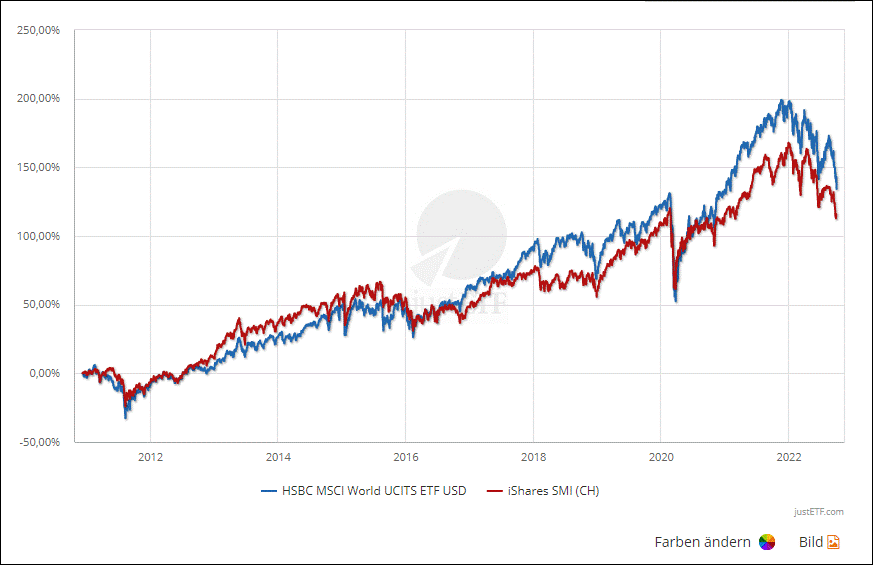
With the SMI, performance depends heavily on just a few stocks. The top 3 positions in the SMI – Nestlé, Novartis and Roche – account for more than 55%. This means that if just one of these stocks weakens, the whole index weakens. It’s a different story with the broadly diversified MSCI World, with around 1,600 companies from 23 developed countries, including Switzerland: the top 3, Apple, Microsoft and Amazon, account for only 11% of the MSCI World’s total market capitalization.
Conclusion: Be patient and harness the power of diversification over the long term. This gives you the only free lunch in investing. In other words, an advantage that doesn’t have to be paid for with a disadvantage. This is reflected in an optimal risk/return ratio.
Thinking error no. 10: Confirmation bias
For Dobelli, confirmation bias is the father of all thinking errors. That is probably why it is the only one to which he devoted two whole chapters in his book “The Art of Thinking Clearly”, which is well worth reading. With us, this thinking error at least makes it into the top 10.
What’s it about? With confirmation bias, we tend to interpret new information in a way that is compatible with our beliefs, for example in the form of theories or world views. New information that contradicts our existing views gets filtered out. This is dangerous, because “facts do not cease to exist because they are ignored”, as the British writer and philosopher Aldous Huxley once put it.
Let’s assume you are firmly convinced that the “equities” asset class is extremely dangerous, that ordinary investors get badly ripped off in the stock market casino and that, sooner or later, they will therefore only suffer losses. If you fall prey to confirmation bias, you will interpret and filter all new stock market news in a way that confirms your beliefs. As a result, your negative “view of the stock market” becomes more and more entrenched.
Conclusion: Write down your beliefs about money. Then devote yourself to the necessary but tedious work of critically questioning these beliefs by looking for counter-examples (disconfirming evidence). If you want to counteract even more effectively, ask your most critical acquaintances to “challenge” your beliefs and, if necessary, tear them to shreds.
Thinking error no. 9: Action bias – overactivity
This mistake often happens in new or unclear situations. We then feel the urge to do something rashly, anything at all – even if it’s to our disadvantage.
Newcomers to the stock market in particular tend to constantly tinker with their portfolio – with unnecessary trades, for example. In doing so, they incur needlessly high costs.
Action bias stems from our hunter-gatherer days, when activity was superior to doing nothing in most situations. Even more: back then, reacting decisively was vital for survival, while waiting patiently could be fatal. Just think of the saber-toothed tiger lurking behind the bushes.
Conclusion: In uncertain situations such as the one we are currently experiencing with the war in Ukraine and the upheavals that come with it (inflation, energy crisis, etc.), it pays to act calmly, rationally and according to rules on the stock market. We see an effective tool against action bias in a written mission statement for your own finances and an asset allocation tailored to your personal risk profile. Tools like these give you security in stormy stock market times. In addition, robo-advisors can be useful for you, as they let you keep your portfolio on autopilot and thus protect you from harmful overactivity.
Either way, you can rein in your impatience by taking to heart the stock market wisdom of stock market guru André Kostolany, who died in 1999: “Buy shares, take sleeping pills and stop looking at them. After many years, you will see: you are rich.” For the equity ETFs we favor, we immediately agree with this “buy and hold” approach. To avoid total losses, however, we strongly advise against doing nothing or sleeping indefinitely with individual shares. Because history teaches us that individual companies can go bust more often and more quickly than is commonly thought (see also thinking error no. 13).
Thinking error no. 8: Information bias – information overload
Information bias is the mistaken belief that more information automatically leads to better decisions. As investors, we are confronted every day with masses of irrelevant and/or false financial news.
Here is a small selection on the Swiss share index SMI as at 29 August 2022: “Heavyweights prevent bigger losses”, “Three negative signals in a row” (both from Finanz und Wirtschaft), “Battered: is the SMI now heading for its low for the year?” (Cash), “SMI – buying opportunity at support” (Onvista). While the first headline is irrelevant but at least correct, the other three are the work of so-called chart technicians. They try to predict future developments from past price movements, which from a scientific point of view is complete nonsense. In his book “Souverän investieren mit Indexfonds und ETFs”, which is well worth reading, author Kommer dismissively calls such hocus-pocus “financial pornography”.
Conclusion: Try to get through life with a minimum of stock market information, in the spirit of “what you don’t know can’t hurt you”. Instead, focus on the relevant basics of investing, which we have summarized in eight lessons here. In addition, read or listen to one or more serious non-fiction books (see our reading recommendations in this chapter). This will help you build a stable and well-founded mindset on financial matters that protects you from uncertainty and from irrational, harmful investment decisions.
Thinking error no. 7: “Regression toward the mean” ignorance – ignoring the regression effect
Regression toward the mean is a somewhat unwieldy term from the world of statistics. It describes the phenomenon that after an extreme measurement, the next measurement will be closer to the average again. Extreme performances therefore alternate with less extreme ones.
Applied to the stock market, the regression effect means that the best-performing equity ETF of the last three years is unlikely to be the best-performing ETF of the next three years.
If we ignore this statistical principle on the stock market, we engage in harmful performance chasing, a variant of market timing. Driven by “FOMO” (fear of missing out), we chase returns – in other words, we buy at peak prices in overheated markets, which is the ultimate losing formula on the stock market.
But why do we behave like this? This thinking error is probably down to our human instincts: winners attract us like magnets.
Conclusion: A simple and effective way of taking regression toward the mean into account is to carry out a rules-based rebalancing periodically based on predefined target weights. This way, you invest anti-cyclically rather than in markets that have already overheated and have a high potential for a crash.
Thinking error no. 6: Social proof – herd instinct
Social proof refers to our still deeply ingrained herd instinct. But why are we wired like this? Because this group-oriented behavior proved to be a good survival strategy in our evolutionary past. Think of the saber-toothed tiger again. Anyone who hesitated and didn’t flee with the rest of the group was eaten and disappeared from the gene pool.
Today, and as far as the stock market is concerned, social proof is above all one thing: the great evil behind bubbles and crashes.
Conclusion: In our view, the best recipe against social proof is solid financial education and, of course, being aware of this thinking error.
Thinking error no. 5: Hindsight bias
With hindsight bias, a development seems completely plausible and predictable to us in retrospect. A big mistake: after all, who correctly predicted the 2008 financial crisis or the 2020 coronavirus crash? Nobody.
According to Dobelli, hindsight bias is one of the most persistent thinking errors of all. He also describes it as the “I knew it all along” phenomenon. According to studies, even people who know about this thinking error fall into the trap just as often as everyone else.
So why is hindsight bias so dangerous for us investors? Because it makes us believe we are better at predicting than we really are. This makes us overconfident on the stock market and leads us to make the wrong decisions.
Conclusion: Dobelli recommends keeping a diary of our economic forecasts so that we can remind ourselves of our misjudgments in black and white at any time. A less time-consuming but no less effective measure, in our view, is the passive, rules-based investment approach free of forecasts and speculation that we advocate on our blog and follow with our own money.
Thinking error no. 4: Loss aversion
Looking at the near-record amounts the average Swiss spends on insurance, we are probably particularly affected by this thinking error. What’s it about? Investors tend to react more strongly to negative price movements than to positive ones. As a rule, price losses of 20% therefore weigh on us more than price gains of the same size please us.
Loss aversion also shows up in overly cautious investment behavior. Risk-averse investors feel most comfortable with their (interest-free) savings account, while avoiding risky asset classes such as equities.
By the way, in our evolutionary past, loss and risk aversion were even more pronounced than they are today. One stupid mistake was enough to end your life. People who were careless or too fond of risk died before they could pass their genes on to the next generation. The cautious ones survived – and so did we, as their descendants.
We see the extreme version of loss aversion in the so-called zero-risk bias. Is there even such a thing as zero risk in financial matters, i.e. total security? Of course not. Even if you sell all your equity ETFs and transfer the money to a savings account, your assets are not safe. The bank could go bust, inflation eats away a little of your savings every day, or a currency reform brings nasty surprises.
Conclusion: Risk is as much a part of life as it is of investing. From a rational point of view, you are well advised to insure against risks that threaten your existence, to bear all other risks and to benefit in the long term from returns above the rate of inflation.
Thinking error no. 3: Overconfidence bias
Almost there! We now come to the medal positions: bronze goes to our overconfidence. This thinking error consists of systematically overestimating our knowledge and our ability to make forecasts. This psychological pitfall is encouraged by previous random successes (“beginner’s luck”).
In the late 1990s, for example, many investors put all their savings into internet stocks. Spurred on by early successes, they imagined they had masterful stock-picking skills, i.e. a knack for choosing successful stocks of the future. A big mistake: the whole market was simply going up at the time. And when the dotcom bubble burst, the financial tragedy of numerous speculators was complete.
Surprisingly, according to Dobelli, experts such as economics professors suffer even more from overconfidence. With serious consequences if we blindly follow these professionals’ forecasts for our investments. This uncritical and harmful faith in authority is also known as “authority bias”.
Conclusion: Ignore forecasts, or at least always be skeptical of both your own market assessments and those of so-called stock market professionals. Especially when it comes to short-term forecasts. In our opinion, the only two forecasts you should make as a rational equity investor are
- that the market economy will endure in the long term and
- that, globally, more and more people will be able to raise their standard of living.
If you share these two assessments, then in our view there is nothing to stop you from investing for the long term in one or more passive, broadly diversified equity ETFs.
Thinking error no. 2: Sunk cost fallacy
Every business student is warned about this thinking error, to which we award the silver medal. What’s it about? Whether company bosses or private investors, they all tend to keep factoring sunk costs from earlier bad decisions into their current decision-making.
As a result, further costs are accepted for unsuccessful projects (“throwing good money after bad”) instead of ending the project and admitting the bad investment. In other words: if you put a project to the test today, only the future cost-benefit ratio should go into your decision, not the past costs that have already been sunk. Because these are irretrievably lost.
Example: you have been invested in an expensive, actively managed equity fund for many years. Let’s call it the “The World’s Best Stocks Premium Fund”. You notice that, due to the high costs, the performance of this investment lags well behind the MSCI World Index benchmark over several years. What do you do? As a rational investor, you pull the ripcord: you stop the high costs, accept any exit fees and invest in a low-cost (passive) equity fund instead. By the way, you should do the same with overpriced brokers.
Conclusion: Treat sunk costs as a valuable, if sometimes expensive, lesson and live by the motto “Better a terrible end than terror without end”.
– P a r t n e r o f f e r –
– – – – –
Thinking error no. 1: Underestimating exponential growth
Gold goes to exponential growth! This choice may surprise you. But exponential growth, which shows up in your investments as the compound interest effect, is so powerful that we consider underestimating it to be the biggest psychological pitfall. When investing, the compound interest effect is your closest ally and, over the long term, a performance booster like no other, as we will see later.
Albert Einstein is said to have once remarked: “Compound interest is the eighth wonder of the world. He who understands it, earns it; he who doesn’t, pays it.” Unlike linear growth, which we understand intuitively, exponential growth exceeds our imagination. That’s because our evolutionary past did not prepare us for it. Our ancestors’ experiences were mainly linear. Anyone who spent twice as much time picking berries, for example, brought in twice the harvest.
To make this easier to understand, consider the following scenario: generous as you are, you want to make a one-off investment of CHF 10,000 for your underage offspring (or, of course, your godchild). You compare three investment options over an investment horizon of 40 years.
Option A is a fixed-income security in the form of a corporate bond with an annual coupon of 8%. Option B is an “MSCI World” equity ETF with expected price increases of 8% per year on average. Option C is an actively managed “global equity fund” from your bank with an expected return of 6% (market return minus 2% in management fees & co.). For simplicity, we leave inflation and taxes out of the equation. Which would you choose?
Well done, you probably picked B and so made the “right” choice.
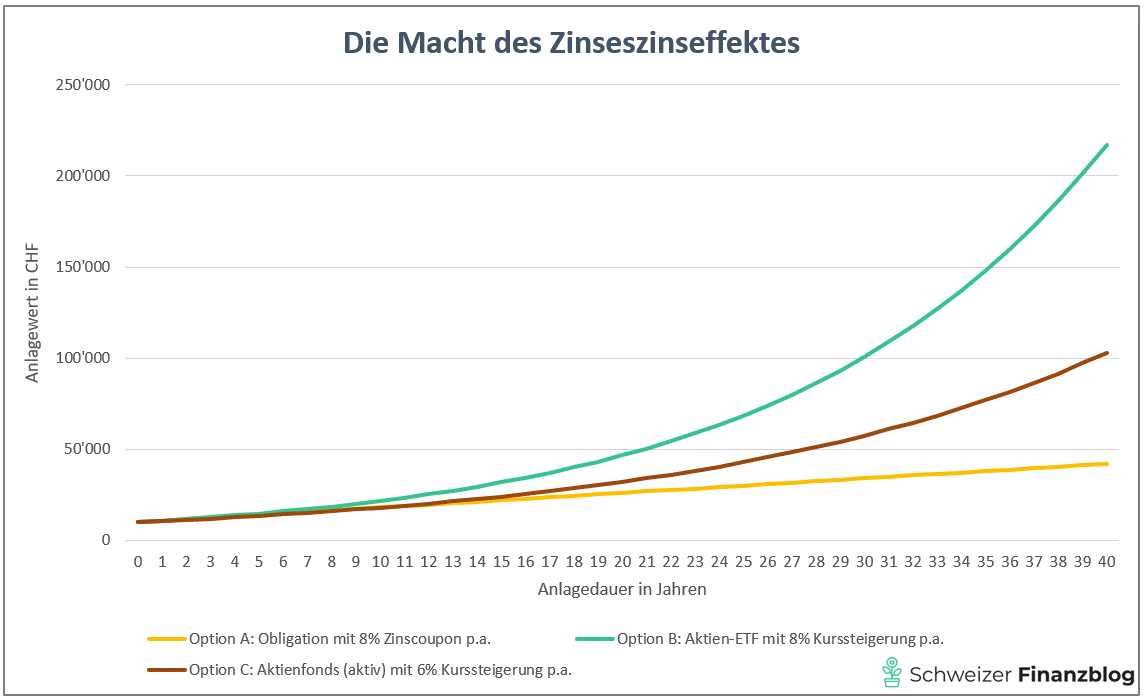
What you may not have expected, however, are the huge differences in the increase in value of the three investment options (see Fig. 3).
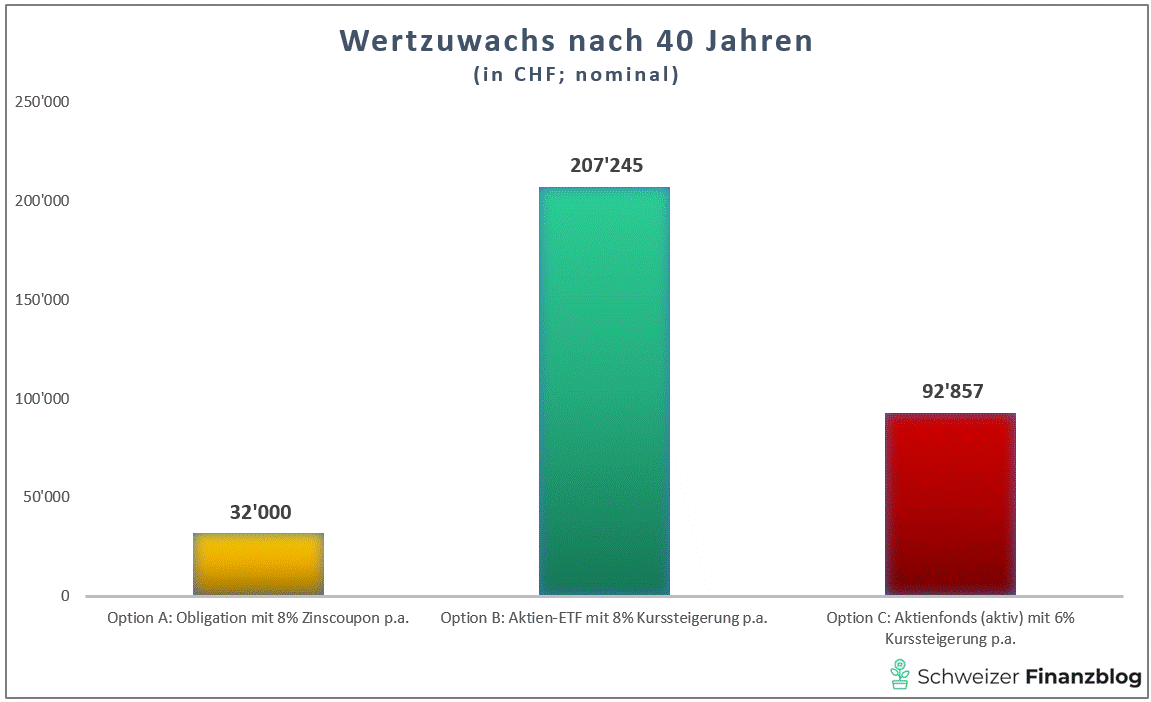
Let’s first compare options A and B. Both pay 8% interest. So the decisive factor here is not the interest rate, but the exponential growth of option B. With the ETF, the compound interest effect kicks in, i.e. the base on which interest is earned grows by 8% every year: 10,000, 10,800, 11,664 and so on. With the bond, on the other hand, it stays constant at CHF 10,000, which is why the interest income also remains stable over the years (linear growth).
What is astonishing is that, thanks to the compound interest effect, the ETF doesn’t just beat the bond by 20, 30 or 50%, but by 548%!
If we compare options A and C, we notice that here, too, compound interest is more powerful than the interest rate. Despite the lower interest rate (8% vs. 6%), option C outperforms A by 190%.
Equity investors, however, will probably be most interested in the considerable difference in performance between options B and C. The same asset class, but a seemingly small interest difference of 2%, due to higher fees, means CHF 114,388 less return after 40 years with the actively managed investment.
Conclusion: Harness the power of compound interest for your investments. Invest passively rather than actively and choose a low-cost broker that suits you to keep the costs of investing as low as possible. Because of the negative compound interest effect, these ongoing costs have a drastic long-term impact on your wealth, as the comparison between options B and C has strikingly shown. Last but not least: when it comes to growth rates, don’t rely on your gut feeling, but on your calculator or the compound interest formula: [=initial investment*(1+interest rate/100)^holding period)-initial investment] or, for option B as an example: [=10000*(1+8/100)^40-10000] (Excel)
It’s even easier with our interactive compound interest calculator – the more efficient alternative that spares you from wrestling with formulas. Simply enter your starting capital, monthly contribution, investment horizon and expected return – and see instantly how your wealth will develop over the years.
Compound interest calculator
Calculation
If you have 10 years, monthly 100CHF to 5% invest, your Final capital 23.763CHF. This is made up of 17.000CHF Deposits and 6.763CHF Interest or investment income.
Diagram
Because we are convinced that the compound interest effect simply can’t be overestimated, we have devoted a separate blog article to it: “Why aren’t we all millionaires by now if compound interest is so simple? 6 stumbling blocks”
In it, we use additional examples to show how strongly it affects your wealth over the years – and why understanding this effect is key for every investor.
Further reading (incl. book tips)
While reading various books on biases and psychological thinking errors, one name came up particularly often: Daniel Kahneman, psychologist, Nobel laureate and expert in behavioral economics. He wrote many scientific papers on cognitive biases, as well as his well-known book “Thinking, Fast and Slow”. We have listed this and other works that inspired us when writing this article below:
- Dobelli, Rolf, Die Kunst des klaren Denkens (The Art of Thinking Clearly), 2011
- Dobelli, Rolf, Die Kunst des klugen Handelns (The Art of the Good Life), 2012
- Housel, Morgan, Über die Psychologie des Geldes (The Psychology of Money), 2021
- Kahneman, Daniel, Schnelles Denken, langsames Denken (Thinking, Fast and Slow), 2012
- Kommer, Gerd, Souverän investieren mit Indexfonds und ETFs, 2018
- Taleb, Nassim Nicholas, The Black Swan, 2007
We find all the books mentioned worth reading and recommend them. If you want a broad and entertaining introduction to psychological pitfalls (including outside the world of finance), Swiss author Rolf Dobelli’s two bestsellers are spot on. US author Morgan Housel’s (audio)book is also lighter fare: in 20 short stories, he vividly explains why we keep making bad financial decisions.
The other three works are somewhat less entertaining, but they offer more scientific depth. In particular, we consider Gerd Kommer’s “Souverän investieren…” essential reading for anyone who wants to adopt a rational, science-based buy-and-hold investment approach. By the way, this standard work is available free of charge as an audiobook on Spotify, both in the original version and in the abridged version for beginners, which we also recommend.
You might also be interested in

Updates
2025-10-21: Compound interest calculator added; reference to separate blog article on compound interest added.
Disclaimer
Disclaimer: This article does not constitute investment advice and is for your information only.
About the authors

Stefan Huser
Stefan has been investing in the stock market himself since 2015. He has been shaped by Markowitz’s portfolio theory and Gerd Kommer’s book “Souverän investieren”. He follows a core-satellite strategy: a global equity portfolio of ETFs forms the core, complemented by alternative investments. At the blog, he mainly takes care of the writing. Stefan lives with his family in Zurich and is interested in literature, photography and financial freedom.

Antun Brcina
Antun (“Toni”) has been investing in the stock market since 2015. Financially, he has been particularly inspired by Gerd Kommer’s book “Souverän investieren” and the Fama-French five-factor model. His money is invested in a broadly diversified, long-term global equity portfolio of ETFs. At the blog, he mainly works on the calculators and the code. Toni lives with his family in the Zurich area and is interested in sports, technology and entrepreneurship.







2 Comments
Hallo, ich wollte die Literaturempfehlungen unter dem angegebenen Link https://schweizerfinanzblog.ch/behavioral-finance-13-denkfehler/?preview_id=3653&preview_nonce=0b04cb9dad&preview=true&_thumbnail_id=3655#Literaturhinweise_inkl_Buchtipps einsehen, leider kommt die Meldung dass ich für Entwürfe nicht berechtigt sei – oder so ähnlich 🙂
Sorry, Brigitte. Dieser Link sollte funktionieren: https://schweizerfinanzblog.ch/behavioral-finance-13-denkfehler/#Literaturhinweise_inkl_Buchtipps