
 Newsletter

Real estate has always been a popular alternative asset class among Swiss investors. Right now, though, the media focus is mainly on ever-rising property prices and the dream of owning a home that this has (all but) shattered for the Swiss middle class.
What’s less well known is that real estate investments don’t necessarily require a lot of capital or have to mean concentration risk. That’s why this article is all about real estate ETFs. We’ll show you why real estate ETFs can be an interesting investment for you, which products have established themselves on the Swiss market, what the high dividends are all about and what you should look out for before buying.
Contents
- How can I invest in real estate in the first place?
- What are real estate ETFs?
- What are REITs?
- Who are real estate ETFs suitable for?
- Which real estate ETFs are available on the Swiss market?
- Cross-regional real estate ETFs compared
- Profile of the “FTSE EPRA/NAREIT Developed Index”
- High dividend income possible with real estate ETFs
- Don’t underestimate the risks of real estate ETFs
- Better risk/return ratio thanks to low correlation with the overall market
- Final conclusion
- You might also be interested in
- Disclaimer
How can I invest in real estate in the first place?
First, you need to distinguish between direct and indirect real estate investments. We don’t see an owner-occupied home as a real estate investment; to us it’s more of a lifestyle decision. Unlike a buy-to-let property, your own home neither generates cash flow nor is its value growth the main focus.
Direct real estate investment (as a buy-to-let property)
With a direct real estate investment, you invest directly in one or more specific properties. This “bricks and mortar” – as real estate investments are often glorified – is usually financed with a combination of equity and a mortgage. Financing can also be done via crowdfunding, which splits ownership among several investors. Examples of direct real estate investments include:
- Apartment buildings
- Condominiums
- Single-family homes
- Commercial properties
Such a direct investment often comes with the following aspects:
- Strong identification with the property or properties
- Direct interaction with tenants and tradespeople
- High administrative effort (official formalities such as land register entries, property-specific tax returns, coordinating tenant management and property maintenance)
- High capital outlay
- Usually a leverage effect thanks to a high share of borrowed capital at currently low interest rates
- As (co-)owner, far-reaching decision-making powers and development options (within the legal framework)
- Taxes due on gains from a sale (unlike shares)
- Not very transparent market and harder to trade (and therefore subjectively less volatile)
- Concentration risk
As rational investors, we steer clear of direct investments in buy-to-let properties because of the effort involved and the concentration risk. What’s more, we don’t consider the sharp rise in property prices in urban centres over recent years to be a law of nature. In the past, there have always been market phases in which individual properties in prime locations (“location, location, location”) were subject to sharp fluctuations and suffered heavy losses in value.
Indirect real estate investment
With indirect real estate investments, the investor holds a stake in real estate through a separate legal entity (for example a fund). You don’t become the owner of any properties yourself, but you do participate in their performance.
The two most important indirect investment options are:
- Real estate funds (incl. REITs)
- Real estate stocks
Indirect real estate investments often come with the opposite aspects to direct investments:
- No identification with specific properties
- No direct interaction with tenants and tradespeople
- No or hardly any administrative effort
- No large capital outlay required
- Usually no leverage effect (unless you take out a securities-backed loan)
- No property-specific decision-making powers
- No property taxes
- Transparent market and easy to trade (and therefore subjectively more volatile)
- No concentration risk
In our view, indirect real estate investments only make sense if simple, transparent market access is ensured and a broadly diversified approach is chosen as well.
In concrete terms, this means investing in numerous real estate companies from different countries and regions with a single transaction on the stock exchange. And for that, we find the real estate ETF unbeatable as an investment vehicle.
What are real estate ETFs?
As we’ve already explained, a real estate ETF is an indirect real estate investment. You invest in an ETF. In our article “ETFs: the investment revolution”, you’ll find a detailed description of this brilliant investment vehicle.
When you buy a real estate ETF, you invest exclusively in listed companies that belong to the real estate sector. This way, you participate directly in their performance.
Like a “normal”, i.e. cross-sector ETF, a real estate ETF is a passive investment based on an index.
The two most important index providers that real estate ETFs and their providers follow are FTSE Russell and S&P Global.
Real estate ETFs are mainly made up of real estate companies that operate on the market as so-called REITs.
What are REITs?
REITs (Real Estate Investment Trusts) were launched in the USA back in 1960 and have been very popular with private investors ever since. The aim was – and still is today – to give a broad range of investors easy access to real estate investments and thus to regular retirement income in the form of dividends.
REIT structures currently exist in around 20 countries – besides the USA, these include the UK, Japan, Germany and France. In Switzerland, there is no legal basis for REITs.
REITs enjoy tax advantages, which is also why they are more strictly regulated than “normal” real estate companies. The key features of REITs are:
- Obligation to make a minimum distribution of up to 90% of profits to shareholders
- Real estate as the main investment focus
- Minimum spread of shareholdings
- Additional country-specific requirements, such as excluding property trading and residential properties
There are three basic types of REITs:
- Equity REITs, which mainly invest in properties with a wide variety of uses
- Mortgage REITs, which mainly invest in real estate loans
- Hybrid REITs, which invest in both
Who are real estate ETFs suitable for?
If you count yourself among at least one of the following groups, real estate ETFs are an option worth considering:
Dividend hunters: Real estate ETFs usually achieve a higher dividend yield than a market-neutral ETF (see this chapter). Besides sector-specific reasons, regulatory requirements for REITs, such as the minimum payout ratio of up to 90% mentioned above, play a key role.
“Easy-going” real estate fans: There’s no doubt that real estate has something fascinating about it. We encounter it every single day, whether at home and at work or during leisure, sport and culture. And there’s no getting around real estate in political debate either. Just think of the ever-present debates about rents, the disagreements about what good architecture is, the shadows cast by high-rise buildings… By investing in real estate ETFs, you participate indirectly in the income generated by properties with all kinds of uses – without having to deal with difficult tradespeople and/or tiresome tenants. It doesn’t get any easier than that!
Rational investors: As hinted at in the previous point, real estate ETFs eliminate both the interpersonal and the property-specific emotions that naturally come with direct investments in “bricks and mortar”. But rational investors don’t care about that anyway. They simply add real estate stocks to their portfolio because they hope this will give them a better risk/return ratio (see also this chapter).
Which real estate ETFs are available on the Swiss market?
According to justetf.ch, 19 real estate ETFs were available on the Swiss stock exchange SIX as of 12 November 2021. Here are the key facts:
- The vast majority (17) have UCITS approval. This means these ETFs are subject to minimum regulatory requirements that better protect investors, such as independent supervision or rules on the mandatory information provided to investors.
- The vast majority (15) are distributing ETFs.
- Two ETFs, both from UBS, are limited to Swiss real estate. One invests only in real estate funds, the other also in listed real estate companies. These two products are the most expensive and the only ones without UCITS approval.
- Although there are numerous REIT indices, no real estate ETFs that invest exclusively in REITs are available on the Swiss exchange SIX. In most cases, they are a combination of REITs and listed real estate companies without REIT status (Real Estate Operating Companies / REOCs), with REITs accounting for the lion’s share. We consider this mix a positive, as it diversifies the investment more broadly. Investing in REOCs makes it possible to include or adequately cover markets where REITs are not allowed (e.g. Switzerland) or are only allowed under strict conditions (e.g. Germany, where trading in residential properties is prohibited).
Cross-regional real estate ETFs compared
Market overview Switzerland
Among real estate ETFs, we consider the cross-regional ones to be the most attractive. With just one ETF, you’re invested globally or at least in the most important industrialised countries.
In Figure 1, we’ve compared the five largest cross-regional ETFs (fund assets > CHF 100 million) that can be bought on the Swiss stock exchange SIX.
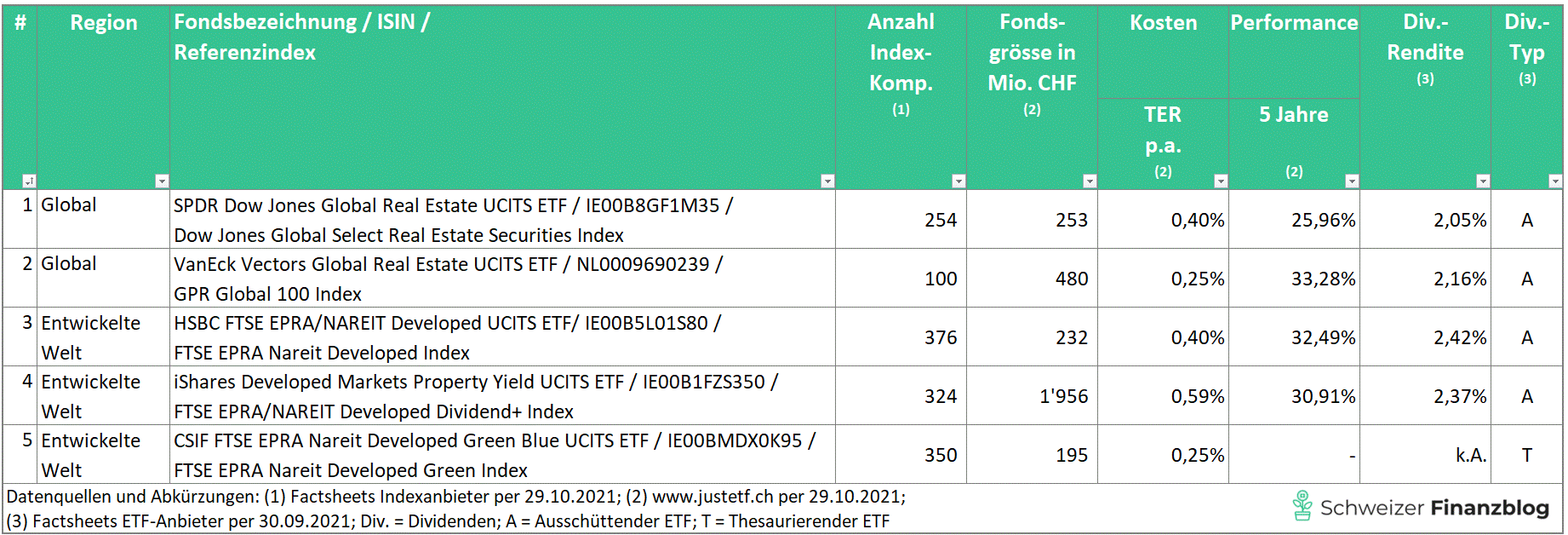
What stands out is that each ETF is based on a different benchmark index. It’s also unusual that the two global real estate ETFs, which cover both developed and emerging markets, invest in fewer companies than the other three ETFs (no. 3–5), which only cover the developed world (industrialised countries).
These three indices are the parent index “FTSE EPRA/NAREIT Developed Index” (no. 3) and the two more selective sub-indices “FTSE EPRA/NAREIT Developed Dividend+ Index” (no. 4, with a dividend focus) and “FTSE EPRA/Developed Green Index” (no. 5, with a sustainability focus on green building certification and energy use).
In terms of money raised, the iShares product (no. 4), with fund assets of just under CHF 2 billion, is by far the most successful real estate ETF available on the Swiss stock exchange. That’s actually surprising, given that it’s the most expensive, with a hefty TER of 0.59%. Perhaps many investors find the underlying index attractive, as it focuses on companies with an expected dividend yield of at least 2%. But the fact that this ETF was launched back in 2006 certainly also plays a role in its high fund volume.
Differences in performance and costs
In terms of performance over the past five years (incl. distributions), the ETF from Dutch niche provider VanEck (no. 2) is the most successful, with a gain of around 33 percent. It’s closely followed by the HSBC product (no. 3), which is the most broadly diversified, with 376 index constituents.
On the plus side: the cheapest cross-regional ETFs are available from a TER of just 0.25% (no. 2 + 5).
Credit Suisse back in the ETF business after a change of strategy
CS, which sold its ETF business to market leader BlackRock (provider of the iShares products) in 2013, has been offering its own ETFs again since 2020 – following a change of strategy. These include the real estate ETF launched in June 2020 (no. 5). It’s the only product in our comparison that focuses on sustainability and doesn’t distribute dividends but reinvests them.
Strong US dominance
For all their differences, the five ETFs we looked at have one thing in common: a strong US dominance (>50%) (see also chap. 7.2). In this respect, they’re no different from sector-neutral indices such as the MSCI ACWI or MSCI World, which have a similarly high US weighting.
If that share is too high for you, you can switch to regional real estate ETFs – although the range available in Switzerland – unlike in the USA – is very limited, and emerging markets are currently not covered.
Alternatively, it can be worth looking across the Atlantic. US exchanges offer numerous so-called “ex-US” ETFs. These cover the whole world excluding the USA. Combined with a US ETF, this gives you a global investment with your own individual US weighting. Stefan chose this route in 2016 and, at the time this article was published, is invested in the following two real estate ETFs:
- Vanguard Global ex-US Real Estate ETF (VNQI): ISIN US9220426764 / TER 0.12% / exchange Nasdaq (note/drawback: as this ETF is US-domiciled, reclaiming withholding tax on dividends means extra work on your tax return; the ETF isn’t offered by DEGIRO)
- iShares US Property Yield UCITS ETF (IUSP): ISIN IE00B1FZSF77 / TER 0.40% / exchanges incl. SIX
Conclusion
All five ETFs examined above are established on the Swiss market and each has its own positive unique selling points. In the end, the choice depends on your individual preferences. To help you decide, you could ask yourself the following questions:
- Global (no. 1 + 2) or developed world only (3–5)?
- Conventional (no. 1–4) or sustainable (no. 5)?
- Distributing (no. 1–4) or accumulating (no. 5)?
- Paid or free ETF (see partner offer below)?
– P a r t n e r o f f e r –
In our experience, one broker that’s particularly attractive for ETFs in terms of cost is “DEGIRO”. DEGIRO offers all five real estate ETFs listed above. No. 1, 2, 4 and 5 via the Swiss stock exchange SIX. No. 2 and 4 even particularly cheaply (core selection) via the Euronext Amsterdam (EAM) exchange. If you’re interested, you can sign up with DEGIRO by clicking on the ad below – you’ll get a trading credit of CHF 100 while supporting our blog at the same time.
– – – – –
Profile of the “FTSE EPRA/NAREIT Developed Index”
In this chapter, we want to take a closer look at the “FTSE EPRA/NAREIT Developed Index”, on which the HSBC ETF presented above is based (see Figure 1, ETF no. 3). The other four indices have similar characteristics and don’t differ significantly from what follows.
Top 10 companies
Figure 2 shows the ten largest real estate companies in the index by market capitalisation. Together, they account for just under 24 percent, with the largest position at around 5 percent. In terms of diversification and any concentration risk, we consider these to be acceptable values.
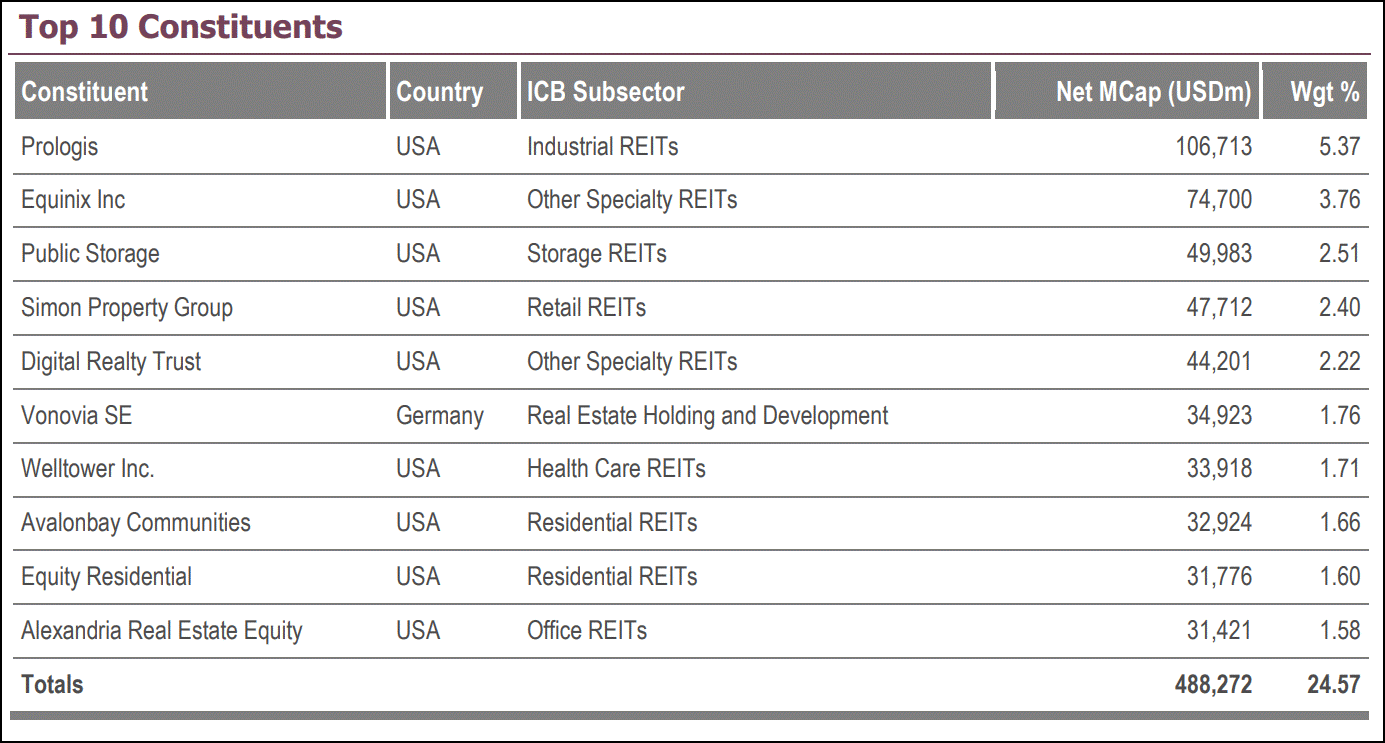
The sector leader, i.e. the company with the highest weighting in the index at around 5 percent, is Prologis, a global owner, operator and developer of logistics real estate. The US company Prologis is a REIT and, despite being the global market leader, is hardly known to the wider public. The following company portrait in the form of a (promotional) video outlines Prologis’s business model.
Country breakdown: strong US dominance
As with sector-neutral indices, there’s a clear US dominance in the real estate sector too (see Figure 3). In the index examined, US companies have a weighting of over 59 percent, followed by Japan with just under 10 percent. In third and fourth place are the UK (4.72%) and Germany (3.49%).
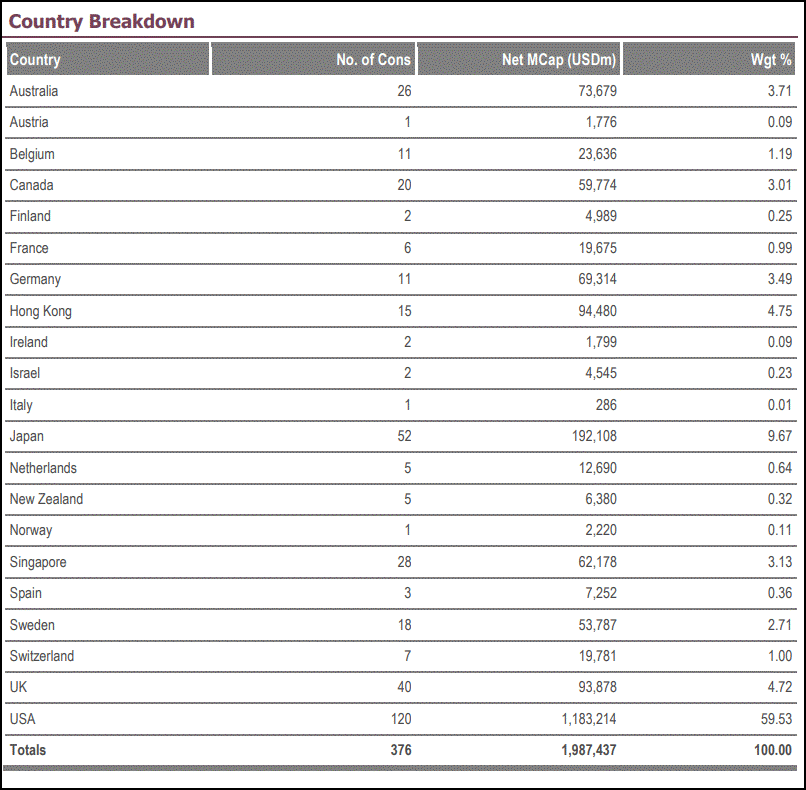
Switzerland, with its seven real estate companies in the index, accounts for just 1 percent. The largest of them is Swiss Prime Site, with a share of 0.4 percent.
Below are the seven Swiss companies, sorted by index weighting (source: FTSE Russell, August 2021):
- Swiss Prime Site (0.4%)
- PSP Swiss Property (0.29%)
- Allreal Hld (0.15%)
- Mobimo (0.11%)
- Intershop I (0.02%)
- Peach Property Group AG (0.03%)
- Hiag Immobilien AG (0.02%)
Real estate sectors: focus on REITs and commercial use
Figure 4 shows that REITs make up the lion’s share, at around 84 percent. The rest are real estate companies without REIT status (see the first two positions in the table). These include, for example, all Swiss companies in the index (see Fig. 3).
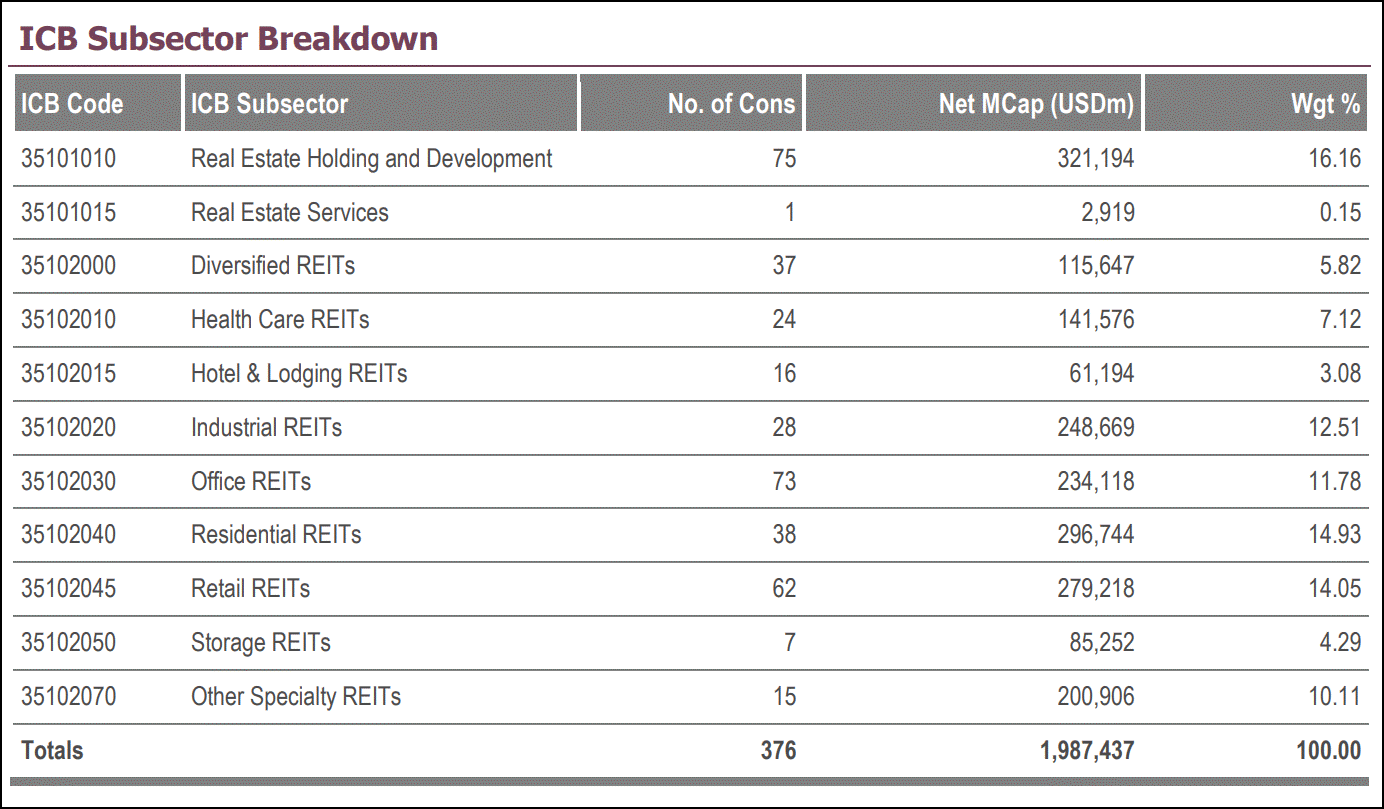
Within REITs, there’s a broad spread in terms of use, with commercial uses and commercial properties dominating. Investments in purely residential properties (“residential REITs”) play a rather marginal role, at just under 15 percent.

High dividend income possible with real estate ETFs
Real estate ETFs should be especially interesting for dividend hunters. Compared with the sector-neutral overall market, they consistently delivered higher dividends over the past five years (see Figure 6).
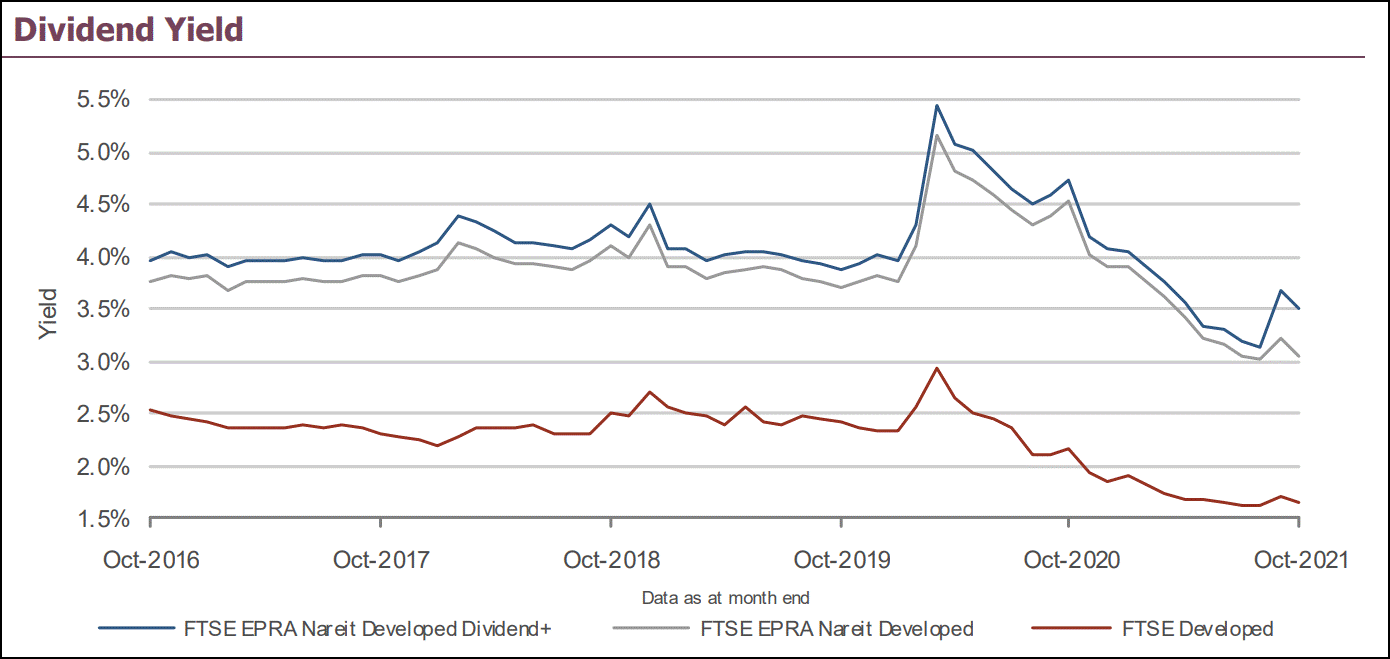
The grey and blue curves show the dividend development of two real estate indices, while the red curve refers to the overall market. All three indices focus on the developed world, i.e. excluding emerging markets.
Bear in mind, however, that the actual dividend paid out by the ETF is generally somewhat lower than Figure 6 suggests because of taxes (see also Figure 1).
Don’t underestimate the risks of real estate ETFs
Real estate ETFs can fluctuate sharply. On the one hand, this is because they’re traded on the stock exchange. On the other hand, they depend heavily on the economic cycle since – as we showed in chapter 7 – they mostly consist of commercially used properties.
Their at times high volatility was strikingly demonstrated during the last, pandemic-related stock market crash in 2020.
Figure 7 shows that over the past five years, the real estate index “FTSE EPRA Nareit Developed” underperformed the market-neutral “FTSE Developed” index. It’s also striking that the pandemic-related crash in 2020 was more pronounced and the subsequent recovery more hesitant than in the overall market.

If you look at a longer period, however, the performance picture is quite different.
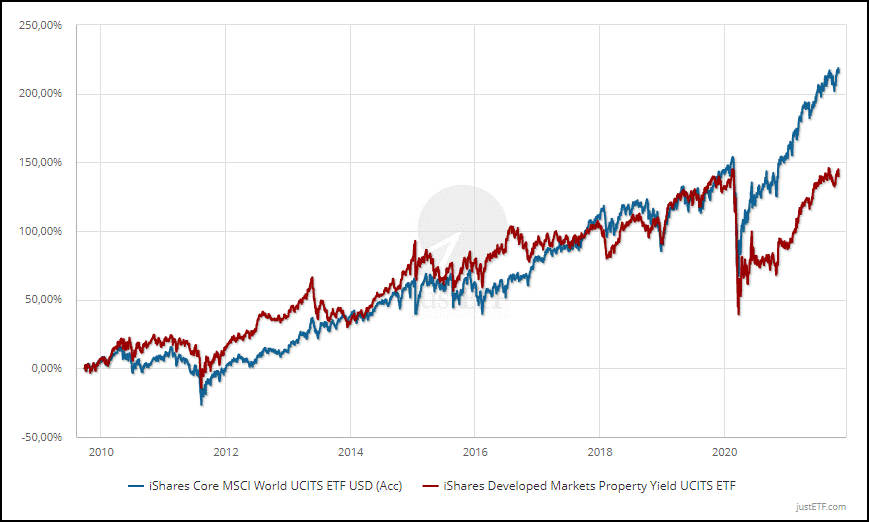
Figure 8 shows the real price development, including distributions, of the real estate ETF “iShares Developed Markets Property Yield” (based on the “FTSE EPRA Nareit Developed Dividend+” index) compared with the sector-neutral ETF “iShares Core MSCI World UCITS” (based on the “MSCI World Index”).
What stands out is that the real estate ETF performed better from September 2009 to August 2016. Only after that did the tide turn in favour of the sector-neutral index.
Better risk/return ratio thanks to low correlation with the overall market
Whether adding the “real estate” asset class makes sense depends not only on the long-term expected return, but also on how strongly real estate correlates with the overall market.
Here, we turn to Gerd Kommer, whom we often quote. In the 5th edition of his standard work “Souverän investieren mit Indexfonds und ETFs”, he sums it up as follows:
“In the 27 years from 1990 to 2016, the S&P Global REIT Index produced a higher return than the global equity market, as measured by the MSCI ACWI. At +0.66, the correlation between the two indices was pleasingly low. All in all, adding a globally or at least Europe-wide diversified real estate component to the world portfolio seems worth considering.”
You can find out how to structure your assets across different asset classes in our article “Asset allocation: the be-all and end-all of investing”.
Final conclusion
Compared with other real estate investments, we consider buying real estate ETFs to be the most suitable investment. Simplicity, low costs, high liquidity, broad diversification and low capital commitment (no concentration risk) are strong arguments in favour of real estate ETFs.
Compared with investing in a global, cross-sector equity ETF, the advantages mentioned above no longer count as unique selling points. However, thanks to the relatively low correlation with the overall market, we see – in line with portfolio theory – an opportunity to achieve a better risk/return ratio in the overall portfolio.
We’re also positive about the range of products on offer. The Swiss stock exchange SIX now has a sufficient, if not lavish, range of well-established, cross-regional real estate ETFs at fair prices from a TER of 0.25%.
For the reasons set out above, we consider real estate ETFs worth considering as an addition (max. 20%) to a global, cross-sector equity (ETF) portfolio.
You might also be interested in



Disclaimer
Disclaimer: Investing involves the risk of loss. You have to decide for yourself whether or not you want to take on these risks.
Errors excepted: We have written this article to the best of our knowledge and belief. Our goal is to provide you, as a private investor, with information about finance that’s as objective and meaningful as possible. If we have nevertheless made any mistakes, forgotten important aspects and/or if information is no longer up to date, we’d be grateful if you let us know.
Transparency notice: At the time of publication, the Schweizer Finanzblog team is invested in real estate ETFs from the providers iShares and Vanguard. Apart from these investments, there are no business relationships (commissions or similar) with any of the index or ETF providers mentioned in this report.
About the authors

Stefan Huser
Stefan has been investing in the stock market himself since 2015. He has been shaped by Markowitz’s portfolio theory and Gerd Kommer’s book “Souverän investieren”. He follows a core-satellite strategy: a global equity portfolio of ETFs forms the core, complemented by alternative investments. At the blog, he mainly takes care of the writing. Stefan lives with his family in Zurich and is interested in literature, photography and financial freedom.

Antun Brcina
Antun (“Toni”) has been investing in the stock market since 2015. Financially, he has been particularly inspired by Gerd Kommer’s book “Souverän investieren” and the Fama-French five-factor model. His money is invested in a broadly diversified, long-term global equity portfolio of ETFs. At the blog, he mainly works on the calculators and the code. Toni lives with his family in the Zurich area and is interested in sports, technology and entrepreneurship.








10 Comments
Hoffe, ich bombardiere euch nicht mit Fragen. Falls es zu viel ist, dann einfach ignorieren:
Hält ihr einen Immo-ETF auch für “prüfenswert”, wenn man bereits zu einem Grossteil im Eigenheim investiert ist, das man aufgrund einer Lifestyle-Entscheidung nicht verkauft? Falls ja, wegen des Vorteils durch Rebalancen (bei einem reinen Aktien-ETF-Portfolio) und um kurz- bis mittelfristig Schwankungen zu reduzieren?
Ja, Immo-ETFs erachten wir als prüfenswert, da das Portfolio durch die Beimischung der alternativen Anlageklasse “Immobilien” breiter diversifiziert und potenziell weniger volatil wird. Da dein Eigenheim kein Anlageobjekt ist, sondern ein “Lifestyle-Objekt”, würden wir auch nicht in der Asset Allocation berücksichtigen. Aber da gehen die Meinungen natürlich auseinander:-)
Hallo zusammen
Vielen Dank für Eure vielen tollen Blog-Beiträge. Mit diesen perfekt aufgearbeiteten Informationen habt Ihr mir schon sehr viel geholfen bei meinem Einstieg ins ETF Investment.
Ich habe mich in den letzten 3 Wochen intensiv mit meiner Asset Allocation und meiner Portfolio-Strategie auseinander gesetzt. Ich möchte meinem Portfolio auch Immobilien ETFs beimischen. Bei meiner Recherche habe ich festgestellt, dass sich der Markt seit der Veröffentlichung dieses Blogbeitrags aber offenbar stark verändert hat. Wenn mich die Filter auf justETF nicht täuschen gibt es aktuell bereits einige ImmoETFS mehr an der SIX. Zudem haben sich die Ausschüttungseigenschaften offenbar teilweise geändert. Der ETF Nr. 5 aus Eurer Auswahl oben ist inzwischen offenbar auch ausschüttend. Dafür hat der ETF 1 aus der Liste einen “thesaurierenden Bruder” bekommen (der bei Euch wegen des geringen Alters und des kleinen Volumens aber wohl noch nicht in die Kränze kommen wird). Aufgrund der starken US Dominanz in den globalen Varianten habe ich mich für die “2 ETF Strategie” aus Kap. 6.5 entschieden. Meine Idee fürs ETF Portfolio sieht aktuell wie folgt aus:
25% IMEA Europa iShares Core MSCI Europe UCITS ETF EUR (Acc)
25% VNRA Nordamerika Vanguard FTSE North America UCITS ETF (USD) Accumulating
10% CSPXJ Asien ohne Japan iShares Core MSCI Pacific ex Japan UCITS ETF (Acc)
5% SJPA Japan iShares Core MSCI Japan IMI UCITS ETF (Acc)
15% EIMI Schwellenländer iShares Core MSCI EM IMI UCITS ETF (Acc)
15% VNQI Immos ex. US Vanguard Global ex-US Real Estate ETF
5% IUSP Immos US iShares US Property Yield UCITS ETF
Was haltet Ihr davon? (natürlich ohne eine Anlageempfehlung geben zu müssen).
Wie Ihr im Artikel über die besten ETFs schreibt überlege ich mir im Sinne einer Core-Satellite Strategie noch ein oder zwei Satelliten dazu zu geben. Ich denke hier bspw. an einen Momentum ETF. Verstehe ich Eure Interpretation der Core-Satellite Strategie richtig, dass bei Euch auch die Satelliten eher langfristig sind (bspw. Momentum ETF verspricht ja auch eher auf lange Frist eine Überrendite). Oder haltet Ihr z.B. auch Branchen-/Themen ETFs als Satelliten? In Artikeln von anderen Autoren werden bspw. auch Einzelaktien als Satelliten genannt. Das wäre dann eher wieder ein Risikospiel.
Bei der Core-Satellite Strategie wäre nach meinem Verständnis das oben beschriebene Portfolio dann der Core und dazu kämen dann noch 15-20% Satelliten (d.h. der Core hätte einen Anteil von 80-85% am Gesamt-Aktienportfolio). Verstehe ich das richtig?
Vielen Dank und beste Grüsse
Hoi Pascal
Merci für dein Update. Erfreulich, wenn der ETF-Markt weiter wächst und die Auswahl dadurch noch grösser wird! Wir können natürlich keine Anlageempfehlungen abgeben, aber die beiden von dir genannten Immo-ETFs sind uns bekannt (Stefan ist darin investiert). Wir würden diese beiden Immo-Produkte als Satellite betrachten, da es sich um branchenspezifische ETFs handelt. Ebenso Satellite sind für uns die von dir erwähnten Momentum-ETFs, weil auch diese nicht “neutral” den Gesamtmarkt abbilden, allfällige Einzel-Aktien, aber auch andere (risikobehaftete) Assetklassen wie beispielsweise “P2P-Kredite” bzw. Crowdlending.
Beste Grüsse
SFB
Vielen Dank für die Erläuterungen und Alternativen. Ich nehme wohl den überschaubaren Mehraufwand doch auf mich 😉
Grüezi miteinander, unter Punkt 6.5 erwähnt ihr ja m.E. korrekterweise die US Dominanz in besagten ETF und zeigt freundlicherweise gleich auch Alternativen zum Aufbrechen dieser Dominanz. Der US-Domizil ETF: gibt es nach euren Kenntnissen eine interessante Alternative, wenn man diesen Steuererklärungsaufwand vermeiden möchte? Vielen Dank im Voraus für eure Unterstützung.
Leider sind alle Alternativen mit gewissen Kompromissen verbunden, die du nach deinen Präferenzen abwägen solltest. Wenn du den steuerlichen Mehraufwand für die beschriebene 2-ETF-Lösung scheust, sehen wir noch die Möglichkeit, deine Immo-Investitionen auf 3 Immo-ETFs mit Steuerdomizil Irland aufzuteilen (alles iShares Produkte): “USA” (IE00B1FZSF77), “Europa” (IE00B0M63284) und “Asien” (IE00B1FZS244). Der Nachteil bzw. Kompromiss bei dieser Variante besteht darin, dass dein Portfolio mit drei (statt nur einem oder zwei) Immo-ETFs komplexer wird und dass die Emerging Markets nicht abgedeckt sind.
Hi; wenn ich in rein in den iShares MSCI ACWI UCITS ETF (Acc) IE00B6R52259 investiere, passt dann Eurer Meinung nach Nr. 2, VanEck Vectors Gobal gut dazu?
Gewichtung: wäre da 90% Ishares, 10% VanEck angebracht?
Damit ergänzt du dein Aktienportfolio mit der Assetklasse “Immobilien”, und zwar mittels eines ETF, unser bevorzugtes Anlagevehikel. Positiv an diesem von dir genannten ETF finden wir die vergleichsweise niedrige TER und die globale Ausrichtung. Die Kombination passt für uns, ohne hier eine Anlageempfehlung geben zu wollen/können.
Vielen Dank für die ausführlichen Erläuterungen. Es ist nicht alltäglich, einen so ausführlichen Blogbeitrag zu sehen. Ich dachte daran, in physische Immobilien zu investieren, aber ETFs sind auch eine wirklich gute Option. Machen Sie weiter so!