
 Newsletter

Building wealth is relatively simple, for example by investing regularly in an equity ETF. What’s more complex is drawing down the wealth you’ve built up so that it secures your standard of living for many years and lasts until the end of your life. To ease into early retirement, you need a smart withdrawal plan as the key to your financial freedom – the happy ending of your financial planning, so to speak! In this article, we introduce three withdrawal plans, show you which one is our favourite and explain why we think the popular “4% rule” is unfit for purpose.

In a nutshell
- With a smart withdrawal plan, your wealth will last from the start of your early retirement until your death while allowing you to spend as much as possible.
- To draw money from your portfolio, you can sell parts of your holdings, “spend” the dividends and interest paid out, or combine the two.
- For a withdrawal plan, you need to know how much wealth you have available at the start, its average return, your annual living expenses and your life expectancy.
- We looked at three withdrawal plans that differ in terms of withdrawal amount and/or market risk.
- We prefer a flexible withdrawal plan. It is based on the annuity rule and rules out running out of money too early.
- However, such a withdrawal plan comes with market-driven swings in spending, which can be very severe depending on how the stock market performs.
- These swings in spending are largely caused by the sequence of returns. Poor stock market years at the start of the withdrawal phase are particularly problematic.
- With a cash reserve that you tap into after poor stock market years and a withdrawal cap that kicks in after good stock market years, you can effectively smooth out swings in spending.
Contents
- Some questions you should ask yourself before retiring early
- What withdrawal plans are there?
- Conclusion: take the best of both worlds for early retirement
- You might also be interested in
- Updates
- Disclaimer
Some questions you should ask yourself before retiring early
What is a withdrawal plan?
A withdrawal plan, also called a withdrawal strategy or decumulation plan, is about turning the wealth you have saved into spending according to a predefined approach. The withdrawal plan is therefore used during the withdrawal phase, which is the counterpart to the wealth-building phase.
Building wealth is relatively easy to put into practice. Our basic rules can be summed up in just a few words: invest in one or more equity ETFs for the long term, regularly, globally diversified and at low cost.
Drawing down wealth that has (hopefully) grown substantially over several decades is a lot more complex, however. Ideally, a smart withdrawal plan should meet the following three needs:
- Spending as much as possible (“I don’t want to die a millionaire.”)
- Spending for long enough (“I don’t want to go broke before I die.”)
- Spending evenly (“I want to enjoy a steady standard of living.”)
As we’ll see later, unfortunately there is no withdrawal plan that can meet all of these needs without compromise.
Based on these three needs, you should ask yourself the following four questions, which we have sorted by how complex they are to answer, starting with the simplest:
- How much money do I want to leave behind?
If you want to leave part of your wealth to your children or a charity, for example, define the amount. This amount will then not go towards spending but will be set aside for the lucky heirs you have chosen.
- How much money do I need to live on?
This question isn’t quite as easy to answer as the first one. But with a bit of research into your own finances, you’ll be able to answer it fairly precisely. That’s because you can draw on a wealth of experience and a reliable data set: your past expenses. Ideally, you should work out not only your average living expenses (standard-case scenario) but also your essential basic needs (worst-case scenario) and what a higher standard of living would mean for you (best-case scenario).
- How much return will my wealth generate?
If, at the start of the withdrawal phase, you put part of your wealth into low-risk government bonds or keep it as cash in a savings account, you can probably expect only a small amount of interest in line with inflation, if that. Nevertheless, we think it’s a good idea to keep an emergency fund for the unexpected. With riskier equity investments, average annual gains of 8 percent including dividends are entirely realistic. Some uncertainty remains, though: as we all know, past returns are no guarantee of future returns.
- For how many years do I want to draw money from my wealth?
Now things definitely get complex. To answer this, you would need to know your exact life expectancy, i.e. when you will die. As a first rough guide, you can use average life expectancy, for example. According to the Federal Statistical Office, life expectancy in Switzerland is among the highest in the world. In 2021, life expectancy at birth was 81.6 years for men and 85.6 years for women. At the age of 65, men can still expect to live another 19.9 years and women another 22.7 years, which puts the average age at death at 84.9 (men) and 87.7 (women). If needed, you can refine these figures with individual factors such as your state of health, lifestyle or genes. But even if you have been too pessimistic about how long you will live, or if you live longer than your money lasts, there’s no reason to panic – at least not in Switzerland. We have well-run public retirement and nursing homes that even seniors without any means are entitled to.
Who does (or doesn’t) need a withdrawal plan?
Even though we use the term “early retirement” in this article, we actually want to address everyone who wants to retire with a pot of wealth. So it basically doesn’t matter whether you are planning to retire conventionally in your mid-60s, not until 70 or – as is very much the trend at the moment – earlier, for example at 50 or even as early as 40 (see also our article “Financial freedom: hype or a goal worth pursuing?”).
It’s obvious, however, that a reliable withdrawal plan is even more important for early retirement, since there are no state-guaranteed pension payments until the regular retirement age, which means spending is covered entirely by drawing down your wealth.
What’s more, our target audience wants to spend their available capital over the long term, i.e. until they die, in order to secure and optimise the standard of living they are used to.
The topic of “early retirement with a withdrawal plan” is likely to be of less interest to people who will have saved little or no wealth by the time they retire. They simply don’t need a withdrawal plan. In Switzerland, their pension is regulated by the state, based on OASI (AHV, 1st pillar), the pension fund (2nd pillar) and, if needed, supplementary benefits.
These people enjoy a high degree of certainty that their state pension will be paid reliably until they die. On the other hand, they have to accept a more or less significant cut in their standard of living, because our state pension benefits are primarily geared towards basic needs such as food, housing and health. Another drawback is that people without savings of their own cannot choose their retirement age freely, i.e. they cannot voluntarily retire early.
What are the risks of early retirement?
Risks always go hand in hand with uncertainty. And there is plenty of that when it comes to early retirement and the withdrawal plans that go with it. However, the more carefully you work through your own withdrawal plan (including answering the questions in the previous sections), the better you will be able to keep the following risks under control:
- Risk of ruin: The risk that your wealth runs out before the end of the planned withdrawal period. This risk is influenced by sequence-of-returns risk and longevity risk.
- Standard-of-living risk: The risk that you will be forced to cut back your standard of living because of swings in spending.
- Unplanned inheritance: The risk that the wealth set aside for spending will not be fully used up by the end of the planned withdrawal period.
For our traditionally safety-conscious compatriots, the risk of ruin is likely to be seen as the most serious risk. That’s why a large share of retirees will probably plan too cautiously.
In Switzerland, however, a guaranteed state pension and – if all else fails – supplementary benefits cushion this risk. Of course, this state retirement provision only applies to people who have reached the regular retirement age in their mid-60s. Anyone who wants to retire early cannot rely on it. They depend all the more on a well-thought-out withdrawal plan.
That’s why we believe – and the market simulations later on suggest – that the far more likely risk is the “unplanned inheritance”. This risk may seem harmless, but it can have a major impact. In concrete terms: out of fear of the risk of ruin, the average Swiss restricts their spending too much during the withdrawal period, which usually lasts several decades. Their own quality of life suffers as a result – to the benefit of the lucky heirs!
How should I draw money from my wealth?
Before we examine and assess the most important withdrawal plans, let’s tackle this last question, which won’t make or break your plan. It concerns the withdrawal technique. Basically, you can choose between the following three options:
- Withdrawing dividends and interest
- Selling parts of your holdings
- A combination of both
Using dividends and interest is likely to be slightly cheaper, because brokers generally don’t charge any fees for this. With partial sales, on the other hand, you usually pay not only brokerage fees but also – if you use a Swiss broker such as Swissquote (review) – stamp duty. Two foreign brokers established on the Swiss market with low fees and no stamp duty are DEGIRO (review) and Interactive Brokers (review).
Distributions are also more convenient, as they happen automatically, whereas partial sales usually have to be “triggered” manually.
By the way, as far as income tax is concerned, it makes no difference whether you tap into the cash flows or sell parts of your holdings. That’s because dividends are taxed as income for both distributing and accumulating securities. You’ll find more detailed information on taxes in the article “ETF taxes in Switzerland: optimise your portfolio with these 4 tax-saving tips”.
Realistically, the first choice for most investors will be a withdrawal technique that combines dividends and interest on the one hand and – more significant in terms of amount – sales of holdings on the other. After all, if you want to live off dividends and interest alone, you need a very large pot of wealth. Besides, only touching the fruits without ever tapping into the wealth itself runs counter to the very purpose of a withdrawal strategy.
– P a r t n e r o f f e r –

– – – – –
What withdrawal plans are there?
There are probably countless withdrawal plans out there. We focus on the following three withdrawal plans, each based on a different underlying strategy:
- Early retirement withdrawal plan, option 1: fixed withdrawals without market risk
- Early retirement withdrawal plan, option 2: fixed withdrawals with market risk
- Early retirement withdrawal plan, option 3: flexible withdrawals with market risk
These three options can be both combined and adapted individually. They differ in terms of two factors: withdrawal amounts (fixed vs. flexible) and market risk (without vs. with). Below, we take a closer look at these three withdrawal plans and some sub-variants and assess them.
Early retirement withdrawal plan, option 1: fixed withdrawals without market risk
With this first option, your wealth is not invested in the stock market during the withdrawal phase, which means it is not exposed to market fluctuations.
So let’s assume that your available wealth sits safely in your bank account, earning interest that exactly matches inflation each year. You can’t expect any more return than that.
The advantages of this option are obvious: predictability, constant spending and no (premature) ruin. Important: the latter refers to your defined withdrawal period. If you outlive it, you also run a risk of going broke.
This option is therefore particularly suitable for very wealthy people who can afford to forgo real growth in their wealth and the market risk that comes with it. For example, if at the start of the withdrawal phase you have saved up liquid assets of CHF 3 million sitting in your bank account, you can spend CHF 100,000 a year in real terms for 30 years. That’s enough for a retirement free of financial worries – all the more so since your state pensions come on top.
This option is also suitable for risk-averse people who need only a little money to live on. For example, if at the start of the withdrawal phase you have “only” CHF 1 million in your savings account, you can spend CHF 33,333 a year in real terms for 30 years. That won’t let you splash out in high-priced Switzerland. But if you factor in your state pensions, you should still get by quite comfortably.
Pros and cons of early retirement withdrawal plan, option 1: fixed withdrawals without market risk
 No premature ruin Constant spending No unplanned inheritance: wealth is fully used up
 Limited spending because you forgo higher returns (no risk premium) High standard of living only possible with substantial wealth
Line spacing
Early retirement withdrawal plan, option 2: fixed withdrawals with market risk
With this second option, you also withdraw a fixed amount plus an adjustment for inflation. This means your total withdrawal stays constant in real terms. Unlike option 1, however, your available wealth is exposed to market fluctuations.
Like option 1, this option guarantees you a steady standard of living thanks to the fixed withdrawal amount. Unlike option 1, you benefit from the risk premium in the form of gains on your equity investments.
However, you take on two risks: unplanned inheritance and the risk of ruin. Since these two risks are mutually exclusive, only one of them can occur. As we’ll see later, the probability of an “unplanned inheritance” is significantly higher than that of running out of money early, even with generous withdrawal rates of 5%. As a general rule, the lower the withdrawal rate, the greater the risk of an “unplanned inheritance”, and the higher the withdrawal rate, the more likely you are to run out of money early.
The “4% rule”
For a long time, this static withdrawal option was given a concrete framework by the so-called “4% rule”, which Bill Bengen developed back in 1994. This rule states that from the start of the decumulation phase you withdraw 4% of your starting wealth each year – and thanks to the risk premium you shouldn’t go broke before you die. In other words, the amount withdrawn from your wealth stays the same. To maintain purchasing power, however, it makes sense to calculate with real withdrawal amounts, i.e. to take inflation into account every year.
The Mannheim study
In the course of our research, we came across the study “Entsparen im Alter – Portfolioentnahmestrategien in der Rentenphase” (Decumulating in old age – portfolio withdrawal strategies in the retirement phase), which was first published in 2017 by the two professors Philipp Schreiber and Martin Weber of the University of Mannheim and last updated in 2020. (After this article was published, the decumulation simulator was updated.) Weber is best known to the wider public as the creator of the ARERO investment fund. What makes this mixed global fund special is that it covers the asset classes equities, bonds and commodities via indices in a single product, based on a scientific concept.
Now let’s take a closer look at the Mannheim study. At our request, Jan Mertes, a doctoral student at the University of Mannheim, explained the study in a bit more detail with regard to the portfolio composition and the return simulation:
- The portfolio
The global portfolio used for the simulation is constructed as follows: a broadly diversified equity and bond portfolio with 60% equities and 40% bonds. Specifically, the portfolio is based on the MSCI All Country World Index (equities) and the Bloomberg Barclays Global Aggregate Bond Index (bonds). Dividends and interest income were taken into account. According to Mertes, the core idea behind this portfolio is to replicate the market as closely as possible and thus achieve maximum diversification (i.e. minimal unsystematic risk). In doing so, you deliberately accept a lower return than with a pure equity portfolio in order to be exposed to smaller fluctuations.
- The return simulation
The monthly returns of the portfolio described above were determined for the period from January 1990 to November 2018. From these returns, 360 returns are drawn at random (with replacement) to simulate how the portfolio develops over 30 years (for a different planning horizon, the planning horizon in years multiplied by 12). This process is then repeated 10,000 times to map different capital market scenarios.
Surprising results on returns
Based on this huge pool of data, we took a closer look at the historical returns and came to the following, partly astonishing, results:
| Average return | 7,2% |
| Share of negative returns | 27% |
| Share of positive returns | 73% |
| Share of positive returns 0–10% | 35% |
| Share of positive returns >10% | 39% |
What surprised us most positively was that returns of more than 10% were achieved in roughly four out of ten stock market years. And what about the “4% rule”? According to the Mannheim study, it seems to work quite well (see Fig. 1)
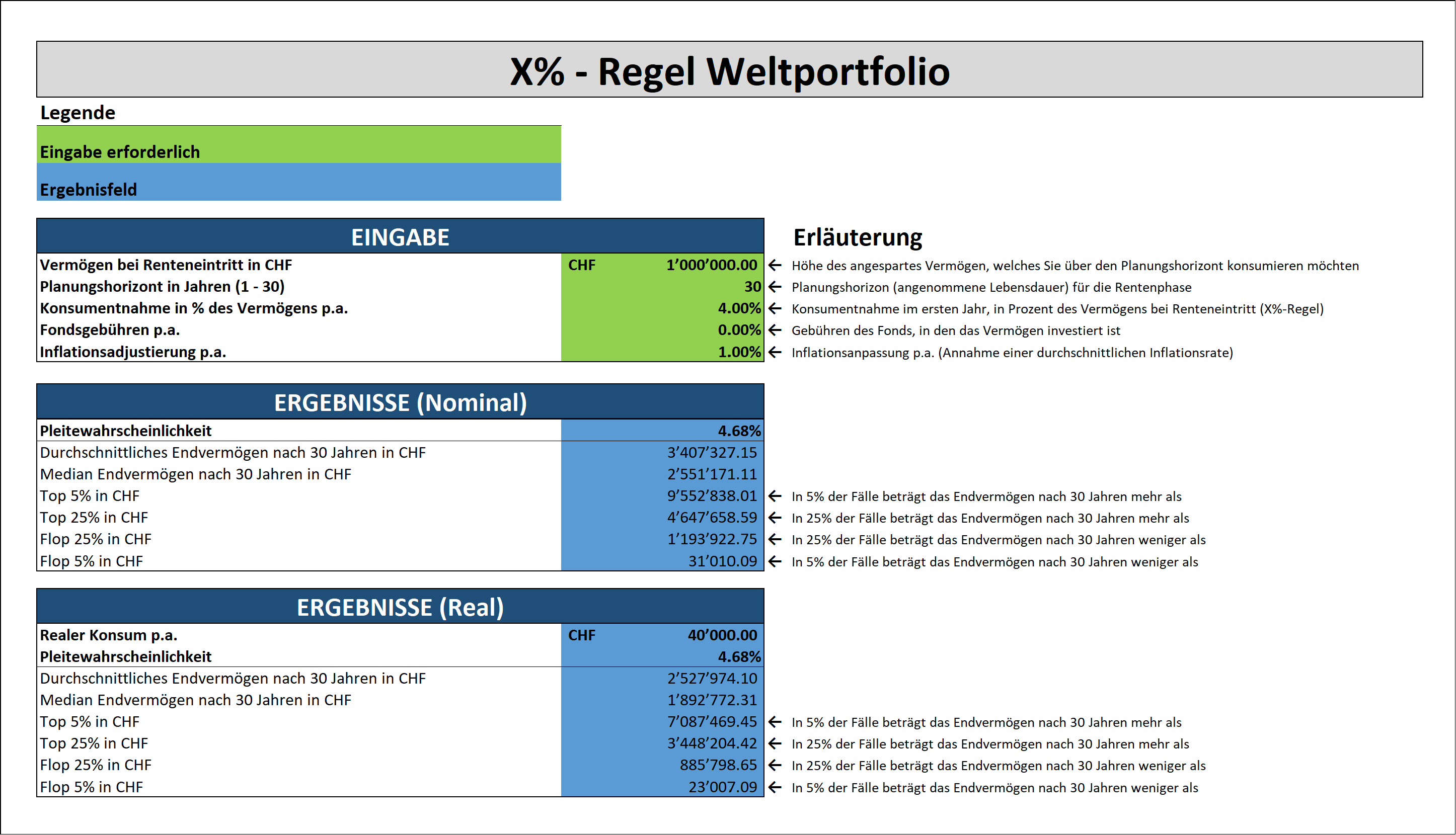
Explanation of Fig. 1: With a fixed withdrawal of 4% of the starting wealth of CHF 1 million (i.e. CHF 40,000 p.a.), including inflation of 1% p.a., over a withdrawal period of 30 years, the probability of running out of money early is 4.68%. Your inflation-adjusted (real) average final wealth is more than 2.5 times your starting wealth, namely CHF 2,527,974.
Based on the historical data of the Mannheim study, the “4% rule” therefore often leads to an unplanned inheritance and relatively rarely to running out of money early.
With regard to the risk of ruin, there is one more important aspect we need to consider: the risk of ruin increases if returns develop unfavourably. In other words, if poor stock market years come at the start of the withdrawal phase. This is known as sequence-of-returns risk.
In this study, simulation 9 is a good example of increased sequence-of-returns risk. Below, we have the withdrawal amounts calculated for the following parameters:
| Starting wealth | CHF 1 million |
| Withdrawal period | 30 years |
| Withdrawal p.a. | 5% |
| Expected inflation p.a. | 1% |
The sequence of the 30 returns in simulation 9 is shown in the table below.
| Year | Historical returns from simulation 9 of the Mannheim study |
|---|---|
| 1 | -12,30% |
| 2 | -4,50% |
| 3 | 5,04% |
| 4 | -2,26% |
| 5 | 13,42% |
| 6 | -2,08% |
| 7 | 31,19% |
| 8 | -0,63% |
| 9 | -8,87% |
| 10 | -11,53% |
| 11 | 26,27% |
| 12 | 7,83% |
| 13 | 27,02% |
| 14 | 29,77% |
| 15 | -8,23% |
| 16 | 4,13% |
| 17 | -12,33% |
| 18 | 3,90% |
| 19 | 8,77% |
| 20 | -7,12% |
| 21 | 25,07% |
| 22 | 12,40% |
| 23 | 13,56% |
| 24 | 12,87% |
| 25 | 17,60% |
| 26 | -0,05% |
| 27 | 4,67% |
| 28 | 5,38% |
| 29 | -6,79% |
| 30 | 11,99% |
Because there were a few stock market slumps at the start of the withdrawal period, the money ran out early, in the course of the 25th year of withdrawals (see Fig. 2).
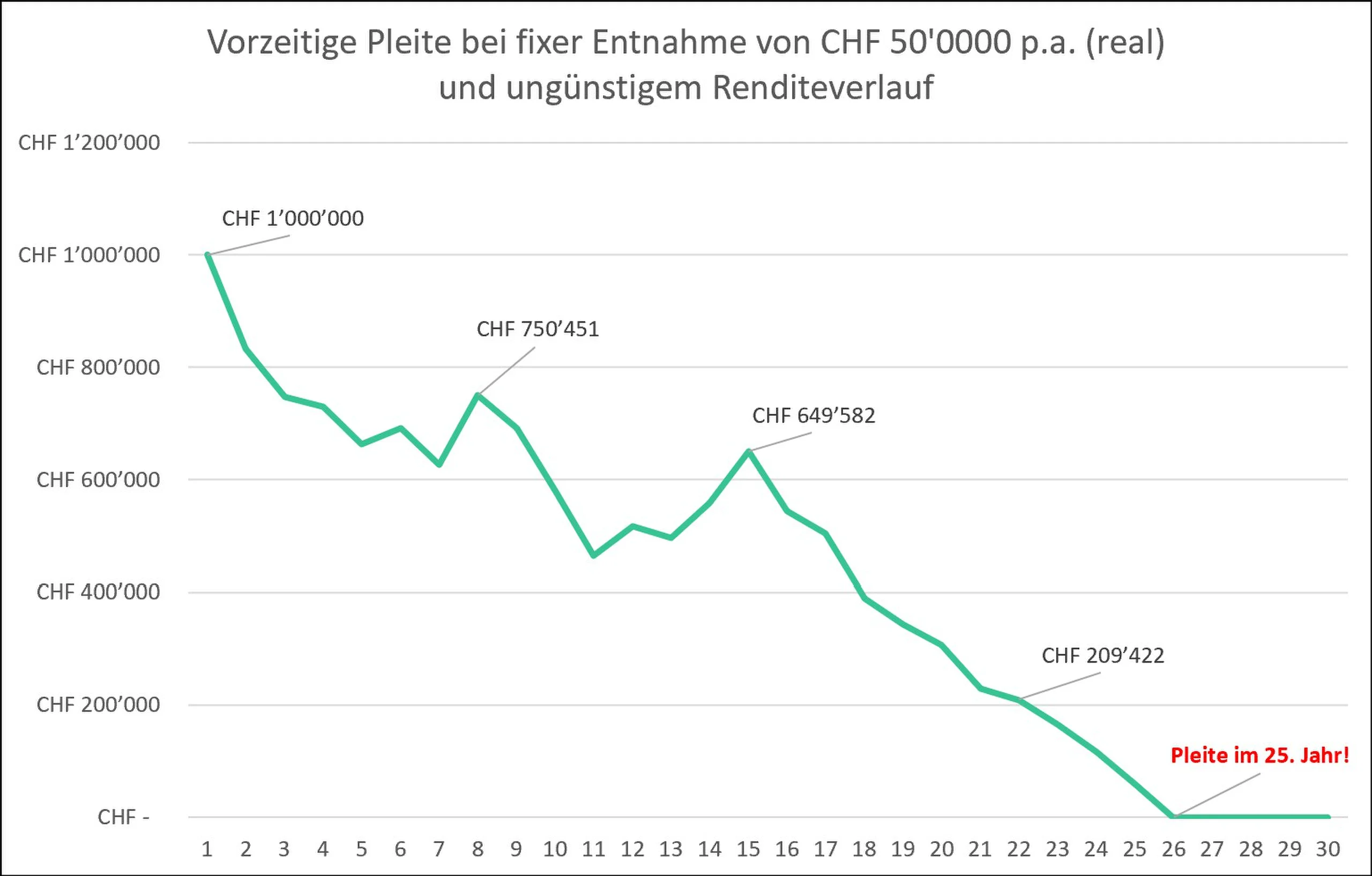
The chart below shows just how incredibly strong this sequence-of-returns effect is. All we did was swap the return in year 1 (-12.30%) with that of year 30 (+11.99%).
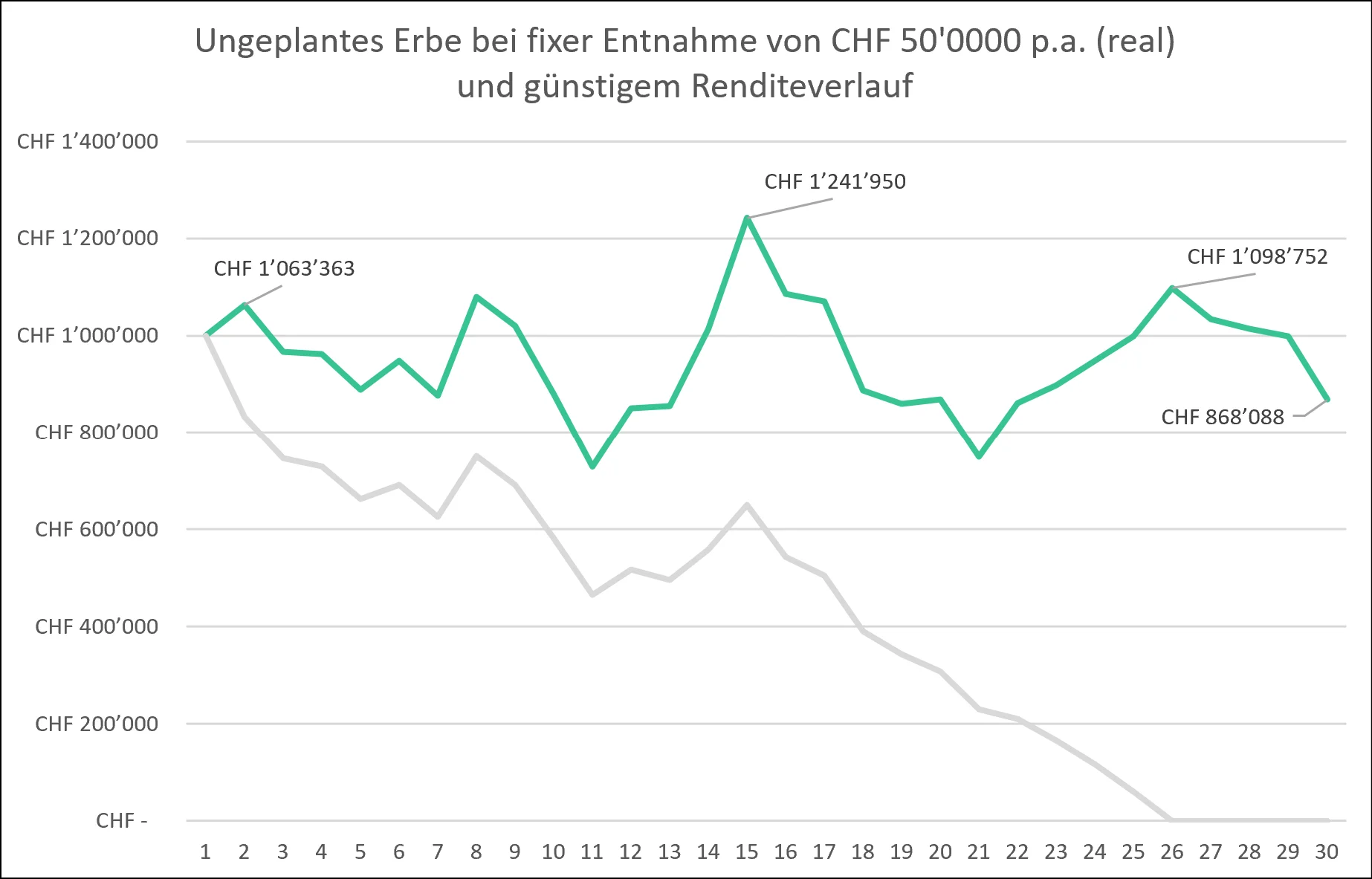
Instead of running out of money early, after 30 years we still have a handsome CHF 868,088 in real terms!
Since we can’t bend the stock market to our will, we have to find other ways to get sequence-of-returns risk under control.
But let’s leave the individual examples aside for now and return to the averages based on the entire historical data set of the Mannheim study.
In the table below, starting from initial wealth of CHF 1 million and inflation of 1% per year, we have compiled the results of nine simulations with three different withdrawal rates and withdrawal periods each.
| Withdrawal period | Ø real final wealth with withdrawals of CHF 30k p.a. (3%) | RR | Ø real final wealth with withdrawals of CHF 40k p.a. (4%) | RR | Ø real final wealth with withdrawals of CHF 50k p.a. (5%) | RR |
|---|---|---|---|---|---|---|
| 20 years | CHF 2,099,002 | 0,04% | CHF 1,697,248 | 0,32% | CHF 1,298,931 | 3,30% |
| 25 years | CHF 2,646,426 | 0,12% | CHF 2,047,091 | 1,98% | CHF 1,467,316 | 10,20% |
| 30 years | CHF 3,391,069 | 0,45% | CHF 2,527,974 | 4,68% | CHF 1,718,889 | 17,95% |
These results from Table 2 amazed us and lead us to the following four conclusions:
- The risk of ruin does increase as the withdrawal rate and withdrawal period increase.
- Thanks to the risk premium and the compound interest effect, however, average final wealth increases the longer the withdrawal period. In other words, in all nine simulations it is higher than the starting wealth, even after adjusting for inflation. (Incidentally, the same applies to median final wealth, albeit to a somewhat lesser extent.)
- The risk of an “unplanned inheritance” is far more likely to materialise than the risk of ruin. Based on our sample returns and periods, you run out of money in “only” between 0.04% and 17.95% of cases. Conversely, this means that at the end of the planned decumulation phase there is still wealth left over in between 82.05% and 99.96% of cases, i.e. the “unplanned inheritance” risk materialises.
- A fixed withdrawal strategy may be easy to implement, but it is unfit for purpose in practice (see point above).
The withdrawal strategy tool (Excel) provided free of charge by the University of Mannheim with the global portfolio simulation described above is no longer available in this form. You can download the updated version via this link.
Criticism of the “4% rule”
Recently, the “4% rule” has increasingly been called into question. The criticism is directed less at the static withdrawal (which is our focus) and more at the “4 percent” itself, which is being questioned or considered too optimistic.
For example, the US study “The Safe Withdrawal Rate: Evidence from a Broad Sample of Developed Markets” of 22 September 2022 concludes that the popular “4% rule” is based on an unsuitable data set: no international focus (home bias) and an observation period (1926–1991) that is no longer representative of today. As a result, it is not safe enough, i.e. the risk of ruin is too high. Statistically speaking, according to the study, a US couple aged 65 should withdraw no more than 2.26% of their starting wealth to keep their risk of ruin from exceeding 5%.
This is of course depressing news, because the lower the withdrawal rate, the less money there is available for spending. You would therefore have to settle for a more modest standard of living, retire later, or a combination of both.
But we don’t share this alarmist mood. Apart from the very real drawbacks that an ever-lower withdrawal rate brings with it, we don’t consider the static concept behind it to be effective. So let’s look at some examples of flexible withdrawal plans in the next section.
Pros and cons of early retirement withdrawal plan, option 2: fixed withdrawals with market risk
Constant spending Higher spending thanks to the risk premium Risk of ruin Unplanned inheritance Line spacing
Early retirement withdrawal plan, option 3: flexible withdrawals with market risk
Unlike options 1 and 2, the same inflation-adjusted amount is not withdrawn every year. Instead, a flexible withdrawal rate takes market fluctuations into account.
This means you redefine your withdrawal amount every single year. There will be years in which you can really push the boat out financially. Other years, on the other hand, will force you to cut back on spending.
In concrete terms, this means two things: first, your standard of living depends to some extent on how the stock market performs. And second, all expenses that aren’t (vitally) necessary for you are room for manoeuvre.
We clearly prefer a flexible withdrawal plan, because in our view it offers the best balance of pros and cons. We accept the fluctuating spending, which we see as its only drawback, as long as it stays within a range that is acceptable to us.
But we do need to get this risk under control. What matters is that the funding of your essential expenses, i.e. your basic needs, is secured at all times. These include, for example, the following cost items:
- Housing
- Food & household
- Health (health insurance)
What is up for grabs, i.e. your room for manoeuvre, is non-essential spending. We call it lifestyle spending. This includes, for example, the following cost items:
- Holidays in upmarket hotels
- Eating out regularly
- Expensive jewellery
So after a “stock market crash year”, for example, it would be a staycation on the balcony instead of a holiday in Hawaii.
Pros and cons of early retirement withdrawal plan, option 3: flexible withdrawals with market risk
Higher spending possible thanks to the risk premium No premature ruin No unplanned inheritance: wealth is fully used up (only guaranteed with the annuity rule without a range) Fluctuating spending Line spacing
How to implement a flexible withdrawal plan with market risk
Let’s now take a closer look at some flexible withdrawal plans and how to implement them. As different as the following sub-variants are, they all share one feature: a variable withdrawal amount.
Rule-of-thumb method with a constant percentage
We start with the simplest option: at the start of each year, you withdraw a fixed percentage of your available (remaining) wealth. Again, we refer to the historical returns from the Mannheim study, i.e. simulation 9 with its unfavourable sequence of returns.
For the calculation, we made the following assumptions for the three required parameters:
| Starting wealth | CHF 1 million |
| Withdrawal period | 30 years |
| Withdrawal p.a. | 5% |
| Expected inflation p.a. | 1% |
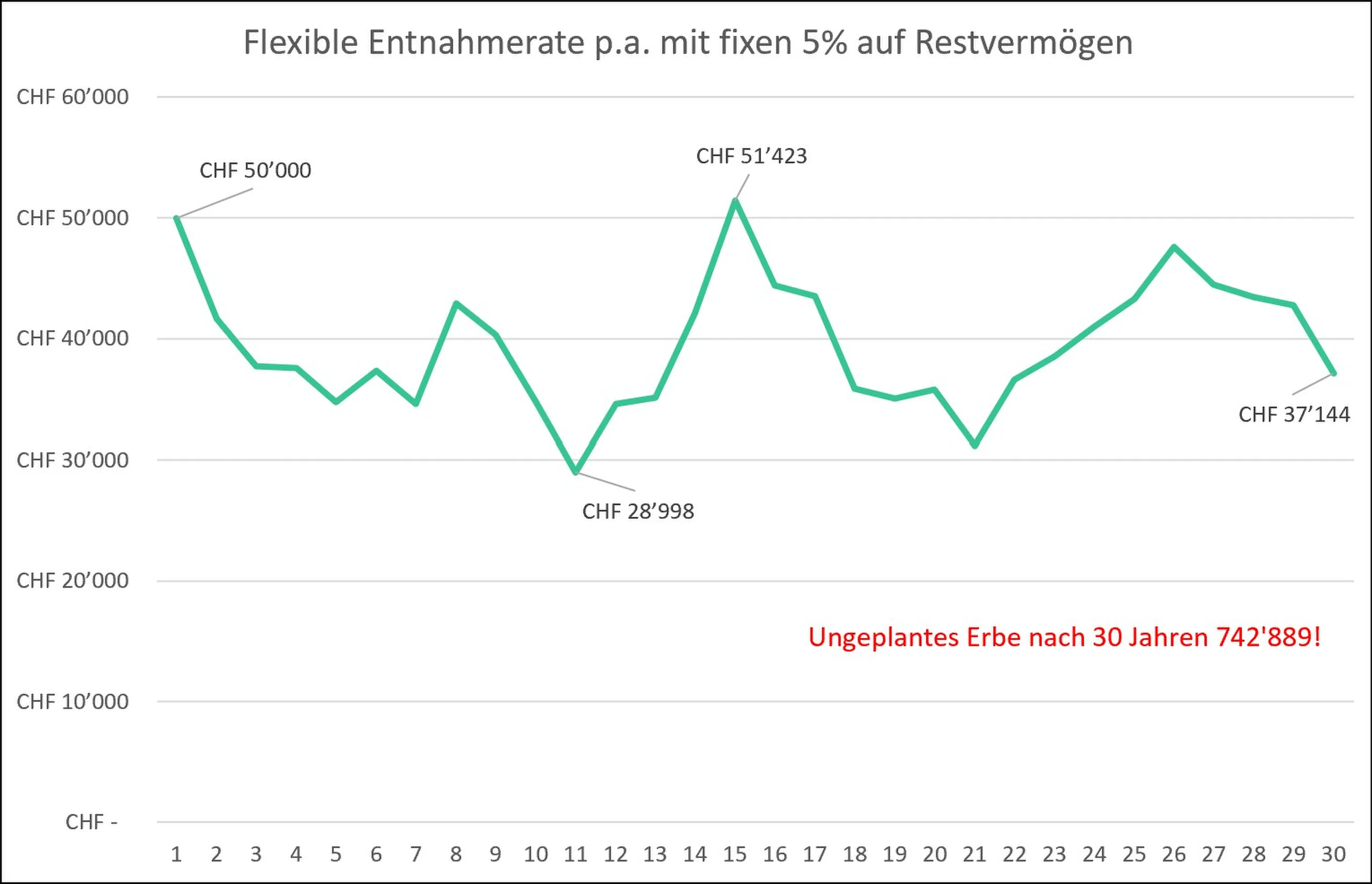
Because wealth is left over after 30 years, the “unplanned inheritance” risk has materialised. This rule-of-thumb method may be easy to implement, but with a constant percentage withdrawal it is mathematically impossible to use up all your wealth by the end of the withdrawal phase. As a result, too little wealth is withdrawn overall, and your standard of living during the decumulation phase is lower than it could have been.
That’s why we can’t recommend this withdrawal plan option.
Annuity rule with and without a cap
Let’s now turn to the original form of flexible withdrawal plans. With the annuity rule, you calculate in each period how much you can spend, taking into account the expected return on the remaining wealth, so that your wealth is used up at the end of the planning horizon. Depending on how the stock market performs, both the amount withdrawn and the percentage withdrawn can fluctuate (sharply) under this rule.
The annuity rule, i.e. the withdrawal amount per year, is based on the following formula (excluding taxes and inflation):
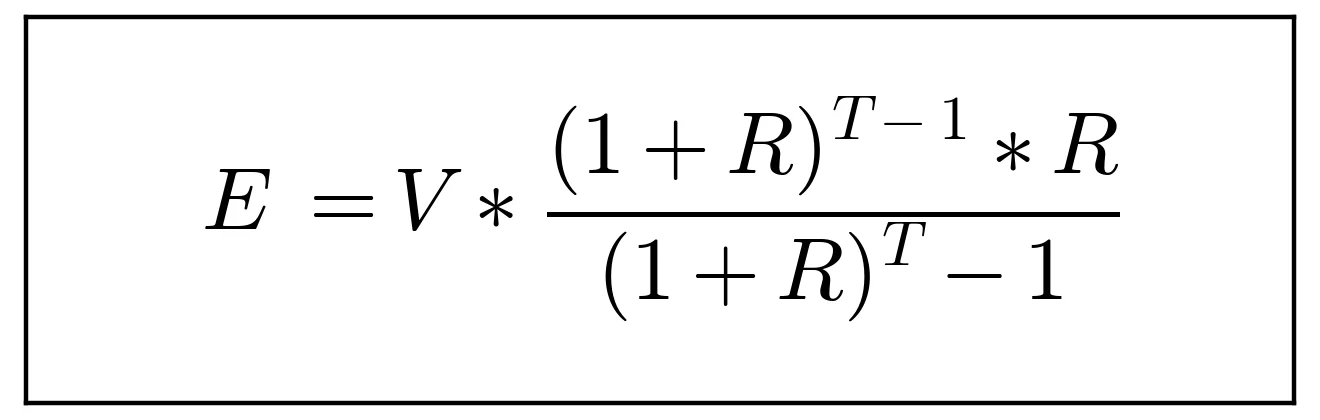
E = withdrawal amount at the start of the year according to the annuity rule
V = (remaining) wealth at the start of the year
R = expected return (e.g. 0.08 for an expected return of 8%)
T = remaining years (including the current year)
Worked example: With starting wealth of CHF 750,000, a remaining term of 25 years and an expected return of 8%, the withdrawal amount is CHF 65,054. The withdrawal amount has to be recalculated every year.
CHF 65,054 = CHF 750,000 * 1.0824 * 0.08 / (1.0825 – 1)
In the last year of the defined planning period, the percentage withdrawn is always 100%. This means your wealth is used up completely and the “unplanned inheritance” risk is eliminated.
To calculate the annuity rule, we made the following assumptions for the four required parameters:
| Starting wealth | CHF 1 million |
| Withdrawal period | 30 years |
| Expected return p.a. | 8% |
| Expected inflation p.a. | 1% |
The annuity rule and the underlying formula are also included in the University of Mannheim’s withdrawal strategy tool (see the “Dynamische Entnahme” [dynamic withdrawal] option in the newly linked, updated tool). Again, we refer to the historical returns from simulation 9. As a reminder: this is an unfavourable sequence of returns that, with the static withdrawal plan earlier, would have left us broke early, in year 25.
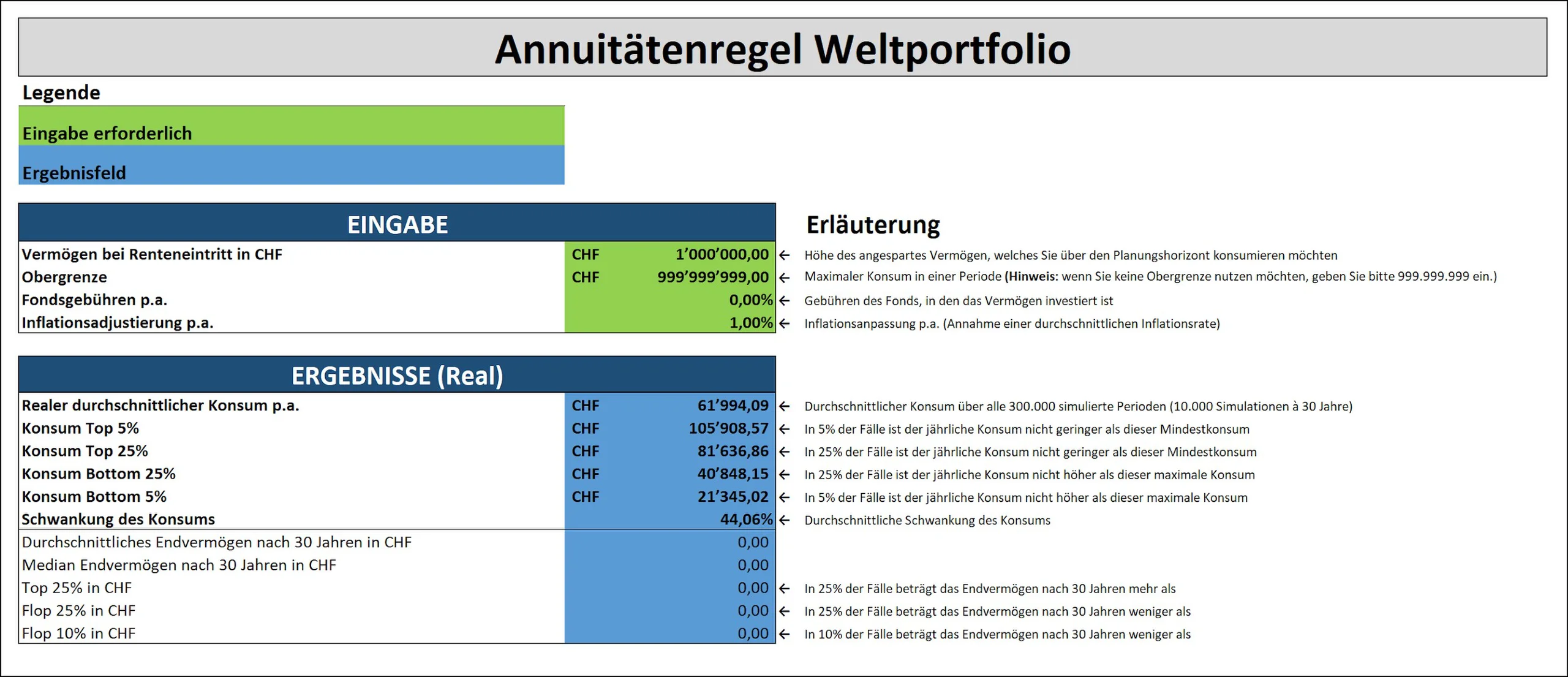
Explanation of Fig. 5: With starting wealth of CHF 1 million and a flexible withdrawal rate without ranges, including 1% inflation, spending fluctuates by an average of 44.06%. At the end of the defined 30-year planning period, your wealth will be completely used up. So there is neither a risk of running out of money early nor an “unplanned inheritance” risk. We assumed an expected return of 8%.
Great that the annuity rule without ranges has wiped out both the risk of ruin and the “unplanned inheritance” risk! But one problem remains: the withdrawal amounts fluctuate (too) much, as the chart below clearly shows.
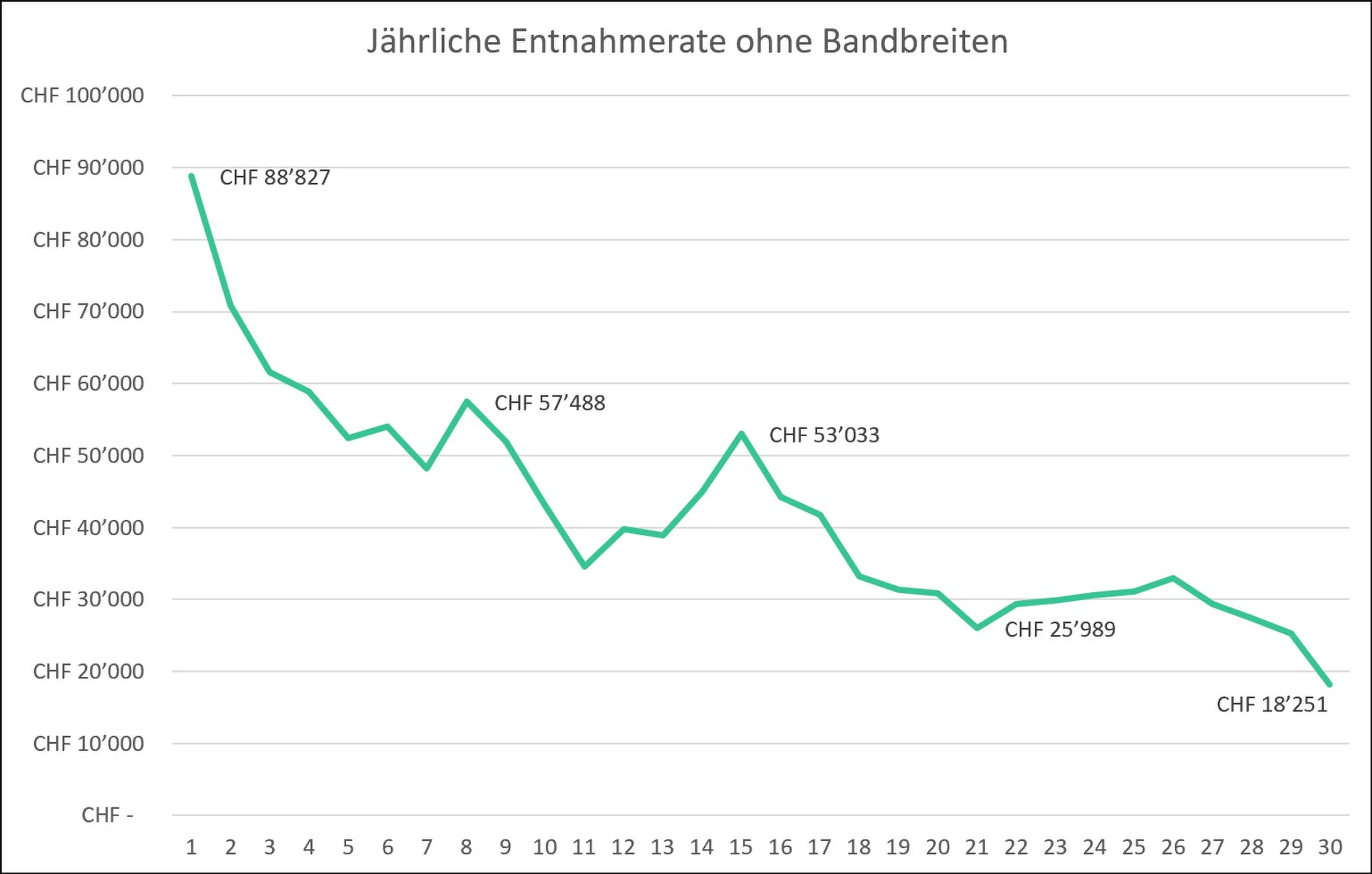
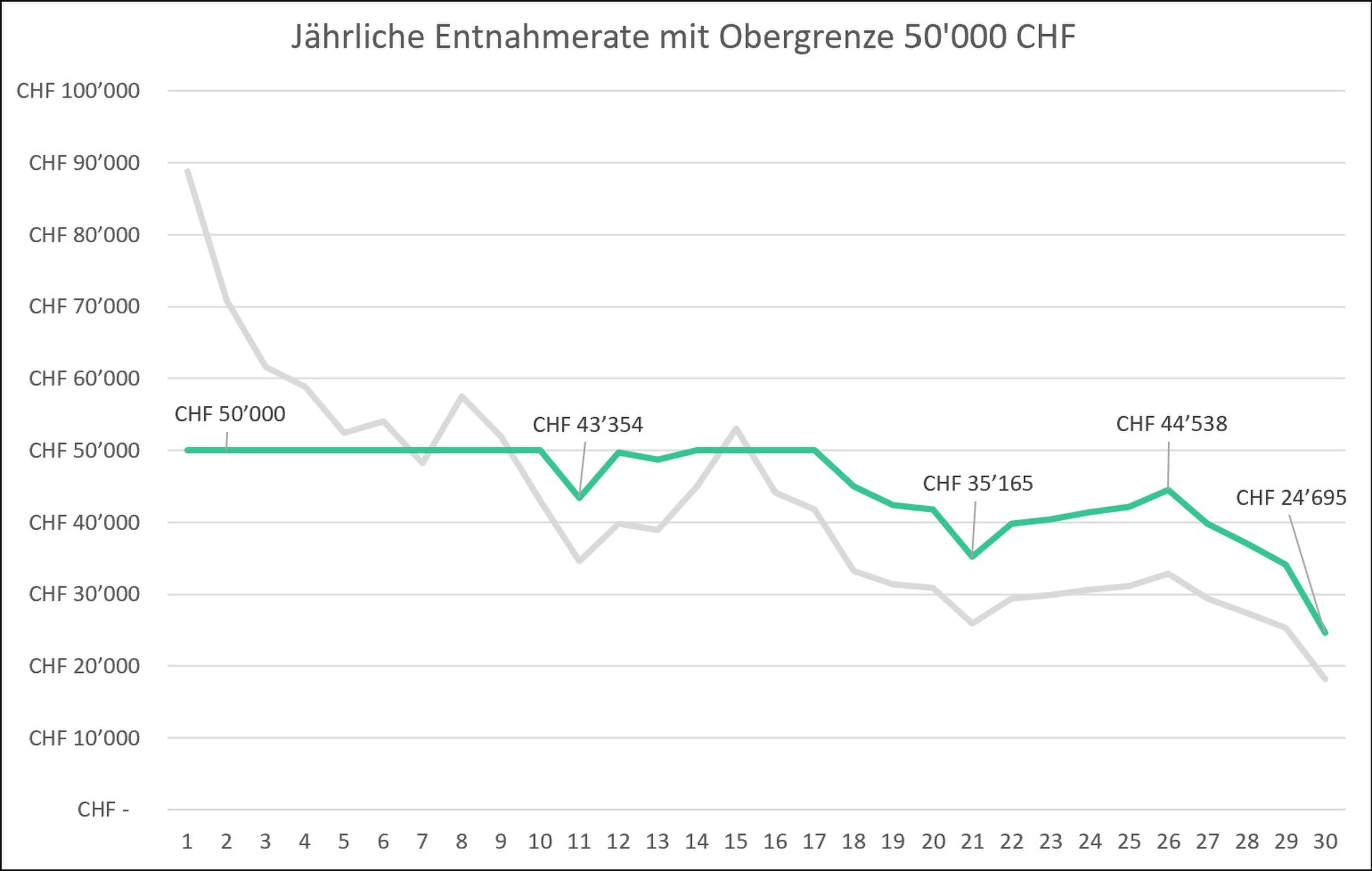
In our example, the annual withdrawal amount swings between a generous CHF 88,827 and a modest CHF 18,251.
With a cap we can reduce these market-driven fluctuations. So in addition to the previous parameters, we set a cap of CHF 50,000 on the annual withdrawal amount (see Fig. 7).
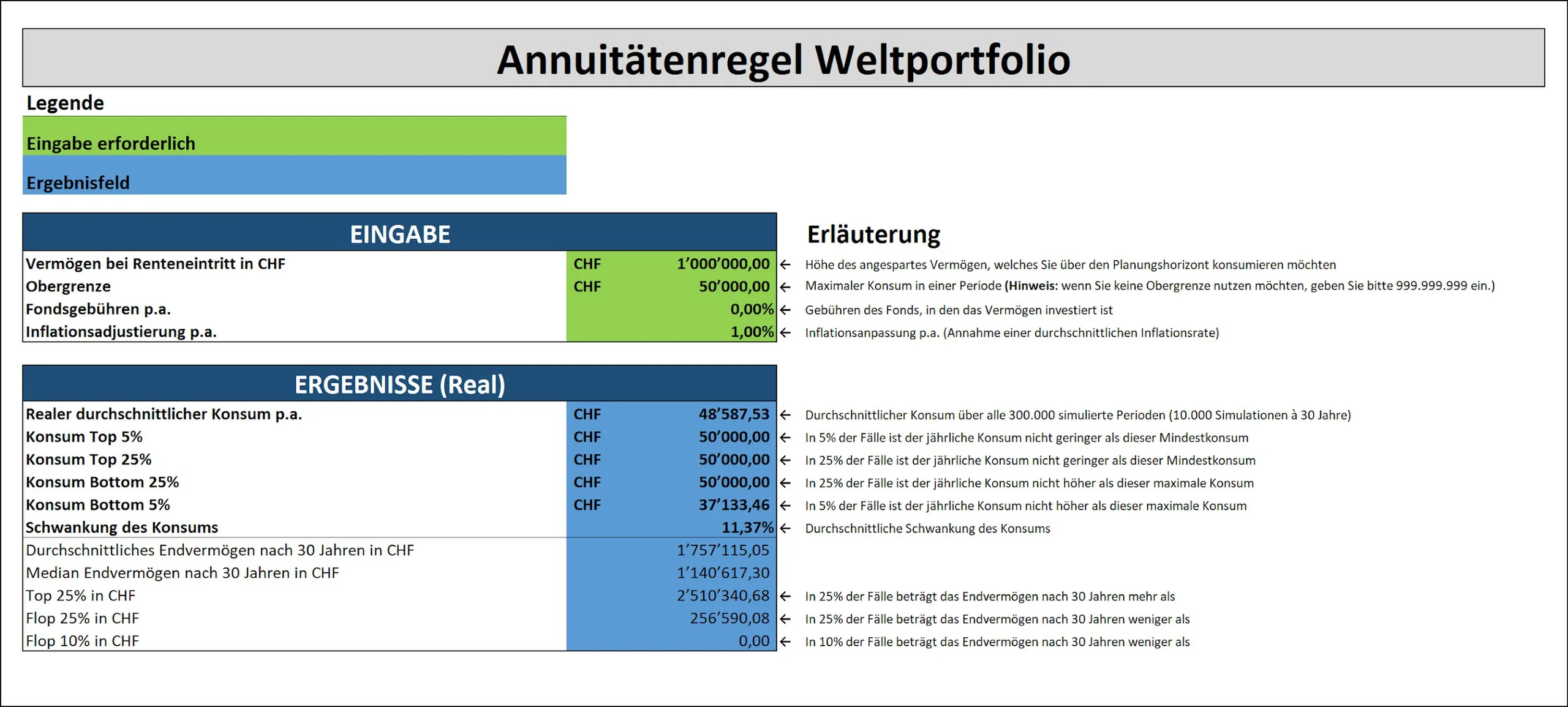
Explanation of Fig. 7: With a flexible withdrawal with a cap of CHF 50,000 p.a., including 1% inflation, spending fluctuates by an average of 11.37%. There is no risk of ruin within the defined 30-year planning period. However, the “unplanned inheritance” risk is highly likely to materialise. We assumed an expected return of 8%.
Figure 8 shows that with our returns from simulation 9 and a cap of CHF 50,000, the fluctuations can be significantly reduced. Even so, the withdrawal amount still swings quite a lot, between CHF 24,695 and CHF 50,000, i.e. by 50%.
In this example, we used up our wealth completely by the end of the 30-year withdrawal phase, i.e. the “unplanned inheritance” risk did not materialise. But as mentioned above, this risk cannot be ruled out with the annuity rule with a cap.
To smooth out the fluctuations even further, you would need to set a floor as well as a cap. We think a floor on the withdrawal amount makes sense especially if your essential expenses can’t be covered by state pensions. But with an additional floor, the annuity rule would carry the risk of running out of money early, which would defeat the main purpose of this rule.
That’s why a bit of creativity is called for, which brings us to our conclusion.
Conclusion: take the best of both worlds for early retirement
What we’ve discussed and analysed so far has shown one thing above all: all three withdrawal plans and their sub-variants can have serious drawbacks. To sum up briefly: fixed withdrawals without market risk lead to a lower standard of living on average; with fixed withdrawals with market risk, you face either ruin or an unplanned inheritance; and with flexible withdrawals with market risk, you are at the mercy of the stock market’s moods, which can lead to a sharply fluctuating standard of living.
That’s why, to wrap up, we’d like to present a home-made rule-of-thumb method that combines the flexible and the static “withdrawal worlds”, at least in places.
Our reference point is the annuity rule described above, on which the flexible withdrawal strategy is based.
As we saw so strikingly earlier, market fluctuations can be a problem with the flexible withdrawal strategy, depending on how returns develop. In extreme cases, i.e. after heavy price losses, the reduced withdrawal amounts may not even cover your essential spending any more. And that’s exactly where we need to step in. Without throwing the whole concept of the flexible withdrawal strategy overboard, you can get excessively fluctuating withdrawal amounts under control with the following two corrective measures.
Measure 1: set a cap for the “best-case scenario”
This cap kicks in after very good stock market years. The maximum withdrawal amount should be set neither too low nor too high. If you set it too low, you run the risk that your wealth won’t be used up (“unplanned inheritance” risk). If you set it too high, on the other hand, you will hardly be able to smooth out the fluctuations. In our simulation above, with starting wealth of CHF 1 million, we capped the maximum withdrawal amount at CHF 50,000. That’s 25% above the “4% rule” (CHF 50,000 vs. CHF 40,000). If you like, the cap can be a bit more generous. You only live once😊.
Measure 2: keep a cash reserve as an emergency fund
For this second measure, we fall back on the fixed withdrawal strategy without market risk. In concrete terms, this means your withdrawal strategy consists of two withdrawal pots: equity ETFs and cash. For loss-making stock market years, keep cash worth at least two annual withdrawal amounts in your bank account. With starting wealth of CHF 1 million and average living expenses of CHF 45,000, that would be around CHF 90,000. You play this cash joker in the first poor stock market years that come along (e.g. with price losses of 10% or more p.a.). 2022, for example, would have been one such joker year, as the broad-market MSCI World Index slumped by around 17%.
The timing is crucial because of sequence-of-returns risk. So if, for example, the stock market corrects by 10% in the third year of withdrawals, you should play this joker straight away, because its positive effect on the following withdrawal amounts and their fluctuations is greatest at the beginning. Later on, i.e. if you play the joker in year 23 instead of year 3, the smoothing effect on the fluctuations is much smaller.
Taboo for many investors, but possibly an alternative for cool-headed number crunchers: if you don’t want to hoard cash earning no interest for an “emergency”, you can instead finance your spending for the withdrawal year after a stock market slump with a Lombard loan. In such a case, your wealth, invested entirely with market risk, would serve as collateral for the lender. The loan would only be repaid once share prices have recovered, by selling parts of your holdings as usual in the withdrawal plan. Of course, it’s important that the loan is financed at the lowest possible interest rate. In our experience, Interactive Brokers offers comparatively attractive interest rates for Lombard loans.
Final remarks
As we have seen, a few precautions are needed to ease into early retirement. It’s particularly important that you can rely on a well-thought-out withdrawal plan. Flexibility when drawing down your wealth is key. As a basic rule, after poor stock market years you should sell none or only a limited amount of your equity holdings.
You might also be interested in


Updates
10 August 2026: Corrected the annuity formula (exponent in the numerator) and the related worked example.
11 September 2023: Replaced the link to the University of Mannheim’s decumulation simulator with the new version.
Disclaimer
Disclaimer: Investing involves the risk of losses. You have to decide for yourself whether or not you want to bear these risks.
Errors excepted: We have written this article to the best of our knowledge and belief. Our aim is to provide you as a private investor with the most objective and meaningful information possible on all things finance. If we have nevertheless made mistakes, or if important aspects have been forgotten and/or are no longer up to date, we would be grateful if you let us know.
About the authors

Stefan Huser
Stefan has been investing in the stock market himself since 2015. He has been shaped by Markowitz’s portfolio theory and Gerd Kommer’s book “Souverän investieren”. He follows a core-satellite strategy: a global equity portfolio of ETFs forms the core, complemented by alternative investments. At the blog, he mainly takes care of the writing. Stefan lives with his family in Zurich and is interested in literature, photography and financial freedom.

Antun Brcina
Antun (“Toni”) has been investing in the stock market since 2015. Financially, he has been particularly inspired by Gerd Kommer’s book “Souverän investieren” and the Fama-French five-factor model. His money is invested in a broadly diversified, long-term global equity portfolio of ETFs. At the blog, he mainly works on the calculators and the code. Toni lives with his family in the Zurich area and is interested in sports, technology and entrepreneurship.







21 Comments
Sollte es in der Annuitätenformel im Zähler für den Exponenten nicht “T-1” heißen (siehe Original-Formel in PDF von Prof. Weber)?
Danke + viele Grüße
Entschuldige die späte Antwort – Sommerferien. Du hast recht, danke für den aufmerksamen Hinweis! Wir haben den Exponenten im Zähler auf T–1 korrigiert und das Rechnungsbeispiel entsprechend angepasst.
Wie immer ein äusserst informativer Blog, danke euch.
Kurze Frage: Sind die 2 Jahre Cash, die man mindestens auf der Seite halten sollte bei Rente, quasi der Notgroschen? Also wenn man pensioniert ist, sollte man anstatt 3-4 Monatsgehältern oder so Cash für 2 Jahre horten?
Und wenn man ein 80/20 Portfolio hat (80% risikoreich, ETFs und 20% risikoarm, Cash), kommen die 2 Jahre Cash obendrauf?
Vermögensbildung bzw. entsprechende Strategien sind ja nicht exakte Wissenschaften. Letztlich hängt die Höhe des Notgroschens von deinem Risikoprofil ab. Wer Cash hortet, damit er für die darauffolgenden zwei Jahre im Notfall sämtliche laufenden Ausgaben decken kann, weist eher eine geringe Risikobereitschaft auf. So oder so, ob Cash für 4 Monate oder 2 Jahre, es ist Bestandteil des risikoarmen Anteils des Portfolios, also in deinem Beispiel wird es den 20% zugerechnet.
Kann ich mir wirklich sicher sein, dass keine Steuern auf die Kapitalgewinne erhoben werden?
Was wenn ich für Säule 1/2: CHF 8000 pro Monat beziehe, aber aus meinem Portfolio weitere CHF 15000 pro Monat?
Versucht die Finanzabteilung dann auf Biegen und Brechen einem ein professionelles Handeln mit ETFs vorzuwerfen?
Wäre gut zu wissen wie sich die Schweizer Steuerbehörden verhalten, ansonsten zwingt mich die Grösse meines Pirtfolios den Lebensabend in einem anderen Land mit max. 10% Kapitalertragssteuer zu verbringen.
Danke für eure Einschätzung.
Wir erachten es als sehr unwahrscheinlich, dass dich die Steuerbehörden mit deinem angedachten Entnahmeplan als gewerblichen Wertschriftenhändler einstufen würden…
Herzlichen Dank für Eure Einschätzung!
Ich bin bald in der Entnahmephase. Bei mir im Portfolio sind Aktien-ETF und ein Teil Einzeltitel (Schweizer Dividendenperlen), die ich schon seit Jahren im Depot habe. Diese Dividenden sorgen schon mal für jährlich ca. Fr. 13’000.- Einkommen. Die Barreserve ist auch vorhanden. Meine Frage: Wenn ich dann jeweils entnehme, was verkaufe ich am besten? ETF, die sich erfolgreich entwickelt haben oder besser die anderen? Oder die Einzeltitel, die seit dem Kauf massiv an Wert zugelegt haben? Das bereitet mir noch Kopfzerbrechen.
In der Entnahmephase würden wir grösseren Wert auf Stabilität und Ausgewogenheit im Portfolio legen. Das heisst, wir würden uns zuerst von (schwankungsanfälligen) Einzeltiteln trennen, dann von den (oft auch volatilen) Nischen-ETFs (falls vorhanden) und erst danach von den breit diversifizierten “Brot- und Butter”-ETFs (MSCI World & Co.). Aber das ist natürlich Geschmacksache und auch keine Anlageempfehlung:-)
Danke vielmals für den Gedankenanstoss! Und natürlich auch für den tollen und aufwändigen Artikel.
Sehr guter Beitrag, seit langer Zeit bin ich auf der Suche von so etwas. Ich wollte die Excel-Tabelle von der Webseite der Uni Mannheim herunterladen, leider funktioniert der Link nicht mehr. Könnt Ihr mir sie bitte zusenden?
Besten Dank und Grüsse,
Peter
Hoi Peter
Tatsächlich, der Link ist von der Uni Mannheim mittlerweile deaktiviert worden. Es soll jedoch hier bald Alternativen zum Download geben.
Beste Grüsse
SFB
…jetzt ist er da! hier geht’s zum neuen Entspar-Simulator der Uni Mannheim.
Ich bin sehr begeistert wie ihr das so konzentriert aber dennoch verständlich aufbereitet habt! Einfach toll!
Ich habe noch eine Rückfrage zur Datenbasis (Simulationstool). Einer der wichtigsten Kenngrössen, die zu erwartende Rendite lässt sich bei der Annuitätenregel nicht erfassen im 1. Reiter (Wo alle anderen Angaben erwartet werden). Im Reiter “Berechnung Annuitätenregel” gibt es ein Feld dafür, dass aber nicht zu Eingabe gekennzeichnet ist. Wenn man dort jetzt aber den Wert ändert, d.h. erhöht, sinkt der “Reale durschnittliche Konsum”. Das ergibt für mich keinen Sinn. Übersehe ich hier etwas?
Beste Grüsse
Gute Frage, die wir soeben an die Uni Mannheim weitergeleitet haben. Wir melden uns, sobald wir die Antwort erfahren.
Beste Grüsse
SFB
…also wenn man den angehenden Doktoranden der Uni Mannheim spannende Fragen, wie die deinige, stellt, dann scheinen sie regelrecht zur Höchstform aufzulaufen und antworten super schnell:-) Hier also die Antwort von Herrn Mertes (die von ihm erwähnten 15% Rendite sind nicht von uns, da hat er fürs bessere Verständnis wohl selber eine Annahme getroffen):
“Das hängt mit den simulierten Renditen zusammen.
Wenn Sie die Erwartete Rendite erhöhen, wird gemäß Annuitätenfaktor zu Beginn ein höherer Betrag pro Periode für den Konsum entnommen. Das macht auch erstmal Sinn, schließlich rechnet man damit, dass das verbliebene Vermögen auch stärker anwächst. Wenn nun allerdings die tatsächliche Rendite (das sind hier die simulierten Renditen) geringer ausfällt als die erwarteten 15%, reist der erhöhte Konsum ein Loch in die Planung und der zukünftige Konsum muss drastischer reduziert werden, da die zuvor erwarteten Anlageeinnahmen fehlen. Auch in den zukünftigen Perioden wird weniger Anlageeinnahmen erwirtschaftet, weil bereits so viel in den ersten Perioden entnommen wurde. Daher reduziert sich das gesamte Vermögen durch die erhöhte Erwartete Rendite.
Im Detail hängt das vom Ablauf der Renditen ab (theoretisch kann auch der umgekehrte Effekt eintreten), da aber die simulierten Renditen in dem Tool (im Einklang mit historischen Werten) nur einen Durchschnitt von etwa 7.2% aufweisen, führt eine Annahme von 15% erwarteter Rendite regelmäßig zu dem oben genannten Effekt.”
Alles klar?
Perfekt, Vielen Dank!
Ein sehr gut aufbereiteter Beitrag. Vielen Dank.
Aus meiner Sicht müsste auch das Alter berücksichtigt werden. Wer am Anfang der Rente steht, unternimmt viel und ist oft unterwegs, die sogenannten GoGo Years. Dann wir man ruhiger und bleibt in der Nähe , die sogenannten SlowGo Years. Ab 80=85 sind die NoGo Years dran. Über 30 Jahre braucht man mehr Geld zu Beginn und weniger am Schluss. Der lebensnahe Entnahmeplan ist also veränderlich. Am Anfang wird viel Geld benötigt, am Schluss wenig. Wie könnte der Entnahmeplan aussehen?
In diesem Fall könntest du dein Vermögen zu Beginn der Rente (z.B. 1 Mio. CHF) in mehrere Teilvermögen splitten. Das heisst, z.B. die ersten “teuren” 10 Jahre mit 500’000 CHF kalkulieren, die zweiten 10 Jahre noch mit 300’000 CHF und die “günstige” letzte Dekade schliesslich mit 200’000 CHF. Abgesehen davon könnte man bezüglich des Kostenverlaufs aber auch umgekehrt argumentieren:-) Nämlich so, dass es “hinten raus” immer teurer wird (Pflegekosten & Co. lassen grüssen…)
Whow, was für ein genial guter Beitrag, vielen DANK. Genau sowas hatte mir noch gefehlt. Auch Dankeschön für die Links. Habe das Excel gleich selber mal ausgetestet und da auch mit der TER gespielt. Bei 1 Mio. was ja mind. das Ziel wäre, macht das schon was aus. Der Sparkojote hatte ja vor kurzem ein Video darüber “diese Gebühren zerstören dein Depot”.
Ich frage mich nun aber, wieso er wie ihr ja auch den VWRL (TER 0.22) und nicht den VT (TER 0.07) im Depot habt. Da gibt es ja diverse Unterschiede wie Fonddomizil, Währung, Steuererklärung, etc. Vielleicht ist das mal ein Thema für ein Blog Beitrag für euch, diese zwei Gegenüber zu stellen mit allen Vor- und Nachteilen….
Merci fürs Lob, was uns natürlich sehr freut! (Umso mehr uns dieser Beitrag einiges an Hirnschmalz abverlangt hat:-) Zu deinem ETF-Vergleich: Beides sind natürlich Top-ETFs. Was u.a. für den VWRL spricht: Handelswährung CHF (Beim Kauf ist kein Währungswechsel nötig). Die TER ist zwar (auf tiefem Niveau) etwas höher, doch die für uns noch wichtigere Tracking Difference liegt bei gerade mal 0,02%. Solange es solch attraktive ETFs an der Heimbörse gibt, ziehen wir diese jeweils den US-Pendants vor.
Beste Grüsse
SFB