
 Newsletter

With this post, we want to introduce you to an asset class that is still relatively unknown in Switzerland but growing fast: crowdlending, also known as peer-to-peer (P2P) or marketplace lending. In this first article, you will learn what P2P loans are and what the Swiss market looks like. We draw on the current Crowdfunding Monitor Switzerland 2019 by Lucerne University of Applied Sciences and Arts.
Contents
What crowdlending (P2P in Switzerland) is and how it works
Crowdlending is one of five categories of crowdfunding and, at around CHF 262 million, accounts for the largest lending volume (see Figure 1)

Crowdlending covers the financing of companies or private individuals through loans (debt capital). Unlike traditional lending, crowdlending involves no intermediary bank. Instead, loans are arranged online via a platform. For a fee, the operator of such a marketplace usually takes on the risk assessment of the borrower as well as all debt collection, including payment reminders, dunning letters and debt enforcement proceedings.
In return for granting the loan, you as the lender receive interest payments, the amount of which depends essentially on the credit risk, the loan term and the type of loan. Figure 2 below shows, in simplified form, how the various players in the crowdlending system interact.

Besides personal and SME loans, mortgages are also granted to private individuals in Switzerland without an intermediary bank. Loans to private individuals are also referred to as consumer crowdlending, those to companies as business crowdlending. For loans in the form of mortgages, the term real estate crowdlending is also used. However different these variants may be in detail, they all share one crucial and cost-efficient feature: there is no expensive bank acting as intermediary.
Within the crowdlending category, SME loans account for the lion’s share at CHF 134.4 million. They are followed by real estate loans (70.5) and consumer loans to private individuals (57) (see Figure 3). The latter remain marginal at 1.3% (2018) of the overall consumer credit market.

What the Swiss market looks like
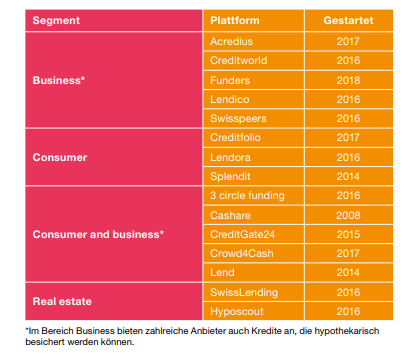
The first so-called P2P platform in Switzerland, Cashare, was founded back in 2008. By the end of 2018, the Swiss market had become considerably more diverse, with a total of 15 active platforms (see Figure 4).
The platforms mostly focus on one or two crowdlending segments. In business and consumer crowdlending, there are also providers that offer mortgage-secured loans. Business crowdlending platforms typically target small and medium-sized enterprises (SMEs). Consumer crowdlending platforms are active in the consumer credit market.
Growth in the number of new platforms has slowed considerably. In 2018, only one new crowdlending platform, Funders, entered the Swiss market.
Although it only launched in 2015, CreditGate24 is clearly the largest crowdlending platform by lending volume (as of 2019).
How the platforms make money
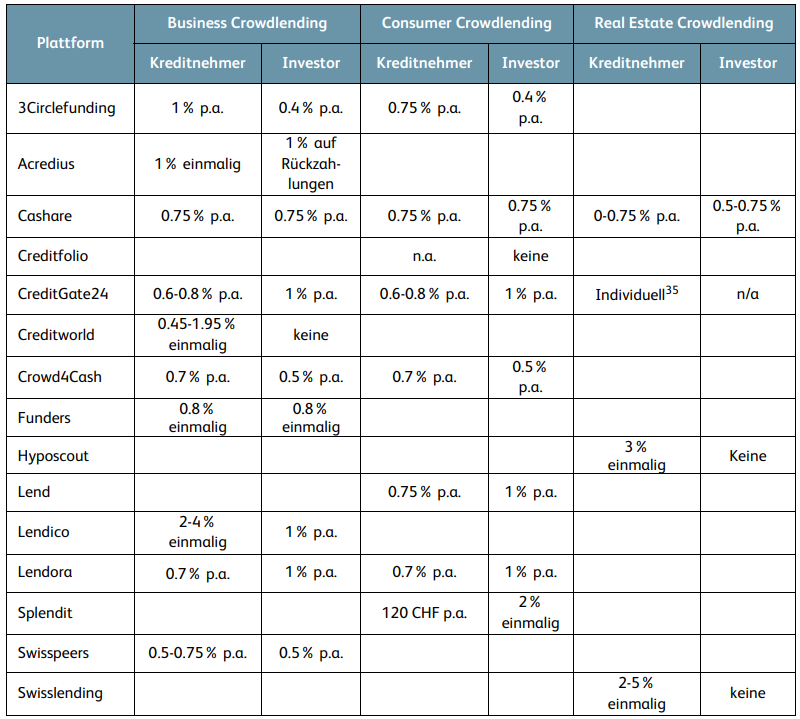
Crowdlending fees are usually based on the size of the loan (see Figure 5). Fees are often charged on both the lender and the borrower side. Depending on the platform, they may also be charged both at signing and over time. The ranges are correspondingly wide and the fee models are sometimes hard to compare.
– P a r t n e r o f f e r –
In our experience, and thanks to its low costs for ETFs, DEGIRO is a particularly attractive broker right now (link to our DEGIRO review). If you are interested, you can sign up with DEGIRO via our partner link, which secures you trading credits worth CHF 100 (subject to conditions) while supporting our blog at the same time.
– – – – –
Switzerland is up among the leaders in international comparison
Looking at crowdfunding volume per capita in international comparison, Switzerland is one of the more relevant markets worldwide. As Figure 6 shows, Switzerland, in 7th place (2017), lags far behind the leaders, the USA and the UK, but is surprisingly far ahead of our neighbours. Note that the figures refer to all crowdfunding categories (see Figure 1), i.e. not just to crowdlending.

Theses on crowdlending
Based on the Crowdfunding Monitor 2019, the following market theses can be derived for crowdlending:
- Continued growth
In 2018, crowdlending in Switzerland grew by around 40%. Continued double-digit growth is also expected for the next few years. - Market concentration or consolidation
The trend towards a market concentrated on three to five providers will become even more pronounced. That’s because there are still too many platforms in Switzerland that are online but have so far financed only very few projects. These will disappear again in the short to medium term. On the other hand, new market entries are likely to become increasingly rare. - Crowdlending is moving away from its original idea
In crowdlending, more and more platforms are carrying out transactions between borrowers and lenders without a public call for funding, and many loans are no longer financed by a crowd but by a single professional investor. As a result, private individuals are becoming less important.
You might also be interested in


Disclaimer
Disclaimer: Investing involves the risk of loss. You have to decide for yourself whether or not you want to take these risks.
Errors excepted: We have written this article to the best of our knowledge and belief. Our aim is to provide you, as a private investor, with information on finance that is as objective and meaningful as possible. Should we nevertheless have made mistakes, or should important aspects have been forgotten and/or no longer be up to date, we would be grateful if you let us know.
About the authors

Stefan Huser
Stefan has been investing in the stock market himself since 2015. He has been shaped by Markowitz’s portfolio theory and Gerd Kommer’s book “Souverän investieren”. He follows a core-satellite strategy: a global equity portfolio of ETFs forms the core, complemented by alternative investments. At the blog, he mainly takes care of the writing. Stefan lives with his family in Zurich and is interested in literature, photography and financial freedom.

Antun Brcina
Antun (“Toni”) has been investing in the stock market since 2015. Financially, he has been particularly inspired by Gerd Kommer’s book “Souverän investieren” and the Fama-French five-factor model. His money is invested in a broadly diversified, long-term global equity portfolio of ETFs. At the blog, he mainly works on the calculators and the code. Toni lives with his family in the Zurich area and is interested in sports, technology and entrepreneurship.







4 Comments
Vielen Dank für den guten Artikel, was wäre denn deine Empfehlung für einen Schweizer P2P Anbieter?
Guten Tag Tinki
Merci für dein positives Feedback! Erfahrungen mit Schweizer P2P-Anbietern haben wir mit Cashare (Toni: nicht empfehlenswert, da Rendite gegen 0% tendiert; Klumpenrisiko) und Creditgate24 (Stefan: prüfenswert) gesammelt. Bei Creditgate24 gefällt insbesondere die automatisierte Risikostreuung mittels Solidarbeitrag. Vorteil: kein Klumpenrisiko bzw. relativ stabile Erträge; aktuell liegt die Rendite bei gut 4%, vor Corona bei rund 5% bei einem über alle Bonitätsstufen gemischtem Portfolio).
Beste Grüsse SFB
Also Cashare habt ihr wohl nicht so gut getestet. Wie kann man dort auf 0% kommen? Und was versteht ihr unter Klumpenrisiko? Das liegt doch echt nicht an der Plattform sondern am Investor Toni! Ich fahre bei Cashare mit Grundpfand gesicherten Krediten rund 8,5% ein und von den gesicherten Krediten ist noch nie einer weggebrochen!
Super spannend! Ich hätte nich gedacht dass die Schweiz so dicht am Baltikum in Bezug auf P2P ist! In Sachen Rendite liegen die Baltischen Plattformen aber noch weit vorne. Auch die Usability und Aufbereitung für die Steuern ist dort weiter vorangeschritten, da die Plattformen in der Regel deutlich älter sind. Mein Favoriten sind dabei Mintos und Bondora – wo es sogar eine Tagesgeld Funktion mit 6,75% Zins gibt. Ganz liebe Grüsse von Eric