Newsletter
Your portfolio is set up, your asset allocation is fixed – and then the markets do whatever they like. Prices rise, fall, shift. Suddenly your portfolio no longer matches your risk profile. Does it have to be that way? Not necessarily. In this fifth lesson of our financial guide, you’ll learn how to get your wealth back in balance with little effort – and when you can skip it altogether.
< Lesson 4 | Overview | Lesson 6 >



In a nutshell
- Rebalancing means bringing your portfolio back to your target weighting after market swings – no more, no less.
- If you hold a single global ETF and a fixed franc amount as your low-risk portion, you don’t need rebalancing.
- It becomes relevant when the low-risk portion is defined as a percentage, or when different asset classes in your portfolio perform differently.
- Checking once or twice a year is enough – readjusting only pays off from a deviation of 5 percentage points, ideally via new contributions rather than sales.
- The so-called rebalancing bonus can deliver a small extra return, but it’s a welcome side effect – the real argument remains risk control.
Contents
What is rebalancing – and do you even need it?
In the last lesson, you learned how to split your wealth into a high-risk and a low-risk portion. That lays the foundation of your portfolio. But the markets don’t stick to your plan: prices rise and fall, and the weightings shift with them. Rebalancing means restoring your original allocation.
An example: you’ve invested CHF 100,000 – 75% high-risk, 25% low-risk.
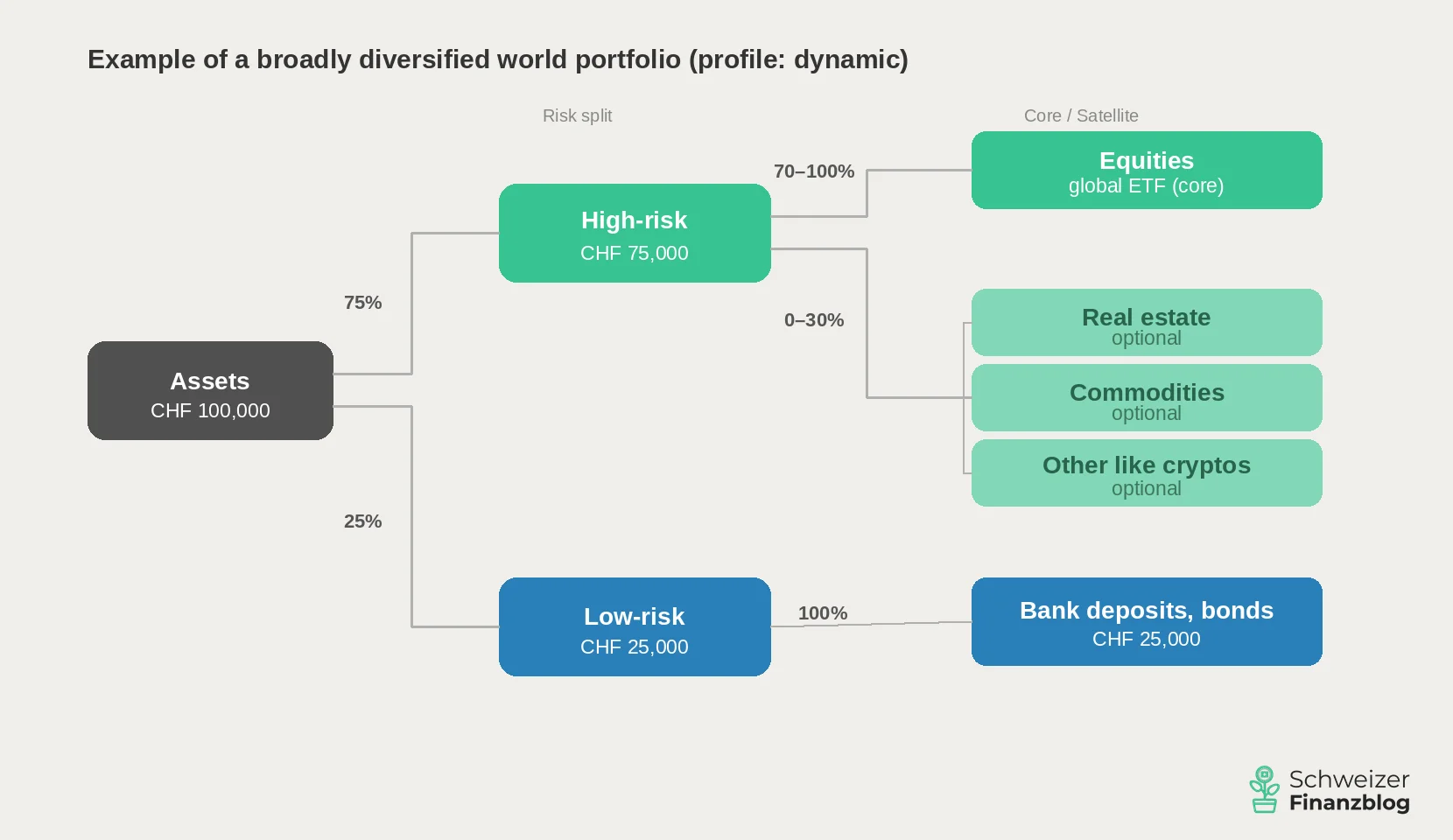
Now the stock markets drop by 30%. Your high-risk portion falls from CHF 75,000 to CHF 52,500, while the CHF 25,000 in your savings account stays the same. Your total assets now come to CHF 77,500 – and the low-risk share is suddenly 32% instead of 25%. Your portfolio is much more conservative than you planned.
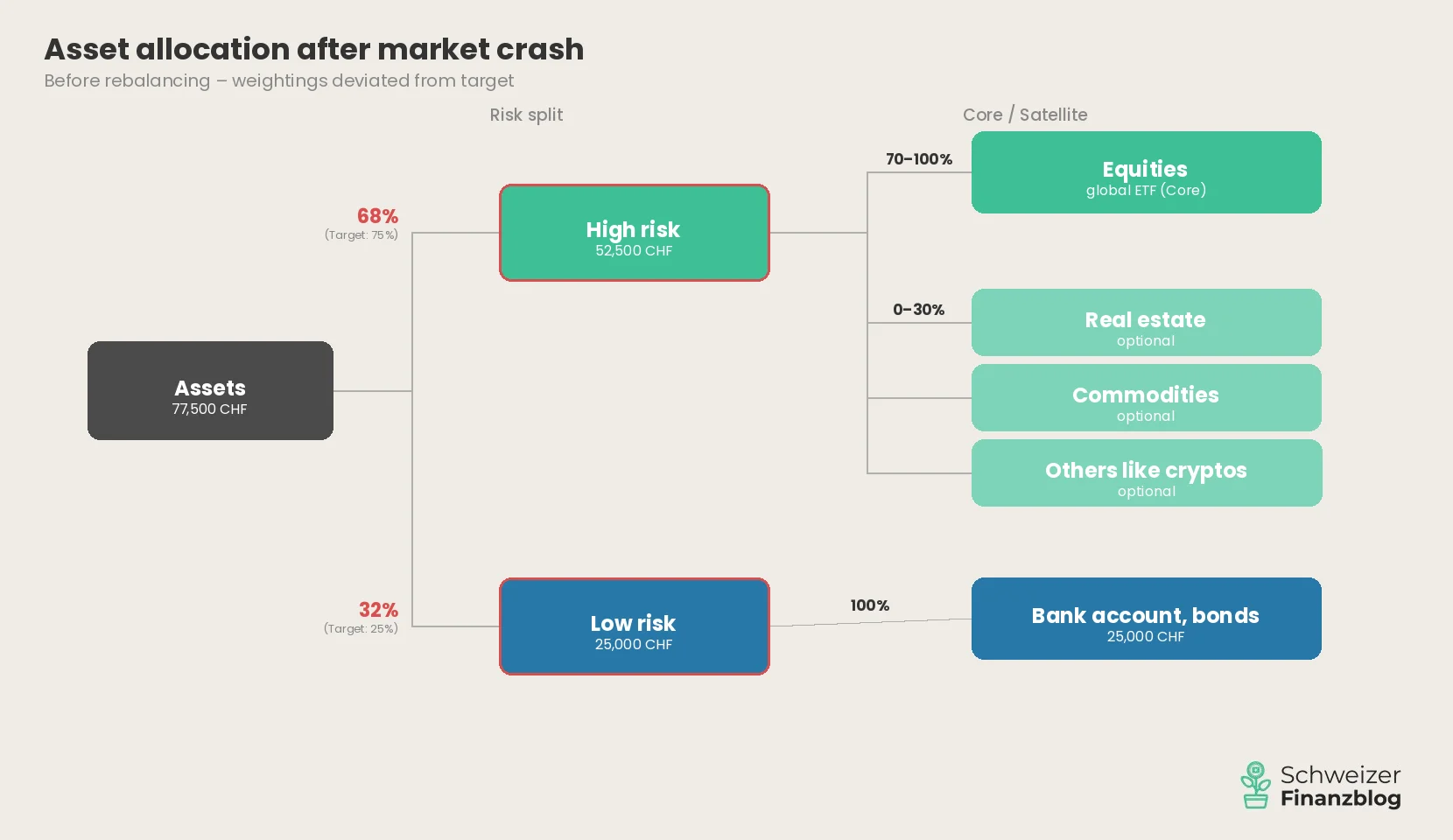
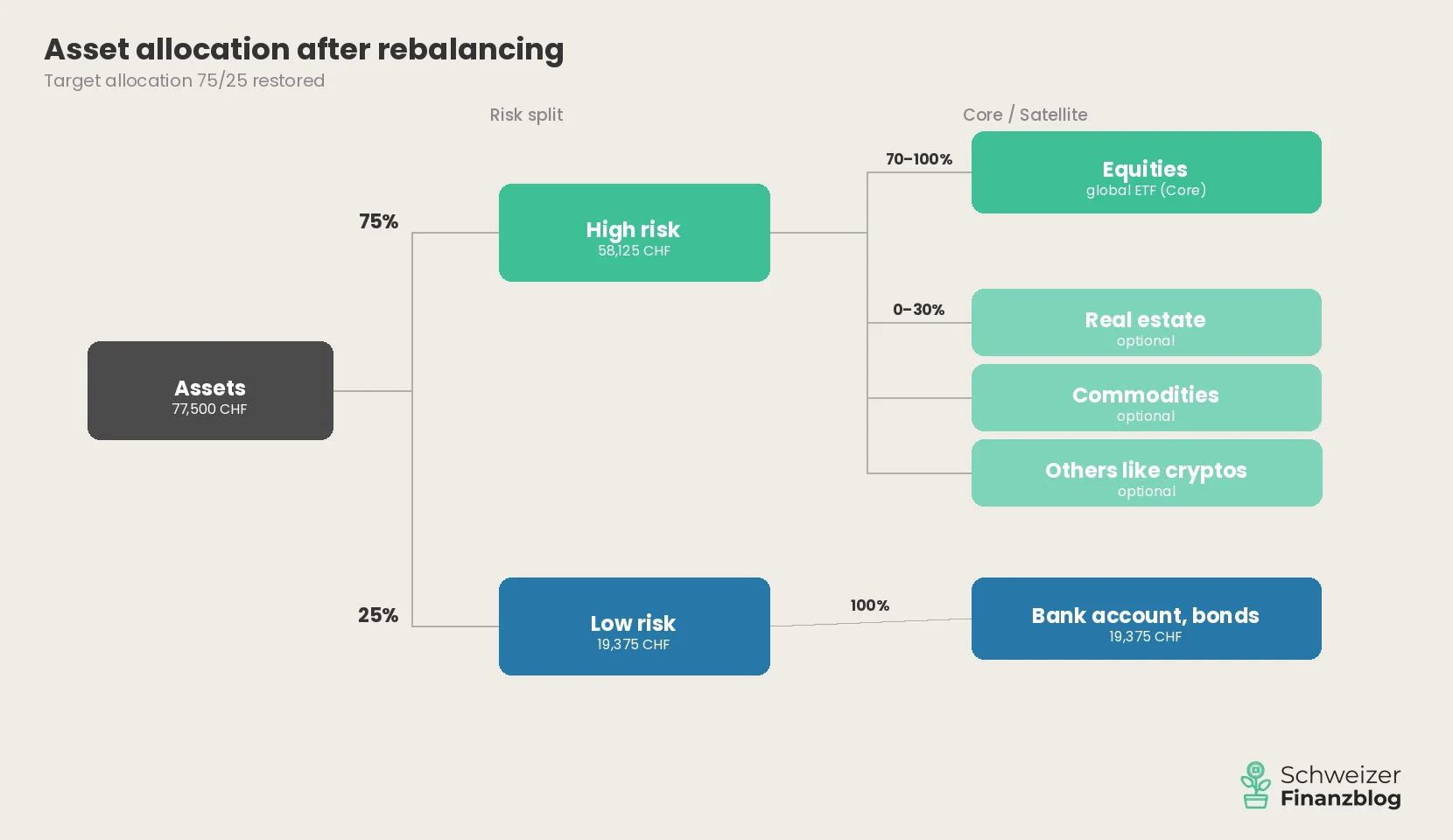
To get back to 75/25, you’d have to shift around CHF 5,600 from your savings account into the high-risk portion – right after a crash, of all times, when your gut is telling you not to. That’s exactly what rebalancing is: a sober, rule-based correction that brings your portfolio back in line with your risk profile.
When you don’t need rebalancing
But before you set up a rebalancing calendar: not every portfolio needs this correction. If you hold a single global ETF and define the low-risk portion as a fixed franc amount – e.g. CHF 25,000 in a savings account, not counting your emergency fund – you simply have nothing to rebalance. The ETF is continuously adjusted internally by the provider. And a fixed amount doesn’t shift, no matter what the markets do. In the same crash, your CHF 25,000 stays where it is. Your high-risk portion has shrunk, but your risk profile hasn’t changed – and that’s the logic behind the fixed franc amount. No action needed.
So rebalancing becomes relevant when the low-risk portion is defined as a percentage (as in the example above) or when the portfolio consists of several ETFs, for example in a core-satellite approach. In both cases, the weightings drift apart over time – and you have to actively readjust. Let’s now look at how to do that pragmatically and cheaply.
Rebalancing in practice: how to bring your portfolio into balance
Two questions arise: when should you rebalance? And how?
When to rebalance?
In theory, there are two approaches: calendar-based and threshold-based. With the calendar-based approach, you review your portfolio at fixed intervals – say, once a year. With the threshold-based approach, you only act when a deviation exceeds a certain value, e.g. 5 percentage points.
In practice, you can combine both: you check your portfolio once or twice a year – and only step in if the deviation is large enough. That’s all it takes. Rebalancing isn’t a day-to-day job, but an occasional fine-tuning.
Three ways to bring your portfolio back into balance
There are basically three methods for bringing your portfolio back to its target weighting:
- Reallocating: You sell investments that are above their target weighting and use the proceeds to top up underweight positions. The classic approach, but it comes with transaction costs.
- Cash-flow rebalancing: You direct new contributions – for example from your monthly savings – specifically into the underweight positions. No selling needed, no extra costs. For investors in the accumulation phase, this is the most elegant way, and it’s the one we follow too.
- Combination: For smaller deviations, you readjust via new contributions. Only for larger shifts do you actively reallocate.
No need for perfection
If you balance every position down to the last franc, you’ll pay unnecessarily high transaction fees – especially with smaller amounts. Focus on the biggest deviations. Once the overall split between the high-risk and low-risk portions is right again, you can safely ignore smaller imbalances within the high-risk portion. You’ll simply realign them with your next savings contribution. As a rule of thumb: if a position deviates from its target weighting by more than 5 percentage points, action is called for. Below that, the effort usually isn’t worth it.
The following chart shows what this looks like in practice.
Good to know: rebalancing in the drawdown phase, Pillar 3 and taxes
Drawdown phase
Everything described so far relates to the accumulation phase – the period in which you build up your wealth. But even if you’re drawing on your wealth in retirement, you can rebalance. The principle is simply reversed: instead of steering new contributions, you first sell positions that are above their target weighting. That way, each withdrawal brings your portfolio closer to its target weighting – without additional transactions.
Pillar 3
If you hold part of your wealth in Pillar 3: here, rebalancing is usually automated. You specify your risk profile once, and the provider takes care of the readjusting for you – often already included in the management fees. You still have to look after rebalancing your non-pension assets yourself, though.
Taxes
For private investors in Switzerland, rebalancing generally has no tax consequences. Capital gains on private assets are tax-free. The only exception: if you trade so frequently and on such a large scale that the tax authorities suspect professional securities trading, your gains are taxed as income. With one or two rebalancing transactions a year, that’s not an issue.
The rebalancing bonus: a welcome side effect
The main goal of rebalancing is clear: your portfolio should match your risk profile again. But there’s a pleasant side effect known in the specialist literature as the rebalancing bonus.
The principle behind it is simple: when rebalancing, you systematically buy more of the investments that have fallen and trim those that have risen. In other words, you act countercyclically – and it’s precisely this behavior that can generate a small extra return over the long term. Various studies put this effect at around 0.1 to 0.5 percentage points per year.
The honest downside
The rebalancing bonus is not a law of nature. It works best when prices return to their average after swings – the so-called regression to the mean. In phases of long-lasting trends, on the other hand, rebalancing can hold you back because you sell winners too early. None other than Charlie Munger, Warren Buffett’s long-time partner, firmly rejected rebalancing for exactly this reason: anyone who systematically trims their winners slows the growth of their portfolio.
Then there are the transaction costs. At an expensive traditional bank, they quickly eat up the bonus. The rebalancing bonus is therefore only worth it with a low-cost online broker that charges low fees per transaction.
So: think of the bonus as a welcome extra, not a guarantee.
“The real case for rebalancing isn’t the extra return – it’s risk control.”
– Partner offers –
Still looking for the right financial solution? Our recommendations – with attractive sign-up bonuses.

– – – – –
Conclusion
Rebalancing isn’t a third major investment principle alongside diversification and asset allocation – it’s the maintenance that ensures your portfolio still matches your risk profile after market swings.
If you keep it simple – one global ETF and a fixed franc amount in a savings account – you don’t need to worry about it. For everyone else: check once or twice a year, readjust when deviations are larger, ideally via new contributions rather than sales. There’s no need for perfection – as long as the overall allocation is right, you can safely ignore smaller imbalances.
In Lesson 6, we take a closer look at the investment vehicle that keeps cropping up in this guide: the ETF. What’s behind it – and why do we speak of a revolution in private investing?
You can find an overview of all lessons here: Learn to invest – in eight lessons.
You might also be interested in

Updates
2026-06-12: Selective adjustments made.
2026-04-14: Article completely revised and updated.
Disclaimer
Disclaimer: Investing involves the risk of loss. You have to decide for yourself whether or not you want to take on these risks.
Errors excepted: We wrote this article on rebalancing to the best of our knowledge and belief. Our goal is to give you, as a private investor, the most objective and meaningful information possible on all things finance. If we have nevertheless made mistakes, or if important aspects have been forgotten and/or are no longer up to date, we’d be grateful if you let us know.
About the authors
Stefan Huser
Stefan has been investing in the stock market himself since 2015. He has been shaped by Markowitz’s portfolio theory and Gerd Kommer’s book “Souverän investieren”. He follows a core-satellite strategy: a global equity portfolio of ETFs forms the core, complemented by alternative investments. At the blog, he mainly takes care of the writing. Stefan lives with his family in Zurich and is interested in literature, photography and financial freedom.
Antun Brcina
Antun (“Toni”) has been investing in the stock market since 2015. Financially, he has been particularly inspired by Gerd Kommer’s book “Souverän investieren” and the Fama-French five-factor model. His money is invested in a broadly diversified, long-term global equity portfolio of ETFs. At the blog, he mainly works on the calculators and the code. Toni lives with his family in the Zurich area and is interested in sports, technology and entrepreneurship.