
 Newsletter
In this article, we turn our attention to the robots among investment advisors. They seem to have made their breakthrough, and the range on offer in Switzerland is now large and hard to keep track of. Reason enough for us to take a closer look at three of the most innovative robo-advisors in Switzerland. In this in-depth comparison of Swiss robo-advisors, you’ll find out what these modern workhorses are good for, how they differ and whether they’re right for you.

In a nutshell
-
Robo-advisors make investing much easier for private investors: once your risk profile is defined and a standing order is set up, your investments run fully automatically.
-
The three robo-advisors we examined, clevercircles (the “flexible one”), findependent (the “price breaker”) and Selma (the “established one”), differ considerably from one another in some respects.
-
What they have in common, however, is that they follow our preferred passive or index-based investment strategy. That is exactly why they can offer their services at fair prices.
-
The robo-advisors we tested are particularly suitable for “savings plan fans”, “lazybones” and
“compromisers”. -
Compared with a do-it-yourself portfolio, they offer the following advantages, among others:
-
Suitable for savings plans
-
Easy rebalancing (at the push of a button or fully automatic)
-
Personal dashboard with appealing data visualisation, statistics and reports
-
Significant time savings
-
-
For investors who place particular value on the widest possible choice of ETFs and/or the lowest possible costs, however, the “do-it-yourself” portfolio remains the first choice.
-
With these vouchers you can secure a starting credit with clevercircles, findependent and Selma.
Contents
- Introduction to “robo-advisors in Switzerland”
- Swiss robo-advisor comparison
- Robo-Advisor profiles
- Cost comparison between robo-advisors and ‘do it yourself’
- Robo-Advisor cost comparison with different investment sums
- Conclusion of our Swiss robo-advisor comparison: which Swiss robo-advisor suits you best?
- Robo-advisors: distinguishing features
- Starting bonus for new customers
- You might also be interested in
- Updates
- Disclaimer
Introduction to “robo-advisors in Switzerland”
Before we get to our comparison of Swiss robo-advisors, we’d like to start by sharpening your basic understanding of robo-advisors and explaining what they are for.
What are robo-advisors?
A robo-advisor is an algorithm-based system that gives automated investment recommendations and can also implement them. The term is a portmanteau of the English words robot and advisor. Robo-advisors aim to digitise and automate the services of a traditional financial advisor. The term “robo-advisor” is also used for financial service providers that work with such systems. (Source: Wikipedia)
How does a robo-advisor fit in with our mission?
Well. The three robo-advisors we examined all support a passive or index-based investment strategy. Their investment universe consists exclusively of passive investment vehicles such as ETFs and/or index funds. The ongoing costs are somewhat higher than if you organise your investments entirely yourself. In return, you save on brokerage fees (e.g. for a savings plan via standing order or when rebalancing). And ultimately, the total costs are well below those of conventional, active investment advice.
Who are robo-advisors suitable for?
If you belong to at least one of the following three groups, robo-advisors are an option worth considering:
“Savings plan enthusiasts”: With robo-advisors, it’s easy to invest even small amounts regularly. No matter how often you invest or how much, unlike with a traditional broker you don’t pay any transaction fees in the form of brokerage fees.
“Lazybones”: Robo-advisors largely automate your investing. Based on your individual investment strategy and the corresponding risk profile, the robo-advisor takes care of your money. The only requirement is that you “feed” it with money. It then invests this according to set rules in the appropriate asset classes and investment products. On top of that, rebalancing, which is rather tedious to do manually, is child’s play with a robo-advisor.
“Compromisers”: For those who are put off by the often (very) high fees of traditional asset management and the lower returns that result, but who also shy away from the extra effort of “do-it-yourself” investing, robo-advisors may be the happy medium. They are substantially cheaper than traditional asset management and yet very easy to use.
What happens if a Swiss robo-advisor goes bankrupt?
Your investments are protected by two measures:
- Cash holdings are covered by deposit insurance of up to CHF 100,000.
- The risk-based investments are segregated assets, as they consist of the investment vehicles ETFs and index funds. Segregated assets are excluded from the bankruptcy estate.
What does the Swiss robo-advisor market look like?
The Swiss robo-advisor market has developed strongly in recent years. The range on offer is now as diverse as it is hard to keep track of. In a recent study, the comparison service moneyland.ch compared the asset management costs of traditional banks with those of no fewer than 14 different robo-advisors. Among other things, the study concludes that mandates from traditional banks are more than twice as expensive as the new online offerings.
Swiss robo-advisor comparison
In this chapter, we look at the following three robo-advisors, which position themselves very differently on the Swiss market:
- clevercircles: the flexible one
- findependent: the price breaker
- Selma: the established one
We have partnered with all three robo-advisors. As a new customer, you benefit from a starting bonus and support our blog at the same time.
- 🎁CHF 20 starting bonus with findependent using promo code SFB20
- 🎁CHF 34 starting bonus with Selma using promo code sfbselma
- 🎁CHF 100 starting bonus with clevercircles using promo code SFB
Profiles of the three Swiss robo-advisors
Before we take a closer look at the sign-up process, investment universe, handling and pricing, the table below shows the key facts about the three Swiss robo-advisors we reviewed.
Robo-Advisor profiles
| clevercircles | findependent | Selma | |
|---|---|---|---|
| Slogan | “The first self-determined asset management” | “Investing has never been so easy” | “Managing finances properly” |
| Founding year | 2018 | 2020 | 2016 |
| Legal form / registered office | AG / Basel | AG / Aarau | AG / Zürich |
| Managing Director | Sebastian Comment | Matthias Bryner | Patrik Schär |
| Partner bank | Bank CIC AG (owner of clevercircles) | None (findependent is a licensed custodian securities firm) | Saxo Bank AG |
| Flat-rate fees | 0,65% TCHF 5 – 100 0,55% TCHF 100 – 200 0,45% ab TCHF 200 0,25% ab CHF 1 Mio. Mindestgebühren CHF 40 | 0,40% TCHF 50 (bis TCHF 2 gratis) 0,38% TCHF 50 – 150 0,35% TCHF 150 – 250 0,33% TCHF 250 – 500 0,31% TCHF 500 – 1 Mio. 0,29% TCHF ab CHF 1 Mio. Keine Gebühren auf dem Cashbestand | 0,68% TCHF 2 – 50 0,55% TCHF 50 – 150 0,47% ab TCHF 150 |
| Minimum amount Initial investment | CHF 5’000 | CHF 500 | CHF 2'000 |
| Savings plan eligibility / minimum amount | Ja / CHF 100 | Ja / CHF 100 | Ja / CHF 100 |
| Trading platform | Internet & App | App | Internet & App |
| Communication channels | Chat / Phone / E-Mail | Chat / Phone / E-Mail | Chat / Phone / E-Mail |
| Specialties (optional) | Currency hedging, flexible rebalancing, own investment committee, free demo version | Own investment solution for the greatest possible self-determination, investing for children | Portfolio alignment according to ESG principles at the touch of a button, pension solution 3a integrated on the platform, AI-supported advice and portfolio analysis |
| New customer code / start bonus | SFB / CHF 100 | SFB20 / CHF 20 | sfbselma / CHF 34 |
How does onboarding work?
In our comparison of Swiss robo-advisors, onboarding involves the following four steps with all three providers:
- signing up with the robo-advisor, including signing the contract and creating an individual risk profile based on a questionnaire,
- opening an account with the partner bank, including signing the contract,
- transferring money to the partner bank, and
- the robo-advisor investing your money based on the risk profile it has determined
Important: With robo-advisors, the onboarding process is much more than a formality. The questionnaire you fill in determines your risk profile. Your risk profile in turn directly determines which asset classes you invest in and in what proportions. This results in your asset allocation, which ultimately has a major influence on your returns.
And one more thing: when transferring money, always enter yourself (and not the robo-advisor) as the beneficiary. Otherwise, the money will be sent back to you, as we found out for ourselves.
Positive: With all three providers, you can cancel immediately or at least at the end of the month (clevercircles) at no cost.
clevercircles
Onboarding is entirely digital and takes around 15 minutes. This includes installing the “clevercircles” smartphone app. Clevercircles is the only provider that isn’t interested in your current income, which we welcome.
findependent
Onboarding is entirely digital via the app and, since findependent obtained its licence as an account-holding securities firm in 2026, takes only around 10 minutes.
Selma
Unlike the other two providers, the digital part of onboarding is complemented by an interaction with a (flesh-and-blood) customer advisor. In a video call, which you join by downloading an app or via your web browser, you are asked to hold your ID document up to the camera. In addition, various details such as your name and date of birth are asked for verbally to verify your identity. Finally, you are asked to confirm acceptance of the contract verbally. This intermezzo, which surprised us, and the comparatively extensive questionnaire meant that onboarding took the longest here in our comparison of Swiss robo-advisors.
What does the investment universe look like, and how sensible is it?
All three providers in our comparison of Swiss robo-advisors use only our preferred passive investment vehicles: ETFs and/or index funds. A distinction must be made between the investment universe of the robo-advisor and that of the investor. In this chapter, we look at the former and focus in particular on the “equities” asset class.
clevercircles
The clevercircles investment universe consists of 16 products spread across the following asset classes:
- Equities (6 products)
- Bonds (4)
- Real estate (3)
- Commodities (2)
- Precious metals (1)
All products offered are based on indices, which non-customers can also view transparently here. The “equities” asset class covers the most important markets in the developed world and the emerging markets. However, some countries such as Canada, Australia and a few countries outside the eurozone (e.g. Norway) are not included. A “blemish”, but one that affects returns only minimally. Also: if you value investing in sustainable ESG products, clevercircles is the wrong place for you. Unlike the other two providers, clevercircles does not offer any green stocks.
findependent
The findependent investment universe consists of around 40 products spread across the following asset classes:
- Equities (30 products; focus on sustainability)
- Bonds (6)
- Real estate (2)
- Precious metals (1; gold)
- Bitcoin (1)
All products offered are ETFs, which non-customers can also view transparently here. The “equities” asset class covers every market in the developed world and the emerging markets without gaps. What stands out is that findependent focuses on sustainable investments and works with corresponding ratings and screenings. As a further unique selling point, findependent also offers five ETFs for the trending themes “Clean Energy”, “Robotics & Automation”, “Digitalisation”, “Health” and “Gender”. Unlike the other two providers, precious metals play no role at findependent.
Selma
Selma offers the following asset classes:
- Equities
- Private equity
- Bonds
- Real estate
- Precious metals
No product list showing the investment universe is published. On request, however, we were given more detailed insights. With the exception of Canada and Australia, the “equities” asset class covers the most important markets in the developed world and the emerging markets. In addition, a sustainable ESG focus for the portfolio is optional and easy to switch on at the push of a button.
How sensible and flexible are the risk profile and asset allocation?
With all three providers in our comparison of Swiss robo-advisors, your risk profile is determined from the questionnaire you fill in during onboarding. This in turn results in your individual asset allocation, i.e. your personal investment universe.
It can’t be said often enough: asset allocation is the be-all and end-all of investing. As a rule of thumb, the higher your equity allocation, the higher the return and risk you can expect. As rational investors with a long investment horizon, we aim for the highest possible equity allocation with a global focus.
Of course, this doesn’t mean we reject cash per se. Cash reserves are undoubtedly important for ongoing expenses, but also for the unexpected. But we don’t need a robo-advisor for that. We handle payments and the like conveniently through our main bank, where we also park our “emergency fund”.
clevercircles
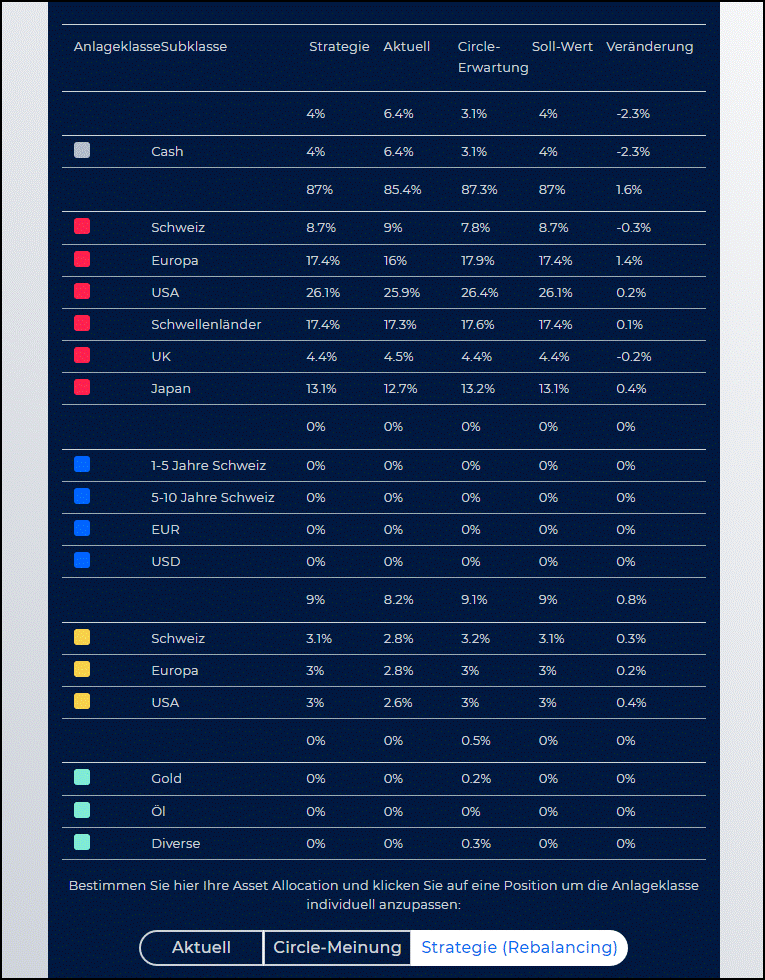
clevercircles distinguishes between “Portfolio” (current asset allocation) and “Strategy” (target or strategic asset allocation). At the start, the cash allocation is 100%, because clevercircles invests at 10-day intervals.
Besides the attractive visualisation, we were pleased that we could adjust the proposed strategy or asset allocation, which was a little too conservative for our taste, super easily using sliders. So in no time at all, we increased the equity allocation in our target allocation, left the real estate as it was, removed the bonds and reduced the cash allocation to the lowest permitted level of 4%.
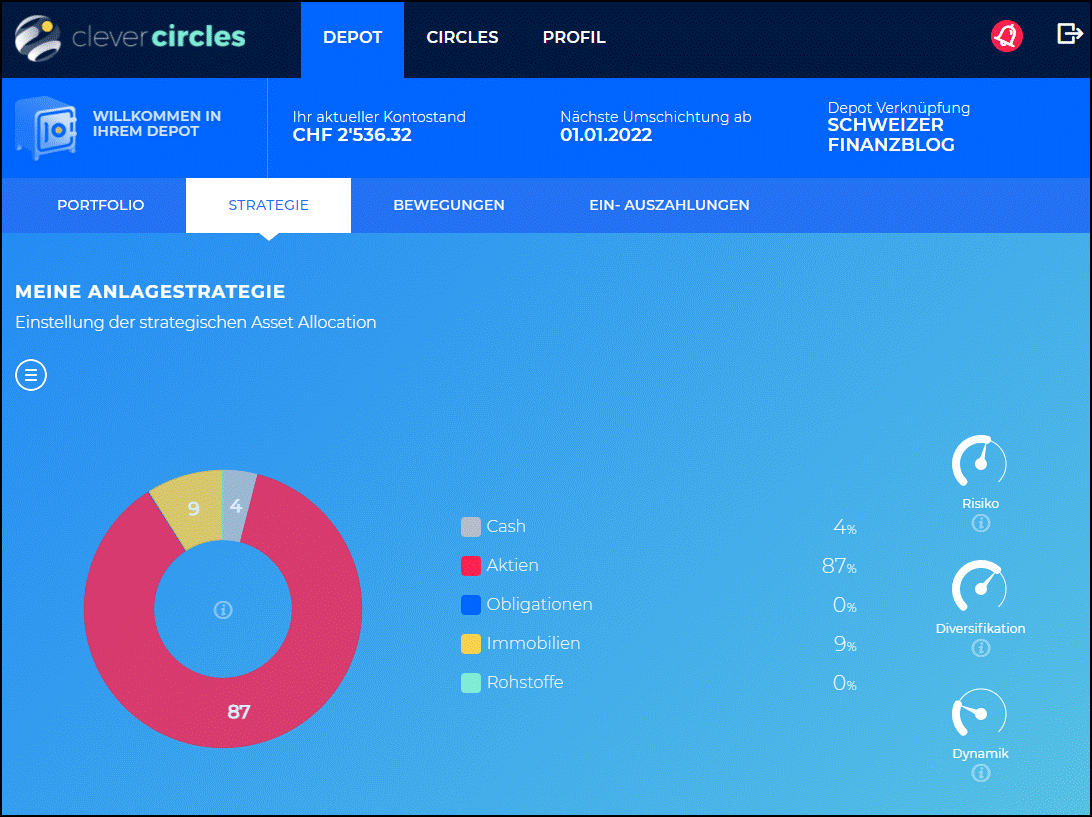
The actual portfolio is based on the strategy, as the image below shows. Deviations can be corrected every two months by rebalancing.
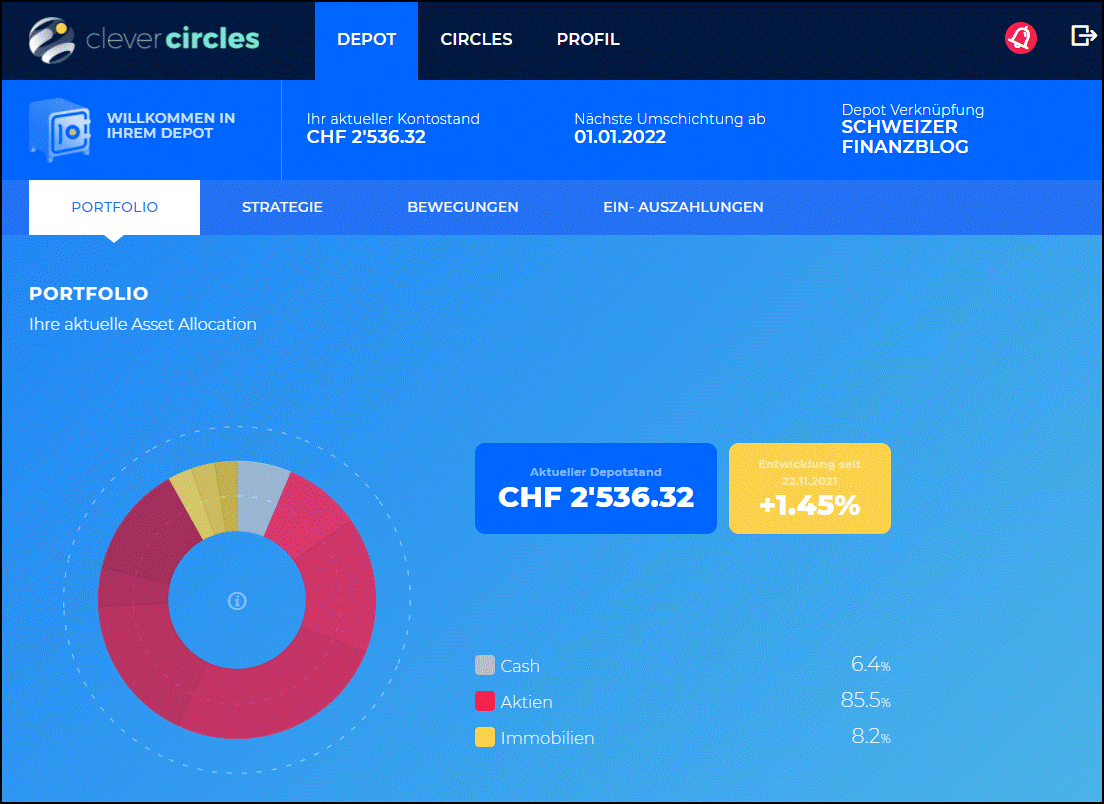
Note: the minimum investment at clevercircles is actually CHF 5,000. clevercircles made an exception for Stefan and Toni for this comparison of Swiss robo-advisors, so they were able to test clevercircles with separate accounts of CHF 2,500 each.
findependent
At findependent, too, we fill in the pleasantly short questionnaire to the best of our knowledge and belief and are given the investor profile “bold”. On closer inspection, this means a target portfolio with 80% equities, 10% real estate, 8% bonds and 2% cash.
To get rid of the (currently almost interest-free) bonds, we have to manually upgrade our risk level to “risk-seeking”. (According to findependent, the highest risk level, “risk-seeking”, is never suggested directly by the robo-advisor; the customer always has to select it manually.) The target allocation is adjusted within seconds. The difference between the “bold” and “risk-seeking” profiles is essentially that the equity allocation is increased and the bonds are eliminated.
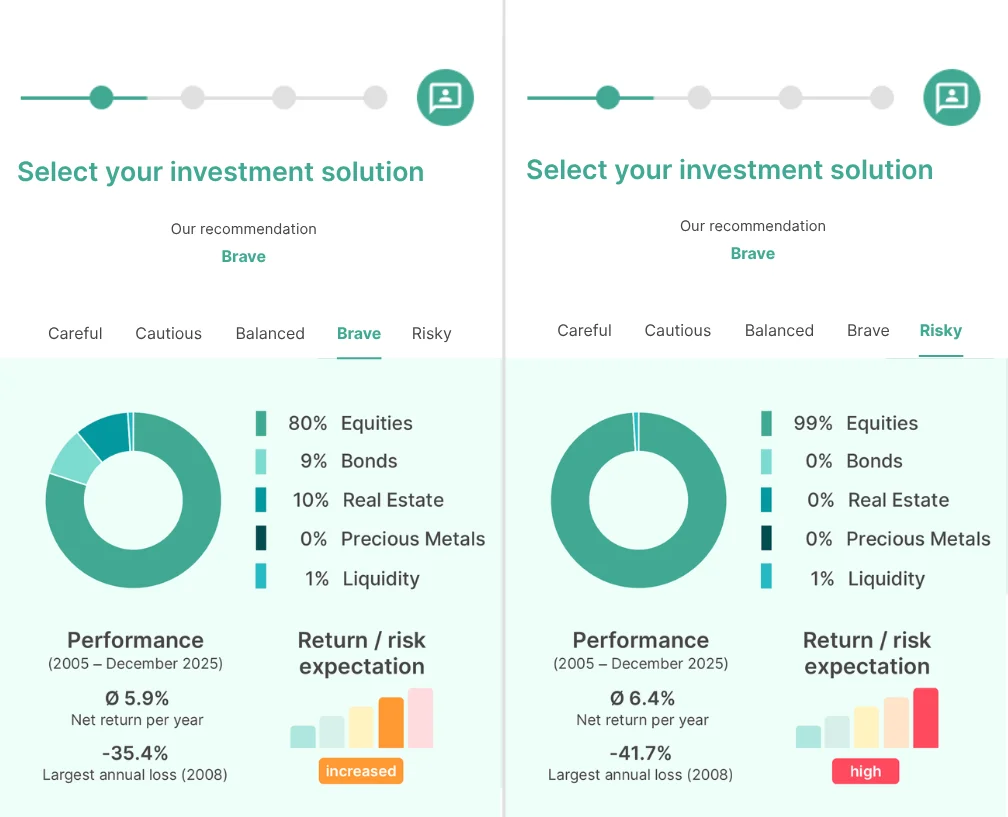
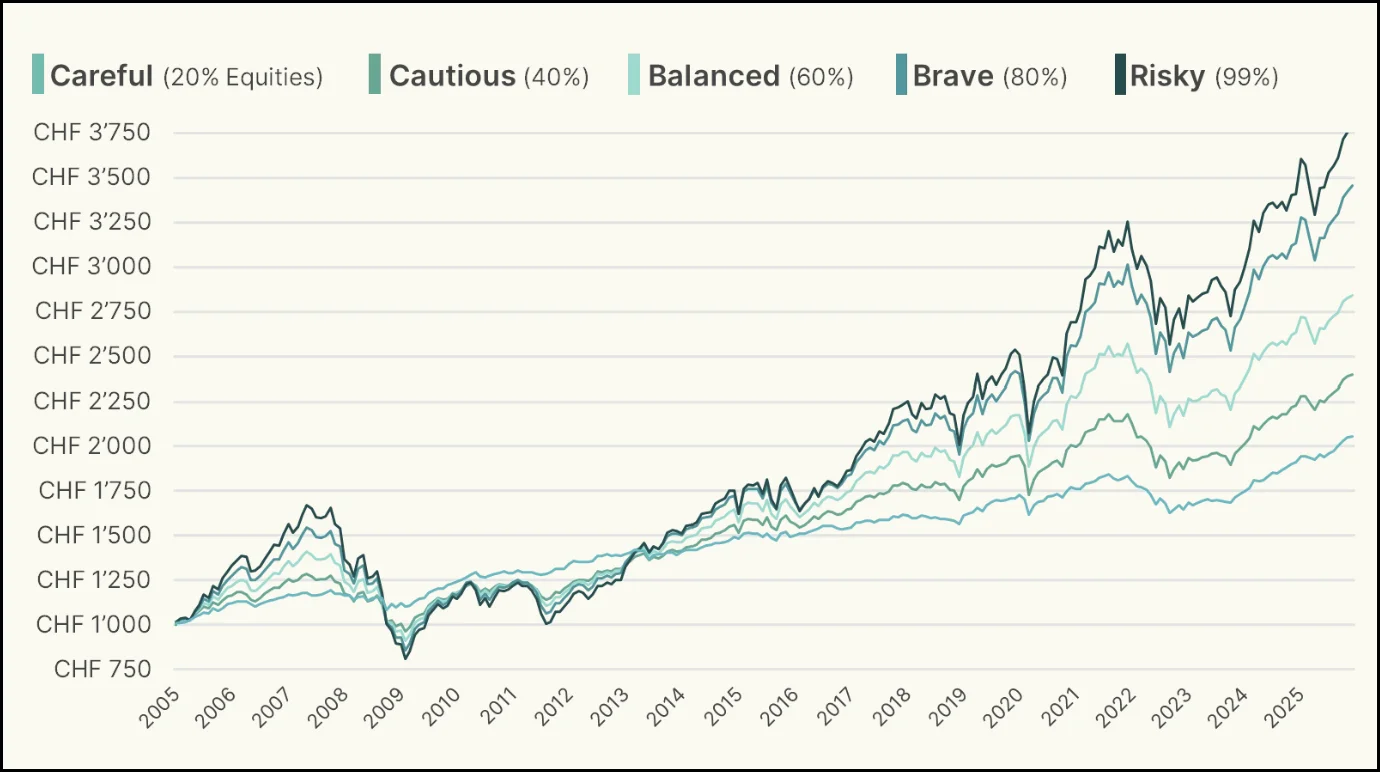
The image below shows the performance of the five risk profiles offered by findependent from 2005 to 2025 and impressively confirms the investment principle: the higher the risk, the higher the return.
A high degree of customisation if you want it: in addition to the five ready-made investment solutions in the standard range, you can put together your own investment solution from around 40 pre-selected ETFs from CHF 5,000 upwards, based on findependent’s investment universe. This gives findependent the highest degree of self-determination over your portfolio of all three robo-advisors we examined.
Selma
At Selma, every investor gets their own planet, e.g. “Antunium” in Antun’s case. As with the other two providers, the asset allocation we were given seems too conservative to us. So we want to increase the equity allocation, eliminate cash as far as possible and throw out the investments the robo-advisor has made in the asset classes cash, bonds and precious metals.
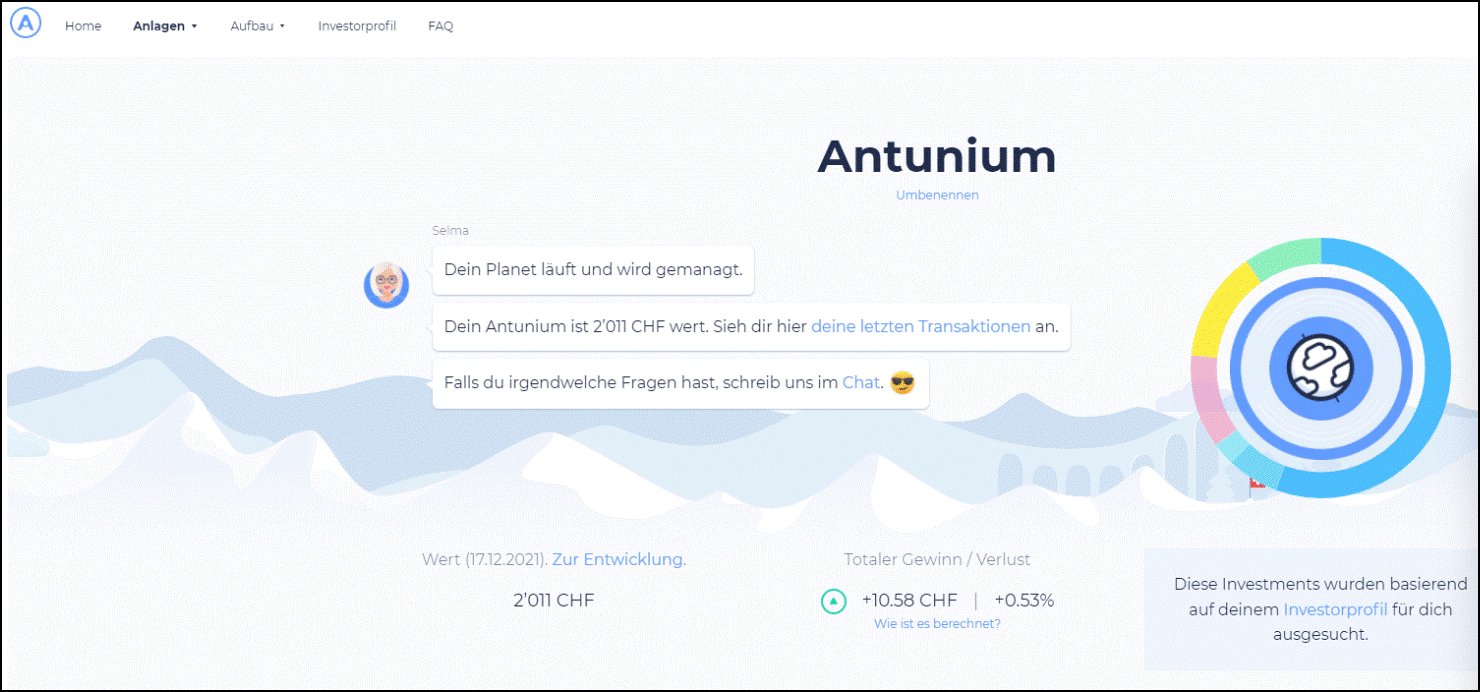
With Selma, that’s easier said than done! Selma is the only provider that does not let you change the asset allocation directly. Via chat, we learn that the asset allocation can only be changed indirectly by adjusting the risk profile. Specifically, we have to answer the first question about our willingness to take risks again. The “right” answer to select is “I like to speculate & like risk”.
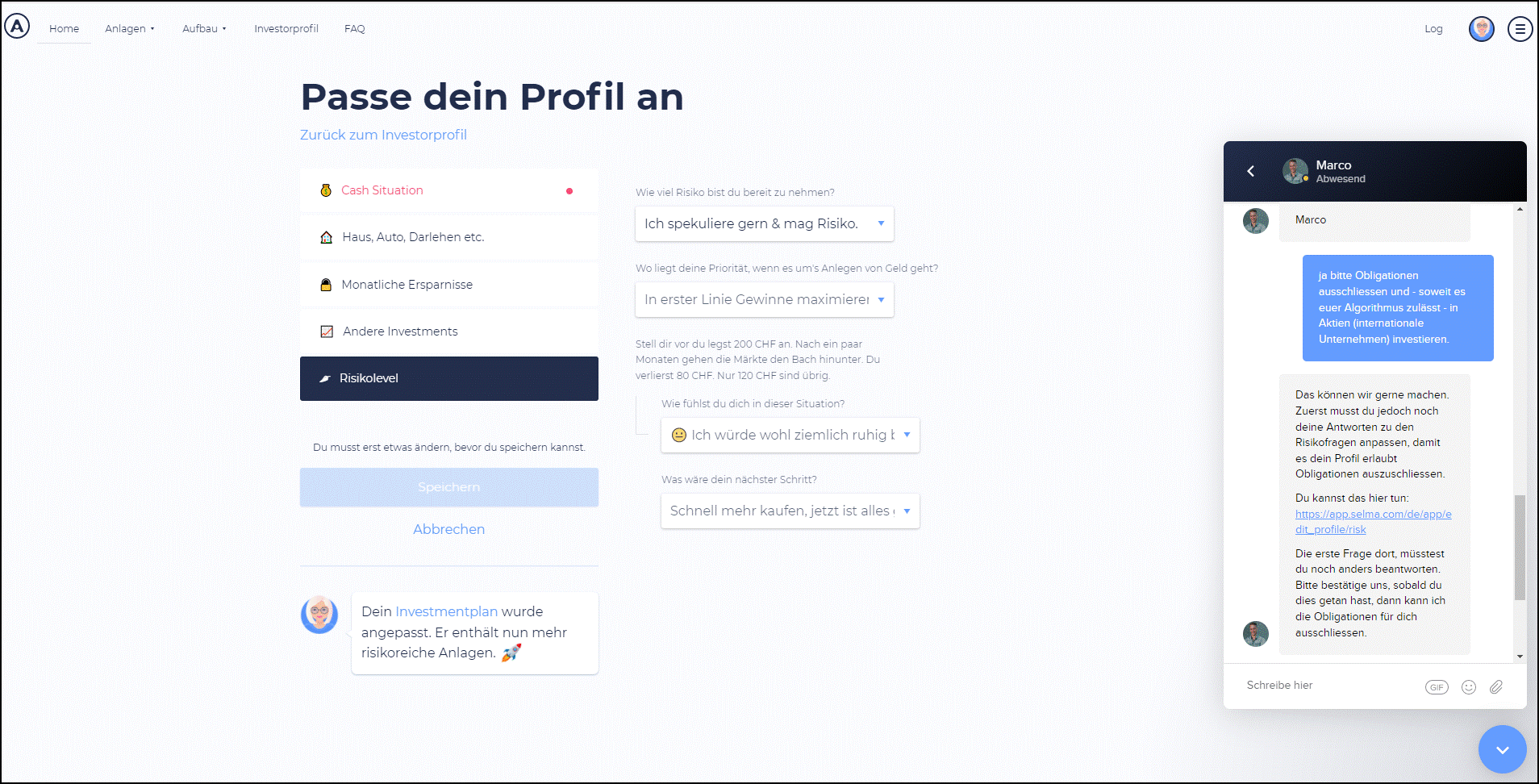
We don’t see the connection between speculation and a higher equity allocation in the form of passive ETF equity investments. In the “equities” asset class, speculative investing for us would be day trading in the form of stock picking and market timing, which, as advocates of the buy-and-hold strategy, we are known to reject.
At least by adjusting the risk profile we got rid of the bonds, but not the precious metals. Support agent Marco explains in the chat: “The precious metals allocation is currently increased, and it will stay that way for some time until the markets are no longer so overpriced.”
So Selma doesn’t seem to quite believe in efficient markets, which according to portfolio theory are always correctly priced.
Positive: the adjustment is made promptly, i.e. on the following day.
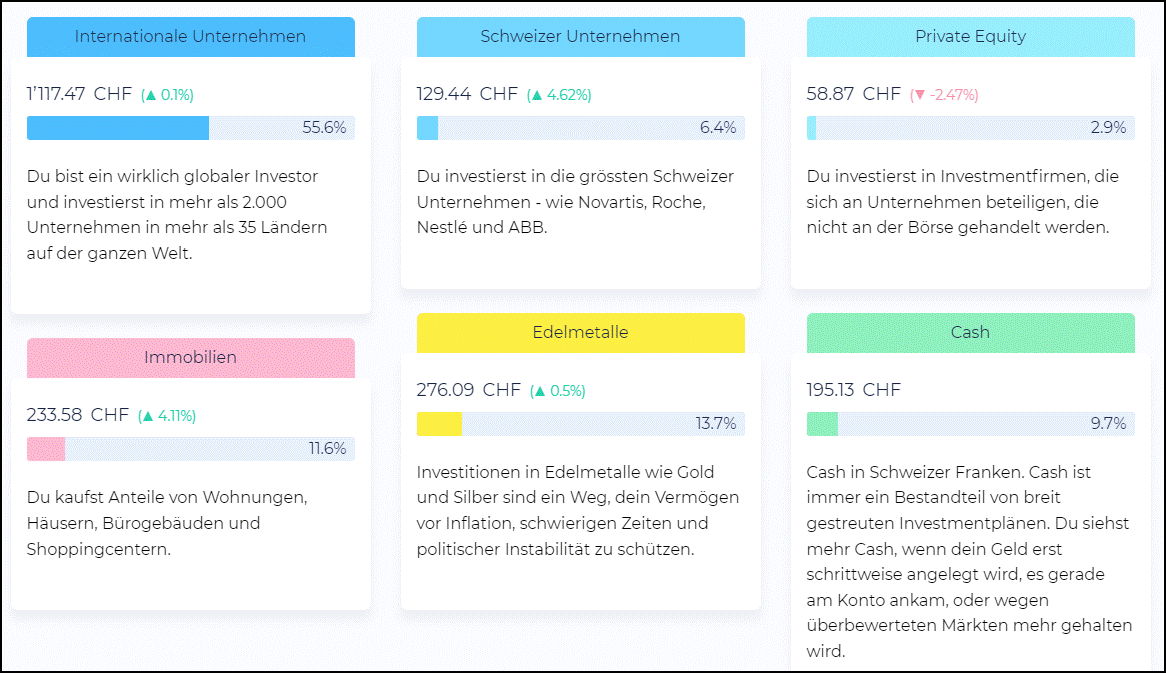
As we later learned from Selma, unlike with the other two providers, the investment strategy underlying the asset allocation is adjusted dynamically, taking into account both the customer’s individual life situation and market conditions.
For example, factors such as a change in your financial situation (e.g. buying a house) or approaching retirement age influence the risk profile and therefore the asset allocation. Market-related factors that influence the asset allocation include changes in global market capitalisations and shifts in over- and undervaluations according to CAPE.
How does rebalancing work?
Depending on how the markets develop, your portfolio can drift away from your target portfolio to a greater or lesser extent over time. In such cases, it makes sense to rebalance periodically, bringing your portfolio back into line with the asset structure (asset allocation) you have chosen.
Rebalancing is very easy with robo-advisors, which we see as a clear advantage over a “do-it-yourself” portfolio. With the latter, you reallocate product by product through transactions you place manually. This can be tedious and expensive. With robo-advisors, on the other hand, rebalancing is done conveniently across the whole portfolio, although we did find significant differences between the providers.
clevercircles
clevercircles offers the greatest flexibility when it comes to rebalancing. It is the only provider that does without an automatic mechanism. Optionally, but conveniently at the push of a button, investors can have their portfolio rebalanced every two months. If they do nothing, nothing is reallocated.
findependent
At findependent, rebalancing is automated and takes place daily.
Selma
At Selma, rebalancing is generally automated every four weeks and, as mentioned, takes both customer-specific and market-specific factors into account.
How high are the costs, and what do they consist of?
For all three robo-advisors, the main source of income is an all-in fee charged as a percentage of the amount invested. A “do-it-yourself” investor saves this fee. In return, the robo-advisor’s fee includes management and custody fees as well as brokerage fees.
All three robo-advisors rely on low-cost ETFs or index funds. We therefore assume that the product costs (TER) are roughly the same as for a “do-it-yourself” portfolio. Likewise, we don’t expect any significant differences in currency exchange surcharges or stamp duty & exchange fees.
For a better understanding, we have broken down the main cost items in the table below and compared them with those of a “do-it-yourself” portfolio:
Cost comparison between robo-advisors and ‘do it yourself’
| Cost blocks | Robo-Advisor | «Do it yourself» |
|---|---|---|
| Flat-rate fees | x | |
| Custody fees | x* | |
| Transaction costs / brokerage fees | x | |
| Product costs (TER) | x | x |
| Exchange rate surcharges | x | x |
| Stamp & stock exchange duties | x | x** |
clevercircles
clevercircles uses a degressive fee model with four tiers which, depending on the amount invested, are 0.65% (CHF 5,000–100,000), 0.55% (CHF 100,000–200,000), 0.45% (from CHF 200,000) or 0.25% (from CHF 1 million), with a minimum charge of CHF 40 per year. Once you reach a cheaper tier, it applies to the entire amount invested. So wealthy investors are rewarded.
findependent
findependent uses a fee model that is rather unconventional in the industry, but very likeable. No all-in fee at all is charged on the first CHF 2,000. So it’s no surprise that findependent is particularly attractive in price for small investors.
After that, a tiered approach applies, and depending on the amount invested, fees of 0.40% (up to CHF 50,000), 0.38% (from 50k), 0.35% (from 150k), 0.33% (from 250k), 0.31% (from 500k) or 0.29% (from 1 million) are charged. Once a new tier is reached, the new rate applies to the entire amount invested. Fair: any cash holdings are exempt from the all-in fee.
Selma
Selma, like clevercircles, has a degressive fee model, with three tiers which, depending on the amount invested, are 0.68% (CHF 2,000–50,000), 0.55% (CHF 50,000–150,000) or 0.47% (from CHF 150,000). Once you reach a cheaper tier, it applies to the entire amount invested. So, as with clevercircles, wealthy investors are rewarded. Positive: when determining the tiers, Selma also takes into account any money paid into the Pillar 3a pension solution integrated into its platform.
Robo-Advisor cost comparison with different investment sums
| Provider | CHF 25'000 | CHF 100’000 | CHF 500’000 | CHF 1'000’000 |
|---|---|---|---|---|
| clevercircles | CHF 163 | CHF 550 | CHF 2’250 | CHF 2'500 |
| findependent | CHF 92 | CHF 372 | CHF 1'544 | CHF 2'894 |
| Selma | CHF 170 | CHF 550 | CHF 2’350 | CHF 4’700 |
How good is the support?
All three providers in our comparison of Swiss robo-advisors have a friendly and competent support team. They also all offer clear and informative FAQs. Naturally, there is no personal advice. We did find differences in the communication channels and response times.
Our experience with clevercircles support
What we like about clevercircles is that individual questions are always answered in depth. Email enquiries are usually answered the next day. Alternatively, a telephone hotline is available. We were unable to test the chat function on the website because it was temporarily unavailable for technical reasons during our test phase. clevercircles has told us that the chat went back into operation in January 2022 and is continuously staffed during office hours.
Our experience with findependent support
In our experience, findependent offers the most efficient support. All our questions were answered via chat within a few minutes. findependent thus lives up to its own ambitious claim of usually replying within a few minutes with flying colours! The chat function is available not only on the website but also in the app. Besides the chat, you can also contact findependent by phone and email.
Our experience with Selma support
Selma offers email, phone and chat as communication channels. Chat replies usually come the same day, but somewhat later than at findependent. (You receive an email to let you know a new chat message has arrived.) Positive: unlike at findependent, the chat runs through your login, so you can look up past chat histories at any time.
Since 2024, Selma has offered optional AI-assisted robo-advice based on OpenAI technology. You can have your assets, your investment strategy or your investments assessed by artificial intelligence using various predefined questions (see example below).

What additional services are offered?
In this chapter, we take a closer look at the three Swiss robo-advisors in terms of special services. By this we mean additional services that not every robo-advisor offers or that even represent a unique selling point (USP). Important: these services are all optional. In other words, investors can use them, but don’t have to.
clevercircles
clevercircles undoubtedly offers the widest range of special services:
- Currency hedging: Every two months, customers can decide for themselves how they want to hedge their investment in the two main foreign currencies (EUR/USD) against currency losses. For each currency, they choose whether 30%, 60% or 90% of their foreign currency holdings should be hedged. Currency hedging is free for customers apart from a minimal spread (90% discount on Bank CIC’s official customer rate). According to clevercircles, more than half of its customers regularly use the currency hedging feature.
- Flexible rebalancing: Because asset classes and markets perform differently, the portfolio can drift significantly from the target allocation over time. At clevercircles, flexible rebalancing is possible at the push of a button (every 2 months or less often), bringing the portfolio back into line with the defined strategy.
- Your own investment committee / your own circle: If you’re interested in what others think about financial matters, you can put together your own advisory panel (circle) made up of investment professionals, business media, the community, friends and family. Clevercircles thus relies on group dynamics and swarm intelligence, which also highlights the playful side of investing. We at Schweizer Finanzblog also run our own circle. The circles can also be used for guidance on overweighting or underweighting certain asset classes in the short term or depending on market conditions. We don’t do this kind of tactical reallocation or make such recommendations, because it doesn’t match our investment philosophy.
- Free demo version: If you’d like to get to know the platform better before using your own money, you can open a free, no-obligation demo account for testing purposes.
findependent
findependent enters the race with the following unique selling point:
- Your own investment solution: If you value a particularly high degree of self-determination in your investments, findependent lets you put together your own portfolio. You can choose from an investment universe of around 40 ETFs. This option is aimed at experienced and discerning investors. From an investment amount of CHF 5,000, it comes at no extra cost.
- Investing for children: You can invest towards several goals using the same app and the same account (e.g. building wealth, child A and child B).
Selma
Selma offers the following additional services:
- A more sustainable alignment of the existing portfolio according to ESG principles at the push of a button.
- Pillar 3a pension provision: From an amount of CHF 500, you can invest in tied pension provision on the same platform. The same all-in fee is charged.
- AI-assisted financial advice based on your Selma portfolio.
Conclusion of our Swiss robo-advisor comparison: which Swiss robo-advisor suits you best?
In our view, robo-advisors are particularly well suited to “savings plan enthusiasts”, “lazybones” and “compromisers”.
In summary, we see the following four main advantages over a “do-it-yourself” portfolio:
- Suitable for savings plans
- Easy rebalancing (at the push of a button or fully automated)
- Individual dashboard (attractive data visualisation in the form of statistics and reports)
- Time savings
On the other hand, for investors who place particular value on a comprehensive product range and/or the lowest possible costs, the “do-it-yourself” portfolio remains the first choice. For this, you need a suitable trading platform: on our recommendations page you’ll find a selection of online brokers we have tested, including starting credits (see also our article series Learn to invest – in eight lessons).
Decision guide: Swiss robo-advisors
Now that we have sharpened the profiles of the three Swiss robo-advisors we examined, the table below will help you decide which provider is right for you. The criteria are distinguishing features that do not apply to all three robo-advisors and that matter to a different degree depending on the type of investor:
Robo-advisors: distinguishing features
| Criteria | clevercircles | findependent | Selma |
|---|---|---|---|
| Multi-channel (app & web) | x | x | |
| Lowest costs and initial investment | x | ||
| Highest starting bonus | x | ||
| Highest degree of self-determination in portfolio construction | x | ||
| Sustainable investments | x | x | |
| Investments in trend themes | x | ||
| ”Precious metals” asset class | x | x | x |
| Currency hedging (optional) | x | ||
| Flexible rebalancing (optional) | x | ||
| Portfolio coordination with experts and the community (optional) | x | ||
| Non-binding demo version (optional) | x | ||
| Integrated 3a pension plan (optional) | x | ||
| Automatic adjustment of the investment strategy to the customer's individual life situation | x | ||
| Investing for children (investing in different investment goals) | x | ||
| AI-supported financial advice (optional) | x |
In addition, regarding the positioning of the three Swiss robo-advisors, we noticed that clevercircles and findependent give investors a great deal of freedom, while Selma takes more control. This comparatively high level of guidance (or, depending on your point of view, limited flexibility) is likely to appeal especially to inexperienced investors or those with little interest in financial topics.
Starting bonus for new customers
Has one of the providers in this Swiss robo-advisor comparison won you over? If so, secure a starting credit by simply choosing one of the bonus coupons below and entering the corresponding code when you sign up.
clevercircles bonus coupon worth CHF 100 (Swiss robo-advisor comparison)


findependent bonus coupon worth CHF 20 (Swiss robo-advisor comparison)

Selma bonus coupon worth CHF 34 (Swiss robo-advisor comparison)

You might also be interested in

Updates
2026-03-26: Mentioned findependent’s licence as an account-holding securities firm and its consequences.
2026-01-12: Selectively updated.
2024-10-31: Noted that the chat function is now also integrated into the app.
2024-06-17: Mentioned Selma’s new AI-assisted analyses, including an example from Toni’s portfolio.
2024-05-22: Updated findependent’s (lower) fees.
2023-07-03: Added findependent’s new, tiered and cheaper fee structure and a note on the new “Investing for children” option.
2023-05-25: Clarified for Selma that money paid into the integrated Pillar 3a pension solution is taken into account for the fee tiers.
2023-05-12: Mentioned findependent’s new onboarding process via the app.
2023-04-13: findependent’s investment universe increased to over 30 ETFs (from 25); automated rebalancing now takes place daily (originally monthly). Mentioned clevercircles’ new and cheapest fee tier of 0.25%.
2023-02-17: Added the new “In a nutshell” section at the beginning of the article.
Disclaimer
Disclaimer: Investing involves the risk of loss. You have to decide for yourself whether or not you want to take these risks.
Errors excepted: We have written this article to the best of our knowledge and belief. Our aim is to give you, as a private investor, the most objective and meaningful information possible on financial topics. If we have nevertheless made mistakes, or if important aspects have been forgotten and/or are out of date, we’d be grateful if you let us know.
Transparency notice: In order to report credibly and realistically from first-hand experience, the Schweizer Finanzblog team was, at the time of publication, a customer of the three Swiss robo-advisors examined, i.e. invested with its own money. We also have partnerships with all three providers that allow us to offer you attractive special terms in the form of starting credits.
About the authors

Stefan Huser
Stefan has been investing in the stock market himself since 2015. He has been shaped by Markowitz’s portfolio theory and Gerd Kommer’s book “Souverän investieren”. He follows a core-satellite strategy: a global equity portfolio of ETFs forms the core, complemented by alternative investments. At the blog, he mainly takes care of the writing. Stefan lives with his family in Zurich and is interested in literature, photography and financial freedom.

Antun Brcina
Antun (“Toni”) has been investing in the stock market since 2015. Financially, he has been particularly inspired by Gerd Kommer’s book “Souverän investieren” and the Fama-French five-factor model. His money is invested in a broadly diversified, long-term global equity portfolio of ETFs. At the blog, he mainly works on the calculators and the code. Toni lives with his family in the Zurich area and is interested in sports, technology and entrepreneurship.




6 Comments
Hoi Toni & Stefan
Danke erstmals für Eure super Blog!!
Was mich jedoch wundert: warum wird das Angebot/Produkte von Truewealth auf eurem Blog komplett totgeschwiegen? Auch via Suchfunktion gibt es “null” Treffer! Spekulativ kommen mir da höchstens persönliche Gründe oder zuwenig finanziellen Anreiz in den Sinn.. oder liege ich da komplett falsch?
Auch wenn ihr Truewealth nicht promoten wollt, wäre eine Einschätzung/Vergleich bei entsprechenden Themen (Vorsorge/RoboAdvisor/Sparplänte..) doch hilfreich und vertrauensbildend.
Besten Dank für Eure Antwort!
Liebe Grüsse
Tom
Hoi Tom
Merci fürs Lob und die Anmerkung bezüglich TrueWealth. Um bei unseren Reviews glaubwürdig aus erster Hand berichten bzw. aus dem Vollen schöpfen zu können, möchten wir bei den vorgestellten Anbietern jeweils selber Kunde sein. Bei TrueWealth sind wir dies nicht. Wahrscheinlich hat uns damals die nach wie vor geltende, relativ hohe Eintrittshürde von CHF 8’500 Starteinlage etwas abgeschreckt:-) Gegenfrage: Gibt es deines Erachtens einen zwingenden Grund “TrueWealth” einem der drei im obigen Artikel vorgestellten Robo-Advisors vorzuziehen?
Liebe Grüsse
SFB
Informativ, danke!
Sali Toni, Sali Stefan
wie immer sehr gute Arbeit und gut recherchiert. Danke für die Infos.
Die “Klassifizierung” gefällt mir sehr gut.
Die Auswahl an ETF’s erscheint mir bei allen jedoch sehr, sehr mager.
Das dürfte vermutlich an den Retrozessionen und Vertriebsentschädigungen liegen welche diese erhalten.
Somit ist der Kunden hier nicht immer am “Besten” bedient und investiert in EFT’s mit höherem TER und ggf. schlechterer Performance. Die Abweichungen sollten bei den einzelnen Index und ETF’s zwar nicht allzu gross sein aber es gibt sie wenn man die Rendite der Anbieter z.B. bei JustETF vergleicht. Einerseits ist dies bedingt durch den TER und anderseits durch den Tracking Error.
Die Integration von 3a und Freizügigkeitskonten finde ich sinnvoll. Dazu nutze ich derzeit VIAC zu günstigeren Konditionen. Für mich persönlich erscheint das Kosten/Nutzen Verhältnis noch zu hoch und unausgereift für den Mehrwert des automatischen Re balancing.
Bin mal gespannt wie sich das Ganze weiter entwickelt.
Hoi Arnaldo
Merci für deine Mitteilung und das positive Feedback.
Wir teilen deine Vorbehalte jedoch nicht ganz. Sicher, die Auswahl oder je nach Standpunkt die Qual der Wahl der zur Verfügung stehenden Anlageprodukte ist beim Robo-Advisor kleiner als beim “Do it yourself”-Portfolio. Aber letztlich wird dieses ja in der Regel auch nur aus einer Handvoll ETFs bestehen. Und bezüglich der Produktkosten (TER), so werden die von den drei getesteten Robo-Advisors verwendeten ETFs oder Indexfonds zu Marktpreisen (TER durchschnittlich rund 0,2%) angeboten. Mehrkosten bzw. Minderrenditen entstehen bei diesem Kostenblock gegenüber dem “Do it yourself”-Anleger also nicht.
Beste Grüsse
SFB
Hallo Arnaldo
Als Gründer von findependent nehme ich gerne kurz Stellung zur ETF-Auswahl. Das Angebot ist unbestritten einiges kleiner, als bspw. bei einem Broker. Wir haben uns aber ganz bewusst dafür entschieden, eine überschaubare ETF-Auswahl anzubieten, da zu viel Auswahl schnell auch überfordern kann. Wir nehmen auch bewusst keine Retrozessionen oder Vetriebsentschädigungen entgegen, damit wir bei der Auswahl der ETFs wirklich nur im besten Interesse der Kunden handeln können.
Liebe Grüsse
Matthias
Gründer von findependent