
 Newsletter

In our last article, we took a close look at Lombard loans. In this post, we shine a light on so-called leveraged ETFs, another way to tilt your portfolio towards higher returns. You’ll learn how these niche ETFs work, which risks you should keep a particularly close eye on and when your chances of achieving dream returns are best.

In a nutshell
- Leveraged ETFs, also known as geared ETFs, are aimed primarily at return-oriented investors with strong nerves who expect share prices to rise over the medium to long term.
- With a leveraged ETF, daily price gains and losses are multiplied by a certain factor (e.g. 2x).
- As a result, leveraged ETFs fluctuate far more than conventional ETFs.
- In other words, if the SMI or MSCI World rises by 2% in a day, for example, a corresponding leveraged ETF (2x) doubles that gain to 4%. Price losses are multiplied in the same way.
- The worst-case scenario, a total loss, would occur with such an ETF if there were a daily correction of -50% or more. This can’t be ruled out, but we consider it extremely unlikely.
- The range of leveraged ETFs on European exchanges is still limited. Their cost (TER) currently averages around 0.35%, which pleasantly surprised us.
- Before you invest in a leveraged ETF, you should be particularly aware of the risks relating to path dependency (volatility drag), the sequence of returns and the counterparty. The sharp price swings can also put your nerves severely to the test.
Contents
- What is a leveraged ETF?
- A modest range of leveraged ETFs
- Impressive performance
- What risks do I take with a leveraged ETF?
- Path dependency in leveraged ETFs: Volatility drag in fluctuating markets
- Path dependency for leveraged ETFs: Volatility drag in the event of a crash with rapid recovery
- Path dependency with leverage ETFs: positive effects with steadily rising markets
- Path dependency with leveraged ETFs: positive effects with constantly falling markets
- In which market phases is a leveraged ETF particularly suitable?
- What are the pros and cons of leveraged ETFs?
- What leveraged alternatives are there to leveraged ETFs?
- Our conclusion on leveraged ETFs
- You might also be interested in
- Disclaimer
What is a leveraged ETF?
Leveraged ETFs, or geared ETFs, are synthetic specialty ETFs that are often classed as strategy ETFs. With synthetic index replication, the ETF provider swaps the assets held by the fund for those of the index by entering into a swap transaction (a total return swap, i.e. a derivative) with a third party, e.g. a big bank.
So, just like their conventional counterparts, leveraged ETFs track an index. However, its price performance is amplified by a certain factor. So if the factor is two, which is common, and the corresponding unleveraged underlying index (e.g. MSCI World or SMI) rises by 2% in one day, the leveraged ETF shoots up by 4%.
The opposite of (long) leveraged ETFs are so-called short ETFs, which move inversely, i.e. in the opposite direction to the underlying index. As an example of the sparse range of short ETFs, let’s mention the Lyxor SMI Daily (-2x) Inverse UCITS ETF, which tracks twice the inverse performance of the SMI on a daily basis. In other words, if the SMI falls by 1%, this ETF rises by 2%, and vice versa.
Short ETFs are not the focus of this article. We reject them because they are highly speculative bets on market timing, i.e. on falling prices, and we consider their risk/return ratio to be extremely unfavorable.
A modest range of leveraged ETFs
The range of conventional ETFs has become huge, and investors are spoiled for choice. (Reading tip: in our article “Best ETFs in Switzerland and worldwide: And the Winner is…”, we put over 1,500 ETFs through a rigorous, multi-stage selection process and picked 14 winning ETFs.)
By contrast, the range of leveraged ETFs approved in Switzerland is still very limited. The portal “justETF” lists a mere five leveraged equity ETFs on European exchanges. (The portal doesn’t cover exchanges outside Europe.)
But it’s not only in terms of quantity that the range of leveraged ETFs leaves something to be desired. We also see two weaknesses in terms of quality: first, not a single product is globally diversified. And second, we consider the fund sizes too small – with the exception of the Amundi product. (To give you a better understanding, we’ll take a closer look at this leveraged ETF later.) On the other hand, we were pleasantly surprised by the annual costs of around 0.35% (TER), which we consider quite moderate for niche ETFs like these.
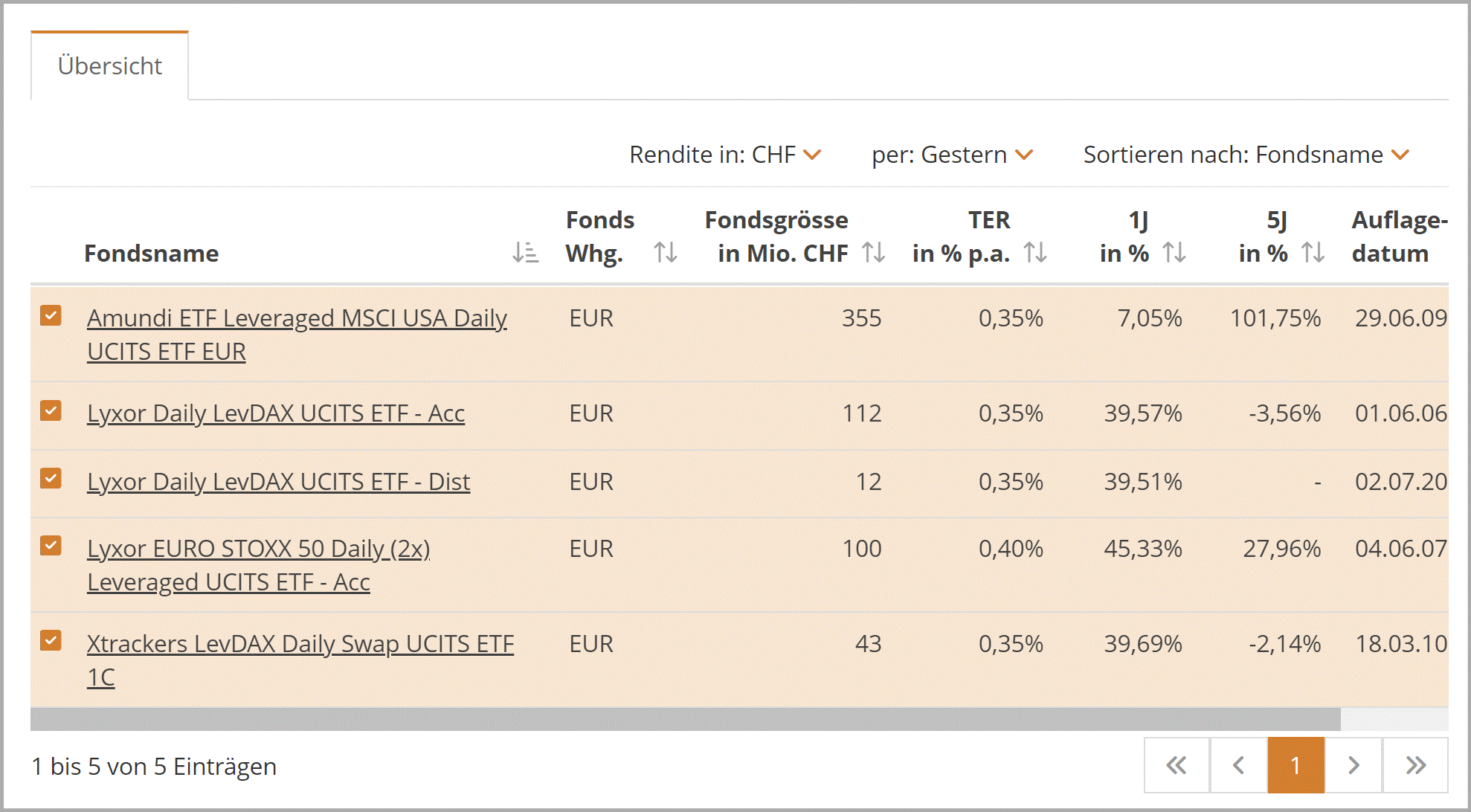
It’s also striking that, despite the small fund volumes, four of the five leveraged ETFs were launched more than ten years ago. True to survivorship bias, this is probably just the tip of the “leveraged ETF” iceberg. Numerous products have presumably been shut down over time for lack of market success and have thus become “invisible”. (Incidentally, a fund liquidation doesn’t mean you suffer a total loss. Instead, you simply have to withdraw the invested capital (market value) from the fund and look for suitable alternatives.)
ETFs that have raised less than CHF 100 million in fund assets over the medium term are likely to be loss-making for fund providers. That’s why the probability that such ETFs will be closed sooner or later is particularly high.
More choice of leveraged ETFs on US exchanges – but more expensive!
On US exchanges, on the other hand, leveraged ETFs are much better established. But even here, we didn’t come across a single globally diversified product that tracks, for example, a leveraged MSCI World Index.
The largest of them, ProShares’ UltraPro QQQ, has managed to attract a considerable fund volume of over USD 20 billion since its launch in 2010 – despite a high fee of 0.98% (TER). This leveraged ETF, the most popular in the world, is considered particularly high-return and high-risk, as it tracks the volatile US tech index Nasdaq 100 with a factor of three.
This overview from the ETF portal VettaFi shows you the key data of this and other leveraged ETFs traded on US exchanges. What stands out is that the product range clearly focuses on US companies, though there are big differences within it: some leveraged ETFs focus on blue chips, some on small caps and others on individual sectors such as tech stocks, or even more specifically on semiconductor manufacturers, for example.
This shows once again that the more an ETF covers a niche, the more attractive the range on US exchanges is compared with European trading venues.
If you want to benefit from the broader range of ETFs traded on US exchanges, you need a platform through which these products can be traded. In our experience, the two pioneering brokers Swissquote and Interactive Brokers are particularly strong in this respect (see our list of recommendations).
Impressive performance
As mentioned, we now want to take a closer look at the Amundi Leveraged MSCI USA Daily UCITS ETF – EUR. In our view, in terms of diversification, fund size and price, it’s the most attractive leveraged ETF traded on European exchanges and approved for Swiss investors.
According to the relevant factsheet, the MSCI USA Leveraged 2x Daily Index underlying the leveraged ETF offers twice the exposure to the daily performance of the MSCI USA Index, which comprises around 600 leading US stocks.
It’s also a synthetic ETF that complies with the European UCITS investor protection directives. Interesting: at least 75% is invested directly in securities. Amundi confirmed to us on request that these are segregated assets, which investors could access even if Amundi went bankrupt, i.e. they would not form part of the bankruptcy estate.
Amundi recommends an investment horizon of at least 5 years, which seems plausible to us. (We don’t share the view, often expressed on social media, that leveraged ETFs are short-term investment vehicles – especially not when the underlying index is broadly diversified. Why should such leveraged ETFs be treated differently in terms of investment horizon than their conventional, i.e. unleveraged, counterparts?)
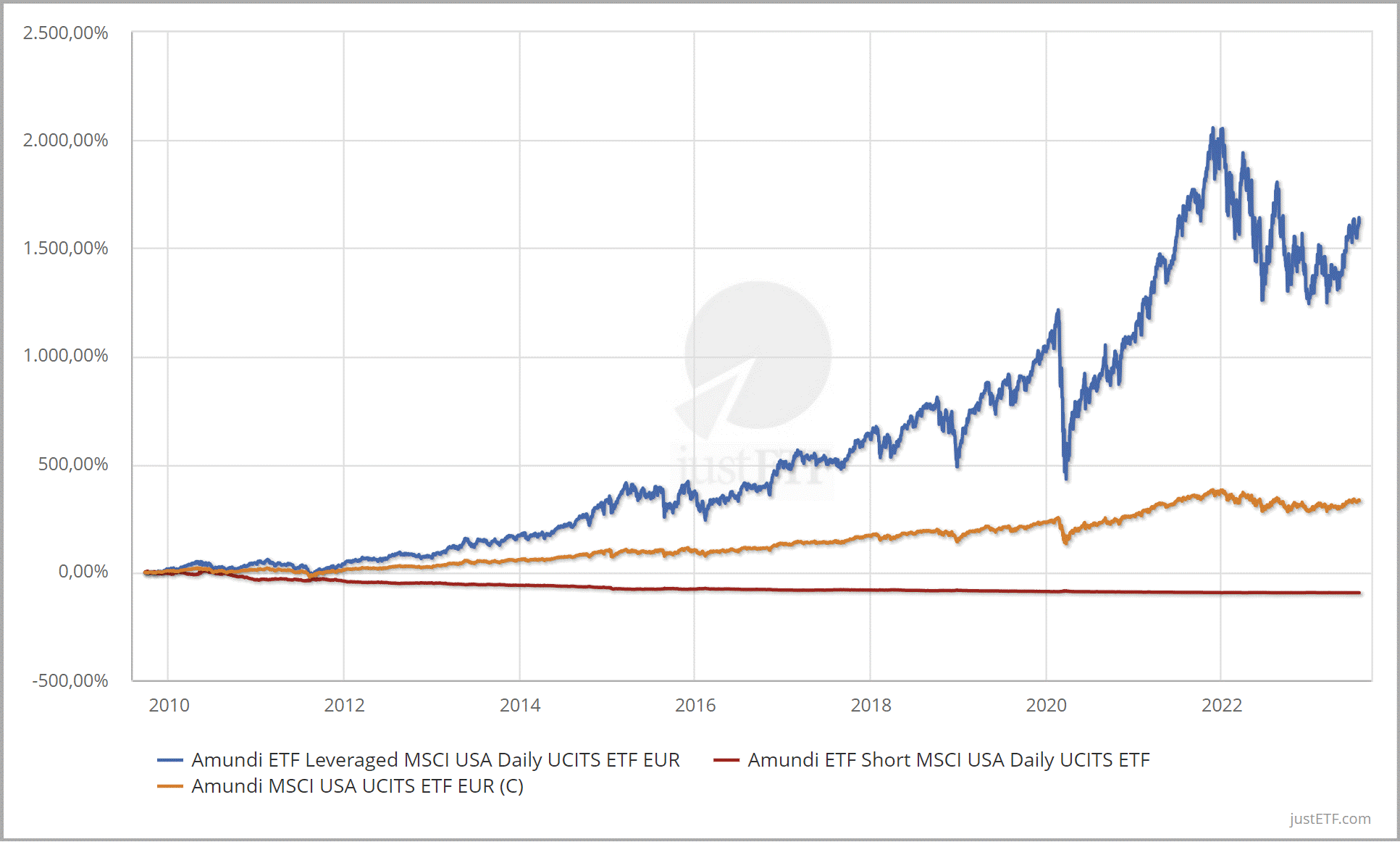
As the chart above impressively shows, a positively leveraged ETF can work very well even over a very long investment horizon of almost 14 years and clearly beat the conventional ETF. On the one hand, this is because share prices rose more often than they fell over the period under review. (As we’ll see later, it’s particularly important for leveraged ETFs that prices mostly rise at the start.) On the other hand, the US, with its major growth-oriented tech stocks such as Apple & Co., had a particularly good run compared with the rest of the stock market world. Incidentally, the performance data has already been converted into our strong home currency, CHF. In EUR or USD, the gains would be even higher!
Leveraged ETF mostly performs better across different entry points and periods too
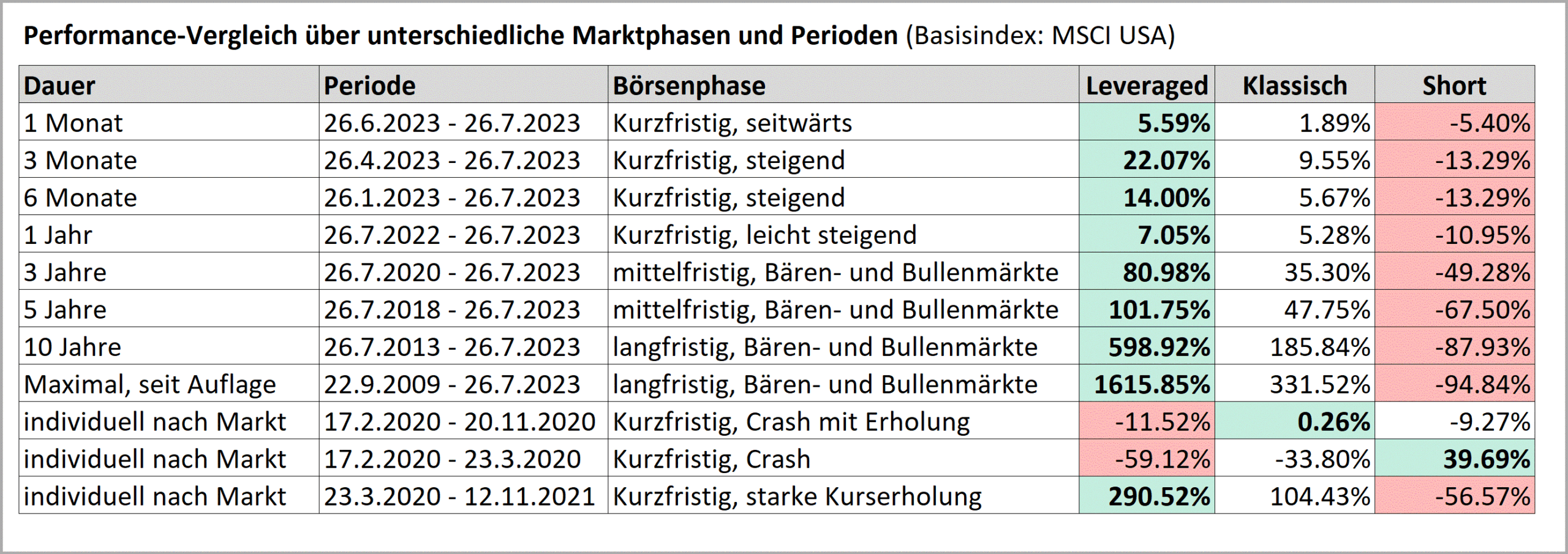
If you look at different entry points and periods, this positive picture in favor of our leveraged ETF is confirmed. It mostly performs better than the same provider’s conventional product, even when significant bear markets had to be weathered along the way. Only in two short-term crash scenarios does the leveraged version perform worse (see table).
Hands off short ETFs!
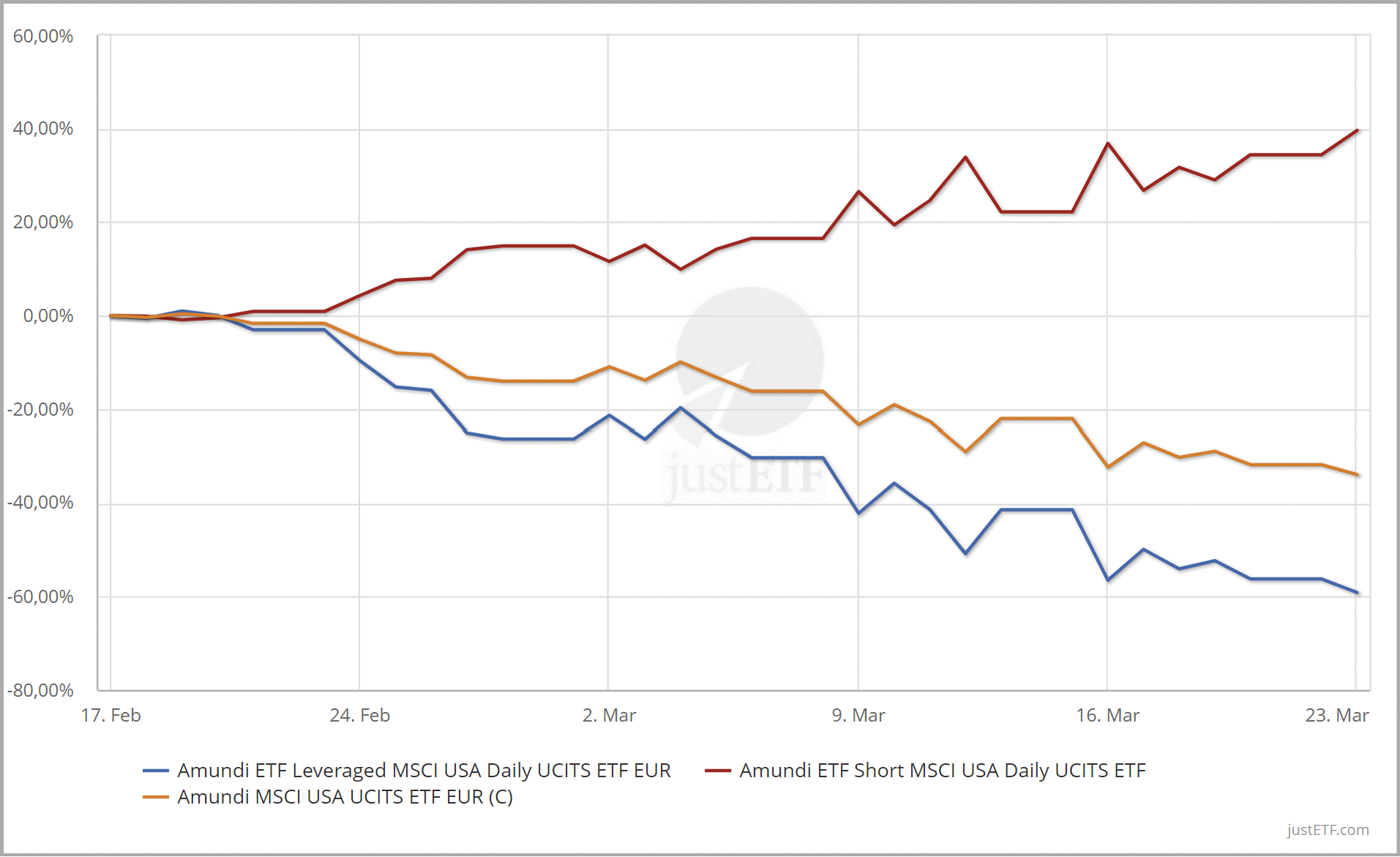
With the short ETF, it’s exactly the other way round: as a rule, it performs poorly – catastrophically poorly, in fact. As its name suggests, it’s much more speculative and focused on short-term gains in bear markets (see chart and table above and chart below). That’s why short ETFs are out of the question for us.
Sequence of returns: the deciding factor for leveraged ETFs
But let’s get back to leveraged ETFs. What does performance look like if, instead of the US market, which has been running superbly since the financial crisis, we focus on more sedate Europe? For lack of choice, we’ll look at the product listed earlier in the leveraged ETF overview, the Lyxor EURO STOXX 50 Daily (2x) Leveraged UCITS ETF (Acc). The underlying index tracks the 50 companies with the largest market capitalization in the eurozone.
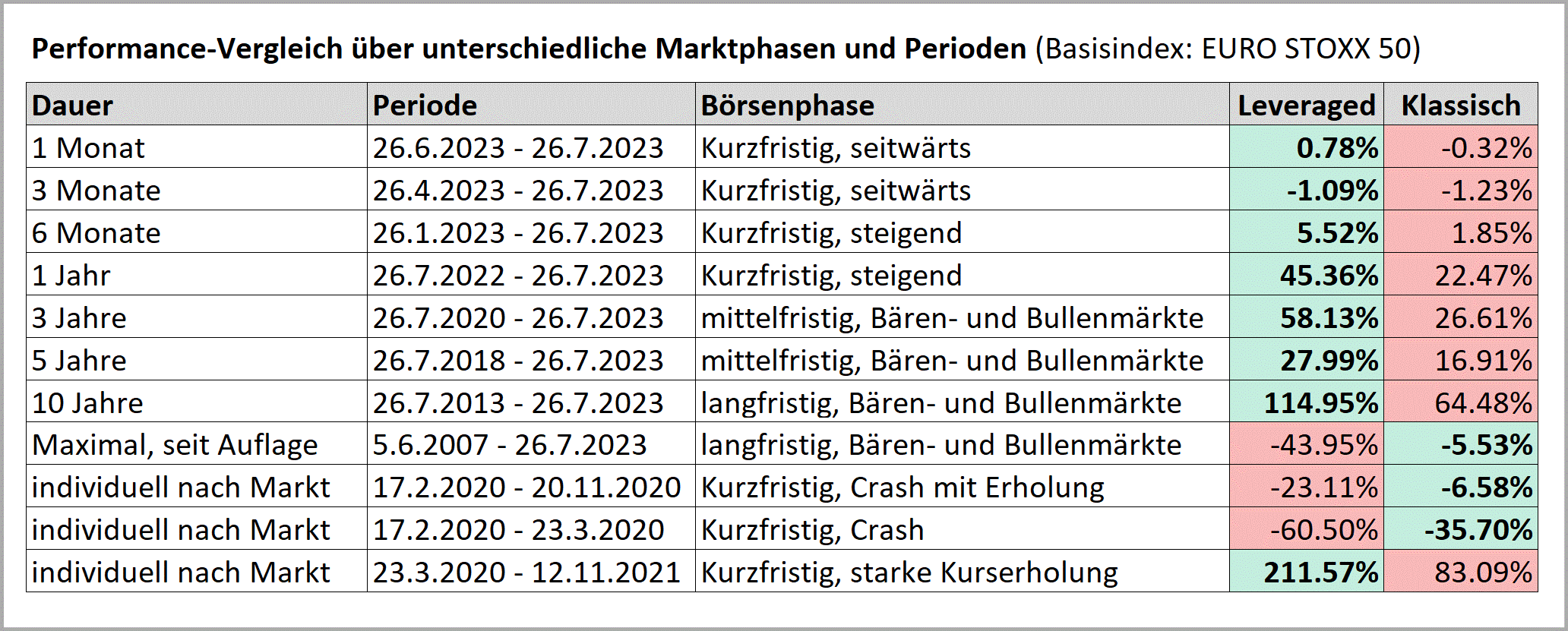
The table shows that the outperformance in most periods also applies to the EURO STOXX leveraged ETF, albeit less clearly than in the previous ETF comparison, which was based on US companies according to the MSCI USA.
Thanks to the earlier launch date, we were also able to look at a longer period of over 16 years (instead of around 14 before), which led us to an interesting insight:
If you get in shortly before a severe stock market crash, such as in the 2008 global financial crisis, the leveraged ETF can no longer recoup its price losses, even over the long term.
After a holding period of over 16 years, our leveraged ETF was still deep in the red as of 26 July 2023, down around 44%, while the conventional ETF was only just over 5% below break-even. This phenomenon is called “volatility drag”, combined with sequence-of-returns risk. You’ll learn more about these risks in the next chapter.
What risks do I take with a leveraged ETF?
No question: leveraged ETFs are riskier than conventional ETFs. After all, leveraged ETFs offer greater return potential, and as we know, that comes with more risk. In particular, you should keep in mind the four risks described below, which apply especially to leveraged ETFs:
- Volatility drag risk
- Sequence-of-returns risk
- Counterparty risk
- “Your own nerves” risk
Volatility drag risk
This risk is about volatility-related losses. Volatility drag is the negative effect of so-called path dependency. These losses arise because leveraged ETFs are revalued every day.
In the table below, we use a fictitious example to show how volatility drag steadily pushes returns down a little in fluctuating markets.
Path dependency in leveraged ETFs: Volatility drag in fluctuating markets
| Day | SMI Index (points) | Change on previous day SMI ETF | Value of investment in SMI ETF (CHF) | Change on previous day SMI Leveraged ETF (2x) | Value Investment in leveraged ETF SMI (2x) |
|---|---|---|---|---|---|
| 0 | 10’000 | 1’000 | 1’000 | ||
| 1 | 9’800 | -2% | 980 | -4% | 960 |
| 2 | 10’000 | 2.04% | 1’000 | 4.08% | 999.17 |
| 3 | 9’700 | -3% | 970 | -6.00% | 939.22 |
| 4 | 10’000 | 3.09% | 1’000 | 6.19% | 997.31 |
So with moderate fluctuations, the negative effect of volatility drag hardly matters. It’s a different story in severe market turbulence: if, for example, the underlying index falls by 25% in one day and then rises by 33% back to its starting value, the price of the leveraged ETF remains well below the starting value.
Path dependency for leveraged ETFs: Volatility drag in the event of a crash with rapid recovery
| Day | SMI Index (points) | Change on previous day SMI ETF | Value of investment in SMI ETF (CHF) | Change on previous day SMI Leveraged ETF (2x) | Value Investment in leveraged ETF SMI (2x) |
|---|---|---|---|---|---|
| 0 | 10’000 | 1’000 | 1’000 | ||
| 1 | 7’500 | -25% | 750 | -50% | 500 |
| 2 | 10’000 | 33.33% | 1’000 | 66.67% | 833.33 |
In the most extreme (unlikely) case, leveraged ETFs can even suffer a total loss: namely if the underlying index were to fall by 50% in a single day. The leveraged ETF (2x) would then suffer a loss of 100%. All of the ETF’s units would be worthless and would stay that way even after a subsequent market recovery, no matter how spectacular.
But the path dependency effect of leveraged ETFs isn’t negative per se. When prices rise or fall steadily, there’s no volatility drag. Leveraged ETFs even benefit in such markets. In other words, when prices rise, the leverage increases slightly, and when prices fall, it decreases slightly (see tables below).
Path dependency with leverage ETFs: positive effects with steadily rising markets
| Day | SMI Index (points) | Change on previous day SMI ETF | Value of investment in SMI ETF (CHF) | Change on previous day SMI Leveraged ETF (2x) | Value investment in leveraged ETF SMI (2x) |
|---|---|---|---|---|---|
| 0 | 10’000 | 1’000 | 1’000 | ||
| 1 | 10’200 | 2% | 1’020 | 4% | 1’040 |
| 2 | 10’353 | 1.5% | 1’035 | 3% | 1’071 |
| 3 | 10’612 | 2.5% | 1’061 | 5% | 1’125 |
| 4 | 10’665 | 0.5% | 1’066 | 1% | 1’136 |
Path dependency with leveraged ETFs: positive effects with constantly falling markets
| Day | SMI Index (points) | Change compared to the previous day SMI ETF | Value of investment in SMI ETF (CHF) | Change on previous day SMI Leveraged ETF (2x) | Value Investment in leveraged ETF SMI (2x) |
|---|---|---|---|---|---|
| 0 | 10’000 | 1’000 | 1’000 | ||
| 1 | 9’800 | -2% | 980 | -4% | 960 |
| 2 | 9’653 | -1.5% | 965 | -3% | 931 |
| 3 | 9’412 | -2.5% | 941 | -5% | 885 |
| 4 | 9’365 | -0.5% | 936 | -1% | 876 |
Sequence-of-returns risk
This risk naturally exists with all investments, including ETFs. But as we saw in the return comparison above, it can have particularly serious consequences with leveraged ETFs. The leverage effect is responsible for this. Specifically: if sharp price corrections occur at the start of the investment, it’s hardly possible to make up the shortfall with a leveraged ETF, even over the longer term.
You can effectively mitigate sequence-of-returns risk with two simple countermeasures:
- invest in stages over a longer period and
- don’t invest at peak prices, but rather after market slumps
For the sake of completeness, it should be mentioned that sequence-of-returns risk also offers great opportunities for you as an investor. If the stock market rises sharply at the start of your investment, the leveraged ETF’s price goes through the roof thanks to the leverage. As we saw in the return comparison above, this outperformance compared with the conventional ETF persists even after subsequent bear markets.
Counterparty risk
As already mentioned, leveraged ETFs are synthetic ETFs based on a swap in the form of a derivative. Counterparty risk is the risk that the swap counterparty can no longer meet its obligations under the swap agreement. This can lead to losses for the ETF and its investors. With our example ETF from Amundi, counterparty risk is mitigated by choosing a financially strong swap partner (BNP Paribas) and by a high proportion of real investments in securities, which constitute segregated assets.
“Your own nerves” risk
This risk basically exists with all risky investments, and equities definitely count among them. However, it’s particularly pronounced with leveraged equity investments, because the price fluctuations of equity investments, which are already considerable, are amplified even further by the leverage.
That means you should honestly answer the following question: can I still sleep soundly with price losses of 50% or more? If you can answer yes, or better still, if you’ve already taken severe stock market crashes in your stride in the past, then leveraged ETFs could be an interesting option for you with above-average return potential.
Otherwise, start with or stick to good old “core ETFs”, which are less volatile and can still deliver great returns in the long run.
In addition to these four risks that are particularly relevant to leveraged ETFs, there are also risks that apply to conventional equity ETFs, such as market and currency risks.
In which market phases is a leveraged ETF particularly suitable?
It’s obvious, and a mathematical fact: positively leveraged ETFs perform better than conventional ETFs when prices rise and worse when prices fall. Unfortunately, though, nobody can predict how the stock market will develop.
However, history shows that a broadly diversified equity investment rises over the long term.
If we add to this insight the statistical phenomenon of “regression to the mean”, according to which returns on equities and other investments always move around the so-called mean over a longer period, then market phases after stock market crashes should be particularly interesting entry points. (Incidentally, this also applies to investments leveraged with borrowed money, as we explained here in our article on Lombard loans.)
By contrast, all-time highs and especially prices before severe market slumps are particularly unfavorable entry points. As we showed above, with a leveraged ETF, heavy initial losses due to volatility drag, combined with sequence-of-returns risk, can hardly be recouped, even in the long term.
However, since bear markets can also correct sharply further down, we consider a staggered approach, i.e. investing in a leveraged ETF in several tranches, an absolute must.
What are the pros and cons of leveraged ETFs?
We want to assess the pros and cons compared both with conventional (unleveraged) ETFs and with Lombard loans, i.e. buying securities on credit.
Pros and cons of leveraged ETFs compared with conventional ETFs
 Much higher return potential thanks to leverage
 A challenge for your nerves due to sharper, leverage-driven fluctuations Volatility-related losses (“volatility drag”) possible Slightly higher product costs (TER: 0.35% vs. 0.10%) Compromises in ETF selection due to the limited range
Pros and cons of leveraged ETFs compared with Lombard loans
Cheaper, as there are no interest costs No forced sale in the event of a shortfall (“margin call”) Ongoing costs easier to plan, as interest rate changes play no role Volatility-related losses (“volatility drag”) possible Compromises in ETF selection due to the limited range What leveraged alternatives are there to leveraged ETFs?
Option 1: Lombard loan
Unlike the sparse range of leveraged ETFs, a Lombard loan basically gives you access to all ETFs. However, you need to bear in mind the risks of a shortfall (“margin call”) and of rising interest costs. You can find out more about Lombard loans in our article “Lombard loans for buying ETFs: a booster for your return on equity or playing with fire?”.
Option 2: Leverage through structured products
Leveraged structured products are complex financial products that let you respond to a price movement in the underlying asset. Popular underlyings are individual shares, indices, commodities and currencies. We reject leveraged structured products because, in our opinion, they are too expensive and not transparent enough. The latter is particularly evident in their opaque structure.
Conclusion on the two leverage alternatives
We prefer Lombard loans to structured leverage products because of their greater transparency and the freedom to choose what to invest in. Note: at the time this article was published, Toni had leveraged his securities portfolio using a Lombard loan from Interactive Brokers.
Our conclusion on leveraged ETFs
Our first impression of leveraged ETFs was as clear as it was negative: “Too small a range, and the little there is isn’t established in the market and/or isn’t sufficiently diversified. Leveraged ETFs? No thanks!” Our initial skepticism was also in line with the blogger mainstream.
But when we took a closer look at performance over different periods and market phases, we softened our stance – especially towards the Amundi leveraged ETF that we examined more closely.
Even so: leveraged ETFs are only suitable for investors with strong nerves who have a medium- to long-term investment horizon. Because the fluctuations are massively greater than with conventional ETFs.
Total loss unlikely
However, we consider a total loss, as raised in the title, to be extremely unlikely with leveraged ETFs. This worst-case scenario would only occur with a 2x leveraged ETF in the event of a daily loss of at least 50%.
But: if you invest before a sharp market correction, you’ll hardly be able to recoup the price losses, even in the long term, due to volatility-related volatility drag combined with sequence-of-returns risk. That’s why we would only invest in a leveraged ETF in stages and preferably in bear markets.
Dream returns possible after crashes and with staggered investments
And what about the dream returns of 100% or more per year mentioned in the title? These are possible depending on the market phase, but require perfect timing, which in turn is pure luck.
But much more interesting for us as committed buy-and-hold investors is the new insight that, thanks to the compound interest effect, leveraged ETFs can perform superbly, especially over the long term – albeit not at 100% a year – provided that a bear market or even a stock market crash isn’t just around the corner.
Over the long term, around 14 years – including several market slumps – our example ETF achieved an impressive increase in value of over 1,600% – five times more than its conservative sibling based on the MSCI USA underlying index.
In addition to the impressive performance track record, we were positively struck by the surprisingly moderate costs and the attractive fund size of this ETF.
Final conclusion
If you have strong nerves, a longer investment horizon and don’t expect a stock market crash any time soon (of course, nobody can predict this with certainty, which is why you should definitely invest in stages and preferably in bear markets), you could in future cover the “North America” region with the leveraged ETF mentioned – or, more defensively, as a kind of trial balloon to gain your first experience with leveraged ETFs, add it to your portfolio.
Whatever you decide: before buying a leveraged ETF, you should research the product thoroughly, understand its specific risks and accept the fact that leveraged ETFs always fluctuate massively more than conventional ETFs – both up and down.
And what are we doing? Stefan is considering launching such a “leveraged” trial balloon at the next opportunity, or when rebalancing calls for it, while Toni continues to prefer borrowed leverage via a Lombard loan and, for the time being, doesn’t want to push his already sporty risk exposure any further.
You might also be interested in

Disclaimer
Transparency notice: At the time of publication, neither Toni nor Stefan is invested in leveraged ETFs, nor do we have a business relationship with the ETF providers mentioned in this article.
Liability disclaimer: Investing involves the risk of loss. You have to decide for yourself whether or not you want to take on these risks.
Errors excepted: We wrote this article to the best of our knowledge and belief. Our goal is to provide you as a private investor with information on finance that is as objective and meaningful as possible. Should we nevertheless have made mistakes, or if important aspects have been forgotten and/or are no longer up to date, we’d be grateful if you let us know.
About the authors

Stefan Huser
Stefan has been investing in the stock market himself since 2015. He has been shaped by Markowitz’s portfolio theory and Gerd Kommer’s book “Souverän investieren”. He follows a core-satellite strategy: a global equity portfolio of ETFs forms the core, complemented by alternative investments. At the blog, he mainly takes care of the writing. Stefan lives with his family in Zurich and is interested in literature, photography and financial freedom.

Antun Brcina
Antun (“Toni”) has been investing in the stock market since 2015. Financially, he has been particularly inspired by Gerd Kommer’s book “Souverän investieren” and the Fama-French five-factor model. His money is invested in a broadly diversified, long-term global equity portfolio of ETFs. At the blog, he mainly works on the calculators and the code. Toni lives with his family in the Zurich area and is interested in sports, technology and entrepreneurship.








13 Comments
Erstmals vielen Dank für eure hilfreichen Antworten!
Könntet ihr mir kurz erklären, wann ein “Crash” vorliegt? Das ist ja beim Hebeln und antizyklisch anlegen wichtig. Ich höre immer wieder von -20% zum dreijährigen All-Time-High. Ich nehme an, als Referenzindex wird der MSCI World genommen, also wenn dieser um 20% einbricht, ist es ein Crash? Und in welcher Währung? Nicht, dass ich aktuell hebeln würde, aber die Kurse sind aktuell ja im Heimwährung viel stärker gefallen wegen des schwachen Dollars. Gehe ich richtig in der Annahme, dass ich mich am MSCI World in CHF orientieren müsste?
Gute Frage:-) Eine allgemeingültige Definition für einen Börsencrash ist uns nicht bekannt. Es gibt aber sicherlich einige wichtige Merkmale, die auf einen Crash hindeuten: rascher und heftiger Kurssturz, Panikverkäufe, Ursache unerwartet, branchenübergreifend (d.h. nicht nur ein Sektor ist davon betroffen). Ab einer 20% Korrektur vom Höchststand spricht man von einem Bärenmarkt, dieser kann sich im Gegensatz zum Crash länger, d.h. auch über Monate, hinziehen. Zu deiner Frage bezüglich Index: Wenn du global investiert bist, ist die Wertentwicklung des breit gestreuten MSCI World (aber auch ACWI) sicherlich ein guter Indikator, um festzustellen, ob es sich um einen Crash (hefiger, kurzer Abschlag), Bärenmarkt (-20%) oder nur um eine normale Korrektur (-10%) handelt. Und ja, als CH-Anleger kannst du ruhig auch allfällige Währungsschwankungen mitberücksichtigen.
Danke euch vielmals. Dann hätte ich 50% meiner 20% Cashreserve gestern anlegen sollen, hab vergebens auf die -20% MSCI ACWI in Dollar gewartet und bereue es jetzt. – Jänu, man lernt nie aus.
Könntet ihr mir kurz sagen, wie ihr das Hebeln automatisiert?
Bei einem gehebelten ETF kann ich’s mir noch vorstellen, aber bei einem Lombardkredit? Also wartet ihr, bis der MSCI ACWI IWI minus 40 Prozent (oder so) ist und schliesst dann einen Lombardkredit ab? Aber dann läuft man doch Gefahr, den Crash zu verpassen?
Und falls ihr via ETF hebelt: Es muss wohl ein ETF in CHF sein, damit man es automatisieren kann, nicht? Ansonsten riskiert man, dass es automatisch kauft, auch wenn der Dollar stark wird bzgl. CHF abschwächt und es effektiv gar kein “harter” Crash ist.
Wie immer, merci für eure Hilfe!
Eine Automatisierung deiner Investments richtest du am einfachsten mittels eines Sparplans ein. Dort hinterlegst du das von dir gewünschte Produkt mit der entsprechenden Handelswährung, den zu investierenden Betrag sowie das Intervall (z.B. monatlich). Damit profitierst du vom Cost Average Effekt (Durchschnittskosteneffekt): Du kaufst also bei hohen Preisen weniger Anteile und bei tiefen Preisen mehr Anteile. Das glättet die Schwankungen und reduziert das Risiko, “zum falschen Zeitpunkt” alles auf einmal zu investieren. Das Währungsrisiko hast du grundsätzlich immer dann, wenn du in ausländische Firmen investierst, und zwar auch dann, wenn die Handelswährung CHF ist.
Bei welchem broker kann man als schweizer breit gestreute leverage-etf auf den US Markt kaufen? Yuh und Swissquote scheinen diese nicht zu führen.
Hoi Andreas
Bezüglich global gestreuter, am Markt etablierter Hebel-ETFs (z.B. gehebelte MSCI World ETFs) sind wir auf der Produktseite nicht fündig geworden. Die ohnehin schon kleine Auswahl an Hebel-ETFs fokussiert sich entweder auf einen bestimmten Markt, z.B. USA, oder eine bestimmte Branche, z.B. Halbleiter. Etablierte, an US-Börsen gehandelte Hebel-Produkte wie TQQQ oder UWM solltest du wie im Artikel erwähnt sowohl bei Swissquote als auch bei Interactive Brokers handeln können. Bei Letzterem muss man sich – aufgrund des erhöhten Risikos – speziell berechtigen lassen. Falls du bei Swissquote nicht fündig wirst, kontaktiere doch mal deren Support.
Beste Grüsse
SFB
Auf SQ kommt die Meldung dass LETF nicht zugelassen sind für pirvatanleger in der Schweiz, stimmt das oder bietet nur SQ das für Pirvatanleger nicht an?
Haben grad mal eine Testabfrage mit dem im Artikel erwähnten Hebelprodukt von Amundi (FR0010755611) gemacht. Swissquote bietet diesen ETF an mehreren Börsen an, wohl auch für CH-Anleger. Allenfalls mal SQ-Support kontaktieren und dein Risikoprofil abklären.
Super Artikel! Kurze Frage: Habe ich es also richtig verstanden, dass bei Hebel-ETFs auch im Falle einer Fondspleite in keinem Fall eine Nachschusspflicht besteht? Heisst, wenn der Fonds pleite geht, würde ich “nur” all mein investiertes Geld verlieren, aber nicht mehr?
Nein, eine Nachschusspflicht sehen wir nicht. Denn Margin Calls (und damit verbunden eine mögliche Nachschusspflicht) wie bei Wertpapierkrediten gibt es bei Hebel-ETFs nicht.
Wenn (sehr theoretisch) der ungehebelte Index an einem Tag um 50% fiele, würde der darauf basierende 2fach-gehebelte ETF nichts mehr Wert sein (2 x -50% = -100%). Andere Szenarien von Totalverlusten bei Hebel-ETFs können wir uns nicht vorstellen. Vgl. hierzu auch diese Textpassage: https://schweizerfinanzblog.ch/hebel-etfs-traumrenditen-sind-moeglich/#Totalverlust_unwahrscheinlich
Hallo zusammen
Sehr aufschlussreicher Artikel.
Ich habe mit Hebelprodukte und CFD nicht die Besten Erfahrung insbesonders auf der Libertex Plattform gemacht. Ich konnte dort mit geringen Beträge ausprobieren aber habe letztendlich etwas an Geld verloren aber daür etwas gelernt.
Beim Amundi ETF Leverage der mich jetzt interessiert ist für mich aber der Preis für einen Anteil von 3813 ein No Go! Gibt es einen Trader der Fraktal Traiding anbietet so dass man Bruchteile davon kaufen kann?
Ja, Interactive Brokers bietet den Handel mit Aktienbruchteilen (Fractional Trading) an. Beste Grüsse, SFB
Amundi hat inzwischen durch einen Split die Stückpreise auf unter 20 Euro (zurzeit) gesenkt.