
 Newsletter
Formerly almost without alternative, today with a lot of competition around the ears: In this detailed review, we want to tell you about our experiences with Swissquote. You will find out where we see the strengths and weaknesses of Switzerland’s largest online broker and for which investors a switch is particularly worthwhile – and for which it is not. Finally, Head of Marketing Romain Le Baud explains the particular challenges Swissquote is currently facing and how the company is positioning itself in an increasingly dynamic market.

Short & sweet
Founded in 1996, the Swiss online bank Swissquote combines security, innovation and a wide range of products. If you want trading, banking and saving all from a single source, you will find one of the most comprehensive solutions on the market here. The most important points at a glance:
- Swiss banking license & deposit protection: Swissquote is regulated in Switzerland and offers protection up to CHF 100,000.
- Comprehensive offering: Over 3 million tradable products are available, including a large selection of ETFs on international exchanges.
- Fee Caps: ETF trades by the “ETF Leaders” on the Swiss stock exchange SIX cost between 3 and a maximum of 9 CHF, depending on the order size—regardless of whether you’re trading 1,500 or 150,000 CHF.
- Automatic ETF savings plan: Regular investments are possible from CHF 3 fee per execution – including fractional trading.
- Banking & multi-currency account: The integrated account allows payments in multiple currencies and includes a free virtual debit card.
- Modern platform & app: The trading interface is intuitive and individually configurable – also ideal for mobile use.
- Foreign currency & FX costs: The flat exchange fee is 0.95%; these costs can be reduced or avoided by using foreign currency accounts.
- Custody account fees with a fee cap: Depending on the account balance, fees range from 80 to 200 CHF per year.
- Invest Easy (optional): Automated asset management offers convenience, but is associated with higher costs.
- Securities lending (optional): Additional passive income can be generated by lending your own securities.
- Support & training: Free support (DE / EN / FR) is available by phone, email or chat, supplemented by online courses for beginners.
Our Swissquote experience shows: If you are looking for an established Swiss platform with a wide range of products and fair, but not the cheapest conditions, Swissquote is a strong choice – everything from a single source.
🎁With the Swissquote promotional code MKT_SFB you will receive 100 CHF trading credits when you open an account.
Contents
- Swissquote promotional code MKT_SFB
- Company history
- Product range
- Security
- Account opening
- App and platform
- Prices
- Securities lending as an additional source of income
- Support
- Suitability
- Interview with Romain Le Baud, Head Marketing Swissquote
- Conclusion on our Swissquote experience
- This might also interest you
- Updates
- Disclaimer
Swissquote promotional code MKT_SFB
If you are convinced by Swissquote’s offer, you can secure a starting bonus in the form of trading credits (fee waiver on trades) when you open an account with the promotional code MKT_SFB . You will also be supporting our blog.
– Partner offer –
– – – – –
Company history
“We want to be the world’s most advanced and intuitive online bank. We use innovation and technology to challenge and rethink traditional conventions.” This is Swissquote’s vision.
Since its foundation in 1996, Swissquote’s corporate history has been characterized by innovation and growth. The latter has been achieved not only organically, but also through frequent company takeovers.
Today, Swissquote has over 700,000 clients and is represented in 12 locations around the world – a clear sign of the bank’s international orientation and growing importance in the global online trading market.

In the following, we focus on those milestones that are particularly relevant for private investors.
- 1996: Launch of Swissquote
- 2000: Listing on the stock exchange (symbol: SQN)
- 2001: Receipt of Swiss banking license
- 2006: Online trading via smartphone
- 2008: Introduction of savings accounts
- 2014: Strategic partnership with PostFinance
- 2018: Introduction of the multi-currency credit card
- 2021: Launch of Neobank Yuh (review) together with PostFinance
- 2023: Launch of a multi-currency debit card and “Invest Easy” for automated investing in an entire portfolio based on your own risk profile
- 2024: Introduction of savings plans from CHF 3
- 2025: Complete takeover of Neobank Yuh
The fact that Swissquote’s dynamic business model works is also demonstrated by the bank’s pleasing share price performance.

Product range
We consider Swissquote’s offering to be very comprehensive. In total, Swissquote offers over 3 million products , including a wealth of ETFs, tradable on over 50 exchanges around the world.
The best known is probably electronic trading in securities such as equities, investment funds (including ETFs), options/warrants and bonds, as well as account and custody account management for private and corporate clients and asset managers. Swissquote’s competitiveness in its core business is also demonstrated by the fact that the major PostFinance has been processing e-trading exclusively via the Swissquote platform since 2015.
Swissquote was also the first online bank to enable trading in the cryptocurrencies Bitcoin, Bitcoin Cash, Ether, Litecoin and Ripple back in 2017.
Swissquote also offers other traditional banking services such as mortgages, Lombard loans, savings and multi-currency accounts as well as various payment cards, including the free, purely virtual “Light” debit card.
Finally, comprehensive analytical tools and an integrated robo-advisory service called “Invest Easy” round out the broad product range.
Focus on equity ETFs: Swissquote therefore offers a versatile multi-asset platform for a wide range of investor groups. As you know, we consider the passive, low-cost, broadly diversified buy and hold investment strategy with a focus on the equity asset class to be the most promising in the long term. We are also convinced that such a strategy can best be implemented with ETFs. That is why we have focused on equity ETFs in this review of our Swissquote experience.
Security
Throughout its more than 30-year history, Swissquote has proven to be resilient in times of crisis. Aside from that, the following factors in particular are likely to be important to risk-averse investors:
- Regulated by FINMA: Swissquote has a Swiss banking license and is therefore subject to the requirements of FINMA (Swiss Financial Market Supervisory Authority).
- Swiss Deposit Protection: As a member of the Swiss Bankers Association (SBA), Swissquote has signed the Depositor Protection Agreement. This agreement guarantees individual bank creditors (depositors) rapid protection in the event of bank bankruptcy up to the equivalent of CHF 100,000 in cash.
- Separate custody of securities: Securities such as ETFs are fully guaranteed in the event of the bankruptcy of Swissquote Bank Ltd, as they are held by the respective custodians and are held there in the name of the client.
- High security standards for account login: 3-level authentication by means of user name, password and password supplement (optional). Incidentally, according to the support team, these are physically printed on laminated paper and sent by post, as in the early days, which surprised us somewhat from a “digital powerhouse”, which Swissquote undoubtedly is. On a positive note: After the initial registration, the purely digital option “Tan”, a one-time-use numerical code sent by SMS to a cell phone, can be selected.
Account opening
Accounts are opened in just a few minutes in purely digital form by scanning documents, among other things. Swissquote does not use video recordings for personal identification. Alternatively, Swissquote offers account opening in person in its lounge in Zurich. Either way, the account opening process is divided into the following three parts:
- Personal data: Here you enter personal information such as marital status, income and assets as well as MKT_SFB in the “Promotion code” field, which will earn you trading credits worth CHF 100 (special offer).
- Login details: You will receive your user name and password here.
- Application completion: Here you can check your details again and sign the application digitally.
App and platform
As befits a modern online broker, Swissquote offers both web-based access via the desktop and an app for mobile devices.
While Swissquote previously presented itself in a rather sober, uninviting image, the new website has a clear structure and a modern look.
The “Bank” menu shows the cash balances and account movements on the three standard accounts in CHF, EUR and USD. You will also see an overview of your card transactions.
The actual trading platform is located in the “Trade” menu. This can be customized: In addition to the positions you already hold, you can create a personal watchlist with securities that are relevant to you. This allows you to keep an eye on price developments, market data and potential buy candidates at all times.


Swissquote enables you to purchase securities on practically all the world’s major stock exchanges. Well-known ETFs, such as the Vanguard FTSE All-World in the illustration below, are often traded on different stock exchanges and in several currencies. The visualization by means of a country flag indicates the origin of the stock exchange and helps you to select the desired security.

Prices
Let’s get straight to the point: Swissquote cannot compete with foreign providers such as Interactive Brokers or DEGIRO in terms of price. In a domestic comparison, however, Swissquote offers very attractive fees.
Fee Highlights: ETF Leaders for up to 9 CHF, savings plans starting at 3 CHF
We were particularly impressed by the fee structure for the “ETF Leaders,” a Swissquote selection of more than 1,000 ETFs. On the Swiss stock exchange SIX, you pay between 3 and a maximum of 9 CHF per trade, depending on the order size—and this cap applies even to large amounts. So whether you’re trading 2,000, 20,000, or 200,000 CHF, the commission remains at 9 CHF.
If you’d like to invest small amounts on a regular basis, Swissquote also offers savings plans —with commissions starting at 3 CHF per trade.
Custody fees
Account maintenance fees apply regardless of your trading activity. Swissquote charges these fees quarterly based on a tiered rate structure, with cash holdings excluded from the calculation basis. You’ll pay between 80 and a maximum of 200 CHF per year. If your account balance exceeds 1 million CHF, an additional 0.0075% per quarter will be charged.
The following comparison illustrates just how effectively a cost cap limits fees on larger assets:
| Provider | 100'000 CHF | 500'000 CHF | 1 Mio. CHF |
|---|---|---|---|
| Swissquote | 100 (0,10%) | 200 (0,04%; Cap) | 200 (0,02%; Cap) |
| Migros Bank | 230 (0,23%) | 1'150 (0,23%) | 2'100 (0,21%) |
| Zürcher Kantonalbank | 300 (0,30%) | 1'500 (0,30%) | 3'000 (0,30%) |
| UBS | 350 (0,35%) | 1'750 (0,35%) | 3'500 (0,35%) |
Brokerage fees (transaction fees)
One positive aspect that stands out to us regarding this important fee category is the capped rate for “ETF Leaders.” The brokerage fee is based on order volume: 3 CHF up to 500 CHF, 5 CHF up to 1,000 CHF, and a flat rate of 9 CHF for amounts of 1,000 CHF or more—regardless of how large your order is beyond that. Swissquote refers to ETFs that benefit from this low fee as “ETF Leaders.”
These are by no means unattractive clearance items from unknown providers. On the contrary: This category includes hundreds of ETFs from the most renowned providers, such as Vanguard and iShares ( BlackRock). What they have in common is that they are all traded on the Swiss stock exchange, SIX.
We are pleased to report that our research has also shown that all the winning ETFs that we selected in the article Best ETFs Switzerland and globally after a rigorous multi-stage selection process benefit from this low flat rate.
Here you will find all the ETFs that Swissquote offers at the “ETF Leaders” special rate.
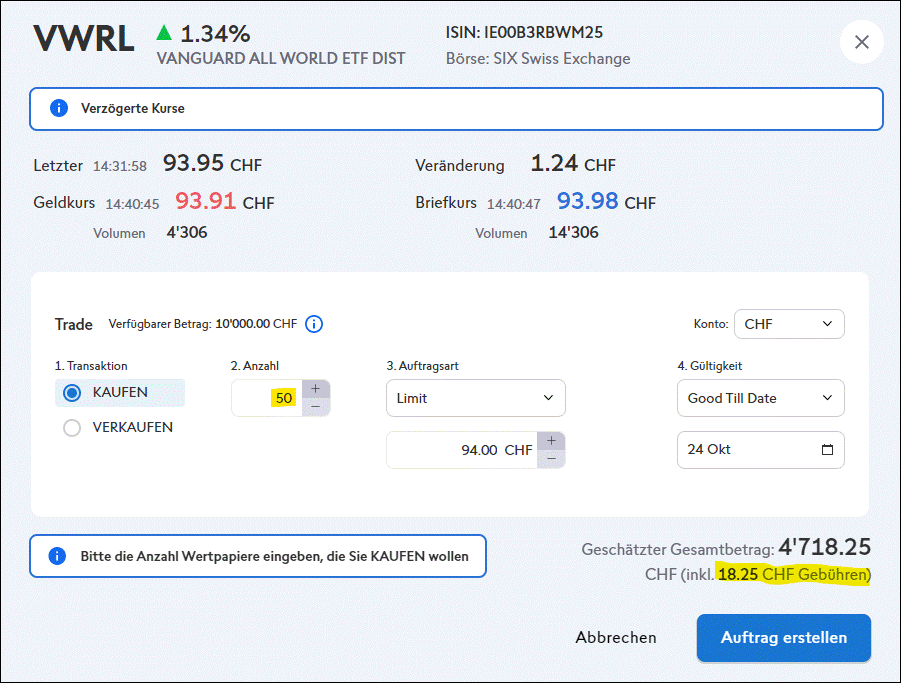
Let’s come back to the costs: A purchase of 50 units of the “ETF Leader” Vanguard All World ETF (VWRL) at a unit price of CHF 94.00 cost us CHF 4,718.25 including fees of CHF 18.25. Below is a brief breakdown of these transaction-related costs:
| Swissquote’s Brokerage Fees: | 9.00 CHF |
| Stamp duty (0.15%): | 7.05 CHF |
| Stock Exchange Fees: | 2.20 CHF |
This means that Swissquote’s fees for our test trade are only around half, with the other half being paid by the federal government and the stock exchange.
If none of these low-cost ETFs appeal to you, you’ll pay significantly higher brokerage fees on trades of 2,000 CHF or more, as shown in the following price overview from Swissquote for stocks and ETFs:
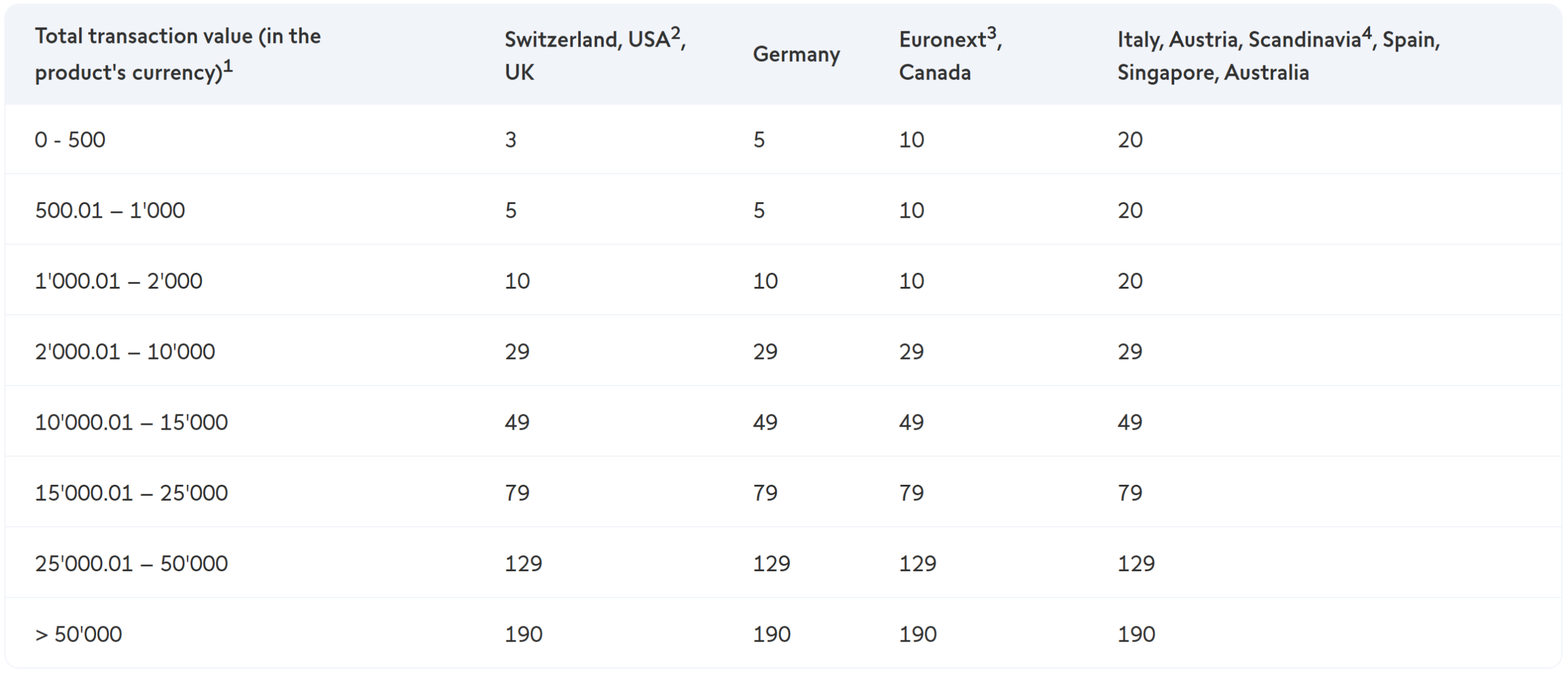
So it’s clear: Anyone who chooses Swissquote as a broker and wants to invest in ETFs should preferably opt for “ETF Leaders” products, which have a maximum commission of 9 CHF. The “standard” rates are reminiscent of Switzerland’s high-cost environment and are unlikely to be an option for cost-conscious investors. With one exception: If you’re investing only small amounts up to 500 or 1,000 CHF—for example, regularly through a savings plan—even the standard rates result in only moderate fees of 3 or 5 CHF, respectively.
Stamp duty (transaction tax)
Since Swissquote is a Swiss broker, stamp duty is levied on every trade. It amounts to 0.075% for funds domiciled in Switzerland (identified by the domestic ISIN “CH…”) and 0.15% for funds domiciled abroad (foreign ISINs such as “IE…” for Ireland). You can find more information on the taxation of ETFs in our separate tax article, “ETF Taxes in Switzerland: Optimize Your Portfolio with These Tax-Saving Tips.”
Foreign currency fees
For currency exchange within major currencies, which includes the Swiss franc, euro, US dollar, British pound and Japanese yen, Swissquote charges a fee of 0.95% . Higher rates apply for so-called minor currencies, which you can find here.
With Swissquote, you can hold almost any number of foreign currency accounts. Foreign currency accounts are advantageous because they can help you save on the relatively high exchange fees. For example, if you already have EUR cash and want to invest in an ETF in EUR trading currency, you will not incur any foreign currency fees. Incoming EUR transfers to your Swissquote Trading account are also free of charge.
Account management fees
At Swissquote, you can manage your cash in different currency accounts free of charge . Practical: When you open an account, you receive a CHF, USD and EUR bank account as standard.
Transfer fees
A welcome development, albeit long overdue: As of January 1, 2023, Swissquote no longer charges fees for domestic payments. Previously, a flat fee of 2 CHF had to be paid for outgoing transfers. For us, this was a deal-breaker, which is why, when this article was published, we advised against using Swissquote as your primary bank. Now, this option may once again be worth considering for some investors. But be careful: If you regularly make international SEPA transfers in euros, you’ll still be charged a fee of €2.
Costs for Lombard loans
If you want to invest more riskily, you can leverage your investments with a securities loan (Lombard loan). You can find Swissquote’s current interest rates here.
If you’re considering a Lombard loan, it’s worth taking a close look at the offers from various providers. As the following comparison shows, there are significant differences in this niche market.
| Provider | CHF | EUR | USD |
|---|---|---|---|
| DEGIRO | 2,5%* - 4% | 4,75%* - 6,25% | 5,25%* - 6,9% |
| Interactive Brokers | 1,5%** | 3,7%** | 5,13%** |
| Saxo Bank | 2%*** | 3,91%*** | 5,7%*** |
| Swissquote | 3% | 5,03% | 6,63% |
Fees for robo-advisory
For those who want to automatically manage their entire portfolio—not just individual holdings in a savings plan—Swissquote offers the optional “Invest Easy” service. However, the relatively high total fees of up to 0.79% are likely to deter many retail investors. The robo-advisors on our recommendations page show that there are significantly more affordable options available.
Securities lending as an additional source of income
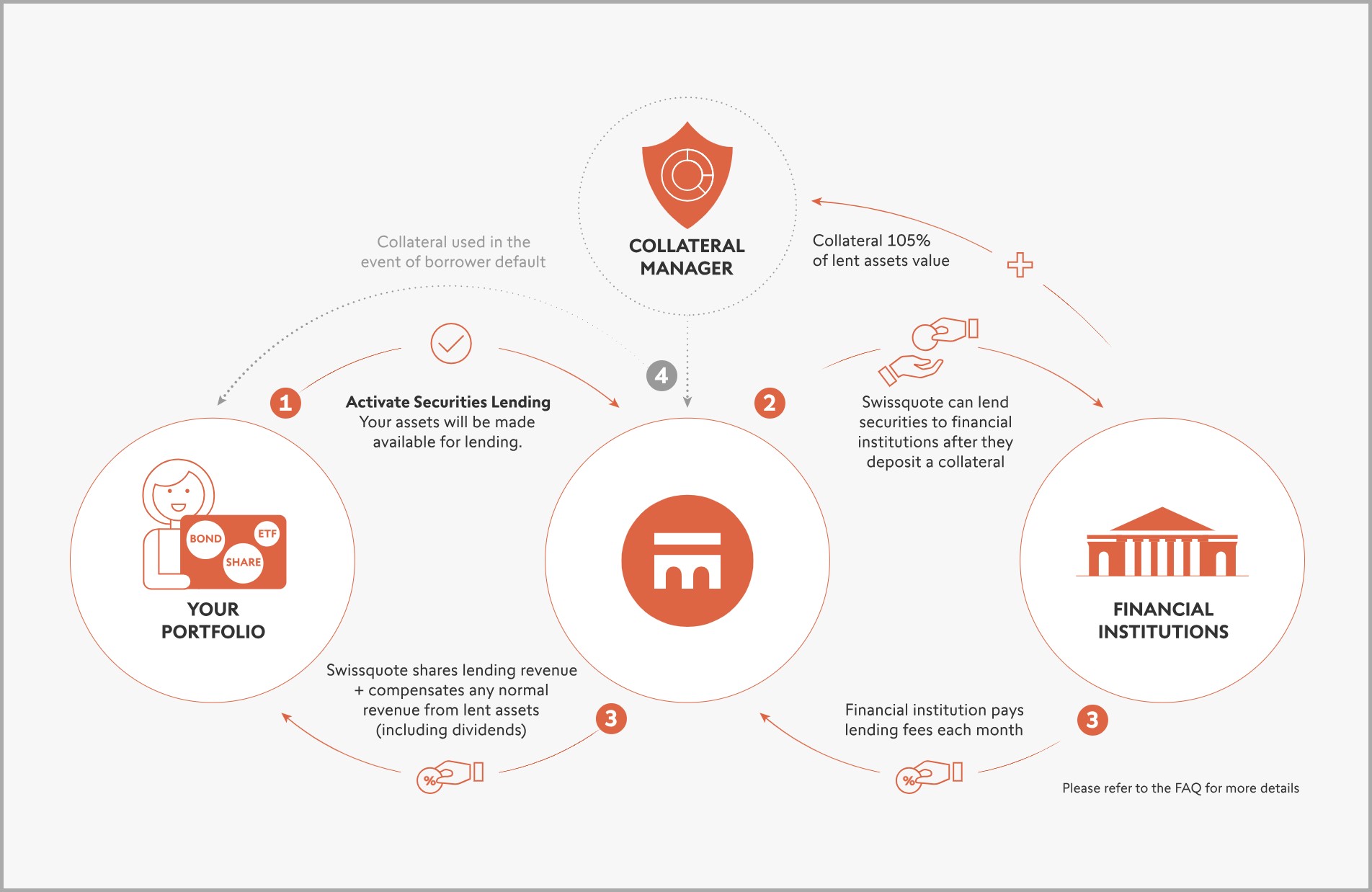
Securities lending is a free, optional service from Swissquote that offers you an additional way to generate passive income from your existing portfolio. Here’s how it works: Swissquote lends your securities on your behalf to institutions that need them and you receive a share of the returns generated. This share can vary greatly: According to Swissquote, the gross return on securities lent ranges from 0.5% to over 4%, depending on the lending transaction. The returns are credited monthly.
Swissquote ensures that it only conducts securities lending with renowned, top-rated institutions and holds at least 105% collateral.
Even if you lend out your securities, you remain their beneficial owner and continue to receive dividends.
Important: Despite all the security precautions taken by Swissquote, you are taking an additional risk with securities lending. Essentially, this is that in the event of a loss, the value of the collateral may not cover the value of the securities lent . You can find out more about securities lending from Swissquote here.
Support
For us, one clear advantage of Swissquote is its customer support: it’s knowledgeable, free, multilingual, and flexible—available via phone, email, or chat.
The latter has proven to be particularly efficient for us (unlike with phone inquiries, where we spent 15 minutes on hold just before noon): While the chatbot is good at helping with standard questions, the human support team handles more specific issues.
The telephone support team once referred us to the contact form when we pointed out a bug in the demo version. (Some widgets in our workspace were no longer displayed correctly). So we filled out the form and attached a print screen with the faulty widgets as “evidence”. We received an e-mail from Swissquote on the same day informing us that it would take two working days to rectify the problem, which it did.
Many people may be less aware that the online bank Swissquote also operates a lounge in Zurich in addition to its headquarters in Gland (VD). Centrally located at Löwenstrasse 62, a five-minute walk from the main train station, you can meet Swissquote in person. And not only, as mentioned above, to open an account, but also to call up stock market information etc. or simply have a coffee in a relaxed atmosphere.
As support in the broader sense, Swissquote offers a wide range of training in the form of free video courses, webinars and eBooks on all aspects of investing. These training formats are primarily aimed at newcomers to the stock market, as the following video on how the stock market works shows.
Suitability
Based on our experience with Swissquote and the research we conducted for this review, we believe this pioneering Swiss broker is particularly well-suited for investors who prioritize one or more of the following characteristics when choosing a broker:
- Domestic broker with a Swiss banking license, Swiss deposit protection of CHF 100,000 and 30 years of market experience
- Huge offering with over 3 million products, including a wealth of (niche) ETFs, tradable on numerous exchanges around the world
- Attractive terms for larger transaction amounts of 1,000 CHF or more thanks to the 9-CHF flat rate for “ETF Leaders” on the Swiss stock exchange SIX
- Automatic savings plan feature: Regular, consistent investments are possible thanks to fractional trading, with moderate fees starting at 3 CHF
- Separate foreign currency accounts, which can save on currency exchange fees
- Expert, multilingual, free support via email, phone, or chat
- Flexible use: Modern, customizable user interface and app for mobile devices
- Everything from a single source: investing, transfers and savings including cards
- Online courses for beginners
– Partner offer –
– – – – –
Interview with Romain Le Baud, Head Marketing Swissquote
As Head of Marketing, you shape Swissquotes’ positioning. What are currently the most important challenges?
- Standing out in a market where everything looks the same
Many providers look similar. Swissquote must remain clearly recognizable as an innovative, reliable and bold brand. - Reconciling price sensitivity and added value
Price pressure is increasing. It is crucial to make the added value behind a regulated Swiss bank with a broad offering and stable infrastructure visible. - Keeping up with the pace without diluting our long-term vision
The industry is accelerating – new technologies, new platforms, new asset classes. We want to stay agile without losing our focus or a consistent customer experience.
What counts in the end is to secure Swissquote’s leading position in an increasingly dynamic market – through a clear identity, innovation and reliability.
Swissquote achieves record figures, but at the same time the custody account fees are coming under increasing criticism. Many people see these fees as a relic of traditional banking precisely because they are incurred even if you don’t trade. What do you think about a possible fee cut and the opportunity to appeal to more price-sensitive investor segments?

It is crucial to distinguish between a low-cost broker and a fully regulated digital bank. Swissquote is the leading digital bank in Switzerland – with Swiss regulation, customer service, internal development and a broad investment universe of over 3 million products. This level of security, infrastructure and quality comes at a price, and we are convinced that the value delivered clearly justifies it.
Our aim is not to be the cheapest provider, but to offer the best value for money. For more price-sensitive customers who prefer a simpler and reduced offering, Yuh already offers a modern and competitive alternative without custody fees.
Finally, a look into the crystal ball: What will banking and trading look like by 2030 – in terms of technology, regulation and customer behavior? And what new functions or products will Swissquote surprise us with in the near future?
It is difficult to speculate reliably about future regulatory developments, and I ask for your understanding that I will only comment on specific new products when they are ready to be launched. What is clear, however, is that two forces will shape the financial world until 2030: Technology and customer behavior – and AI will greatly accelerate both.
- Technology: AI-based, frictionless and highly personalized
AI will become the core of the trading and banking experience by 2030. Platforms will become smarter, more personal and more dialog-oriented – from analysis and risk control to almost invisible processes such as onboarding or compliance. Technology is thus evolving from an execution tool to an actual intelligence engine. - Customer behavior: from DIY trading to AI-powered investing
Investors still want control, but less complexity. AI will simplify decisions and enable personalized, guided experiences. Banking, trading and digital assets will increasingly merge into a seamless user journey.
Thank you Romain for the exciting insights.
(The interview with Romain Le Baud was conducted in writing in English on 20.11.2025 and is reproduced here in slightly abridged form).
Conclusion on our Swissquote experience
Our experience with Swissquote has shown that the Swiss market leader offers an attractive overall package for anyone who values an online broker with a Swiss banking license.
This target audience also benefits from a modern trading platform and efficient, multilingual customer support.
However, we believe the key factor in deciding to switch is the fees charged by “ETF Leaders”: depending on the order size, these range from 3 to a maximum of 9 CHF per trade on SIX. This means Swissquote also stands out in terms of price when compared to other Swiss providers.
But even if you only want to invest small amounts—for example, conveniently through an automated savings plan—Swissquote has made improvements and significantly lowered the minimum investment amounts: 3 CHF for investment amounts up to 500 CHF.
And one more thing: Domestic payments are now free of charge at Swissquote. This change—which we believe was long overdue—makes them an attractive option not only as an online broker but also as a traditional bank—and thus for anyone who wants to handle both banking and securities transactions through a single provider.
This might also interest you


Updates
2026-07-24: Modified fee model implemented.
2026-01-03: Various updates made to text and images.
2025-12-16: New platform redesign presented.
2025-12-02: Bonus (trading credits) increased to CHF 200.
2025-11-21: New interview with Swissquotes Head of Marketing Romain Le Baud added.
2025-10-06: Various minor updates made.
2025-07-15: Various minor updates made.
2025-01-13: New price chart Swissquote vs. UBS added. Fee comparison updated. Various minor adjustments made.
2024-11-19: New savings plan offer with fees from CHF 3 explained and prices updated.
2024-04-11: Various links updated; the new “Invest Easy” tool for automatic asset management and the new, purely virtual free “Light” debit card mentioned; note added that PostFinance has been offering e-trading on the Swissquote platform since 2015.
2024-01-29: Specifies that Swissquote offers over 50 trading venues and more than 9,000 ETFs worldwide at a flat rate of CHF 9.
2023-12-08: Note on the demo account deleted, as this was discontinued on 27.11.2023.
2023-10-05: New chapter on securities lending added.
2023-06-15: Comprehensive product range specified and quantified.
2023-01-04: Text block “Short & sweet” added.
2022-12-12: Text supplemented by new investment plan for regular, automated investing.
2022-12-10: Fees updated: Abolition of fees for domestic payment transactions adopted as of 1.1.2023 (previously CHF 2 fee for outgoing payments).
Disclaimer
Disclaimer: Investing involves risks of loss. You must decide for yourself whether you want to bear these risks or not.
Errors excepted: We have written this article about our Swissquote experience to the best of our knowledge and belief. Our aim is to provide you as a private investor with the most objective and meaningful financial information possible. However, should we have made any errors, forgotten important aspects and/or no longer have up-to-date information, we would be grateful if you could let us know.
Transparency note: We, Stefan and Toni, have extensive Swissquote experience, as we have managed and continue to manage our securities accounts on the Swissquote e-trading platform, including via PostFinance, for many years. In addition, we opened a Swissquote demo account for this review, used it to execute trades and tested Swissquote support through various channels.




27 Kommentare
Bei einem hohen Betrag in EUR z.B. 100k, lieber bereits vor dem Kauf in die benötigten Währungen über z.B. Wise wechseln und dann zu SQ senden?
Und kann man grundsätzlich sagen, dass man bevorzugt immer über die SIX und in CHF kaufen sollte? Wenn man langfristig in der Schweiz lebt und die Kosten für Transaktionen mindern möchte.
Ich habe vor 2-3 ETF und Edelmetalle (über ETF abgebildet) zu kaufen.
Wenn deine Referenzwährung CHF ist, sparst du bei ETFs in Handelswährung CHF natürlich die Wechselgebühren. In unserem umfassenden ETF-Review gibt es einige attraktive Exemplare in Heimwährung an der SIX, alle auch bei Swissquote handelbar. Wenn es dein Wunsch-ETF jedoch nicht in Handelswährung CHF gibt, kann sich vorgängig ein Währungswechsel bei einem günstigeren Drittanbieter und danach kostenlose SEPA Überweisung (nur in EUR) vor allem bei grösseren Beträgen durchaus lohnen.
Danke für die schnelle Antwort. Was sind Vorteile und Nachteile bei den anderen Währungen. In letzter Zeit ist der EUR ja abgewertet zum CHF
Vorteile:
– Auswahl an ETFs in Handelswährung EUR oder USD ist global betrachtet deutlich grösser
– Das Handelsvolumen ist oft grösser, was die Handelsspanne tief hält (Spread)
Nachteil:
– Währungswechselgebühren
Wichtig: Das Währungsrisiko (“Abwertung Euro”) hängt nicht mit der Handelswährung ab, sondern vom Domizil der im ETF/Index gelisteten Unternehmen.
Hallo
Erstmal vielen Dank für den super Blog!
Mich würde noch gerne etwas genauer interessieren ob eine Depot-Übertragung von IBKR beispielsweise zu Swissquote auch einfach funktioniert.
Ich spare schon regelmässig seit einigen Jahren in ETFs (Börse Schweiz, Euronext und Xetra). Mein Depot habe ich aktuell bei Degiro und da bin ich eigentlich zufrieden.
Da ich jetzt aber langsam etwas höre Beträge angespart habe, würde ich mich wohler fühlen wenn meine Einlagen von einem Broker welcher in der Schweiz reguliert ist, verwaltet werden.
Ich überlege mir also zu Swissquote zu wechseln, möchte aber nicht die hohen Handelsgebühren zahlen. Deswegen ist meine Idee, bei einem günstigen Broker (Degiro, IBKR) zu kaufen und dann sobald ein grösserer Betrag zusammengekommen ist die Position zu Swissquote zu übertragen.
Wäre das ein Ansatz? Was müsste ich dabei speziell bedenken?
FG, Cary
Hoi Cary
Merci für das Lob und deine unkonventionelle Idee. Positiv: Für Überträge von Wertschriften zu Swissquote gibt es aktuell ein bis Ende Mai 2025 befristetes Spezialangebot, wonach Swissquote die Übertragungskosten von bis zu 500 CHF übernimmt (vgl. auch https://www.swissquote.com/de-ch/500). Speziell bedenken würden wir, ob die zu übertragenden ETFs zu den sogenannten ETF Leaders (vgl. Swissquote Website) gehören, deren Courtagen, z.B. bei einem späteren Verkauf, bei 9 CHF gedeckelt sind. Wenn nicht, studiere doch mal die entsprechende Swissquote Preisliste für (spätere) Trades in der von dir gewünschten Höhe, sodass du bezüglich der vergleichsweise hohen Gebühren kein böses Erwachen hast.
Beste Grüsse
SFB
Hallo Schweizer Finanzblog
Ich bin in vertiefter Recherche zwecks Start meiner Fondssparpläne auf euren tollen Blog gestossen.
Thema Swissquote, ETF-Fondssparplan: Habt ihr den neusten Wurf, dieses Angeot ev. schon kritisch geprüft?
https://www.swissquote.com/de-ch/private/invest/products/saving-plan
Eure Konklusion und Meinung dazu würde mich sehr interessieren (Frei wählbare ETF’s/Palette; Gebühren Kauf/Depot; Handling; mehrere Fondssparpläne möglich…).
Und könnte ich hierbei die 200.- TradingCredits auch mitnehmen?
Danke für euer Feedback, Gruss Rolf
Hoi Rolf
Vielen Dank für den Hinweis. Wir haben die neuen Einstiegspreise von Swissquote ab 3 CHF im Artikel thematisiert. Mit dieser Preissenkung ist Swissquote nun endlich auch für kleinere Investitionsbeträge interessant geworden, insbesondere im Zusammenhang mit den von dir erwähnten neu lancierten Sparplänen, welches automatisiertes Investieren mit gleichbleibenden Beträgen (Fractional Trading) ermöglicht.
Und ja, gemäss Swissquote können unsere Trading Credits auch für die Sparplan-Gebühren verwendet werden. Es gelten jedoch Bedingungen, u.a. 3 Monate Gültigkeit (vgl. auch das Kleingedruckte in unserem Werbebanner).
Beste Grüsse
SFB
Ich plane, langfristig in einen ETF zu investieren. Da ich recht unerfahren bin, wollte ich mit einer kleinen Summe die Funktionalität der Plattform ausprobieren. Ich habe einen HBSC MSCI World in USD auf SIX gekauft. Mir wurden beim Kauf lediglich die Kaufgebühren angeziegt. Den TER kann ich nirgends finden und auch keine Info, ob meine Variante ausschüttend ist. Gibt es Aussiegskosten? Ich bin wie gesagt neu und habe vielleicht einiges noch nicht gefunden.
Die TER findest du auf dem Produkt-Factsheet des ETF-Anbieters, also in deinem Fall HSBC. Die TER wird dir direkt vom ETF-Anbieter abgezogen, ohne dass du dafür eine Abrechnung erhältst. Ebenfalls auf dem erwähnten Factsheet ist aufgeführt, ob es sich bei deinem ETF um eine ausschüttende oder thesaurierende Variante handelt. Nein, Ausstiegskosten gibt es bei ETFs nicht, sondern du bezahlst einfach beim Verkauf die entsprechenden Transaktionskosten, die bei Swissquote transparent ausgewiesen werden. In diesem Artikel findest du, worauf du beim ETF-Kauf achten solltest: ETFs: Worauf du bei der Wahl achten solltest
Vielen Dank!
Swissquote bietet wieder einmal ein exklusives Angebot zum Einführungspreis von CHF 9.- Spesen bis zum 30. Juni an.
So etwas habe ich vor einiger Zeit schon einmal erlebt: “Lake Diamond”, ein Unternehmen von angeblich hervorragender Qualität, von Swissquote geprüft und für gut befunden. Das Angebot bestand darin, dass pro gekauften Aktienanteil 10 % gratis dazugegeben wurden.
Und was ist passiert? Die seriöse Firma “Lake Diamond” ist kaputt gegangen und das Geld alles verloren. Und die ganze Swissquote-Crew wusch selbstverständlich die Hände in Unschuld. Der CEO teilte mir in einer eMail mit, dass die Verantwortung ja bei mir liegen würde.
Wenn ich mir die jetzt angebotenen Titel anschaue, sehe ich nicht eine bessere Qualität, als damals bei “Lake Diamond”. Also Leute passt auf!
Meine Mutter und ich haben jeweils ein Konto bei Saxo geöffnet. Wurden aber beide nach wenigen Tagen gesperrt. Obwohl ich “nur” 50k eingezahlt habe und es keine Schenkung ist, muss ich folgendes einreichen:
“Wir benötigen einige zusätzliche Finanznachweise von Ihnen. Bitte legen Sie die folgenden Unterlagen über die erhaltene Schenkung vor:
– Die Schenkungserklärung/den Brief des Schenkers mit Angabe des Schenkungsbetrags, des Eingangsdatums und des Grundes für die Schenkung.
– Ein Kontoauszug, welcher den geschenkten Betrag ausweist.
– Der Ausweis des Schenkers.
– Belege über die Herkunft der Mittel des Schenkers. ”
Meine Mutter muss auch 5 verschiedene Dokumente, inkl. Angaben des Arbeitgebers, Lohnausweis, etc. einschicken, obwohl sie pensioniert ist.
Ist das normal bei Schweizer Brokern, also ist Swissquote auch derart restriktiv? Weil Degiro ist es definitiv nicht.
In deinem Fall liegt ja offensichtlich ein Missverständnis vor. Kläre doch deinen Broker einfach über die korrekte Mittelherkunft auf und teile ihm mit, dass es sich nicht um eine Schenkung handelt, weshalb du auch nicht gewillt bist, die entsprechenden Unterlagen einzureichen.
Danke dir. Habe es versucht, aber sie halten daran fest. Jänu, dann schliesse ich halt mein Konto bei Sao, wechsle zu Degiro, kaufe dort einen ETF und führe dann einen Depotübertrag durch zurück zu Saxo.
Hallo Beat
Wie ist da jetzt mit den Gebühren? Ab welchem Betrag lohnt es sich monatlich (als Sparplan) bei SQ zu investieren z.B. in den ETF Vanguard FTSE all world? Pro Transaktion kostet es ja jetzt CHF 5.00. Es gibt doch eine Faustregel…?
Danke für dein höfliches Feedback 😉
Einen guten Rutsch und auf ein erfolgreiches neues Jahr!
Hallo SFB Team
Gibt es bei SQ einen globalen ETF auf FTSE oder MSCI, welcher in Euro gehandelt wird und günstig ist zu erwerben? Bei den Flatrate CHF 9 ETFs, finde ich nur ETFs in USD und CHF. Ich habe eine grössere Summe inEuro, welche ich in 5-10 Tranchen anlegen möchte.
…dieser nachhaltige ETF von iShares basierend auf dem MSCI World SRI ist in Handelswährung EUR und mit einer TER von 0.20% recht günstig: IE00BYX2JD69. Konventionelle ETFs zu einem vernünftigen Preis sind aber in der Tat Mangelware. Am besten recherchierst du direkt auf der SIX-Seite, wo du nach Handelswährung filtern kannst.
Wenn immer man ETFs/Aktien in Fremdwährungen kauft/verkauft, fallen Wechselgebühren an. Diese betragen bei Swissquote fast 1%! Bei Degiro sind es es nur 0.25%. Das ist drei-Viertel weniger!
Diese Wechselgebühren können sich schnell als grösster Kostenfaktor herausstellen. Beim Kauf der Fremdwährungen werden sie zudem nicht deklariert. Man muss sich zuerst durch lange Preislisten lesen…
Auch bei den meisten anderen Gebührenarten ist Degiro viel günstiger und kostet in der Regel eine Bruchteil…
Deine erste Aussage trifft auf DEGIRO zu, nicht aber auf Swissquote. Denn Swissquote bietet im Gegensatz zu DEGIRO Fremdwährungskonten an. Du bist bei Swissquote also nicht verpflichtet, den Geldwechsel über Swissquote abzuwickeln. Stattdessen kannst du beispielsweise die bei deiner Hausbank bereits vorhandenen Euro-Vermögen oder bei einem günstigen Drittanbieter deines Vertrauens gewechselten Euro-Bestände aufs Euro-Konto von Swissquote überweisen und sparst so die Wechselgebühren ganz oder teilweise. Ansonsten teilen wir deine Meinung natürlich: Wechselgebühren können ins Gewicht fallen und sollten deshalb im Auge behalten werden.
Und sollten transparent angezeigt werden. Das vermisse ich bei SQ schon noch!
Im Bericht vermisse ich alles was bei SQ neu wurde. Die neuen Gebühren gehören da rein. Auch vermisse ich Infos über die Investitionspläne, welche neu möglich sind bei SQ.
Aus meiner Sicht ist der Artikel auf einem Stand vor einem Jahr. Wurde der aus der Mottenkiste genommen?
Nein, natürlich nicht aus der Mottenkiste, Beat😉 Der Artikel ist taufrisch, enthält sogar bereits ein erstes Update, welches die Gratiszahlungen aufgreift, welche Swissquote neu per 1.1.2023 einführen will. Gegenfrage: Gibt es Informationen/Gebühren im Artikel, die für dich nicht mehr stimmen? Wenn ja, danke im Voraus für deinen entsprechenden Hinweis. Bezüglich der Investitonspläne: Damit meinst du wohl das automatisierte Investieren in einen bestimmten ETF & Co. mit einem fixen Betrag und vordefiniertem Intervall, oder? Diese Info haben wir in einem Kundenmailing von Swissquote erst am 29.11.2022 erhalten. Aber du hast recht: Diese Info könnte die eine oder der andere langfristig orientierte ETF-Anleger:in (Diese Zielgruppe wollten wir im Artikel ansprechen.) interessieren. Wir werden dieses Thema deshalb gerne noch im Artikel aufnehmen. Merci für diesen Hinweis/Reminder!
Beste Grüsse
SFB
Ihr rüde Art ist unangebracht und despektierlich. Ihre Hinweise als Gratiskonsument, so berechtigt diese sein mögen, lesen alle interessierten hier lieber in einem respektvollen und höflichen Ton.
Hallo Guido
Ich denke dies galt meinem Eintrag. Ich finde weder daran etwas rüde noch despektierlich. Aber ist bezeichnend für die heutige Zeit das man in den Kommentaren nur noch loben darf und nicht Kritik anbringen.
Und deshalb ein grosses Lob an das SFB Team, welche den Kommentar veröffentlicht hat und dazu Stellung nahm.
Ich weis nicht was für Sie respektvoll ist. Meine Schreibweise ist direkt ja. Aber diese als unhöflich zu titulieren, fragt sich dan was unhöflich ist. 🙂
Grüsse
Beat
Da ich von Sonderkonditionen bei einer Universalbank profitieren kann, lohnen sich für mich keine anderen Lösungen. Nichtsdestotrotz gratuliere ich zu diesem neuen Bericht. Well done! Jedoch habe ich überschlagsmässig den Eindruck, dass die PostFinance overall die attraktivere Alternative zu Swissquote für die meisten Anlegerprofile mit Domizil Schweiz darstellt.
Merci für das positive Feedback! Und ja, es mag gute Gründe für ein Depot bei Postfinance geben. So können je nach Vermögensgrösse die Depotgebühren bei PostFinance etwas tiefer liegen als bei Swissquote. Auf der anderen Seite kauft PostFinance Know-how und eTrading Plattform bei Swissquote ein. Diese Abhängigkeit erachten wir nicht unbedingt als Vorteil und schlägt sich auch in der diesbezüglich mässigen Kompetenz beim PostFinance Support nieder. Den grössten Trumpf von Swissquote gegenüber PostFinance sehen wir aber im vergleichsweise günstigen Pauschaltarif von 9 CHF bei Transaktionen mit “ETF Leaders” und anderen Produkten, welche an der SIX gehandelt werden.