Newsletter
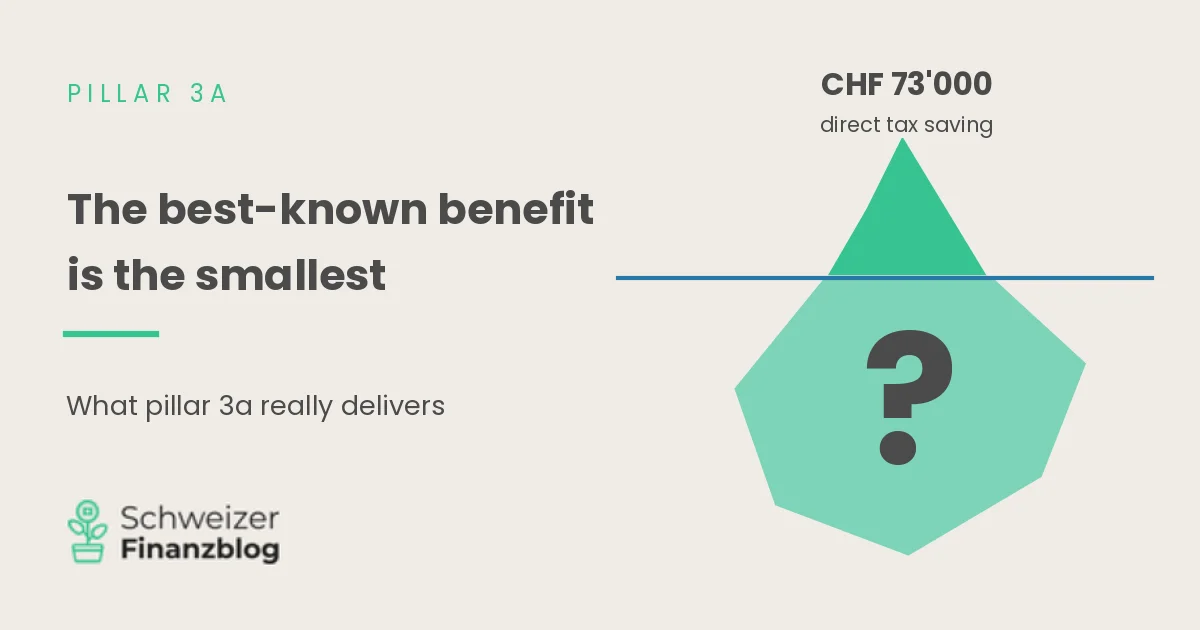
Why do you pay into Pillar 3a? Most people say: because of the taxes. Every December, it’s the same message on every channel: “Save taxes with Pillar 3a while you still can!” The tax deduction really is the best-known benefit of the 3a. But it isn’t the biggest one. The effects that truly make the difference work almost unnoticed in the background for decades – and in our model calculation they add up to around CHF 500,000. Unless fees eat them up first.

In a nutshell
- Compared with investing freely, Pillar 3a pays off for almost everyone with taxable earned income – but for a different reason than most people think.
- Three effects make the difference: the annual Pillar 3a tax deduction, plus no tax on dividends and no wealth tax. But they only carry real weight thanks to compound interest, which multiplies each of them over decades.
- In our model calculation, the 3a is around CHF 500,000 ahead of a regular ETF portfolio after 40 years – you can run the numbers with your own figures in the calculator further down.
- How you invest is what counts: you need a securities solution with a high equity allocation and low fees. In a 3a savings account or in expensive funds, most of the advantage fizzles out.
- If you open several accounts and stagger your withdrawals, you can cut the tax on withdrawal massively.
- New since 2026: you can make up missed contributions retroactively, but only for gaps from 2025 onwards.
Contents
- Pillar 3a in brief
- Pillar 3b: freedom with a tax burden
- Pillar 3a or 3b: the model calculation
- Pillar 3a tax deduction: what it gets you – and what the withdrawal costs
- How we calculate
- Advantage 1: the state chips in
- Advantage 2: no income tax on dividends
- Advantage 3: no wealth tax
- Another plus: withholding tax on US dividends
- The catch: higher fees
- How robust is the result?
- 3a tax calculator: what your contribution really gets you
- The honest downside of the 3a
- Is the 3a worth it with small amounts or a late start?
- Investing your Pillar 3a: account or securities – the decision with the biggest impact
- Switching your Pillar 3a: easier than you think
- Lowering Pillar 3a taxes: several accounts and staggered withdrawal
- New since 2026: making up contribution gaps
- Conclusion
- You might also be interested in
- Updates
- Disclaimer
Pillar 3a in brief
Pillar 3a is restricted private pension provision. It is part of the third pillar, the voluntary part of the Swiss three-pillar system, and supplements the AHV (1st pillar) and the pension fund (2nd pillar). The state promotes it with tax benefits; in return, the money is subject to rules.
It is widely used: in 2019, 56% of 25- to 64-year-olds said they paid in regularly. In 2020, 1.8 million taxpayers claimed a 3a deduction and paid in a total of just under 11 billion francs, an average of just over 6,000 francs per person. The figures come from an analysis by the Federal Social Insurance Office that combines data from the Federal Statistical Office (FSO) and the Federal Tax Administration (FTA).
Who can pay in, and how much
Anyone in Switzerland with earned income subject to AHV contributions can pay in. You can deduct the full amount you pay in from your taxable income. How much you’re allowed to pay in depends less on your salary than on whether you belong to a pension fund.
With a pension fund, the limit in 2026 is exactly CHF 7,258, regardless of salary or workload. Even if you work 40%, you can pay in the full amount, not just a share of it. From 2027, the maximum rises to CHF 7,373.
Without a pension fund, a different rule applies: 20% of your net earned income, i.e. your salary after social security contributions, but no more than CHF 36,288; from 2027, it is CHF 36,864. This lets self-employed people pay in many times as much; reaching the maximum takes an income of around CHF 180,000. For employees on a low salary, the same rule cuts the other way: anyone earning less than the BVG entry threshold of CHF 22,680 a year with one employer isn’t covered by a pension fund. With a net earned income of CHF 20,000, that means only CHF 4,000 is possible.
At this threshold, things get lopsided. With a salary of CHF 23,000 and a pension fund, you can pay in CHF 7,258, almost a third of your salary. With CHF 22,000 and no pension fund, it’s CHF 4,400. There is no lower limit, though: the 3a has no minimum contribution.
People taxed at source can also pay in, but they don’t get the deduction automatically. To get it, they have to apply for a subsequent ordinary assessment by 31 March of the following year. The switch is irreversible.
Pillar 3a withdrawal: when you can get at the money
The balance is locked until five years before the AHV reference age at the earliest. If you keep working beyond the reference age, you can postpone the withdrawal by up to five years and keep paying in. You can only get at the money early in these cases defined by law:
- Buying, building or paying down the mortgage on a home you live in
- Becoming self-employed
- Leaving Switzerland for good
- Buying into a pension fund
- Receiving a full disability (IV) pension
On withdrawal, the capital is taxed once, separately from your other income and at a reduced rate. This capital withdrawal tax, often simply called withdrawal tax, is only levied once. The federal government calculates it the same way across Switzerland, at one fifth of the ordinary rate. Cantons and municipalities apply their own rates, which is why the burden varies widely depending on where you live. Because the rates are progressive in most cantons, you can push the tax down further with several accounts and a withdrawal staggered over several years.
You decide for yourself how your 3a money is invested: in a 3a savings account with a fixed preferential interest rate or in a securities solution with funds or ETFs. As the model calculation below shows, this choice has bigger consequences than the tax deduction itself.
Pillar 3b: freedom with a tax burden
Pillar 3b is unrestricted private provision. It covers everything you put aside for later on top of the 3a: savings account, securities account, home ownership or life insurance. The state sets no rules for you, but doesn’t support you either. Insurers usually mean their policies when they say “3b”. In this article, we mean what is the more sensible option for most investors: a self-managed ETF portfolio.
The advantages of the 3b
- Full freedom: you can pay in and access your money at any time. There are no maximum amounts, no lock-up periods and no legal conditions for withdrawal.
- Free choice of investments: you pick the broker, ETFs and equity allocation yourself and aren’t tied to what a pension foundation offers.
- Lower costs: a low-cost online broker with a broadly diversified ETF is often a little cheaper than the cheapest 3a solutions.
- No capital gains tax: price gains are tax-free for private investors in Switzerland, and there is no capital withdrawal tax when you sell.
The disadvantages of the 3b
The downside shows up in the taxes you pay year after year:
- Dividends are taxable as income, even with accumulating ETFs that automatically reinvest their earnings.
- Your portfolio counts towards your taxable wealth every year.
Each of these taxes looks small on its own. But over decades, the money isn’t just missing once – it’s missing along with all the returns it could have earned. The model calculation shows how much that adds up to.
On top of that comes a drawback that doesn’t show up in any calculation: money that’s available at any time is more likely to get spent. The 3a lock-up protects your retirement savings from yourself.
Pillar 3a or 3b: the model calculation
Pillar 3a tax deduction: what it gets you – and what the withdrawal costs
Every December, the same argument: quickly pay into your 3a, it saves taxes. That’s true, but only half the story. The state isn’t giving you the tax as a gift. It takes it back when you withdraw – with interest and compound interest.
In our model calculation, you pay in CHF 7,258 a year and, at a marginal tax rate of 25%, save around CHF 1,814 in income tax every year, so around CHF 73,000 over 40 years. On withdrawal, you then owe just over CHF 109,000 in capital withdrawal tax – more than the deduction brought in over all those years. In nominal terms, nothing is left of the much-praised tax deduction.
The reason lies in what the two taxes are actually levied on. The deduction only applies to the CHF 290,320 you paid in. The capital withdrawal tax, on the other hand, hits the entire balance of just over 1.8 million at the end, including all the returns. That way, a low rate on a large amount catches up with a high rate on a small one. How the race ends depends on two independent factors: the deduction depends on your marginal tax rate, the capital withdrawal tax on the size of each tranche and your canton of residence in the year of withdrawal.
And yet the 3a ends up around CHF 500,000 ahead of a regular portfolio. Patrick Eugster, who holds a PhD in financial economics, pointed out this apparent contradiction in a guest article at VIAC that is well worth reading. We recalculated his reasoning using our own assumptions.
How we calculate
We compare two people with identical incomes. Each spends CHF 5,444 of their own money on retirement savings every year for 40 years, from age 25 to 65. So it costs them both the same. The 3a person does transfer the full CHF 7,258 at first, but gets the difference back via the tax bill. One invests the amount in an ETF portfolio. The other pays it into a 3a securities solution, where, thanks to the tax deduction, CHF 7,258 arrives. Both invest 100% in global equities.
Our assumptions: an 8% return per year (nominal) including dividends, as a globally diversified equity portfolio has historically achieved over recent decades, of which 2% is dividend yield. Costs of 0.4% in the 3a and 0.2% in the regular portfolio. Marginal tax rate 25%, wealth tax 0.15%, capital withdrawal tax 6%, as is typical for a withdrawal staggered over several years.
These figures are simplified and vary by canton, income and provider. In reality, wealth tax is progressive and only kicks in above a tax-free allowance. In the city of Zurich, 0.2% would correspond to wealth of around one million, which our portfolio only reaches at the very end. The 0.15% should therefore be read as an average over the entire period. If different values apply to you, you can enter them in the calculator further down.

After 40 years, the 3a holds around CHF 1,712,000 after capital withdrawal tax, the regular portfolio around CHF 1,207,000. The lead of around CHF 505,000 comes down to three effects.

Advantage 1: the state chips in
CHF 7,258 arrives in the 3a, CHF 5,444 in the regular portfolio, at the same cost to you. The difference of CHF 1,814 is the tax saving at our assumed marginal tax rate of 25%, and it sits in the retirement account from the start instead of you having to invest it separately. Over 40 years, it generates returns that in turn generate returns.
So it’s not that something is taken away from you in the regular portfolio. It’s the other way round: the state contributes to your 3a payment, and that share works for you for forty years. On withdrawal, it takes part of it back – but only 6% of the final value, after contributing 25% of the amount paid in. After deducting the capital withdrawal tax, that comes to around CHF 365,000 in our calculation, the largest single item.
Advantage 2: no income tax on dividends
In the regular portfolio, dividends are taxable as income, even with accumulating ETFs. With a 2% dividend yield and a 25% marginal tax rate, that costs you 0.5% in returns every year. That sounds like little, but over 40 years it adds up to around CHF 182,000. In the 3a, this tax doesn’t apply.
Advantage 3: no wealth tax
Your 3a balance is exempt from wealth tax; the regular portfolio is not. At 0.15% a year, that comes to around CHF 53,000 over 40 years. How big this effect is depends heavily on your canton and your other wealth.
Another plus: withholding tax on US dividends
We deliberately left a fourth advantage out of the model calculation because it doesn’t apply to every 3a: the US tax authorities withhold part of US dividends as withholding tax. In a private portfolio with an Irish ETF, this money is lost, whereas Swiss pension foundations can reclaim it. However, this only works with 3a solutions that use Swiss index funds, not with those that rely on ETFs. Where the claim is made, the 3a’s lead is therefore a little bigger than shown here.
“The biggest advantage of Pillar 3a isn’t the tax deduction, but the time during which the tax money you’ve saved works for you.”
The catch: higher fees
We have to set the higher fees of the 3a against this – around CHF 95,000 in our calculation. Even so, the lead remains clear.
How robust is the result?
At a marginal tax rate of 15%, the lead shrinks to around CHF 269,000; at 35%, it grows to around CHF 721,000. With a cautious 6% return instead of 8%, it comes to around CHF 293,000. The 3a with equities wins in every realistic scenario. Only high fees shrink the lead to a fraction.
3a tax calculator: what your contribution really gets you
All the figures above are based on our assumptions. Here you can enter your own: contribution, duration, marginal tax rate, return, costs and capital withdrawal tax.
Calculator
Pillar 3a vs. a regular ETF portfolio
Adjust further assumptions
- Pillar 3a
- Regular ETF portfolio
- after dividend & wealth tax
The lead grows over time
Where the difference comes from
Model calculation with simplified assumptions: contributions at the start of each year, constant marginal tax rate, dividend and wealth tax paid annually from the portfolio. Wealth tax and capital withdrawal tax vary considerably by canton. Assumed returns are not guaranteed.

The honest downside of the 3a
The 3a comes at a price, and that price is freedom. If you need your money before retirement and can’t invoke any of the legal reasons for withdrawal, you’re locked out. That’s why your 3a balance should never be your only wealth; alongside it, you need a cash reserve and non-pension assets.
Then there’s political risk. In the 2027 relief package, the Federal Council wanted to tax capital withdrawals above CHF 100,000 more heavily under direct federal tax. Parliament dropped the measure in March 2026, but that doesn’t mean the issue is off the table. If you pay in today, you bear the risk that different rules will apply in 30 years. At least the effect remains manageable: a capital withdrawal tax of 8% instead of 6% costs around CHF 36,000 of the lead in our calculation.
And finally, our model calculation is based on assumptions. Past returns are no guarantee for the future, and your personal result depends on your income, canton of residence and choice of provider.
Is the 3a worth it with small amounts or a late start?
Yes, the lead is just smaller. If you pay in CHF 2,400 a year for 30 years and have a marginal tax rate of 15%, you end up around CHF 41,000 ahead of the regular portfolio in our calculation. If you only start at 50 and pay in the maximum for 15 years, at a 30% marginal tax rate you get a lead of around CHF 58,000.
The rule of thumb: the higher your marginal tax rate and the longer your investment horizon, the more the 3a pays off. It’s hardly worth it only on a very low income, for example while you’re in training or studying. Then the tax deduction brings little, and if you’re not covered by a pension fund, you can only pay in 20% of your income anyway. The long investment horizon does argue for starting early – but it counts just as much in the regular portfolio, and there you can get at your money any time.
Investing your Pillar 3a: account or securities – the decision with the biggest impact
All the advantages of the 3a only come into play if your money actually earns a return. And this is exactly where the 3a is special: the money is locked up until shortly before retirement anyway (apart from legal exceptions such as home ownership or leaving the country). If you pay in at 30, you have an investment horizon of more than 30 years. A horizon like that is the best basis for riding out market swings, and therefore the strongest argument for a high equity allocation. The paradox: of all money, it’s this long-term locked-up money that, in Switzerland, largely sits in accounts.
The figures confirm this. According to calculations by the VZ VermögensZentrum, there were 143 billion francs in Pillar 3a at the end of 2023. Of that, 91 billion was with banks – and 58 billion, almost two thirds of the bank balances, was simply sitting in accounts instead of securities.
What that costs is shown by the comparison with an annual contribution of CHF 7,258. We assume 1.5% interest on the 3a account and an 8% return on equities, minus 0.4% costs for the securities solution, i.e. 7.6% net. The account has no product costs, and within the 3a both options are tax-free. All figures are nominal, so inflation has not been deducted.
Both rates are long-term averages, as we derived them in Lesson 1 of our finance guide. Based on historical data, we are therefore assuming much higher interest than is currently on offer: today, 3a account interest rates average less than half a percent.
| Investment horizon | 3a account | 3a with equities | 3b with equities |
| 10 years | 74,000 | 104,000 | 81,000 |
| 20 years | 160,000 | 321,000 | 243,000 |
| 30 years | 260,000 | 773,000 | 565,000 |
| 40 years | 376,000 | 1,712,000 | 1,207,000 |
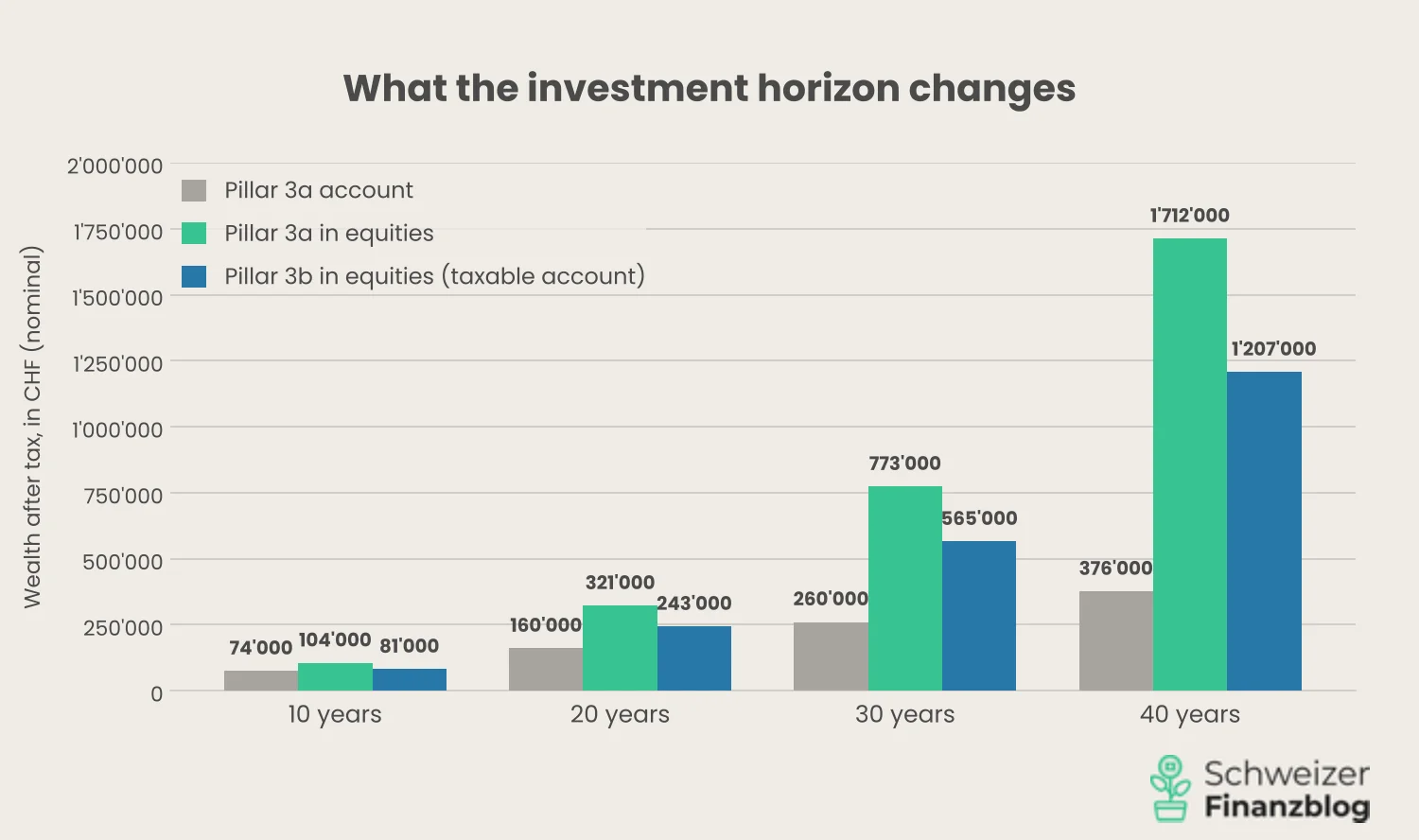
After 40 years, the account holds around CHF 400,000, from contributions of CHF 290,320. A decent increase in nominal terms, but stagnation once adjusted for purchasing power. After tax on withdrawal, around CHF 376,000 remains – not even a third of what a regular ETF portfolio achieves without any tax advantage. Better tax treatment simply doesn’t help much when there are hardly any returns to tax.
The second lever: fees
Over decades, fees also work like interest, just in the opposite direction. Many banks offer 3a funds with total costs of 1% to 1.5%. At 1.5%, the lead over the regular portfolio shrinks in our calculation from around CHF 505,000 to just CHF 69,000. The total costs of digital providers with index funds or ETFs are usually between 0.4% and 0.5%. Two exceptions: True Wealth and findependent are significantly cheaper. How True Wealth can afford such low fees is explained in our True Wealth review.
| Provider | Total costs per year | Bonus |
| True Wealth | 0,12% | For a 3b account: CHF 100 with code SFB100TW |
| findependent | 0,29% | CHF 2,000 permanently fee-free, code SFB3a |
| Typical bank 3a fund | 1.0% to 1.5% | – |
So for a long investment horizon: securities instead of an account, a high equity allocation and low fees.
When equities aren’t the right fit
If the withdrawal is only a few years away, for example for a home, the step into self-employment or approaching retirement, the money doesn’t belong in equities. A 30% slump can’t be reliably made up in three years, and unlike in the regular portfolio, you can only postpone the withdrawal to a limited extent. In these cases, the 3a account is the right choice despite the low interest rate. What matters isn’t the withdrawal itself, but whether you actually need the money then: if you want to keep it invested, you can transfer the securities to your private portfolio, depending on the provider, and don’t have to sell in a crash year of all times.
Switching your Pillar 3a: easier than you think
You’re not tied to the provider you once chose. You can switch at any time, tax-free, as long as the money stays in Pillar 3a. You open an account with the new provider and instruct them to make the transfer; the two foundations handle the rest between themselves.
There are three things you should know:
- You can only ever transfer an entire account; partial amounts aren’t possible.
- Switching is free with most providers. Some banks charge a closing fee of a few dozen francs, which some new providers cover as a switching bonus.
- Securities are sold and bought again at the new provider. A direct transfer of fund units between two pension foundations is usually not possible, so your money is out of the market for a few days.
The big exception is 3a insurance policies. They can’t simply be transferred, and early surrender usually involves painful losses. That’s one of the reasons why we don’t recommend such policies.
Lowering Pillar 3a taxes: several accounts and staggered withdrawal
For a regular payout, a 3a account can only be withdrawn in full; partial withdrawals aren’t possible. One exception is the early withdrawal for home ownership, which is also possible in partial amounts, usually at most every five years. And in most cases, the capital withdrawal tax is progressive: the higher the amount paid out in one year, the higher the tax rate. At federal level this is always the case, whereas some cantons apply a fixed percentage. There, staggering only affects the federal share.
That’s why it pays to keep several 3a accounts from the start and withdraw them spread over several years. Most providers allow several accounts or portfolios side by side. Since withdrawal is possible at the earliest five years before the reference age, you can close one account per year. Make sure to factor in withdrawals from your pension fund and those of your partner. Many cantons add up all capital withdrawals in a year.
New since 2026: making up contribution gaps
First, the most important thing: every year your money is in the market ends up having a bigger impact than any tax consideration. Statistically speaking, this gives you a small podium:
- Gold: pay in the full amount in January. Your money works eleven months longer than with the widespread December approach.
- Silver: a standing order, spread evenly over the year. This costs a little return, but you’ll barely notice it in your budget.
- Bronze: pay in later what was left undone. This has only been possible at all since 2026.
Until the end of 2024, a missed contribution was lost for good. Since 2026, gaps can be filled retroactively, going back up to ten years, but only gaps from 2025 onwards. In concrete terms: in 2026 you can only make up 2025; in 2027, 2026 as well. Everything before that is lost forever.
The conditions: you need earned income subject to AHV contributions both in the gap year and in the year you make up the payment, and the regular contribution for the current year must be paid in full first. You can make up at most CHF 7,258 extra per year (as of 2026). By the way, this amount also applies to the self-employed. The make-up payment is also deductible, so in the best case your deduction doubles to CHF 14,516.
The rule is meant for years when there simply isn’t enough: parental leave, further training, a tight budget, starting out as self-employed. Deliberately waiting so you can deduct double the amount later, on the other hand, rarely pays off. In our model calculation, it only makes sense if your marginal tax rate rises by around eight percentage points, for example when you start working after your studies. A normal pay rise isn’t enough.
So making up contributions is a lifeline, not a strategy.
– Partner offers –
Still looking for the right financial solution? Our recommendations – with attractive welcome bonuses.

– – – – –
Conclusion
Pillar 3a is worth it, but not just because of the tax deduction. A good part of that is taken back from you on withdrawal. The real advantage builds up over decades, almost unnoticed: in the 3a, the full amount works for you because the state doesn’t levy income tax on it. In the regular portfolio, that share is missing from the start. And throughout all those years, neither dividend tax nor wealth tax nibbles away at it. In our model calculation, this adds up to around CHF 500,000 more after 40 years than a regular ETF portfolio.
However, you only achieve this lead under four conditions:
- securities instead of an account
- a high equity allocation
- low fees
- several accounts for staggered withdrawal
The regular portfolio still matters: for anything you might need before retirement, and for everything you want to invest beyond the maxed-out 3a limit.
That leaves the question of where best to keep your 3a. In the next article, we compare all the major providers in detail: what costs really arise, how free are you in your investments, and how do the 3a solutions perform in practice?
You might also be interested in

Updates
2026-10-13: First published
Disclaimer
Disclaimer: Investing involves the risk of losses. You have to decide for yourself whether or not you want to take these risks.
Errors excepted: We wrote this article on Pillar 3a taxes to the best of our knowledge and belief. Our goal is to give you, as a private investor, the most objective and meaningful information possible on all things finance. If we have nevertheless made mistakes, or if important aspects have been left out and/or are no longer up to date, we would be grateful if you let us know.
About the authors

Stefan Huser
Stefan has been investing in the stock market himself since 2015. He has been shaped by Markowitz’s portfolio theory and Gerd Kommer’s book “Souverän investieren”. He follows a core-satellite strategy: a global equity portfolio of ETFs forms the core, complemented by alternative investments. At the blog, he mainly takes care of the writing. Stefan lives with his family in Zurich and is interested in literature, photography and financial freedom.

Antun Brcina
Antun (“Toni”) has been investing in the stock market since 2015. Financially, he has been particularly inspired by Gerd Kommer’s book “Souverän investieren” and the Fama-French five-factor model. His money is invested in a broadly diversified, long-term global equity portfolio of ETFs. At the blog, he mainly works on the calculators and the code. Toni lives with his family in the Zurich area and is interested in sports, technology and entrepreneurship.