
 Newsletter
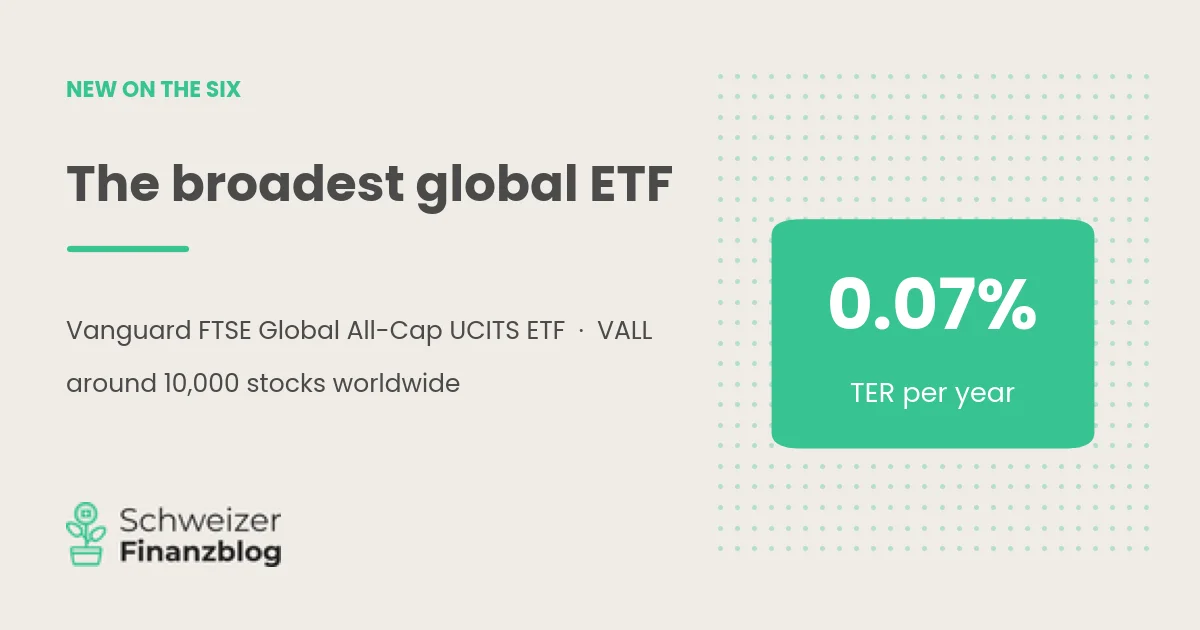
A single ETF, around 10,000 stocks, 0.07% in fees per year. What would have been taken for a misprint ten years ago has been tradable on SIX under the ticker VALL since 20 August 2026. With the FTSE Global All-Cap UCITS ETF, Vanguard has launched the broadest global ETF to date for investors in Switzerland – and at the same time the cheapest in its category – accompanied by two further products on the same day. In this article, you’ll find out what’s behind the move, why it’s coming now of all times and who the newcomers are suitable for.

In a nutshell
- On 20 August 2026, Vanguard listed three new global equity ETFs on SIX and four other exchanges.
- The flagship of the new launches is the Vanguard FTSE Global All-Cap UCITS ETF (ticker VALL) with a TER of 0.07% – the cheapest global ETF that also includes small caps.
- The underlying index comprises around 10,000 stocks and thus covers about 99% of the world’s investable market capitalisation.
- All three newcomers can now also be traded in Swiss francs on SIX, the All-Cap under the ticker VALC (distributing: VALCD) – which means no currency exchange fee when you buy.
- Three weeks before the launch, Vanguard had already cut the costs of its two All-World flagships VWRA and VWRL from 0.19% to 0.14%.
- We don’t believe these are teaser offers – on the contrary, the trend continues to point downwards.
- If you’re already invested, there’s no reason to rush: the ETF isn’t available everywhere yet, and redirecting your monthly contribution is cheaper than reallocating.
Contents
- From Bogle to cooperative: a short history of Vanguard
- What exactly Vanguard has launched
- Why now? Vanguard takes aim at the market leader
- And what about the Vanguard flagships VWRA and VWRL?
- The price war: TER heading towards zero
- Will the 0.07% last?
- Why VALL isn’t in our ETF comparison yet
- Should I sell my existing ETFs now?
- Conclusion
- You might also be interested in
- Updates
- Disclaimer
From Bogle to cooperative: a short history of Vanguard
To understand why this launch is more than just a product announcement, it’s worth looking back. In 1975, John C. Bogle launched the first index fund for private investors. The experts responded with ridicule – a fund that doesn’t even try to beat the market was seen as surrendering to mediocrity. Today, passive investing is the standard, and Vanguard is the second-largest asset manager in the world after BlackRock – with an ownership structure that makes falling costs not a marketing tool, but the normal state of affairs. We explain why further below.
For a long time, there was little sign of this in Europe – Vanguard charged significantly higher prices here than in its home market. Its own product range shows this: in the US, the Vanguard Total World Stock ETF (VT) tracks the same index as the new VALL, i.e. large-, mid- and small-cap stocks worldwide, and costs 0.06% there. There was simply no European counterpart, and where alternatives existed, you paid many times as much. The latest launch closes this gap: the difference is now just a single basis point – 0.06% versus 0.07%.
What exactly Vanguard has launched
Launched on 18 August 2026 and listed on 20 August on the London Stock Exchange, Deutsche Börse, Euronext Amsterdam, Borsa Italiana and SIX Swiss Exchange – three new ETFs, each with an accumulating and a distributing share class:
| Vanguard FTSE Global All-Cap UCITS ETF | Vanguard FTSE All-World ex-US UCITS ETF | Vanguard FTSE Global Small-Cap UCITS ETF | |
|---|---|---|---|
| Ticker USD | VALL / VALLD | VXUS / VXUD | VSML / VSMLD |
| Ticker CHF | VALC / VALCD | VXUC / VXUCD | VSMC / VSMCD |
| TER | 0.07% | 0.12% | 0.22% |
| Trading currency | USD | USD | USD |
| Index | FTSE Global All Cap | FTSE All-World ex US | FTSE Global Small Cap |
| Number of constituents | 10,127 | 3,763 | 5,862 |
VALL: Vanguard FTSE Global All-Cap UCITS ETF
The heavyweight of the three launches covers large-, mid- and small-cap stocks from developed and emerging markets and, with around 10,000 stocks, holds more than twice as many as the well-known FTSE All-World. The difference lies in the small companies: the All-World stops at mid-sized companies and captures around 90% of investable market capitalisation, while the Global All Cap reaches about 99%.
So small caps make up only around 9% of the portfolio. By number they dominate the index, but by weight they remain an admixture – accordingly, the difference in returns compared with the All-World is small in practice.
As is usual with broadly diversified global ETFs, Vanguard uses a sampling approach: the ETF doesn’t hold every stock in the index, but a representative selection of more than 7,000 securities. This is not a disadvantage, because the smallest index constituents carry so little weight that leaving them out barely affects replication – while saving costs.
This makes the ETF particularly suitable for three situations: for a portfolio that is meant to cover the entire equity allocation with a single product; for cost-conscious investors; and last but not least for anyone who wants to skip the annual rebalancing. You’ll find all key data, including the ISINs of both share classes, on Vanguard’s product page.
The logical complement to its ESG counterpart V3AA
One point that gets lost in all the excitement: Vanguard has long offered all-cap coverage – but only in the sustainable version. The Vanguard ESG Global All Cap UCITS ETF (V3AA) has been around since March 2021, but costs 0.24% and excludes companies based on sustainability criteria.
In terms of geography and company size, the two ETFs are set up identically. So until now, anyone who wanted the widest possible market coverage had no choice but to buy the ESG exclusions as well. This link has now been broken: V3AA remains the choice for anyone who deliberately selects by sustainability criteria, while VALL tracks the entire market – at a third of the price.
VXUS: Vanguard FTSE All-World ex-US UCITS ETF
The ex-US ETF addresses an issue that is on many people’s minds at the moment: the US concentration risk. In a classic global ETF, well over 60% of the weight is in US stocks. If you want to control this share yourself – for example by combining it with a separate US building block – this ETF gives you freedom to design your portfolio.
The ETF is also interesting as an alternative to a regional portfolio. If you have so far covered the developed world with three building blocks for North America, Europe and Asia-Pacific and needed a fourth for emerging markets, you can now manage with two: a US ETF and the ex-US, which already includes emerging markets. This noticeably reduces the rebalancing effort without giving up the option of setting the US allocation yourself. You’ll find all key data, including the ISINs of both share classes, on Vanguard’s product page.
VSML: Vanguard FTSE Global Small-Cap UCITS ETF
The small-cap ETF is intended for anyone who wants to give small companies more room in their portfolio.
The background: over long periods, smaller companies have on average delivered somewhat higher returns than large ones – but their prices fluctuated more. In technical terms, this relationship is called the size factor. We looked at whether such a factor approach is worth it at all in a separate article: Is factor investing worth it?
Whether you already benefit from this depends on your existing ETF. In the three best-known global indices – MSCI World, MSCI ACWI and FTSE All-World – small caps simply don’t feature. These indices stop at mid-sized companies. The MSCI ACWI IMI and the FTSE Global All Cap, on the other hand, do include small companies, but weight them by their market value. That results in a share of around 9% – exactly as much as they actually represent in the global market.
If you want to add small caps to your portfolio for the first time or give them a higher weighting than this market share, you therefore need a separate ETF. You’ll find all key data, including the ISINs of both share classes, on Vanguard’s product page.
Trading currency and taxes
This is where there was a drawback at first: all three newcomers were only available in US dollars on SIX. In the meantime, the exchange has added a Swiss franc line for each share class: for the All-Cap, VALC, and VALCD for the distributing class. Vanguard is evidently reading along. Behind each one is the same ETF with the same ISIN; the only difference is the currency in which your trade confirmation is issued.
Buying in francs saves you the currency exchange fee – depending on the broker, often between 0.2% and 1.5% of the transaction volume. Unlike the annual TER, it is charged per transaction and can wipe out the cost advantage of several years. The trading currency has nothing to do with currency risk, though: that arises from the currencies of the stocks held and is identical whether you buy in dollars or in francs. The franc line saves you the currency exchange fee, not the exchange rate fluctuations.
That leaves the missing track record as the only objection to the newcomers – and that simply can’t be delivered at the push of a button.
All three ETFs are domiciled in Ireland – usually the cheapest option for investors in Switzerland, because the double taxation agreement reduces the withholding tax on US dividends. Capital gains remain tax-free for private assets; dividends are taxable as income, whether the fund is accumulating or distributing. We show you how to optimise your portfolio for tax purposes in the article ETF taxes in Switzerland.
Why now? Vanguard takes aim at the market leader
Vanguard isn’t launching into a vacuum. In the category “one ETF for the whole world including small caps” there was already an established top dog: the SPDR MSCI ACWI IMI UCITS ETF (IE00B3YLTY66) with a TER of 0.17%. It pursues practically the same idea and has one decisive advantage over the newcomer: a track record going back years.
That’s exactly why Vanguard has to compete on price despite its strong brand name. Ongoing costs are the only argument that counts from day one and can be compared in black and white. 0.07% versus 0.17% – that’s no subtle difference, that’s 59% lower fees.
Top dog, challenger and classic compared
How VALL stacks up against the established competitor and Vanguard’s own classic:
| Incumbent: SPDR MSCI ACWI IMI | Challenger: Vanguard FTSE Global All-Cap | Classic: Vanguard FTSE All-World |
|
|---|---|---|---|
| Ticker | IMID | VALL (USD) / VALC (CHF) | VWRA |
| ISIN | IE00B3YLTY66 | IE000VAHT5T0 | IE00BK5BQT80 |
| Index | MSCI ACWI IMI | FTSE Global All Cap | FTSE All-World |
| Coverage | Large, mid, small cap | Large, mid, small cap | Large, mid cap |
| Countries | 47 | 48 | 48 |
| Index constituents | 8,176 | 10,127 | 4,265 |
| TER | 0.17% | 0.07% | 0.14% |
| Fund size | CHF 7,704m | CHF 2,596m | CHF 51,564m |
| Inception | 13 May 2011 | 18 Aug 2026 | 23 Jul 2019 |
| Replication | Physical (sampling) | Physical (sampling) | Physical (sampling) |
| Use of income | Accumulating | Accumulating | Accumulating |
| Trading currency | USD | USD / CHF | CHF |
With practically identical market coverage, the newcomer undercuts the SPDR by 10 basis points. But it also hits Vanguard’s own house: anyone holding VWRA gets less market coverage at twice the price. Vanguard may be pointedly positioning the new VALL as a complement, but the attack on the competition inevitably cannibalises its own classic as well.
The SPDR, for its part, scores with what VALL still has to build up: fifteen years of trading history, fund assets in the billions and a proven tracking difference. These factors can’t be offset by a low price.
The fact that Vanguard can afford this has to do with economies of scale. With the Vanguard FTSE All-World, the provider runs Europe’s largest global equity ETF. On such a basis, it can price aggressively in a niche without jeopardising the business as a whole.
And what about the Vanguard flagships VWRA and VWRL?
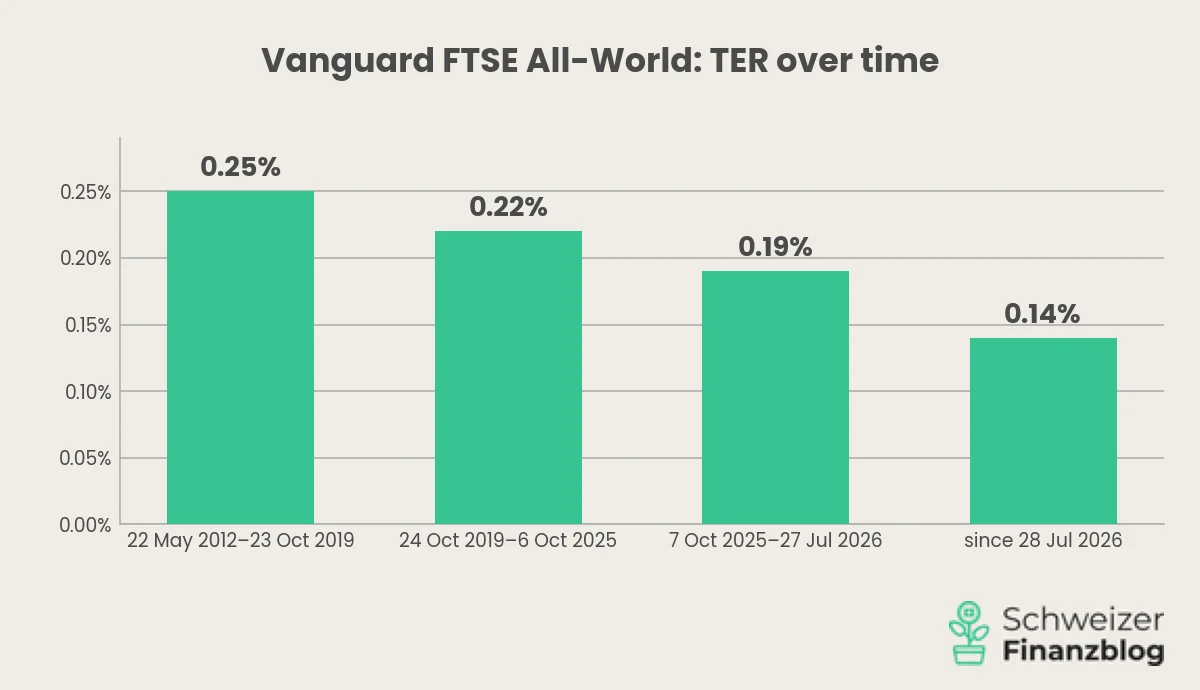
Three weeks before the launch, Vanguard had already tweaked its existing range: as of 28 July 2026, the TER of the FTSE All-World UCITS ETF fell from 0.19% to 0.14% – for both the accumulating version (VWRA, IE00BK5BQT80) and the distributing one (VWRL, IE00B3RBWM25).
The sequence is revealing. First the existing products were made cheaper, and only then came the big splash with the new ETF. Anyone who holds VWRA or VWRL therefore also benefits from an improvement – without a single click – and may think twice about switching.
The price war: TER heading towards zero
This step doesn’t stand alone. Xtrackers has also cut its FTSE All-World to 0.07%, UBS even undercuts this mark for global ETFs on developed markets, and the big US indices have reached levels of 0.03%. Anyone who wants to track a standard index today pays only a fraction of what was common ten years ago.
The Vanguard flagship shows how consistently costs have been falling: the TER of the Vanguard FTSE All-World started at 0.25% when the first share class was launched in 2012, fell to 0.22% in October 2019, to 0.19% in October 2025 and has stood at 0.14% since the end of July 2026. Not a single step went upwards – and the intervals between the cuts are getting shorter.
For us private investors, this is a welcome development – with one caveat. The TER only tells you what the provider charges, not how well it actually tracks the index. That quality only shows in the tracking difference. An ETF with a low TER that tracks its index poorly can end up costing you more return than a slightly more expensive one with clean tracking. The tracking difference over several years is therefore often more meaningful than the TER alone.
What the TER actually costs you
A difference of a few basis points sounds like very little – but the higher the amount invested, the more it adds up. Four ETFs in a cost comparison:
| Amount invested | VALL (0.07%) | VWRA (0.14%) | IMID (0.17%) | V3AA (0.24%) |
|---|---|---|---|---|
| 10’000 | 7 | 14 | 17 | 24 |
| 50’000 | 35 | 70 | 85 | 120 |
| 100’000 | 70 | 140 | 170 | 240 |
| 250’000 | 175 | 350 | 425 | 600 |
So with CHF 100,000, the new Vanguard costs CHF 70 a year – CHF 100 less than the SPDR and CHF 70 less than Vanguard’s own All-World flagship. Over a long investment horizon this adds up, because the costs you save stay in your securities account and generate returns of their own.
You will never see these amounts on your account statement, though. The TER is deducted directly from the fund assets on an ongoing basis and is not shown separately anywhere – it is already reflected in the ETF’s price. That makes the costs invisible, but no less effective: they eat into your return day after day.
Will the 0.07% last?
With prices this low, the question is justified: how long will this last? We consider a temporary teaser offer unlikely – for three reasons.
First, the ownership structure: Vanguard is owned by its fund investors. There is no external investor who will later demand wider margins. In line with this is the company’s track record: according to its own figures, Vanguard has cut the fees of its European funds and ETFs more than eighty times over the past ten years.
Second, the compact product range: in Europe, Vanguard offers comparatively few but carefully positioned products. A company that launches a product as a strategic cornerstone doesn’t withdraw it after two years or make it more expensive.
Third, market dynamics: the costs of standard global ETFs have been falling steadily for years, and the market has adjusted to this. A price increase would therefore be seen as a break with this trend and would likely cause reputational damage far exceeding the additional revenue.
That’s our assessment, not a guarantee. Contractually, a TER can be changed at any time. But the incentives all point in the same direction.
Why VALL isn’t in our ETF comparison yet
If you look at our article Best ETFs for Switzerland and worldwide now, you won’t find the new All-Cap there. That’s intentional, not an oversight.
Among other things, our selection criteria require a market history of at least five years and fund assets of at least CHF 500 million. The fund size is no longer an issue: less than two months after the launch, the fund holds around CHF 2.4 billion – a pace that is remarkable even for a Vanguard launch. The five years, on the other hand, can’t be sped up. They are the only reason VALL is still missing from our comparison.
We’re not saying the ETF is bad – we simply can’t judge it yet. An ETF needs a full economic cycle to show how cleanly it tracks the index and how tight the spreads stay in turbulent phases. As soon as VALL and VALLD as well as the franc lines VALC and VALCD meet our criteria – and we’re convinced they will – they will appear in the comparison.
Should I sell my existing ETFs now?
Our answer: patience and a sense of proportion.
The first argument for patience is a very practical one: VALL and VALLD aren’t even available everywhere yet. It will probably take a few more months before a new product is offered by all the brokers commonly used in Switzerland and can be bought through a savings plan.
The second question is more decisive: does the ETF fit your strategy at all? If you deliberately do without small caps, you gain nothing from the broader coverage. If you weight regions in a targeted way, a single all-cap ETF means giving up exactly that control. So the question is not whether the ETF is cheap – but whether it does the job your portfolio assigns to it.
Then there are the costs of switching: trading fees on both sides and the spread. Especially with smaller securities accounts, this eats up the savings from the lower TER for years.
The more elegant route is via your monthly contribution: instead of liquidating your existing portfolio, you direct future payments into the new ETF and leave the existing position as it is. That way, every new franc benefits from the lower price without a single centime in selling costs – and over the years the portfolio shifts by itself. You can still reallocate later, but then with better information.
A new ETF is rarely a reason to rush: if you’re already invested broadly and cheaply, you lose almost nothing by waiting – whereas acting hastily may cost you more than you save. Before we sum up, a quick word about our partner offers.
– Partner offers –
Still looking for the right broker for your ETF purchases? Our recommendations – with attractive sign-up bonuses.

–––––
Conclusion
With the Vanguard FTSE Global All-Cap UCITS ETF, almost the entire investable equity universe is available in Switzerland for the first time at a price previously only known from ETFs on the US market. If you want to invest globally, including small caps, with a single product, there is currently no more consistent solution.
What’s remarkable is not just the price, but the willingness behind it: with VALL, Vanguard is undercutting its own flagship, which manages billions. Anyone who acts like this isn’t counting on a short-lived advertising effect, but on a market in which costs keep falling.
Still, a new ETF remains a promise, not a track record. How cleanly VALL tracks its index will only become clear over several years – and it will only be truly put to the test in the next downturn.
The real winners of this price war aren’t the providers, but us – the people who invest.
You might also be interested in


Updates
2026-10-12: As of today, all three new launches can also be traded in CHF on SIX. Information on tickers and trading currency updated.
2026-08-31: First published
Disclaimer
Disclaimer: Investing involves the risk of loss. You have to decide for yourself whether or not you want to bear these risks.
Errors excepted: We have written this article to the best of our knowledge and belief. Our aim is to provide you as a private investor with information on finance that is as objective and meaningful as possible. Should we nevertheless have made mistakes, or should important aspects have been forgotten and/or be out of date, we would be grateful if you let us know.
Transparency notice: At the time of publication, the Schweizer Finanzblog team is invested in the following investment mentioned in the article: Vanguard FTSE All-World UCITS ETF (VWRA). Apart from this investment, there are no business relationships (commissions or similar) with any of the index or ETF providers mentioned in this report.
About the authors

Stefan Huser
Stefan has been investing in the stock market himself since 2015. He has been shaped by Markowitz’s portfolio theory and Gerd Kommer’s book “Souverän investieren”. He follows a core-satellite strategy: a global equity portfolio of ETFs forms the core, complemented by alternative investments. At the blog, he mainly takes care of the writing. Stefan lives with his family in Zurich and is interested in literature, photography and financial freedom.

Antun Brcina
Antun (“Toni”) has been investing in the stock market since 2015. Financially, he has been particularly inspired by Gerd Kommer’s book “Souverän investieren” and the Fama-French five-factor model. His money is invested in a broadly diversified, long-term global equity portfolio of ETFs. At the blog, he mainly works on the calculators and the code. Toni lives with his family in the Zurich area and is interested in sports, technology and entrepreneurship.





10 Comments
Ich bin zwar kompletter Neuling, was Investments anbelangt, aber anhand dieser Website (herzliches Dankeschön und Chapeau an die Creators fürs verständliche Rüberbringen der Inhalte) habe ich mich entschieden, mit diesem VALL ETF anzufangen.
–> nun, laut meinen Recherchen gestern sollte VALL seit heute, 12.10.2026 auf der SIX in CHF (!) verfügbar sein, zumindest ist er auf der SIX Website gelistet. Vielleicht könnt ihr das ja in diesem Blog ergänzen.
Ich habe vor einigen Tagen nun ein Konto bei Degiro eingerichtet (da kein CH-Broker, sollten somit auch keine Stempelsteuern anfallen).
Habt ihr als CH-Anleger gute Erfahrungen mit Degiro?
Weiss man, ob der VALL bald bei Degiro auch in CHF kaufbar sein wird? Er ist nach wie vor nur in USD erhältlich, was unnötige FX-Kosten nach sich zieht.
Danke dir für den Hinweis! Seit heute gibt es den ETF an der SIX tatsächlich in CHF (Ticker VALC, ausschüttend VALCD), wir ergänzen den Artikel. Am besten äusserst du beim Degiro-Support deinen ETF-Wunsch. Wir haben gute Erfahrungen gemacht, neue ETFs wurden auf Anfrage teils recht zügig aufgenommen.
Handelbar in CHF auf der BX Swiss?
https://www.bxswiss.com/instruments/IE000VAHT5T0
Kann das blog das bestätigen?
Wo ist der Haken im Vergleich zur SIX?
Ja, VALL ist nach dem fulminanten Start mittlerweile auch an der BX Swiss in CHF handelbar – die Börse hat ihn selbst in den Handel aufgenommen, deshalb steht er nicht im Factsheet von Vanguard, und der Market Maker rechnet laufend von USD in CHF um. Die Währungsumrechnung steckt dabei im Spread, was je nach Broker günstiger sein kann als dessen Wechselgebühr beim USD-Handel an der SIX; der Haken ist die dünnere Liquidität mit nur einem Market Maker, weshalb der Spread schwanken und phasenweise deutlich höher ausfallen kann. Am besten vergleichst du vor dem Kauf den BX-Spread mit dem SIX-Spread plus FX-Gebühr deines Brokers und setzt immer eine Limitorder – je nach Broker und aktuellem Spread kann auch die USD-Linie an der SIX die günstigere Wahl sein.
Bei meinem Broker hätte ich 2 Modi:
Best execution mit Marktvorgabe: BX Swiss
Best execution ohne Marktvorgabe vermutlich SIX mit 0,4% Forex
Ohne best execution, gepoolt, vermutlich LSE (USD), Ausführung 1x am Tag, dafür minimale ordergebühren.
Hallo miteinander,
Danke für eure fundierte Analyse. Ich sehe mit dem neue ETF wenige eine Kanibalisierung der eignen Anlageprodukte von Vanguard als vielmehr ein Angriff auf den ETF Amundi Prime All Country World UCITS ETFIE0009HF1MK9 /WEBG, der ebenfalls eine TER von 0.07% aufweist. Habt ihr diesen ETF auch auf dem Radar? Was unterscheidet die beiden Fonds im Wesentlichen?
Hoi Beat
Beim WEBG handelt es sich um einen ausschüttenden ETF, der 2024 lanciert wurde. Der entscheidende Unterschied: Er bildet den Solactive GBS Global Markets Large & Mid Cap ab – also ohne Small Caps. Damit ist er kein All-Cap-Konkurrent, sondern spielt in derselben Liga wie der Vanguard FTSE All-World, nur zu 0,07% statt 0,14%. Der WEBG greift also den VWRA bzw. VWRL an, der neue VALL dagegen den SPDR ACWI IMI.
Beste Grüsse
SFB
Top Beitrag – danke für den Tipp! Ich bespare nach mehreren Jahren FTSE All World nun den All Cap. In der willbe App ist er bereits gelistet und besparbar.
Bester Beitrag den ich bislang zu diesem Thema und zur Einführung des neues ETFs gelesen habe. Super Überblick und sehr gut der Vergleich zum Allworld und SPDR ETF. Danke dafür. Für mich ist es tatsächlich die Handelswährung, welche mich vom Wechsel abhält. Grundsätzlich würde ich gerne den All Cap besparen, aber eben nur in CHF. Der Allworld kommt so trotz doppelter TER, aber fehlender Währungsgebühren, günstiger. Warten wir ab. Denkst du, die Handelswährung für den All Cap wird sich auch einmal von USD zu CHF an der SIX ändern?
Liebe Grüsse
Vielen Dank für das positive Feedback – freut uns sehr!
Deine Rechnung teilen wir: Die Wechselgebühr kann den TER-Vorteil über Jahre aufwiegen. Ob eine Franken-Linie dazukommt, lässt sich nicht seriös vorhersagen. An der Börse London führt Vanguard oft zwei Währungen, für den kleineren Schweizer Markt meist nur eine. Entscheidend dürfte das Handelsvolumen sein – und das wird unseres Erachtens rasant wachsen. Wir behalten es im Auge.
Beste Grüsse
SFB