
 Newsletter

This time we’re tackling a highly controversial topic: leveraging your return on equity with credit-financed equity ETFs. In fact, for many investors, including much of the blogging community, investing with borrowed money is a no-go. Not for us. In this blog post, we share our experience with Lombard loans, show you how to confidently steer clear of the dreaded “margin call” scenario, and explain when you should definitely keep your hands off securities-backed loans.

In a nutshell
- Lombard loans are only for investors with strong nerves and a focus on returns.
- With a Lombard loan, your custodian bank gives you additional liquidity in return for pledging your securities and charging interest.
- Loan interest rates vary greatly from provider to provider. In our experience, Interactive Brokers offers particularly attractive terms.
- This liquidity is granted to you as a credit line that you can draw on flexibly.
- If you invest this additional cash in securities, you create a leverage effect.
- When prices rise, this credit leverage increases your return on equity with comparatively little capital of your own. When prices fall, the exact opposite happens.
- Before you take out a Lombard loan, you should understand the two risks “margin call” and “rising interest rates” and take effective precautions, such as never fully using your credit line and planning your budget carefully.
- Finally, you should ask yourself honestly whether you can handle sharp price swings emotionally at all. If not, keep your hands off Lombard loans!
Let’s start with a short, tempting thought experiment: “If global ETFs return a good 8 percent a year over the long term and loan interest rates are well below that, then investing with borrowed money is a fantastic deal, a real no-brainer.”
Contents
- What is a Lombard loan?
- What types of Lombard loans are there?
- Why should I take out a Lombard loan at all?
- What is a loan-to-value ratio?
- How does the loan-to-value ratio affect my return on equity?
- What interest rates should I expect?
- What are the risks of a Lombard loan?
- In which market phases does leveraging with Lombard loans make sense?
- MSCI World performance by lows
- When is the ideal time to repay Lombard loans?
- What are the advantages and disadvantages of Lombard loans?
- What leverage alternatives are there to a Lombard loan?
- Conclusion
- You might also be interested in
- Updates
- Disclaimer
What is a Lombard loan?
A Lombard loan is a securities-backed loan. In other words, in return for pledging your liquid securities, such as shares (or equity ETFs) or bonds, your custodian bank gives you a credit line that you can draw on flexibly. The pledged securities remain your property, and you continue to benefit from any increase in value and from dividend payments.
You pay interest on the amount of credit you use. This interest rate is often significantly lower than for a personal or consumer loan. That’s because your pledged securities give the bank additional collateral (similar to financing a property with a mortgage). This considerably reduces the default risk for the lending bank. In other words, if you are no longer able to pay the interest and repay the loan, the bank can simply sell your collateral in the form of securities. In summary, a Lombard loan has the following features:
- Pledging of the assets in your securities account
- The maximum loan amount depends on the value of the pledged assets (as a rule, the safer the bank considers the securities to be pledged, the larger the credit line it grants.)
- Obligation to add funds or forced sale in the event of a shortfall (“margin call”)
- As a rule, can be terminated by either party at any time
What types of Lombard loans are there?
According to our research, the Swiss market often offers current account Lombard loans and, less often, fixed-advance Lombard loans. Unlike a fixed advance, the current account variant usually has no fixed term, no fixed loan amount and no fixed interest rate. Instead, with the current account variant you can usually terminate the loan at any time and use the credit line granted flexibly according to your actual needs (and only pay interest on what you use!). Finally, the interest rate is flexible too, i.e. it can change daily depending on market conditions. In this article, we focus on the “current account Lombard loan” variant.
The explanations in the section above are a simplified description of securities lending business. Before taking out a Lombard loan, you should carefully study the individual contract terms and the small print of your lending custodian bank.
Why should I take out a Lombard loan at all?
You can pursue various goals with a Lombard loan. In any case, you get additional liquidity without having to sell your securities. You can use this extra cash for different purposes: for example, a trip around the world, a new kitchen or additional investments.
We focus on additional investments (in equity ETFs), because only then can you leverage your return on equity. In other words, when you invest with leverage, you are basically always pursuing the same goal: moving large sums of money with little capital.
Soberly, i.e. purely financially speaking, a Lombard loan pays off whenever the price gains including dividends exceed the loan interest.
What is a loan-to-value ratio?
The pledged assets are lent against at a percentage of their market value. This so-called lending value rate, also known as the loan-to-value ratio (LTV), varies depending on the risk, the tradability of the security and the bank.
Let’s assume you have a global equity ETF portfolio with a market value of CHF 100,000 and want to take out a Lombard loan. Your custodian bank first carries out a risk assessment of your portfolio. On this basis, it determines the loan-to-value ratio, which must not be exceeded, otherwise you face a margin call. But more on that later.
The safer the bank rates your portfolio, the higher the maximum loan-to-value ratio will be. In this article, including the following example, we always assume a maximum LTV of 50%, which is realistic for a broadly diversified equity ETF portfolio.
This means that on top of your own securities worth CHF 100,000, you can get up to another CHF 100,000 in borrowed capital. If you use the entire credit line and invest it in securities, you have leverage of two.
The higher the loan-to-value ratio (LTV), the more leverage potential you have. So the LTV formula is:
LTV = loan / value = Lombard loan / portfolio value
Portfolio value = 200,000 (current market value consisting of equity and loan)
Equity = 100,000
Loan = 100,000
LTV = 100,000 / (200,000) = 0.50 = 50%
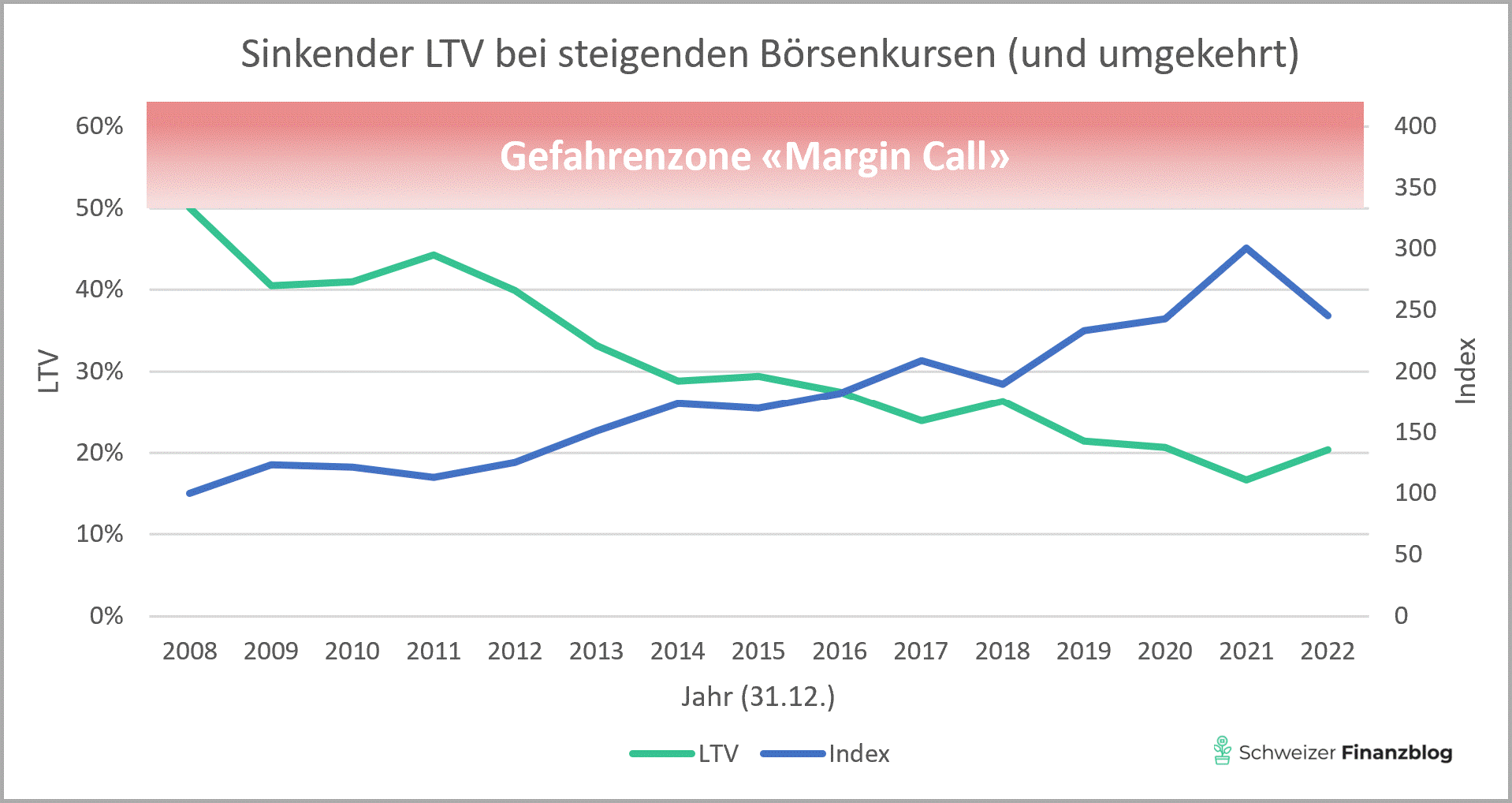
Starting from an LTV of 50%, the chart below shows the interplay between price performance and LTV. As a rule: when prices, and thus the portfolio value, rise, the LTV falls, and vice versa.
Thanks to prices rising at the start and mostly rising afterwards, the LTV never entered the critical “margin call” danger zone during the entire 14-year period, which in our example would have meant an LTV above 50%. (As we will show later, we strongly advise against using the entire credit line up to an LTV of 50% right from the start.)
How does the loan-to-value ratio affect my return on equity?
In short: very directly, both when prices rise and when they fall. This leverage is therefore a double-edged sword.
To put it in concrete terms using the example above: if your securities account rises by 10% to CHF 220,000 after one year, the credit leverage doubles your return on equity to 20% (20,000 price gains on securities / 100,000 equity invested). Without a Lombard loan, your return on equity would only be 10%.
With price losses, things look correspondingly bleak: in a 10% market slump, your portfolio value drops to CHF 180,000. Your leveraged negative return on equity doubles to -20% (20,000 price losses / 100,000 equity invested) instead of -10% without a Lombard loan.
What interest rates should I expect?
Interest rates for Lombard loans vary enormously from provider to provider. But even among the more affordable online brokers, the terms can differ quite significantly, as the following table shows:
| Provider | CHF | EUR | USD |
|---|---|---|---|
| DEGIRO | 2,5%* - 4% | 4,75%* - 6,25% | 5,25%* - 6,9% |
| Interactive Brokers | 1,5%** | 3,7%** | 5,13%** |
| Saxo Bank | 2%*** | 3,91%*** | 5,7%*** |
| Swissquote | 3% | 5,03% | 6,63% |
You can find the current Lombard loan terms of the four providers via the following links: DEGIRO | Interactive Brokers | Saxo Bank | Swissquote
On our new recommendations page, you’ll find the key features and terms (including bonus credit) of these four online brokers.
In our experience, Interactive Brokers has offered extremely attractive terms for Lombard loans, even over longer periods. Nevertheless, it’s worth doing your own research and checking the terms of your existing custodian bank first. After all, the securities to be pledged must be held in the securities account of the lending bank.
What are the risks of a Lombard loan?
Risk and Lombard loans go hand in hand, which is why we want to give this topic plenty of space. In particular, you should understand and keep an eye on the following three risks:
Risk: “locking in price losses through a margin call”
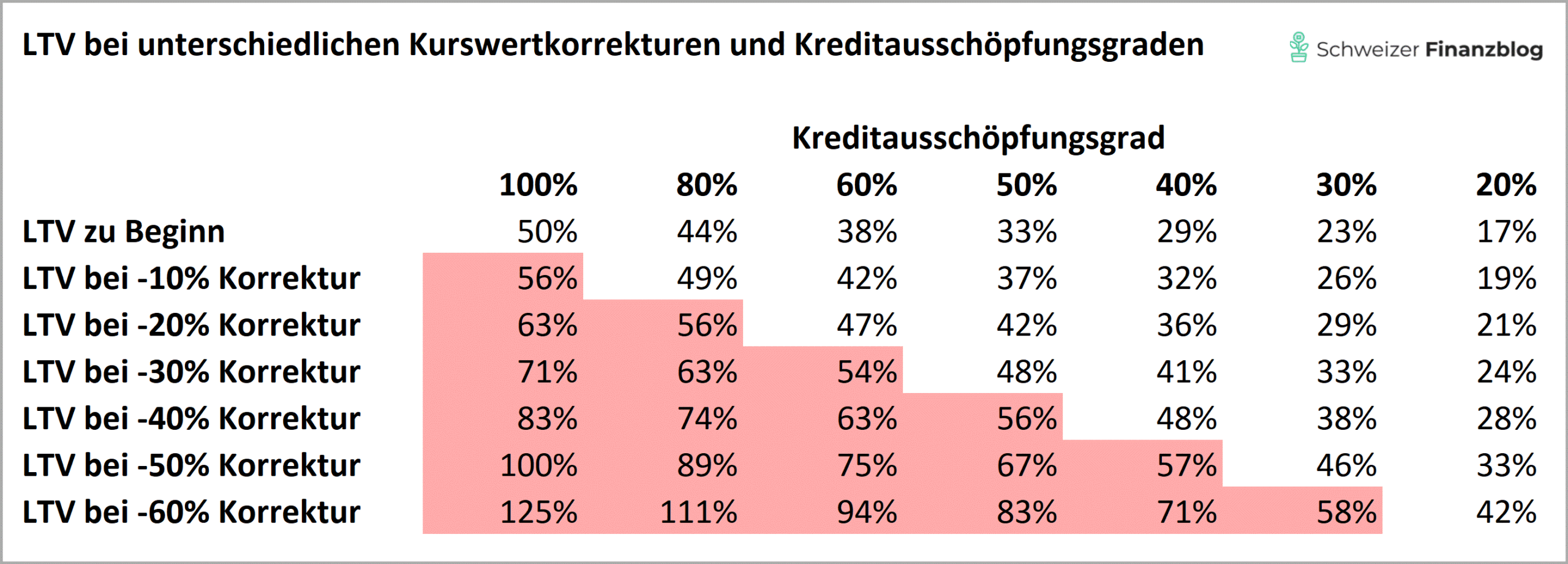
We see the risk with the greatest financial impact in the broker forcing a sale of the collateral. How can it come to that? Basically, whenever the value of your margin account (i.e. an account partly financed with a securities-backed loan) falls below the minimum amount required by the custodian bank (maintenance margin), so that the LTV exceeds the maximum permitted limit.
Although the term “margin call” is still in common use and has been known to a wider public since the 2011 film of the same name, it has long ceased to be taken literally.

So your bank advisor won’t pick up the phone as in the old days, but will ask you in writing to inject additional capital or sell your positions within a certain deadline.
Otherwise, i.e. if you don’t meet the margin call, your bank advisor will close the positions concerned himself. In other words, he sells the collateral that has fallen in value at a time that is extremely unfavourable from the investor’s point of view.
To avoid a margin call, you should consider the following preventive countermeasures:
- Pledge “good collateral” to the bank, e.g. broadly diversified equity ETFs. Reason: the safer the bank considers the pledged securities to be, the more generous the loan-to-value ratio (LTV) will be, giving you a bigger safety margin (see next point).
- Don’t use the full credit line, i.e. start with a low LTV (e.g. 20%) that is well below the LTV granted by the bank. For broadly diversified equity ETFs, the bank usually works with a maximum LTV of 50% or more.
- Don’t take out loans at all-time highs, only in bear markets. The ideal moment would be at the start of a longer recovery phase. But hitting such perfect timing is of course pure luck and can only be determined with certainty in hindsight. (Later on, we’ll show you a rule-based approach to borrowing in detail.)
Risk: “rising interest costs”
Interest rates for Lombard loans can change depending on market conditions and currency. What drives Lombard loan rates in your home currency is the policy rate, which is set and regularly reviewed by the Swiss National Bank (SNB).
So the higher the policy rate, the higher the Lombard loan rate and the higher your ongoing interest costs. Besides the policy rate, the margin of the lending bank also affects interest costs. As we’ve already seen above, Lombard loan terms vary greatly from provider to provider.
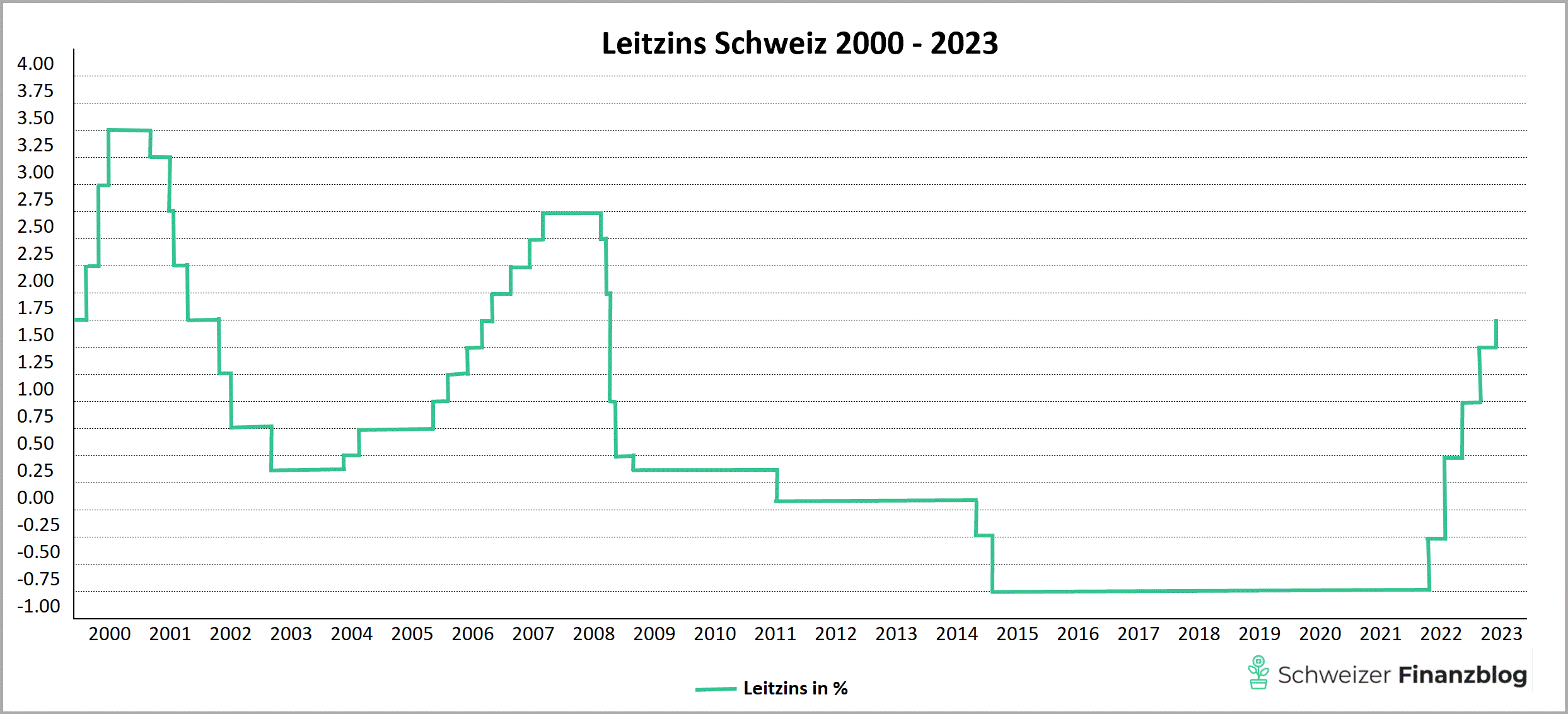
Despite these recent rate rises, interest rates in Switzerland are currently significantly lower than abroad (USA and euro area), and as a rule this was also the case in the past. This is reflected in Lombard rates, which vary widely depending on the currency.
Nevertheless, to avoid the risk of excessive interest costs, you should consider the following countermeasures:
- Avoid financial hardship through careful budgeting with an imputed interest rate of 5% (i.e. budgeting with a safety margin, as in the mortgage business)
- Only take out a Lombard loan in your home currency, CHF, to avoid currency risks and to benefit from interest rates that are generally lower and more stable than in foreign currencies
- Set an interest rate limit when taking out the loan
Risk: “your own nerves”
The two risks mentioned above can be kept under control with a rule-based approach. We’re convinced of that. We’ll go into this in more detail later. Things look very different, however, when emotions take over and panic spreads after heavy (paper) losses.
In other words, you should honestly answer the following question: How have I reacted to price losses so far? If you’ve always kept your cool and (in a rule-based way) topped up your portfolio at low prices, Lombard loans could be an option for you.
If, on the other hand, like most investors, you suffer from loss aversion, we think you should generally keep your hands off Lombard loans. A good quality of life, which includes sleeping well, is definitely worth more than maximising profits!
In which market phases does leveraging with Lombard loans make sense?
Regardless of the general state of the stock market, the question is whether the interest rate environment described above should determine whether or not you take out a Lombard loan.
While Stefan would only consider borrowing if Lombard loan rates were moderate (below 3%), the interest rate level plays only a minor role for Toni and hardly affects his decision to borrow.
Either way, luckily Switzerland is traditionally a low-interest-rate country, which is why Lombard loans in Swiss francs are comparatively cheap.
In practice, Lombard loans are often used short term for speculative investments. Anyone who wants to speculate on short-term gains therefore leverages up especially in bull markets, i.e. during stock market booms.
The speculator hopes that the price of a promising stock will soon go through the roof.
In other words, he is riding the momentum. In finance, momentum describes the tendency of stocks with comparatively strong gains in the recent past to continue to perform above average in the near future.
An opposing tendency is described by the statistical term “regression to the mean”. This is a phenomenon that affects the long-term performance of returns on investments.
Statistically speaking, the returns of shares and other investments always move around their long-term mean over a longer period of time. This means that the gross return on your investment will sooner or later revert to a long-term market average – regardless of whether the initial returns were positive or negative. However, this mainly applies to medium- to long-term periods. For periods of less than 5 years, regression to the mean does not apply.
Based on this phenomenon, it seems sensible, in turn, to leverage with securities-backed loans in bear markets. Ideally, that is, when prices of an index such as the MSCI World are well below their all-time high.
MSCI World performance by lows
| Start | End | Duration in days | Drawdown | after 1 year | +/- peak* |
|---|---|---|---|---|---|
| 20.11.1980 | 12.08.1982 | 630 | -28% | 47% | 6% |
| 27.08.1987 | 26.10.1987 | 60 | -24% | 25% | -5% |
| 04.01.1990 | 28.09.1990 | 267 | -26% | 21% | -10% |
| 20.07.1998 | 05.10.1998 | 77 | -21% | 36% | 7% |
| 27.03.2000 | 09.10.2002 | 926 | -51% | 36% | -33% |
| 31.10.2007 | 09.03.2009 | 495 | -59% | 70% | -30% |
| 21.05.2015 | 11.02.2016 | 266 | -19% | 24% | 0% |
| 26.01.2018 | 25.12.2018 | 333 | -20% | 31% | 5% |
| 12.02.2020 | 23.03.2020 | 40 | -34% | 74% | 15% |
Interim conclusion: Short-term speculation is not our thing. That’s why our rule is: If we take out a Lombard loan at all, then only when share prices are well below their all-time high and – in Stefan’s case – when interest rates are moderate.
When is the ideal time to repay Lombard loans?
In Switzerland, mortgage debt is usually not repaid in full. What about Lombard loans?
Based on what is, for us, the key insight regarding Lombard loans – namely that in the past above-average recoveries set in only one year after market slumps (see table above) – we have developed a strictly rule-based exit strategy. This set of rules comprises the following three rules:
- Rule no. 1:
Based on the pledged securities, the custodian bank should grant Lombard loans up to a maximum LTV of 50% or higher . (Reason: the higher the maximum LTV granted by the bank, the more safety margin you have in a market crash.) - Rule no. 2:
Borrowing is staggered, with a maximum of three tranches when prices are 25% (up to LTV 20%), 40% (LTV 30%) and 50% (LTV 40%) below the last all-time high of the MSCI World Index, a comparable index or an ETF based on it. - Rule no. 3:
Repayment of the loan, on the other hand, always takes place in full once the last all-time high is reached again, i.e. after price recoveries of 33%, 67% and 100%.
These three rules ensure that even in an extreme stock market crash of 60%, there is no risk of a forced sale at the worst possible moment due to a “margin call”.
In the table below, we have played through four exit scenarios S1 – S4 with their respective repayment dates.
This is how to read the table: if there is a price correction of 25% (to <40%), it is scenario 1 (S1). If there is a price correction of 40% (to <50%), it is scenario 2 (S2). Scenario 2 includes all the white rows above it, i.e. also the first three of S1. The same applies to the extreme scenarios 3 and 4, which cover massive price losses of 50% and 60% respectively and will therefore occur very rarely. Each scenario is highlighted in green and consists of two events (separate rows): price recovery to the peak and loan repayment.
Once again, we have assumed that the custodian bank grants Lombard loans up to a maximum LTV of 50%. If this threshold is exceeded, a forced sale looms, i.e. a margin call occurs.
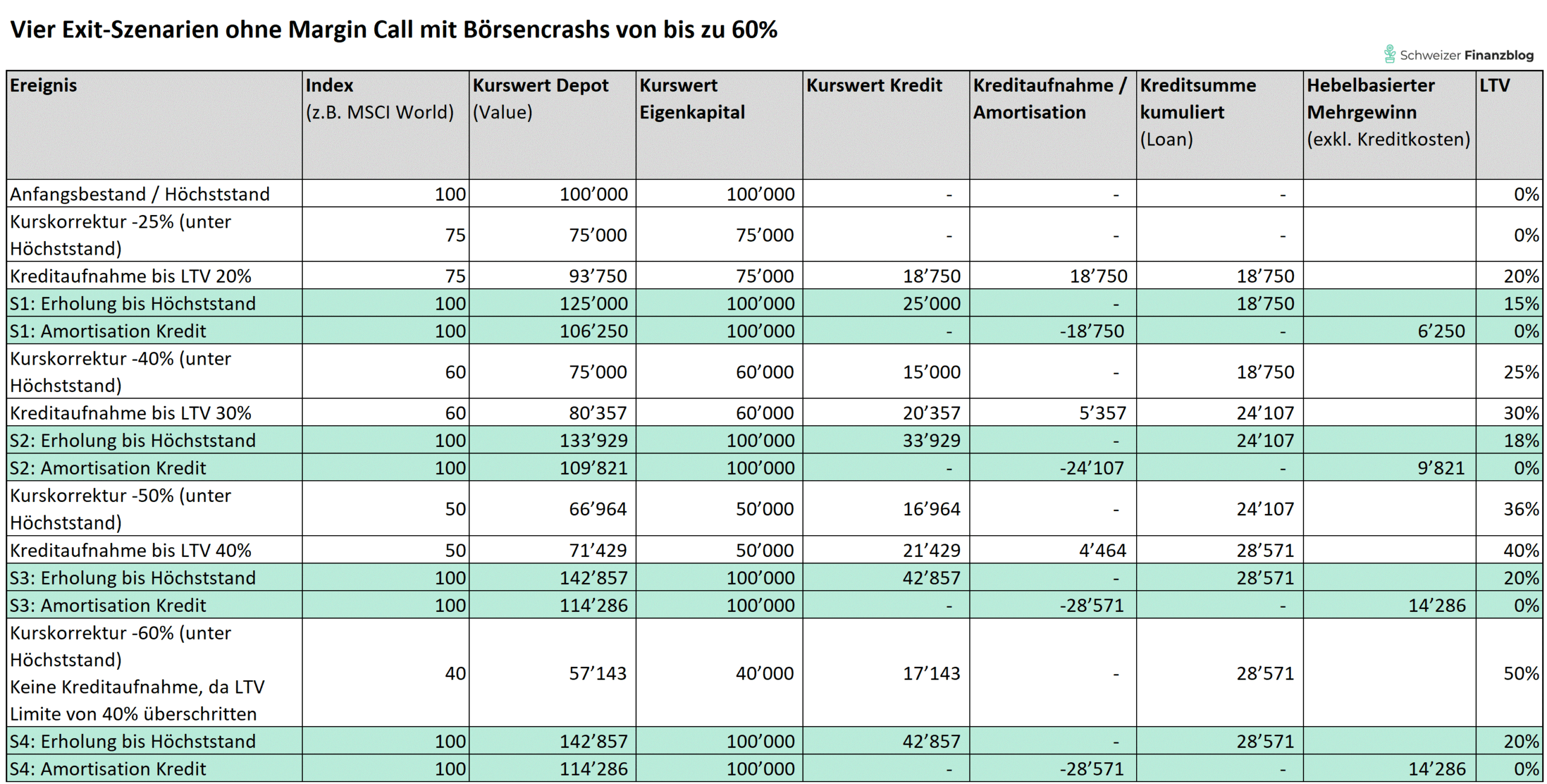
Anyone who wants more safety margin in a price correction of -60%, i.e. wants to keep the LTV below 50%, skips the 3rd loan at a price correction of -50%. With this simple measure, a stock market crash of 60% would result in an LTV of 45% (instead of 50% as in the table).
So what does this mean for your return? Below, we have compared the return on equity in scenario 1 (S1) with the return without credit leverage. Note that we use the same equity in both calculations, namely the equity at the time the loan is taken out. We have also assumed borrowing costs of 3% and a loan term of 1 year.
Calculating return on equity WITHOUT credit leverage
Equity invested = CHF 75,000 (portfolio value at the same time as when the loan is taken out)
Price gain = CHF 25,000 (CHF 100,000 – CHF 75,000)
Return on equity = 33.3% (CHF 25,000 / CHF 75,000 = gain / equity invested)
Calculating return on equity WITH credit leverage
Equity invested = CHF 75,000 (value of equity at the time the loan is taken out)
Price gain = CHF 31,250 (CHF 125,000 – CHF 93,750)
Borrowing costs p.a. = CHF 563 (= CHF 18,750 * 3%)
Gain after borrowing costs = 30,687 (= CHF 31,250 – CHF 563)
Return on equity = 40.9% (= 30,687 / 75,000 = gain / equity invested)
What are the advantages and disadvantages of Lombard loans?
As mentioned, you can use the additional liquidity you get from a Lombard loan for different purposes. If, for example, you “spend” the loan on consumption, the main advantage is that you don’t have to sell your securities to get the cash you need. You also usually benefit from lower interest rates than with a personal loan.
Here, however, we’re only interested in Lombard loans that are invested in additional securities. The advantages and disadvantages listed reflect our subjective opinion and should be understood in comparison with a classic, unleveraged investment.
Advantages and disadvantages of Lombard loans
 Higher potential returns thanks to leverage Building wealth with less capital of your own is possible Tax optimisation by deducting loan interest
 Risk of financial losses due to a forced sale (margin call) or rising borrowing costs A test of your nerves due to sharper, leverage-driven price swings More expensive due to borrowing costs and more frequent trading of securities (transaction fees) More time spent on regular portfolio checks and monitoring the markets Limited use of the pledged securities, as they serve as collateral for the bank (e.g. you can’t sell them and spend the proceeds)
What leverage alternatives are there to a Lombard loan?
Below, we present two other ways to invest with leverage.
Alternative 1: leverage through leveraged ETFs
With this option, you invest in special leveraged ETFs which, like classic ETFs, track an index, but amplify its price movements by a certain factor. For example, if the factor is two and the reference index rises by 2% in one day, the leveraged ETF shoots up by 4%. Unlike with a Lombard loan, a leveraged ETF gives you no additional liquidity, and the range on offer is still fairly limited. Nevertheless, we find the concept behind leveraged ETFs exciting, which is why we will devote a separate article to this investment option.
Alternative 2: leverage through structured products
Leveraged structured products are complex financial products that let you respond to price movements of the underlying asset. Popular underlyings are individual shares, indices, commodities and currencies. We reject leveraged structured products because, in our opinion, they are too expensive and not transparent enough. The latter shows in particular in their often opaque structure.
Conclusion
It’s obvious: taking out a securities-backed loan is only suitable for investors with strong nerves and should be well thought through. After all, the leverage that comes with borrowing works both ways: both price gains and price losses are amplified. On top of that, loan interest rates can rise at short notice, which can put your nerves under even more strain.
What’s more, you should only consider a Lombard loan if you have already invested your available cash or other, cheaper equity.
If you’re aware of these points, you should now arm yourself against the risks that come with a Lombard loan.
And that brings us back to our opening thought experiment. Unfortunately, investing with borrowed money is not a no-brainer, even though long-term stock market returns are likely to be higher than the interest on Lombard loans – especially in our home currency, CHF.
Because, unlike with ETFs financed with your own money, with credit-financed securities you can’t simply sit out sharp price losses in the tried-and-tested buy-and-hold manner. The reason for this is the margin call, i.e. the associated risk of having to sell your securities at the worst possible moment.
To avoid the financial losses associated with a margin call, you should never fully use the credit line granted by the bank. This gives you an important safety margin – and calmer nights.
You should also make sure that your interest costs don’t get out of hand. Specifically, this second safety measure could be to estimate the expected interest costs conservatively, based on sound budgeting (i.e. with a safety margin, or a high imputed interest rate of 5%). Another measure against high interest costs could be to set yourself an interest rate limit when taking out the loan.
Final conclusion: Credit-financed equity ETFs boost your return on equity when prices rise. A Lombard loan becomes playing with fire for you if you haven’t taken any rule-based safety precautions – and therefore stumble into a margin call.
You might also be interested in

Updates
2025-08-17: Updated the margin rates for Lombard loans from DEGIRO, Interactive Brokers and Swissquote and added the rates from Saxo Bank.
2025-01-14: Updated the margin rates for Lombard loans from DEGIRO, Interactive Brokers and Swissquote.
2024-07-02: Updated the margin rates for Lombard loans from DEGIRO, Interactive Brokers and Swissquote.
Disclaimer
Transparency note: Unlike Stefan, at the time this article was published Toni had leveraged his portfolio with a Lombard loan, namely from Interactive Brokers. Before that, both had gained their first experience with Lombard loans from DEGIRO.
Disclaimer: Investing involves risks. You have to decide for yourself whether or not you want to take these risks.
Errors excepted: We have written this article to the best of our knowledge and belief. Our aim is to provide you, as a private investor, with the most objective and meaningful information possible on all things finance. Should we nevertheless have made mistakes, forgotten important aspects or if information is no longer up to date, we would be grateful if you let us know.
About the authors

Stefan Huser
Stefan has been investing in the stock market himself since 2015. He has been shaped by Markowitz’s portfolio theory and Gerd Kommer’s book “Souverän investieren”. He follows a core-satellite strategy: a global equity portfolio of ETFs forms the core, complemented by alternative investments. At the blog, he mainly takes care of the writing. Stefan lives with his family in Zurich and is interested in literature, photography and financial freedom.

Antun Brcina
Antun (“Toni”) has been investing in the stock market since 2015. Financially, he has been particularly inspired by Gerd Kommer’s book “Souverän investieren” and the Fama-French five-factor model. His money is invested in a broadly diversified, long-term global equity portfolio of ETFs. At the blog, he mainly works on the calculators and the code. Toni lives with his family in the Zurich area and is interested in sports, technology and entrepreneurship.







16 Comments
Hoi zusammen
Mich würde interessieren, was ihr von der SMA-Strategie haltet?
Der Youtuber “Notgroschen” hat vor 5 Tagen dazu ein Video veröffentlich, in dem er es mit dauerhaftem Buy& Hold und der hier erwähnten Drawdown-Strategie vergleicht (darf hier glaubs keine Links posten, daher ohne). Dabei schneidet die SMA-Strategie deutlich besser ab, und umsetzen liesse sie sie sich wohl auch mit wenig Aufwand (einmal wöchentlich den MSCI-World Kurs zum SMA checken oder noch sporadischer). Hierzulande wäre die erwartbare Rendite wohl nochmals deutlich höher, da keine Kapitalertragsteuer anfällt.
Liebe Grüsse
Mirco
Hoi Mirco
Spannender Input, danke dir fürs Teilen. SMA ist kein eigenes Konzept, sondern nur ein Indikator. Sobald du ihn mit festen Ein-/Ausstiegsregeln nutzt, betreibst du aktives (wenn auch regelbasiertes) Timing. In der Praxis heisst das: mehr Transaktionen → Kosten und Spreads, häufige Fehlsignale in Seitwärtsphasen und das Risiko, starke Erholungstage zu verpassen. Zudem ist der SMA nachlaufend und viele Backtests wirken besser als die Realität. Wir praktizieren es selber nicht und denken, dass für die meisten Buy & Hold erfolgsversprechender und definitiv einfacher ist.
Beste Grüsse
SFB
Hoi SFB
Danke für eure fundierte Rückmeldung. Ich versuche das Thema gerade wirklich zu Ende zu denken und habe eure Kritikpunkte mit den Daten aus der Analyse von Notgroschen und eurem eigenen Blog-Artikel zum Lombard-Hebel abgeglichen. Dabei sind mir ein paar fachliche Punkte aufgefallen, bei denen ich froh um eure Einordnung wäre:
1. Timing: Ihr schreibt, der SMA führe zu „aktivem Timing“. Aber ist die von euch im Blog befürwortete Drawdown-Strategie (Hebeln bei –25 %, –40 % etc. und Ausstieg bei ATH) nicht im Kern genau dasselbe? Es ist ein regelbasiertes, prognosefreies Timing. Warum gewichtet ihr die Nachteile (Transaktionskosten, Signale) beim SMA so viel stärker als bei eurem eigenen Drawdown-Modell, obwohl der SMA laut “YT-Video von Notgroschen “97 % schlagen den Markt? Die Wahrheit über Hebel ETF!” eine deutlich höhere Erfolgsquote liefert
2. Risiko eines Margin Calls: Notgroschen hat in seiner Simulation beide Strategien direkt verglichen. Die Ergebnisse sind ziemlich eindeutig:
* Die Median-Rendite der aggressiven SMA-Strategie beträgt 8.71%, jene der aggressiven Drawdown-Strategie nur 5,80% (im Vergleich zum Buy & Hold mit einer Meidan-Rendite von 4,94%).
* Die aggressive SMA-Strategie begrenzte den maximalen Drawdown im Median auf 44,28 % (sogar leicht besser als reines Buy & Hold mit 45,96 %).
* Die aggressive Drawdown-Strategie (ATH –30 %) schoss im Risiko auf 60,21 % hoch. In der Simulation scheint der SMA also das Risiko eines Margin Calls statistisch viel besser im Griff zu haben, während man beim Drawdown-Hebel oft „ins offene Messer“ läuft, weil man zu früh den Hebel hochfährt. Zudem lassen sich die beiden Strategien kombinieren, wenn ich mich nicht irre. Also den SMA als „Notbremse“ für den Ausstieg zu nutzen, um das 60 %-Drawdown-Risiko zu vermeiden, aber den Wiedereinstieg über feste Drawdown-Marken (z. B. –30 %) zu triggern. Damit würde man die Erholungstage mitnehmen, wäre aber bei Beginn des Absturzes bereits abgesichert gewesen.
3. Fehlsignale & Puffer: Das Problem der Fehlsignale in Seitwärtsphasen („Whipsawing“) lässt sich ja durch Puffer-Prozentpunkte (z. B. erst einsteigen bei SMA +1 %) oder eine geringere Check-Frequenz (z. B. nur einmal wöchentlich) entschärfen. Zudem ist ein 250-Tage-SMA so träge, dass die Handelsfrequenz ohnehin tief bleibt.
4. Transaktionskosten & Steuervorteil Schweiz: Ihr erwähntet Kosten und Spreads. In der Simulation wurden Spreads (0,25 % pro Trade), Ordergebühren und sogar Steuern explizit abgezogen – und der SMA blieb dennoch bei einer Erfolgsquote von 97,2 % im Vergleich zum Buy-and-Hold. Da wir in der Schweiz keine Kapitalertragssteuer auf private Kursgewinne haben, fällt der grösste Performance-Killer beim Umschichten für uns ja komplett weg. Müsste das die Strategie hierzulande nicht massiv effizienter machen als in Deutschland?
5. Robustheit der Backtests: Ihr schreibt, dass Backtests oft trügen. Mir ist bewusst, dass jede Simulation auf historischen Daten basiert – das gilt ja auch für die Beispiele in eurem Blog. Notgroschen nutzt hier jedoch eine Monte-Carlo-Simulation (10’000 Verläufe), die den „Glücksfaktor“ eines einzelnen Zeitstrahls eliminiert. Zudem hat er einen Stress-Test gerechnet, bei dem die Zinsen (SOFR/Fed Funds) nie unter 4 % fielen und der Index zusätzlich 1 % schlechter performte (vgl. YT-Video von Notgroschen “Optimaler Hebel beim MSCI World: Ein rationaler Leitfaden.”) Dass die Strategie selbst unter diesen „Worst-Case“-Bedingungen statistisch überlegen bleibt, gibt dem Ganzen doch eine andere Tiefe als ein herkömmlicher Backtest, oder wie seht ihr das?
Wenn man also ohnehin bereit ist, das Risiko eines Hebels einzugehen (wie in eurem Artikel beschrieben), wirkt der SMA laut diesen Daten wie die deutlich präzisere „Versicherung“ gegen einen Totalabsturz als das Hebeln bei fixen Prozentmarken. Und wie bereits erwähnt, lassen sich diese beiden Strategien auch kombinieren, zumind. gehe ich davon aus. Oder übersehe ich da was? Wie gesagt, kenne ich mich wirklich nicht damit aus und möchte mir nur eine rationale Strategie bauen.
Vielen Dank und beste Grüsse
Mirco
Hoi Mirco
Danke dir für deine ausführlichen Überlegungen. Für den Austausch hier wäre es hilfreich, wenn du dich kürzer fassen könntest 🙂
Unsere Antwort bezog sich auf einen nicht gehebelten Buy-&-Hold-Ansatz. Dein Vorschlag zielt hingegen offenbar auf den Einsatz eines SMA bei gehebelten Investments ab – das ist eine andere Ausgangslage.
Unsere diesbezüglichen praktischen Erfahrungen beschränken sich auf das im Artikel beschriebene regelbasierte Vorgehen mit Lombardkredit. Ob SMA in der Praxis und im Zusammenhang mit Lombardkrediten zu besseren Ergebnissen führt, können wir daher nicht beurteilen.
Wenn du diesen Weg gehen willst: selbst testen und dir der Risiken bewusst sein.
Beste Grüsse
SFB
Grüezi!
Ich würde gerne Ihre Meinung zur langfristigen Nachhaltigkeit einer einfachen, aber effizienten Kapitalentnahmestrategie einholen. Mein Ziel ist es, einen kontinuierlichen, langfristigen Cash-Flow zu generieren, ohne den Basiswert jemals verkaufen zu müssen.
Die Eckpfeiler des Modells:
Anlageinstrument: Ein akkumulierender S&P 500 ETF (USD), der historisch gesehen ein stabiles langfristiges Wachstum von durchschnittlich 10 % pro Jahr aufweist.
Cash-Flow-Mechanismus: Anstatt Anteile zu verkaufen, wird die Liquidität über einen Lombardkredit auf Basis des Portfolios als monatlich fixer Betrag sichergestellt.
Kosten: Angesichts des aktuellen Schweizer Lombardzinses von 2,15 % und der gedeckelten Depotgebühren des Swissquote Prime-Kontos ist die Aufrechterhaltung der Infrastruktur äusserst kosteneffizient.
Theoretische Grundlage der Strategie: Da die erwartete langfristige Rendite des Index (~10 %) die Kreditkosten (2,15 %) deutlich übersteigt, vergrössert sich die Lücke zwischen Vermögenswert und Schuldenstand kontinuierlich. Meinen Berechnungen zufolge bleibt das Belehnungsauslauf-Verhältnis (LTV) trotz der monatlichen Auszahlungen über Jahrzehnte hinweg weit in der Sicherheitszone. Gleichzeitig werden realisierte Kapitalertragssteuern und der Verzehr des Grundkapitals vermieden.
Meine Frage ist auf den Punkt gebracht: Funktioniert dies in der Praxis über Jahrzehnte hinweg oder nicht?
Besonders interessieren würde mich:
Wie stabil ist die Bereitschaft von Swissquote zur Lombardkredit-Vergabe während eines länger anhaltenden Marktrückgangs?
Gibt es Erfahrungen im langfristigen Umgang mit dem Währungsrisiko zwischen der USD-basierten Sicherheit und dem Kredit in CHF?
Gibt es technische oder bankspezifische Hindernisse, die dieses Modell zum Scheitern bringen könnten?
Ihre Antwort im Voraus bestens dankend!
Eine dauerhafte Entnahme über Lombardkredite bleibt fragil. Auch wenn in der Schweiz die Zinsdifferenz langfristig meist positiv ist, kommt ein zusätzliches Risiko dazu: steigende Lombardzinsen. Sie können den Renditevorteil verkleinern oder ganz aufheben und die Strategie schnell unter Druck setzen.
Wenn überhaupt, dann nur mit sehr tiefem LTV (bis 10%). Das reduziert Nachschussrisiken und Stress, kostet aber Flexibilität und Hebelpotenzial.
Sinnvoll ist Lombard eher situativ, z.B. nach starken Markteinbrüchen als temporäres Instrument.
Fazit:
Lombard taktisch → ja.
Lombard als permanente Entnahmestrategie → nein.
Vielen Dank für einen weiteren sehr interessanten Beitrsg. Dürfte ich noch folgende Fragen stellen:
1. Ich spare monatlich sprich überweise monatlich auf mein Depot und kaufe einen ETF. Kann man bei diesem Vorgehen mit Lombardkrediten arbeiten? Spielt es auch für die Höhe des Lombardkredits eine Rolle – sprich muss ich jeden Monat auch einen neuen Lombardkredit aufnehmen, da der Depotwert steigt. Was für eine Implikation hätte es auf den Margin Call?
2. Was ist hiermit genau gemeint: Dank sorgfältiger Budgetplanung mit Verwendung eines kalkulatorischen Zinssatzes von 5% (d.h. mit einer Sicherheitsmarge analog dem Hypothekengeschäft budgetieren) eine finanzielle Notlage vermeiden
3. Wäre aktuell ein guter Zeitpunkt mit Lombardkrediten zu beginnen?
4. Wann gibt es genau einen Margin Call? Wenn man einen Kursverlust von >50% hat (sofern der LTV von 50% gewährt wurde)? Solange der Kursverlust <50% würde es keinen Margin Call geben
5. Wie läuft es bei Euch mit dem Lombardkredit? Habt ihr selber positive Erfahrungen gesammelt?
Nachfolgend die Antworten zu deinen Fragen basierend auf den Erfahrungen (keine Anlageempfehlung!) von Toni mit Lombardkrediten bei Interactive Brokers (gehe bei Bedarf nochmals den Artikel sorgfältig durch):
1) Du zahlst monatlich Geld ins Depot ein und kaufst ETFs.Der Beleihungswert deines Depots steigt damit automatisch. Die Bank vergibt dir einen Lombardrahmen (z.B. 50 % des Beleihungswerts). Du musst nicht jeden Monat einen neuen Kredit aufnehmen.
→ Du nutzt flexibel den bestehenden Kreditrahmen, ähnlich wie bei einem Kontokorrent.
Implikationen für Margin Calls: Mehr Depotwert = mehr Puffer; regelmässiges Sparen reduziert das Risiko eines Margin Calls, solange du den Kredit nicht aggressiv erhöhst. Kritisch wird es insbesondere, wenn du jede Depotsteigerung sofort wieder maximal beleihst, du den Lombard nutzt, um weiter ETFs zu kaufen (Hebeleffekt). Der Margin Call hängt nicht von einem fixen Kursverlust (z. B. −50%) ab, sondern vom Beleihungssatz des Portfolios.
2) Das ist ein konservativer Budget-Ansatz, ähnlich wie beim Hypothekengeschäft. Konkret bedeutet das: Auch wenn der Lombardzins aktuell z.B. 2,5 – 3,5% beträgt, rechnest du für dich mit 5%, um sicherzustellen, a) dass du die Zinsen auch bei stark steigenden Zinsen problemlos tragen kannst und b) dass du nicht gezwungen bist, Positionen im falschen Moment zu verkaufen.
3) Wenn du an der Börse bald mit einer heftigen Korrektur rechnest, wäre aktuell kein guter Zeitpunkt für die Aufnahme eines Lombardkredits. Wir betrachten Marktkorrekturen als attraktive Einstiegschancen. Eine Krise definieren wir dabei als einen Rückgang des globalen Aktienmarktes von mindestens 20%. Solche Phasen bieten aus unserer Sicht langfristig orientierten, risikobereiten Investoren besonders gute Opportunitäten.
4) Der Margin Call hängt nicht von einem fixen Kursverlust (z. B. −50 %) ab, sondern vom Beleihungssatz des Portfolios. Dieser Beleihungssatz wird vom Broker auf Basis des Gesamtrisikos des Portfolios festgelegt. Massgebend ist dabei:
– die Art der Vermögenswerte (z. B. Einzelaktien vs. ETFs),
– der Diversifikationsgrad,
– die Volatilität der Positionen sowie
– die Korrelation innerhalb des Portfolios.
Je höher das eingeschätzte Risiko, desto tiefer fällt der Beleihungssatz aus: Einzelaktien gelten üblicherweise als risikoreicher → tieferer Beleihungssatz, während breit diversifizierte, weltweit investierte ETFs als stabiler beurteilt werden → höherer Beleihungssatz
Ein Margin Call entsteht genau dann, wenn der tatsächliche Beleihungsgrad (Kredit im Verhältnis zum aktuellen Portfoliowert) den vom Broker festgelegten maximal zulässigen Beleihungssatz überschreitet.
Das bedeutet:
– Es gibt keinen festen Prozentsatz, ab dem automatisch ein Margin Call ausgelöst wird.
– Ein Margin Call kann bereits bei relativ moderaten Marktbewegungen eintreten, wenn das Portfolio stark schwankt oder hoch belehnt ist.
– Umgekehrt können breit diversifizierte Portfolios auch stärkere Kursrückgänge verkraften, ohne sofort einen Margin Call auszulösen – sofern konservativ belehnt.
Entscheidend ist daher nicht der Marktverlust an sich, sondern das Verhältnis zwischen Portfoliowert, Risiko und eingesetztem Kredit.
5) Seit 2020 kam es an den Finanzmärkten zu drei Korrekturen von jeweils über 20 %. In allen drei Fällen hat Toni gezielt Lombardkredite genutzt, um während der Marktschwäche nachzukaufen. Da sich die Märkte in allen genannten Phasen vollständig erholt haben, konnten die aufgebauten Positionen später gewinnbringend verkauft werden. Diese Erfahrungen bestätigen aus seiner Sicht, dass Lombardkredite – bei diszipliniertem Einsatz, klar definierten Regeln und ausreichenden Sicherheitsmargen – ein wirkungsvolles Instrument sein können, um Krisenphasen gezielt zu nutzen.
Stand heute (28.12.2025) hat weder Toni noch Stefan offene Lombardkredite.
Hebeln via ETF und Lombardkredit habt ihr im Detail erklärt, danke euch dafür.
Wie sieht’s aber bzgl. Hebeln in ETFs mit Hypotheken aus? Wäre das nicht die bessere Variante als Lombardkredit, wenn man sich sowieso schon für die Verbindlichkeit Eigenheim entschieden hat (und nicht mehr zurück kann xD)? Wäre bei Hypotheken nicht ein höhere Beleihungsgrenze vertretbar, da sich die Gefahr des Margin Calls nicht stellt?
Und wäre dort sogar eine langjährige Festhypothek zu bevorzugen (normalerweise empfiehlt sich ja Saron)?
Ich gehöre zu den besonders Schlauen, die ihre Hypothek weitestgehend amortisiert haben… Überlege mir nun, eine neue aufzunehmen und in einen Welt-ETF zu stecken, sofern dies noch möglich ist.
Ein Risiko solltet ihr vielleicht noch erwähnen: Die Maintenance Margin ist keine fixe Grösse. Die Bank / der Broker kann sie bei einem bestehenden Kredit je nach Risikobeurteilung jederzeit anpassen. Auch die Beleihungsfaktoren für die einzelnen Wertpapiere, die die Bank zur Berechnung der LTV Ratio verwendet, können angepasst werden. Insofern kann es unter ungünstigen Umständen auch bei strikter Einhaltung der selbst definierten Regeln zum Margin Call kommen.
Was aus meiner Sicht fehlt, ist das Risiko von der Steuerbehörden als professioneller Trader behandelt zu werden. Eines der Kriterin dazu ist nähmlich, dass man auf Kredit kauft.
Oder habe ich dies überlesen?
Sonst finde ich den Artikel sehr interessant uns ausgewogen.
wir und aktuell insbesondere Toni, welcher sein Portfolio substanziell mit Lombardkrediten hebelt, können nicht bestätigen, dass eine solche steuerliche Neubehandlung stattfindet.
Dann lest doch bitte mal dies hier:
https://www.estv.admin.ch/dam/estv/de/dokumente/dbst/kreisschreiben/2004/1-036-D-2012.pdf.download.pdf/1-036-D-2012-d.pdf
Ist aber eine Fremdfinanzierung vorhanden, trägt die steuerpflichtige Person ein erhöhtes Risiko, welches ein Indiz für eine selbständige Erwerbstätigkeit darstellt. Sofern die Schuldzinsen und Spesen nicht durch periodische Einkünfte gedeckt werden können, sondern mittels Veräusserungsgewinnen beglichen werden müssen, kann von einer privaten Vermögensverwaltung nicht mehr die Rede sein (ASA 69, 788).
Ich sage nicht, dass es so sein muss, aber es gibt 5 Kriterien und jeder von diesen muss erfüllt sein, damit wir als private Investoren angesehen werden. Somit besteht beim Lobardkredit das Risiko diesen Status zu verlieren.
Danke für das Einbringen der 5 Kriterien in Ziff. 3 aus dem verlinkten ESTV-Kreisschreiben, welches eine gute Diskussionsbasis darstellt. Eine Korrektur gleich zu Beginn: Du schreibst, alle 5 Kriterien müssen erfüllt sein, damit wir als private Investoren angesehen werden. Diese Formulierung ist offensichtlich nicht korrekt. Denn im besagten Schreiben heisst es in Ziff. 3, letzter Absatz: “Sind diese Kriterien nicht kumulativ erfüllt, kann gewerbsmässiger Wertschriftenhandel nicht ausgeschlossen werden. Die entsprechende Beurteilung erfolgt hierbei auf Grund sämtlicher Umstände des konkreten Einzelfalls.”
Auf der gleichen Seite ist Fussnote 3, in welcher Alt-Bundesrat Villiger zitiert wird, für uns Anleger interessant, weil hier eine sehr zurückhaltende Auslegung angedeutet wird: “…Es sind im
allgemeinen seltene Fälle, und dabei wird es bleiben. Das ist auch im Interesse des Fiskus, denn der Fiskus trägt bei der gewerbsmässigen Besteuerung auch ein Risiko, weil er dann nämlich auch
Verluste zum Abzug zulassen muss; …”
Zudem erwähnst du (zurecht) Kriterium 4, denn dieses spricht die Fremdfinanzierung direkt an. Im Wortlaut gemäss erwähntem Kreisschreiben: “Die Anlagen sind nicht fremdfinanziert oder die steuerbaren Vermögenserträge aus den Wertschriften (wie z.B. Zinsen, Dividenden, usw.) sind grösser als die anteiligen Schuldzinsen.” Hier scheint uns wichtig, dass es sich um eine oder-Formulierung handelt und der zweite Teil dieses Kriteriums für viele Anleger mit fremdfinanzierten Wertschriften wohl problemlos erfüllt sein dürfte.
Unser Fazit: In den meisten Fällen werden die Steuerbehörden wohl auf eine Statusänderung (vom Privatanleger zum Wertschriftenhändler) verzichten, und zwar auch im Fall, wenn nicht alle 5 Kriterien erfüllt werden. Wer diesbezüglich kein Risiko eingehen will, macht ein Steuerruling, d.h. er oder sie beantragt vor der Aufnahme des Lombardkredits bei der kantonalen Steuerbehörde einen Steuervorbescheid. (Disclaimer: Dies ist lediglich unsere Meinung/Interpretation und keine Steuerberatung.)
Guten Tag
Ich finde die Vorstellung des Lombardkredites in einem seriösen Finanzblog etwas heikel. Die NY-Börse steht bald auf einem Allzeit-Hoch, trotz anstehender Rezession.
Wenn schon spekulieren, dann mit Geld, das nicht für den Lebensunterhalt gebraucht wird. Deshalb ist ein Exposure über Mini-Futures, auch wenn „intransparent“, besser als ein Lombardkredit. Mini-Futures gibt es auch auf auf single stocks wie auch auf Indices und die Verlustmöglichkeit ist klar begrenzt.
Wenn ein Lombardkredit, dann nur um Zinsarbitrage zu machen. Ich zahle Lombardzinsen, erhalte aber im Gegenzug einen höheren Dividenden- oder Couponsbetrag. Beispielsweise wären aktuell die Schweizer Versicherungstitel attrakive Kandidaten. Sie werfen alle zwischen 5-6% Dividendenrendite ab.
Lombardkreditzinsen sind im übrigen, normalerweise nicht von den Steuern abzugsfähig.
Guten Tag
Danke für deinen Beitrag, auch wenn wir deine Meinung nicht teilen. Wir finden nämlich, dass das Thema Lombardkredite sehr wohl in einen seriösen Finanzblog passt, insbesondere dann, wenn es so vertieft und differenziert behandelt wird wie in unserem Beitrag. (Genauso wie das Hypothekenthema in einen seriösen Immobilienblog passt:-). Deutlich skeptischer sind wir hingegen gegenüber den von dir erwähnten intransparenten und teuren strukturierten Produkten.
Es scheint, als hättest du unseren Artikel nur überflogen. Schade. Denn wir haben den mit dem Lombardkredit verbundenen Risiken sehr viel Raum gewidmet. Auch dein Warnhinweis bezüglich des mutmasslich bald erreichten Allzeithochs passt nicht zu unserer Aussage, dass für uns Lombardkredite nur in Bärenmärkten und nach klaren Regeln in Frage kämen (Konkret: -25% von Allzeithoch und max. 20% LTV).
Beste Grüsse
SFB