
 Newsletter

Who wouldn’t want to escape the daily hamster wheel and become financially free? Financial freedom and financial independence – these glittering buzzwords are on everyone’s lips these days. But what do they actually mean? Which factors are decisive in achieving financial freedom? You’ll find the answers to these and other questions in this post.
Let’s get one thing straight from the start: achieving financial freedom without an inheritance or the like is definitely not a sprint but a marathon. But there is some consolation for us “ordinary mortals”: average earners quite often manage to become financially free, while many high earners can’t, because of their lavish lifestyle combined with a lack of financial literacy.
Contents
- From quick riches straight to bankruptcy
- Financial freedom vs. financial independence
- What financial freedom comes down to
- Examples of passive income
- Financially free – now what?
- How to become financially free in just 8.8 years
- Financially free with 20 times your annual expenses
- Step by step to financial freedom
- Conclusion
- You might also be interested in
- Disclaimer
From quick riches straight to bankruptcy
Just think of the many dramas of former multimillionaires from the world of sport (see the Watson article “Just standing at the bar and drinking – 22 football stars who went bankrupt”) and show business (a striking example is Curtis Jackson, once the most successful rapper and better known as “50 Cent”; in 2015 a bankruptcy court confirmed his insolvency, as well as his running costs of USD 108,000 – per month!). All of them ran into serious financial trouble after the peak of their careers. Not to mention the many former lottery millionaires who ended up broke.
Financial freedom vs. financial independence
But what exactly do we mean by financial freedom or financial independence?
Following the FIRE movement (“Financial Independence, Retire Early”) and the frugalist scene, we use the following definition:
Financial freedom = being able to live exclusively on passive income streams, without a budget, i.e. essentially without any restrictions on spending.
Financial independence = being able to live exclusively on passive income streams within the scope of your current spending.
Financial independence is therefore a preliminary stage of financial freedom. For the sake of simplicity, we will only use the term financial freedom from here on. In other words, we assume that all our financial needs and wishes can be covered by our current spending. So the following applies: financial freedom = financial independence.
What financial freedom comes down to
“The goal of financial freedom is to be able to live on passive cash flows from investments.”
To become financially free, you need to go through the following three steps over and over again:
- Earn money
- Save the money you earn
- Invest the money you save profitably
The goal is to be able to live on passive cash flows from investments and thus to depend neither on an employer (salary) nor on the state (pension).
Passive cash flows can come in many forms, such as income from shares, real estate or P2P lending. What all these cash flows have in common, however, is that they are not generated by active work but earned regardless of how much of your own time you invest. This is such a central aspect of financial freedom that we want to explain it in more detail in the next section.
Examples of passive income
If, for example, someone holds individual stocks in their equity portfolio, the income from them is often not passive at all. That’s because these investors tend to be more or less heavily involved with their portfolio: they study annual reports, attend general meetings, trade, reshuffle and so on. In other words, the income in the form of dividends and realized price gains is generated by active work. Our recommendation: a buy-and-hold strategy with passive investments in broadly diversified equity ETFs (see our blog article “ETFs: the revolution in investing”).
“Rental income generated by managing the property and looking after tenants yourself is not passive income.”
It’s a similar story with real estate: rental income generated by managing the property and looking after tenants yourself is not passive income. Because here, too, the income in the form of rent is matched by active work. Our recommendation: a buy-and-hold strategy with passive investments in broadly diversified real estate ETFs.
Finally, a word on P2P loans. Here you play bank by lending money to SMEs or private individuals. In return, you receive interest (and bear the default risk). Interest income that requires active risk management, such as checking the borrower and their financing project, is not passive but involves (often nerve-racking) work. Our recommendation: choose a P2P platform where you can lend with just a few clicks and don’t have to interact with the borrower. In addition, risk diversification should happen automatically or be built into the system, i.e. without you having to invest countless tiny amounts. (In our view, the Swiss platform “Creditgate24” takes an interesting approach with its automatic risk diversification and its solidarity contribution concept.)
Financially free – now what?
Once you’ve achieved financial freedom, you can basically do whatever you like: explore the world, pursue your hobbies, devote yourself to your family or, of course, carry on working in your job. The latter with the crucial added freedom of simply walking away when it no longer suits you.
“For us, financial freedom is primarily a matter of being rather than having.”
From this perspective, we consider financial freedom a thoroughly worthwhile goal (with certain reservations, as we will show in the conclusion below). For us, financial freedom is primarily a matter of being (i.e. living in freedom) rather than having (in the sense of having lots of money), although of course one doesn’t rule out the other.
– P a r t n e r o f f e r –
In our experience, and thanks to its low ETF costs, “DEGIRO” is currently a particularly attractive broker (link to our DEGIRO review). If you’re interested, you can sign up with DEGIRO via our partner link to secure trading credits worth CHF 100 (subject to conditions) while supporting our blog at the same time.
– – – – –
How to become financially free in just 8.8 years
As mentioned above, three factors play a role in financial freedom: income, saving and investing. The basic rule is: the less money you need to live on, the more of your income you can put aside and invest – and the sooner you can live on the investment income from your assets.
These three factors can be summarized in the following two key drivers:
- Savings rate: the amount you save relative to your active income
- Investments: broadly diversified, profitable investments
A high savings rate is likely to be much harder to achieve, as it means going without, i.e. living frugally. By contrast, broadly diversified and potentially profitable investments via passive equity ETFs are very easy to make with just a few clicks (see this article).
Oliver Noelting, probably the best-known frugalist in the German-speaking world, who has set himself the goal of retiring before 40, has set up a corresponding calculator on his blog Frugalisten.de. As Figure 1 below strikingly shows, the higher your savings rate, the earlier you can reach your individual retirement age. With a savings rate of 70%, for example, in as little as 8.8 years!
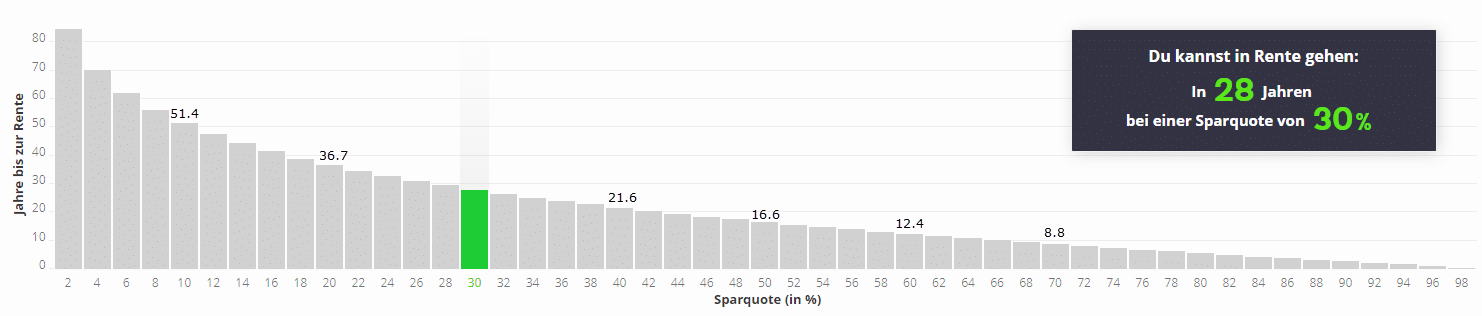
The calculations are based on the following simplifying assumptions:
- Your expenses stay the same – now and during retirement
- Income and return (5%) are net amounts (after tax)
- All amounts are adjusted for inflation
Financially free with 20 times your annual expenses
This means you would need to have invested 20 times your annual expenses in order to live off the returns afterwards. With annual expenses of CHF 50,000, you would therefore need an ETF portfolio worth CHF 1 million. Important: in the context of shares or equity ETFs, returns always consist of dividends and price gains. This means that, in this case, the passive income consists of dividends and/or proceeds from sales.
“If the focus is not on preserving capital (and on your heirs) but on generating the highest possible passive income for the rest of your life, the road to financial freedom can be considerably shorter.”
If we also assume that shares return an average of 8 percent (see our blog article “Why investing pays off more than saving”) and that average inflation does not exceed three percent, then this 5% rule will not eat into the real value of your assets. In other words: if the focus is not on preserving capital (and on your heirs) but on generating the highest possible passive income for the rest of your life, the road to financial freedom can be considerably shorter.
And that assumes constant net returns, which of course is not realistic. Even with a globally well-diversified equity portfolio, more or less strong fluctuations are the reality. Depending on whether returns are positive or negative at the start of the withdrawal phase, you will end up with inflation-adjusted capital growth or capital depletion.
If you are hit by extreme negative events at the start of the withdrawal phase – so-called black swans such as the Great Depression from 1929 onwards – your capital could even run out completely ahead of time. That’s why our 5% rule should be understood as a rule of thumb (see also our reply to Oliver’s input in the comments below).
In the article “Withdrawal plans: how to retire early with peace of mind”, we use historical data to present different ways of funding early retirement.
Step by step to financial freedom
On your way to financial freedom, it can be motivating to draw up a cross-off list of all your major expense items, such as health insurance or taxes, and cross off each one you can already fund with passive income.
Or you can work out the number of days you’re already financially free. Based on the example above, this means: if your passive income is currently CHF 10,000, you’re already financially free for an impressive 73 days a year (365 * 10,000 / 50,000). Or, perhaps even more motivating: every time your passive income increases by CHF 137 (50,000 / 365), you gain an extra day of financial freedom per year – for the rest of your life!
Conclusion
In our view, financial freedom is fundamentally a worthwhile goal. After all, it can give you a sense of security and comfort in life. But for most people, complete financial freedom will probably remain a pipe dream. The sacrifices are too great and the costly extras too dear to them. You also need to be aware that on the way to financial freedom – from a purely financial point of view – you are “sacrificing” life in the present for the future. To end on a conciliatory note, we would like to draw a nuanced conclusion on financial freedom:
For those who hardly want to save or can hardly afford to, financial freedom is neither achievable nor desirable.
At the other end of the spectrum are the hardcore savers, the so-called frugalists. These folks lead an extremely modest lifestyle as far as consumption and materialism are concerned, often combined with a good income and equally good financial literacy. Naturally, they have the best prerequisites for achieving financial freedom.
For the majority who belong to neither group, the authors included, there is an interesting middle way: steadily building up your passive income through conscious spending and regular investments (e.g. in broadly diversified ETFs), and thereby gradually reducing your financial dependence on others, be it your employer or the state.
If, for example, your passive income reaches 20 percent of your current expenses, you could also reduce your working hours by 20 percent. You can then “invest” the time you gain in your family, your hobbies or simply in doing nothing, depending on your taste. Now that’s a great start!
You might also be interested in



Disclaimer
Disclaimer: Investing involves the risk of loss. You have to decide for yourself whether you want to take on these risks or not.
Errors excepted: We have written this article to the best of our knowledge and belief. Our aim is to provide you, as a private investor, with information on financial topics that is as objective and meaningful as possible. Should we nevertheless have made mistakes, or if important aspects have been overlooked and/or are no longer up to date, we would be grateful if you let us know.
About the authors

Stefan Huser
Stefan has been investing in the stock market himself since 2015. He has been shaped by Markowitz’s portfolio theory and Gerd Kommer’s book “Souverän investieren”. He follows a core-satellite strategy: a global equity portfolio of ETFs forms the core, complemented by alternative investments. At the blog, he mainly takes care of the writing. Stefan lives with his family in Zurich and is interested in literature, photography and financial freedom.

Antun Brcina
Antun (“Toni”) has been investing in the stock market since 2015. Financially, he has been particularly inspired by Gerd Kommer’s book “Souverän investieren” and the Fama-French five-factor model. His money is invested in a broadly diversified, long-term global equity portfolio of ETFs. At the blog, he mainly works on the calculators and the code. Toni lives with his family in the Zurich area and is interested in sports, technology and entrepreneurship.





2 Comments
Hallo liebe Schweizer Finanzblogger,
ihr schreibt, dass bei einem Aktienportfolio, das durchschnittlich mit real 5 % (8 % minus 3 % Inflation) rentiert, auch eine konstante Kapitalentnahme von 5 % im Jahr möglich ist (ohne Kapitalverzehr). Das ist jedoch falsch. Ganz im Gegenteil hätte eine solche Entnahme sogar ein ziemlich hohes Risiko für einen frühzeitigen Bankrott. Der Grund ist das Sequence-of-Returns-Risiko, das bei der reinen Betrachtung der Durchschnittsrendite unberücksichtigt bleibt:
https://frugalisten.de/das-sequence-of-returns-risiko-entnahmestrategien-teil-2/
In der FIRE-Community wird deshalb typischerweise eher mit Werten zwischen 3 und 4 % (sogar mit Kapitalverzehr) gerechnet, siehe auch die “4 %-Regel”:
https://frugalisten.de/die-4-prozent-regel-wie-viel-geld-brauchst-du-um-nicht-mehr-arbeiten-gehen-zu-muessen/
https://frugalisten.de/william-bengen-trinity-wahrscheinlichkeiten-entnahmestrategien-teil-3/
Hoi Oliver
Vielen Dank für deine Mitteilung und die verlinkten Artikel zum Thema.
Die 4-Prozent-Regel kennen wir natürlich, sie ist uns aber etwas zu konservativ. (“German Angst” lässt grüssen:-) Deshalb haben wir in unserem Artikel die 5-Prozent-Regel erwähnt, und zwar basierend auf empirischen Daten und der Voraussetzung eines global gestreuten, d.h. mutmasslich weniger volatilen Aktien-Portfolios. Gemäss der von dir im Link erwähnten Trinity-Studie besteht für eine 30-jährige 5%-Entnahmeperiode eine Erfolgsquote von 85%, und zwar bezogen auf ein nicht global gestreutes S&P 500-Portfolio und unter Berücksichtigung der bisher wohl schlimmsten Weltwirtschaftskrise, welche den S&P-Index von 1929 bis 1932 um über 70% zusammenstauchte.
Solche Extremereignisse bzw. sogenannte “Schwarzen Schwäne”, wie auch dein fiktives Beispiel mit ebenfalls vier aufeinanderfolgenden Jahren mit Negativrenditen zu Beginn der Entnahmeperiode, können selbstverständlich zu einem vorzeitigen vollständigen Vermögensverzehr führen. Und bei einem Zusammenbruch des kapitalistischen Systems taugt selbst die superkonservative 3-Prozent-Regel nichts mehr….
Uns ging es jedoch um eine Faustregel, nicht um eine wasserdichte Entnahmestrategie, welche es ja ohnehin nicht gibt, da niemand die Zukunft bzw. die “Schwarzen Schwäne” voraussehen kann. Diesbezüglich haben wir unseren Artikel aufgrund deines Inputs präzisiert.
Mit bestem Dank und Gruss
Schweizer Finanzblog