
 Newsletter

In the previous article, we learned that we’re a pretty thrifty little nation. But how much wealth does that add up to? Which investments are currently in favor? Which ones lead a wallflower existence? And how does investment behavior differ by gender, age, wealth and region? You’ll find the answers in this article.
Contents
The Swiss have the world’s second-highest wealth
According to the Credit Suisse Global Wealth Report 2017, the average net wealth per adult in Switzerland after deducting debts is exactly USD 537,599, putting Switzerland in second place behind Iceland (see Figure 1).
This amount probably seems surreally high to most people. Two factors should be kept in mind here: firstly, it includes our compulsory contributions to occupational pension provision. Secondly, these are average figures.
Median beats average (when it comes to meaningfulness)
For body height, averages make sense because we can assume a normal distribution. For wealth, on the other hand, averages say little because of the great inequality.
To illustrate: a single billionaire (and Switzerland has quite a few of them) plus 99 people with nothing results in an average wealth of CHF 10 million per person.
In such cases, a better benchmark is the median, which splits wealth into two groups: one half of Switzerland owns more than the median wealth, the other half less. The study in question arrives at a median of USD 229,059, which in our view is still an exceptionally high amount (see Figure 1).
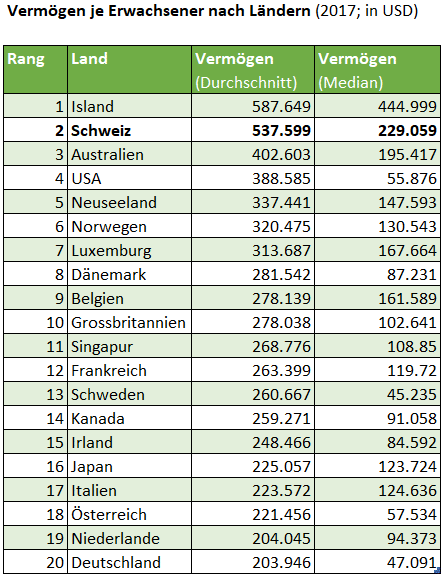
Now let’s go a step further and look at how Mrs and Mr Swiss invest their evidently plentiful money.
Cash and savings accounts top – ETFs flop (unfortunately)
In 2018, the comparison service Moneyland, together with the market research institute GfK, conducted a representative survey on Swiss investment behavior among around 1,500 people. Respondents were asked how much money they had invested in various types of investment.
Here are the most popular investments in descending order:
- 67% hold cash as an investment
- 64% have medium or large amounts in a savings account
- 59% have medium or large amounts in a personal account
- 55% have a 3a account; 43% a 3a fund
- 41% have invested in real estate (usually in the home they live in)
- 39% hold shares (individual stocks)
- 25% hold actively managed investment funds
- 19% have invested in gold and 10% in other precious metals
- 14% hold ETFs (this brilliant investment vehicle is unfortunately still far too little known; here’s the explanatory article: ETFs: the investment revolution)
- 12% own structured products
- 8% are invested in cryptocurrencies
– P a r t n e r o f f e r –
Based on our experience and its low ETF costs, one broker that is particularly attractive right now is “DEGIRO” (link to our DEGIRO review). If you’re interested, you can sign up with DEGIRO via our partner link, which gets you CHF 100 in trading credits (subject to conditions) while supporting our blog at the same time.
– – – – –
Young people go for low-risk investments – and bitcoins
Investment behavior also changes markedly with age. In the youngest group of respondents, aged 19 to 25, personal accounts, savings accounts and cash are more widespread than average.
At the same time, affinity for new technologies and investment options declines among older respondents. Cryptocurrencies such as Bitcoin, for example, are considerably more popular with younger investors than with older ones. Conversely, ownership of shares, real estate and investment funds rises significantly with age.
The wealthier, the riskier
Investment behavior is strongly shaped by your personal wealth. Many asset classes correlate positively with growing wealth, including investment funds, ETFs, shares, real estate, structured products and even 3a savings accounts.
This refers not only to absolute amounts: as wealth increases, their share relative to the other investments held rises as well.
This finding is especially pronounced in the wealthiest group, with assets of CHF 1 million or more. Practically all millionaires have invested in shares and real estate, two thirds in a 3a savings account, 65% in investment funds and around half in structured products and ETFs.
Cautious women
Women are generally more hesitant than men when it comes to investing. This is particularly evident with somewhat riskier forms of investment such as shares, investment funds and speculative investments like structured products and cryptocurrencies.
Only just over a quarter of women hold shares, whereas around half of men own such securities.
Depending on the asset class, there are clear differences between the language regions. Cash, personal accounts and savings accounts, for example, are more popular in German-speaking Switzerland than in French-speaking Switzerland.
The difference is also clear when it comes to shares: 41% of respondents in German-speaking Switzerland own shares, compared with just 28% in French-speaking Switzerland. Interestingly, though, highly speculative cryptocurrencies such as Bitcoin are somewhat more popular in western Switzerland than in German-speaking Switzerland.
By contrast, the differences between urban and rural populations are not significant for most asset classes.
Conclusion
At USD 537,599 (average) and USD 229,059 (median), the net wealth (i.e. after deducting debts) of adults living in Switzerland is very high by international standards. This puts Switzerland in 2nd place behind Iceland.
Apart from the millionaires, people in Switzerland mostly invest very conservatively, across all age groups, genders and regions.
This is all the more surprising given that the popular savings and personal accounts haven’t paid any interest for years, as we showed in this article. And given that ETFs offer very attractive alternatives on the market.
If we also factor in the current inflation rate of around 1 percent, the result is even a creeping loss of wealth.
You can get a complete overview of the topic of “investing” here: Learning to invest – in eight lessons.
You might also be interested in


About the authors
Stefan Huser
Stefan has been investing in the stock market himself since 2015. He has been shaped by Markowitz’s portfolio theory and Gerd Kommer’s book “Souverän investieren”. He follows a core-satellite strategy: a global equity portfolio of ETFs forms the core, complemented by alternative investments. At the blog, he mainly takes care of the writing. Stefan lives with his family in Zurich and is interested in literature, photography and financial freedom.

Antun Brcina
Antun (“Toni”) has been investing in the stock market since 2015. Financially, he has been particularly inspired by Gerd Kommer’s book “Souverän investieren” and the Fama-French five-factor model. His money is invested in a broadly diversified, long-term global equity portfolio of ETFs. At the blog, he mainly works on the calculators and the code. Toni lives with his family in the Zurich area and is interested in sports, technology and entrepreneurship.




1 Comments
Klasse Beitrag! Einen ähnlichen, aber doch ganz anderen habe ich erst kürzlich auf meinem Blog veröffentlicht! Über deine Meinung wäre ich sehr gespannt, LG Eric